A Guide to Dynamic Power Management for EV Charging
Think of dynamic power management (DPM) as an intelligent traffic controller but for electricity. Instead of just letting every device pull as much power as it wants all at once, DPM constantly adjusts the flow of energy to stop the system from getting overloaded. This is absolutely critical for things like electric vehicle (EV) charging, making sure every vehicle gets the power it needs without bringing the local grid to its knees.
Defining Dynamic Power Management
At its heart, dynamic power management is a system that intelligently balances the amount of electricity available with what is being demanded in real time.
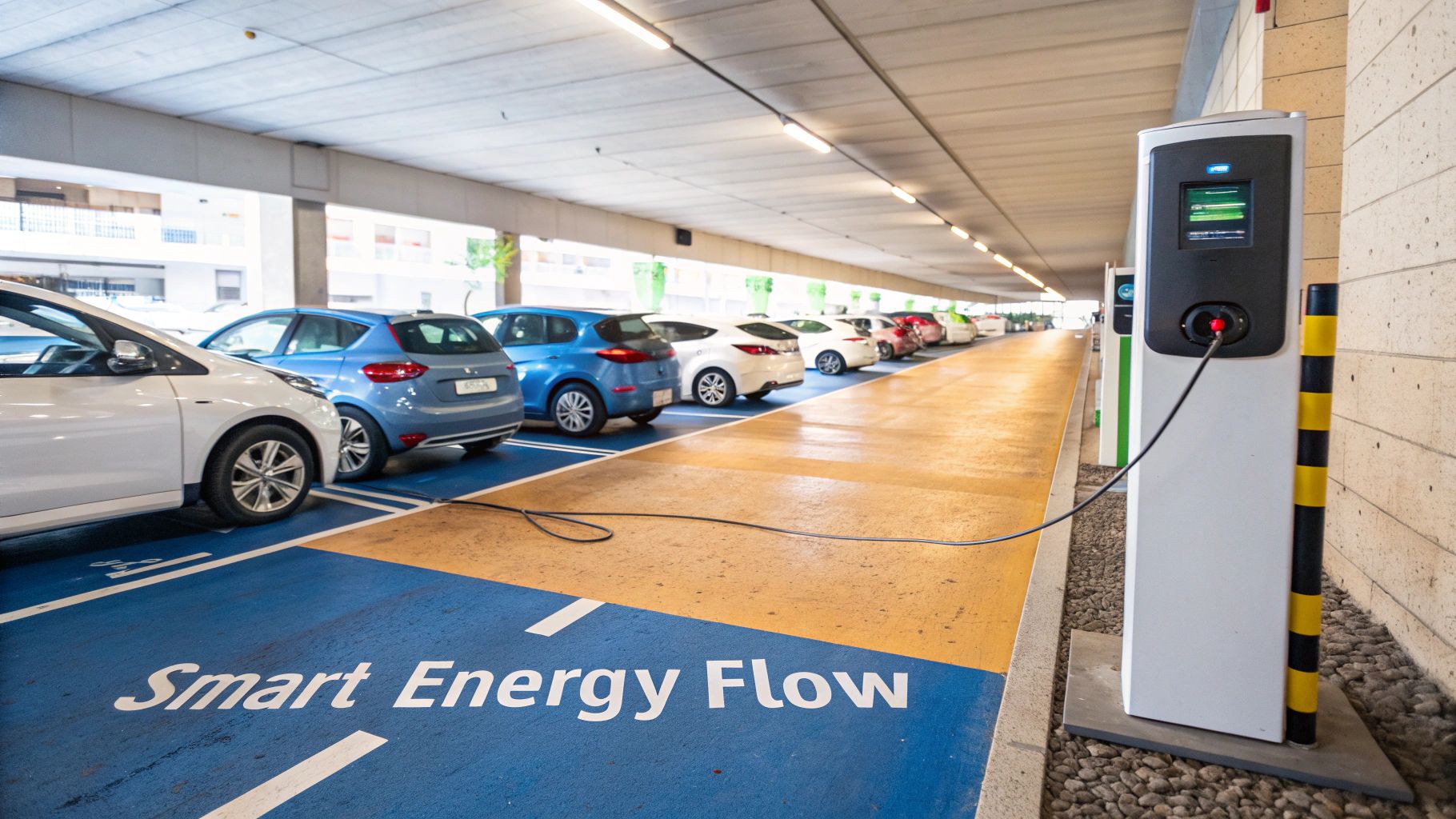
Picture a car park with ten EV chargers, all running off a single, limited power supply. If ten cars plug in at the same time without DPM, they could easily trip the main circuit breaker and shut everything down. It is a recipe for frustration.
DPM acts as the central 'brain' to stop that from happening. It watches the total amount of power being used and cleverly shares the available capacity among all the active chargers. As soon as one car finishes charging or needs less power, the system automatically redirects that spare capacity to the others. It is a simple but powerful idea: never exceed the site’s electrical limit.
And this is not just about EV charging. The same principle can be applied to manage all electrical loads on a site—from the lights and air conditioning to heavy machinery—creating a single, resilient energy ecosystem from combined on-site renewables, EV charging and batteries and distributed energy.
Why DPM Is Essential Today
Here in the United Kingdom, the need for DPM has exploded alongside our shift to renewable energy. As of May 2025, a massive 57% of the UK’s electricity came from zero-carbon sources , with wind power alone hitting a record 27% .
The thing about renewables is they are variable—the sun does not always shine and the wind does not always blow. This makes intelligent power management vital for balancing this fluctuating generation with our demand, keeping the grid stable and reliable.
DPM is not just a nice-to-have anymore; it is a fundamental piece of modern energy infrastructure. It helps achieve several key goals:
- Preventing Grid Overload: It smooths out the sudden demand spikes from multiple EVs plugging in, which can easily overwhelm constrained grid connections.
- Avoiding Costly Upgrades: By making the most of the existing electrical supply, businesses can often sidestep the huge expense and long delays of grid reinforcement projects.
- Integrating Renewables: DPM helps you use every last drop of on-site renewables, like solar, by sending that clean energy exactly where it is needed most, whether that is EV chargers or a battery storage system.
- Enabling Rapid Charging: When you combine DPM with grid-scale batteries, you can offer rapid and even mobile EV charging in places where the grid connection is otherwise too weak to support it.
Ultimately, dynamic power management is what makes the large-scale rollout of EV charging infrastructure possible, efficient, and safe. By helping businesses unlock the power of smart energy management , we can get ready for an electric future without putting the national grid under impossible strain. It is the smart approach we need to build a flexible and reliable energy network for tomorrow.
How a DPM System Works in Practice
So, how does dynamic power management actually work? Let’s look under the bonnet at the technology that makes it all possible. A DPM system acts like a vigilant site manager, constantly monitoring, analysing, and acting to keep energy use within safe and efficient limits. It is a continuous, automated process that happens in fractions of a second.
This system is not a single piece of hardware but a clever combination of interconnected components. Each part has a specific role, and they all work together to create a cohesive, intelligent energy network. Think of it as a finely tuned team where every member communicates instantly to achieve one common goal: balancing power supply and demand perfectly.
It all starts with data. Without a crystal-clear picture of what is happening on-site and at the grid connection, the system simply cannot make smart decisions.
Real-Time Monitoring and Data Collection
The absolute foundation of any DPM system is its ability to see electricity usage in real time. This is done through a network of smart meters and sensors installed at key points across the site.
- Grid Connection Meter: This is the master sensor. It measures the total power being drawn from the grid by the entire site, making sure the main supply limit is never breached.
- Building Load Meters: These keep an eye on the electricity consumption of everything else – lighting, HVAC systems, machinery. This gives the DPM system a complete view of the site’s energy profile.
- Individual EV Charger Data: Each smart EV charger constantly communicates its status, including exactly how much power it is delivering to a vehicle at any given moment.
To manage power this dynamically, the system needs an instantaneous flow of information from all these sources. Understanding how this data moves is crucial. For those who want to dive deeper into the nuts and bolts, there is a practical guide to real-time data streaming that explains the core concepts well. This constant stream of information is the lifeblood of the system.
Before we get into the components, here’s a quick breakdown of what makes up a typical DPM system. Each part plays a critical role in the bigger picture, from gathering data to making split-second adjustments.
Core Components of a Dynamic Power Management System
| Component | Function | Analogy |
|---|---|---|
| Smart Meters & Sensors | These are the eyes and ears, collecting real-time data on energy usage from the grid, buildings, and EV chargers. | The scouts on the ground, reporting back on what is happening everywhere, all at once. |
| Central Controller (DPM Software) | The "brain" that processes all incoming data, analyses it against set rules, and makes intelligent decisions about power allocation. | The control tower at an airport, directing traffic to ensure smooth and safe operations. |
| Communication Network | The nervous system connecting all components, allowing instant communication between sensors, the controller, and the chargers. | The internal messenger service, ensuring every command and piece of data gets where it needs to go instantly. |
| Smart EV Chargers | The "hands" of the system. These chargers can receive commands to adjust their power output up or down as needed. | The workers on the assembly line who can speed up or slow down based on instructions from the manager. |
Ultimately, it is the seamless interaction between these parts that allows the system to be truly dynamic and responsive to ever-changing conditions on site.
The Central 'Brain' and Decision-Making
All this real-time data feeds into a central controller or software platform—the 'brain' of the entire operation. This is where the magic really happens.
The software continuously crunches the numbers from the incoming data stream, comparing it against a set of predefined rules and priorities. For instance, a site operator might set a rule that the total site consumption must always stay 10% below the maximum grid capacity to create a comfortable safety buffer.
This intelligent core is what separates DPM from simple load sharing. It does not just slice the power pie equally; it allocates it based on logic, priority, and real-time conditions. That is what makes it a truly dynamic solution.
Based on its analysis, the DPM brain sends commands to the EV chargers. If total consumption is creeping up towards the site's limit, it might instruct several chargers to dial back their output just a little. On the flip side, as a vehicle's battery nears full capacity and its charging rate naturally slows down, the system reallocates that spare power to other vehicles that can use it.
This constant push and pull ensures the electrical infrastructure is never stressed and every connected EV gets an optimal charge. The whole process is seamless, automated, and completely invisible to the end user, who simply plugs in their car and gets the charge they need without ever risking a blackout.
Unlocking Advanced EV Charging Solutions
Nowhere does the real value of dynamic power management shine brighter than in the world of electric vehicle charging. It gets straight to the heart of the practical, on-the-ground challenges that could easily stop the expansion of EV infrastructure in its tracks. From busy workplace car parks to remote rural spots, DPM is what makes reliable charging a widespread reality.
At its core, DPM solves the classic "too many cars, not enough power" problem. Imagine a typical office building or public car park wanting to install twenty EV chargers. The old way would mean a costly and painfully slow grid connection upgrade to handle the maximum possible load—a project that could drag on for months, or even years.
Dynamic power management offers a much smarter path. Instead of digging up roads for a bigger cable, a DPM system simply works with the power you already have. It intelligently shares the available capacity among all connected vehicles. While individual charging speeds might flex up and down, every car gets a meaningful charge without ever tripping the main breaker.
This infographic breaks down the continuous loop a DPM system uses to manage energy flow on site.
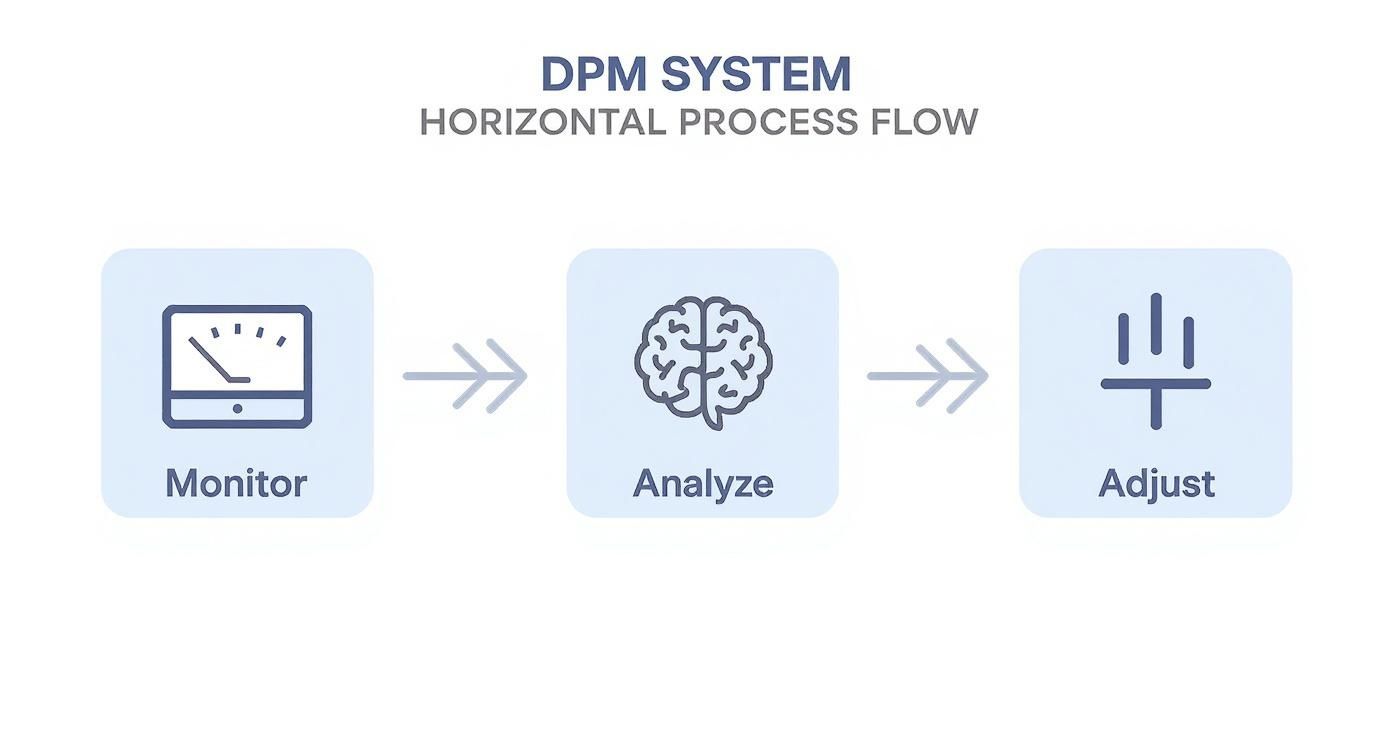
This simple cycle— monitor, analyse, adjust —is the engine that allows a site to get the most out of its charging assets without pushing the local electricity supply past its limits.
Enabling Rapid EV Charging from Constrained Grid Connections
When you pair dynamic power management with on-site battery storage, things get really interesting. This combination is a game-changer for deploying rapid and even mobile EV charging solutions. Many perfect locations for charging hubs, like service stations or retail parks, are held back by constrained grid connections that just cannot handle the immense power draw of multiple rapid chargers.
This is where a grid-scale battery energy storage system (BESS) steps in, acting as a power reservoir.
- Trickle-Charging the Battery: The BESS can be charged up slowly from the weak grid connection, often during off-peak hours when electricity is cheapest.
- Unleashing a Rapid Charge: When an EV plugs in, the system discharges all that stored energy from the battery at a massive rate, delivering a powerful, fast charge far beyond what the grid could ever supply on its own.
DPM is the conductor of this entire orchestra. It directs the flow of energy from the grid to the battery and from the battery to the chargers, making sure the grid is never overloaded and power is delivered with precision. This setup makes it possible to install high-power charging infrastructure almost anywhere you can think of.
Powering Mobile EV Charging and Distributed Energy
This same principle is what is fuelling the rise of mobile EV charging. A large battery unit, mounted on a truck or trailer, can be charged where power is cheap and plentiful. It can then be driven to wherever charging is needed on a temporary basis—think festivals, fleet depots, or even roadside assistance call-outs.
DPM software is absolutely critical here, managing the battery's state of charge and its power output to make these distributed energy resources a viable business. It completely flips the script on the traditional, static model of EV charging, making it far more flexible and responsive.
By decoupling the act of charging a vehicle from the real-time capacity of the local grid, DPM combined with battery storage fundamentally changes where and how rapid charging can be delivered. It opens up new markets and provides a critical service in previously inaccessible areas.
This need for intelligent energy modulation is not unique to the EV sector. Recent UK government data shows that final energy consumption is on the rise, with domestic and service sectors seeing a 3.8% increase , driven partly by unpredictable weather and pricing. This just goes to show the volatile nature of demand that DPM technologies are perfectly built to handle, whether for EV charging or managing a building's entire energy system. You can explore these national energy consumption patterns and their implications on the official government statistics page.
Integrating Renewables and Battery Storage
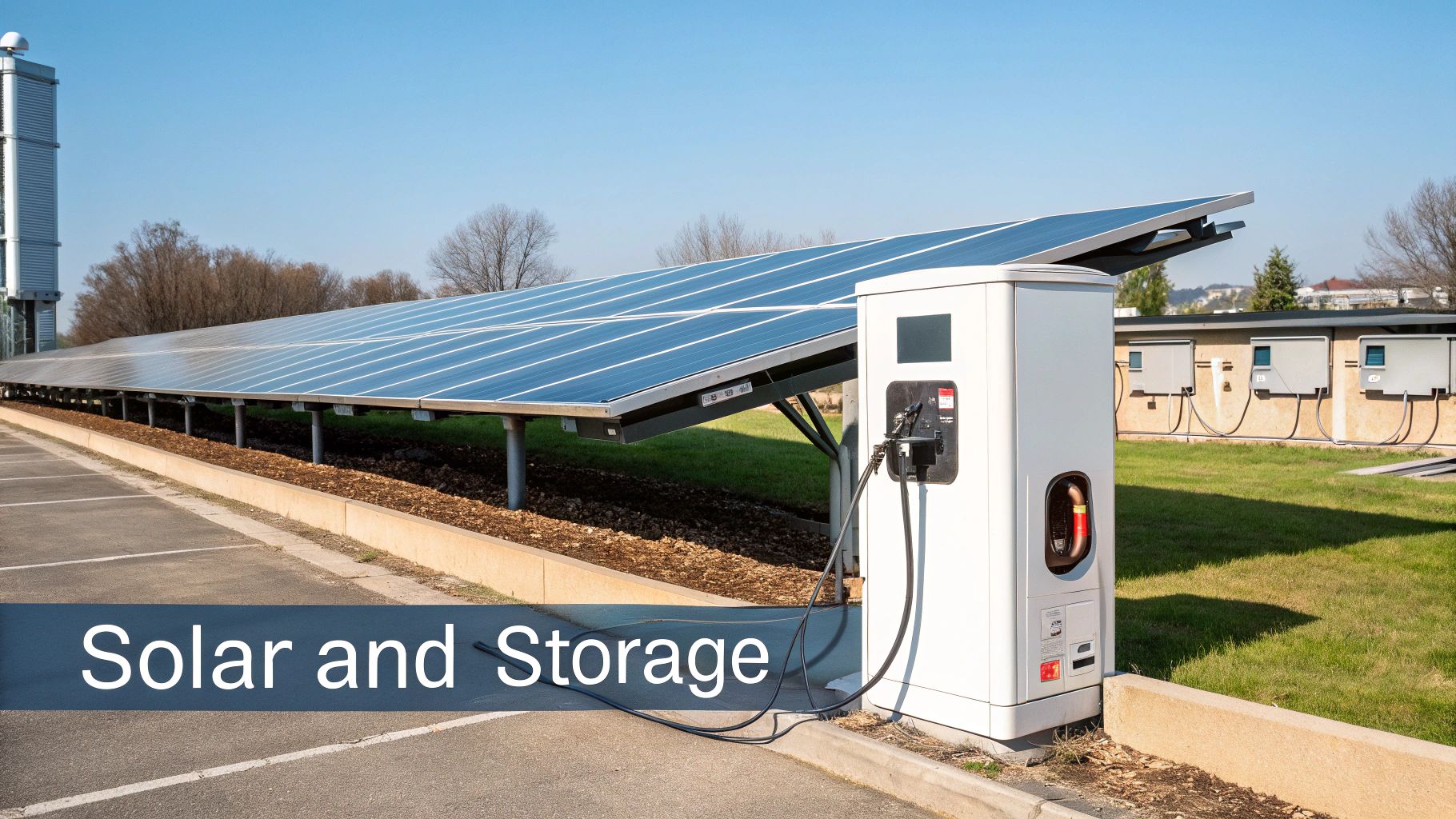
This is where dynamic power management truly shines—as the conductor of a modern, distributed energy orchestra. Its full potential is unlocked when it coordinates not just EV chargers but also combined on-site renewables like solar panels and grid-scale battery energy storage systems (BESS).
This powerful trio creates a largely self-sufficient energy ecosystem that can drastically reduce reliance on the grid and slash operational costs, especially when integrating EV charging and batteries.
Think about a commercial building with solar panels on its roof and a bank of EV chargers in the car park. Without an intelligent system, it is a story of missed opportunities. The site might be exporting cheap solar power to the grid at midday, only to buy back expensive electricity later that evening to charge vehicles. Dynamic power management flips this inefficient model completely on its head.
Prioritising Self-Generated Energy
A DPM system can be programmed with smart, cost-saving priorities. During a sunny afternoon, it sees the abundant, free energy being generated by the solar panels and makes an instant decision. Instead of letting that valuable electricity escape to the grid for a pittance, it directs it precisely where it is needed most.
The system can send this clean power straight to any EVs that are plugged in, offering ‘solar-powered’ charging at virtually no cost. If the chargers do not need all the power, the DPM intelligently diverts the excess solar generation into an on-site battery, storing it for later. This ensures every last kilowatt-hour of self-generated electricity is captured and used on-site, maximising its value.
This is what makes modern energy solutions so effective. For a deeper look into this synergy, you can learn more about the mechanics of battery-backed EV charging and how it overcomes grid limitations.
Smoothing Out Renewable Intermittency
One of the biggest headaches with renewables is their variable nature. A cloud passing over the sun can cause a sudden drop in solar generation, creating instability. This is where the partnership between DPM and battery storage becomes absolutely essential.
The battery acts as a crucial buffer, absorbing the unpredictable ebbs and flows in energy supply.
- Absorbing Excess Power: When the sun is shining brightly and generation outstrips site demand, the battery soaks up the surplus energy like a sponge.
- Filling the Gaps: When a cloud causes a dip in solar output, the DPM system instantly tells the battery to discharge, filling the gap seamlessly.
This constant balancing act smooths out the choppy output from the renewables, creating a firm, reliable power supply for the site. It transforms an unpredictable energy source into a dependable asset. To make this work effectively, it is vital to keep the system running at its best; for instance, by understanding the importance of maintaining solar PV panels for peak performance .
Dynamic power management turns a collection of individual energy assets into a single, cohesive microgrid. It ensures the right power source is used at the right time for the right task, optimising for cost, carbon, and resilience.
Becoming an Active Grid Participant
This integrated setup does more than just benefit the site owner; it can actively support the entire electrical grid. A site equipped with DPM, renewables, and battery storage can shift from being a passive energy consumer to an active 'prosumer' that participates in grid services.
During periods of high national demand, when the grid is under strain and wholesale electricity prices are soaring, the DPM system can automatically take action. It can reduce the site's overall consumption by throttling back non-essential loads, or it can go a step further and export stored energy from the battery back to the grid.
This not only helps to stabilise the national network but can also generate significant revenue for the business. By becoming a flexible asset that the grid operator can call upon, a company turns its energy system from a simple overhead into a revenue-generating part of its operations. This is the future of distributed energy, all made possible by the intelligent coordination of dynamic power management.
Weighing the Benefits and Challenges of DPM
Adopting any new technology requires a balanced perspective, and implementing dynamic power management is no different. It brings substantial advantages for deploying EV charging but also comes with real-world considerations that site operators need to weigh up. A clear-eyed view of the pros and cons is essential for making a well-informed decision.
The upside is compelling, tackling the biggest practical barriers to expanding EV infrastructure. By intelligently managing electricity, DPM delivers tangible wins that directly impact a project's bottom line.
The Clear Advantages of a DPM Strategy
One of the most powerful benefits is the ability to avoid expensive and lengthy grid upgrades . For many potential sites, the cost of bringing in a beefier electrical supply can stop a project in its tracks. Dynamic power management lets you work with what you have got, maximising your existing connection to support more EV chargers than would otherwise be possible.
This leads straight to another huge plus: reduced operational energy costs . You can program the system to sidestep charging during peak demand periods when electricity tariffs are at their highest, significantly cutting your energy bills. For fleet operators, one study found that using DPM to shift charging outside of peak hours (like California's 4-9 p.m. window) could slash electricity costs by up to 60% .
By making the most of the existing grid connection, dynamic power management fundamentally alters the business case for EV charging. It can turn what was a non-starter into a viable, cost-effective investment.
On top of that, a DPM system allows you to install more charge points at a single location. For businesses looking to attract EV drivers or serve an electric fleet, this ability to scale up capacity without massive capital outlay is a game-changer. It means a better user experience and future-proofs the site against growing demand.
Navigating the Potential Challenges
Of course, it is not without its challenges. The most obvious is the initial investment cost for the DPM hardware and software. While this is often just a fraction of the price of a full grid upgrade, it is still a capital expense that needs to be factored into any project budget.
Another potential hurdle is the complexity of integration . In a perfect world, all your EV chargers and energy assets would come from one manufacturer. The reality is that most sites have a mix of kit from different providers. Getting all these components to communicate seamlessly with the DPM controller requires careful planning and technical expertise to avoid compatibility headaches.
Finally, like any connected, intelligent system, cybersecurity is a paramount concern . A DPM system that controls a site's entire energy flow is a critical piece of infrastructure and must be protected from unauthorised access. Ensuring robust security protocols are in place is not just a good idea—it is essential for maintaining a reliable and safe operation. These systems are crucial for helping to support grid stability and resilience , which makes their security even more important.
DPM Implementation Compared to Traditional Grid Upgrades
When deciding on the best path forward, it is helpful to see a direct comparison. A DPM solution offers a very different set of trade-offs compared to the conventional approach of upgrading the grid connection.
| Factor | Dynamic Power Management | Traditional Grid Upgrade |
|---|---|---|
| Upfront Cost | Moderate initial cost for hardware and software. | High capital expenditure for new transformers, cables, and labour. |
| Installation Time | Relatively quick, often measured in weeks. | Can take many months, sometimes over a year, due to planning and utility schedules. |
| Scalability | Highly flexible; easy to add more chargers to the existing system. | Inflexible; future expansion often requires another major upgrade project. |
| Operational Costs | Lower ongoing energy bills through optimised charging schedules. | Higher energy costs, as power is drawn without optimisation for peak tariffs. |
| Site Disruption | Minimal disruption to site operations during installation. | Significant disruption, including trenching and potential downtime. |
| Grid Impact | Reduces strain on the local grid by managing load intelligently. | Increases the maximum load and potential strain on the local grid infrastructure. |
Ultimately, the choice depends on the specific project's budget, timeline, and long-term goals. While a traditional upgrade provides raw power, DPM delivers intelligent, flexible power—a crucial distinction in today's evolving energy landscape.
The Future of Smart Energy and DPM
Looking ahead, it is clear that dynamic power management is becoming absolutely central to the UK's energy strategy. It is moving beyond a reactive system that simply juggles today's loads. The next step is a predictive engine that anticipates tomorrow's needs, paving the way for a far more resilient and efficient national grid.
This evolution is being supercharged by artificial intelligence (AI) and machine learning. These technologies will give DPM systems the power to learn from historical data, weather patterns, and even real-time market signals. The result will be platforms that can forecast energy demand and renewable generation with uncanny accuracy, getting the grid ready for changes before they even happen.
The Rise of Vehicle-to-Grid Technology
One of the most exciting developments on the horizon is Vehicle-to-Grid (V2G) technology . This idea flips the script entirely, transforming every electric vehicle from a simple energy user into a dynamic, two-way grid asset. With V2G, an EV's battery does not just draw power from the grid—it can send it back when it is needed most.
Dynamic power management is the brain that will make this two-way energy flow work. Picture this: thousands of EVs are plugged in at office car parks on a sunny afternoon. A smart DPM system could coordinate them to soak up all that excess solar power from the grid, preventing local network overload while storing clean energy.
Later, when everyone gets home and turns on their kettles for the evening peak, the system could ask those same vehicles to export a small, managed amount of their stored power back to the grid. This collective effort helps stabilise the whole network, meaning we do not need to fire up fossil fuel power plants. It paints a picture of a decentralised, intelligent energy network where every EV and battery becomes a flexible, coordinated resource for the country.
Dynamic power management is not just a niche technology for EV charging; it is a foundational building block for the UK's entire net-zero ambition. It is the intelligence layer that will weave renewables, storage, and electric transport into one cohesive, smart system.
DPM's Expanding Role in a Smarter Grid
The principles of DPM are already proving their worth in other power-hungry sectors. Take the UK's data centre power market, valued at around USD 1.19 billion in 2024. It relies heavily on these techniques to manage its enormous electricity consumption. Top-tier facilities use DPM to control power supplies and right-size their generator fleets, ensuring maximum efficiency and reliability. You can dive deeper into these energy optimisation findings in the data centre market.
This reinforces the idea that dynamic power management is the key to unlocking a truly smart grid. It allows for the seamless integration of distributed energy resources—from rooftop solar panels to grid-scale batteries—managing the complex dance between local generation and consumption. By intelligently balancing supply and demand at every level, DPM ensures the grid remains stable, efficient, and ready for a fully electric future.
Got Questions? We've Got Answers
As dynamic power management becomes a more common sight, it is only natural for businesses to have practical questions. If you are thinking about this technology, you are probably wondering about installation, compatibility, and what it really means for your bottom line. We get it.
Below, we’ll tackle some of the most common queries we hear, especially from those looking to install or upgrade their EV charging setup while juggling renewables, battery storage, and tricky grid connections.
Can DPM Be Retrofitted to Existing EV Charging Sites?
Yes, absolutely. One of the best things about modern dynamic power management systems is that they are designed to be retrofitted. You do not have to rip everything out and start from scratch; you can integrate a DPM controller into your existing setup.
Typically, the process involves installing a central controller and smart meters to keep an eye on your site's main connection and overall load. As long as your current chargers are 'smart'—meaning they can communicate using a standard protocol like OCPP—they can be brought into the DPM network. This makes it a really smart, cost-effective upgrade for sites wanting more charging capacity without a massive overhaul.
Think of it like this: retrofitting DPM unlocks the hidden potential of your current infrastructure. It lets you add more chargers and use energy far more efficiently, all without exceeding the limits of your existing grid connection.
How Does DPM Work with Different Charger Brands?
This is a great question, because very few charging sites use hardware from just one manufacturer. High-quality DPM systems are built to be brand-agnostic. They work by using open industry standards—most commonly the Open Charge Point Protocol (OCPP) —to talk to a huge variety of chargers.
This interoperability is key. It means the DPM 'brain' can send instructions and receive data from any charger that is OCPP-compliant, no matter who made it. This gives you the freedom to build a flexible charging network that is ready for the future, without getting locked into a single hardware supplier. The main thing is to always double-check that both your DPM system and your chargers support the same communication protocol.
ZPN Energy provides advanced dynamic power management solutions that work seamlessly with on-site renewables and battery storage. Our systems unlock powerful, rapid EV charging, even on the weakest grid connections. Discover our integrated energy solutions at https://www.zpnenergy.com.