What Is Demand Side Response? A Guide for UK Businesses
Demand Side Response (DSR) is all about making the national grid smarter. At its core, it's a system that rewards businesses and consumers for being flexible with how and when they use electricity.
Think of it as a dynamic balancing act. Instead of the old-school approach of firing up expensive, often polluting, power stations every time demand spikes, DSR encourages a simple reduction or shift in energy consumption during these peak times.
What Is Demand Side Response in Simple Terms?
Imagine the national grid is a busy motorway. During rush hour, the roads get completely clogged up. Now, instead of spending billions building more lanes (the equivalent of new power stations), a smart traffic system could temporarily reroute non-essential traffic or offer incentives for drivers to travel a bit later.
Demand Side Response does exactly this for our electricity network. It’s an intelligent way of managing the flow of energy to prevent gridlock.
When everyone uses electricity at the same time—say, on a cold winter's evening—the grid is put under immense strain. DSR provides a powerful solution by asking large energy users to temporarily dial down their consumption. This isn't about shutting down your operations; it's about making small, strategic adjustments that have a big impact, particularly with assets like EV charging hubs and grid-scale batteries.
For businesses, this flexibility is transformed from a simple operational tweak into a valuable new revenue stream, all while helping to create a more stable and efficient national grid for everyone.
The Core Idea Behind DSR
At its heart, DSR is about collaboration. It’s a partnership between energy users and the National Grid, moving us away from the traditional model where power stations just crank out more energy to meet demand, whatever the cost.
Instead, it empowers businesses to become active, crucial participants in keeping the grid balanced. This approach isn't just more cost-effective; it's absolutely essential for integrating distributed energy resources like on-site renewables and EV charging infrastructure. Wind and solar, by their nature, don't generate power 24/7, and DSR helps smooth out these fluctuations.
Demand Side Response turns your energy consumption from a fixed cost into a flexible asset. By adjusting usage when the grid needs it most, your business can earn payments, reduce energy bills, and contribute to a greener, more resilient energy system.
To help you get a quick handle on the key terms, here’s a simple breakdown.
Key Demand Side Response Concepts at a Glance
| Concept | Simple Explanation |
|---|---|
| Peak Demand | The times of day when electricity usage across the country is highest (e.g., weekday evenings). |
| Grid Balancing | The constant job of matching electricity supply with real-time demand to keep the lights on. |
| Flexibility | Your business's ability to turn down, turn up, or shift its energy consumption when asked. |
| Aggregation | A service where a third party (an aggregator) bundles the flexibility of many smaller users to participate in DSR schemes. |
| Curtailment | The technical term for temporarily reducing your electricity consumption from the grid. |
| Load Shifting | Moving your energy-intensive processes from peak hours to off-peak hours when demand is lower. |
Essentially, DSR is about being smart with the energy we already have, rather than just endlessly producing more.
The whole concept is gathering serious momentum across the UK. Take the National Grid's Demand Flexibility Service (DFS), which has seen incredible growth by encouraging households and businesses to cut electricity use during peak events.
In the 2023-24 winter season alone, over 2 million households and dozens of businesses took part, proving just how effective this collaborative model can be. As this shift towards smarter energy management for businesses continues, it's opening up exciting new ways for commercial and industrial users to make their assets work harder for them.
How Demand Side Response Actually Works in the UK
Demand Side Response schemes might sound complicated but they run on a simple principle: your business gets paid to offer the grid a bit of flexibility. So, what does that look like in practice? Think of it as National Grid having a toolkit to keep the country’s power network stable and secure, with different tools for different jobs.
The main mechanisms fall into a few key categories. Some are like long-term insurance policies, designed to prevent future power shortfalls. Others are all about real-time, second-by-second adjustments that stop the grid from becoming unstable.
This diagram shows how the core ideas of flexibility and financial rewards come together to balance the national grid.
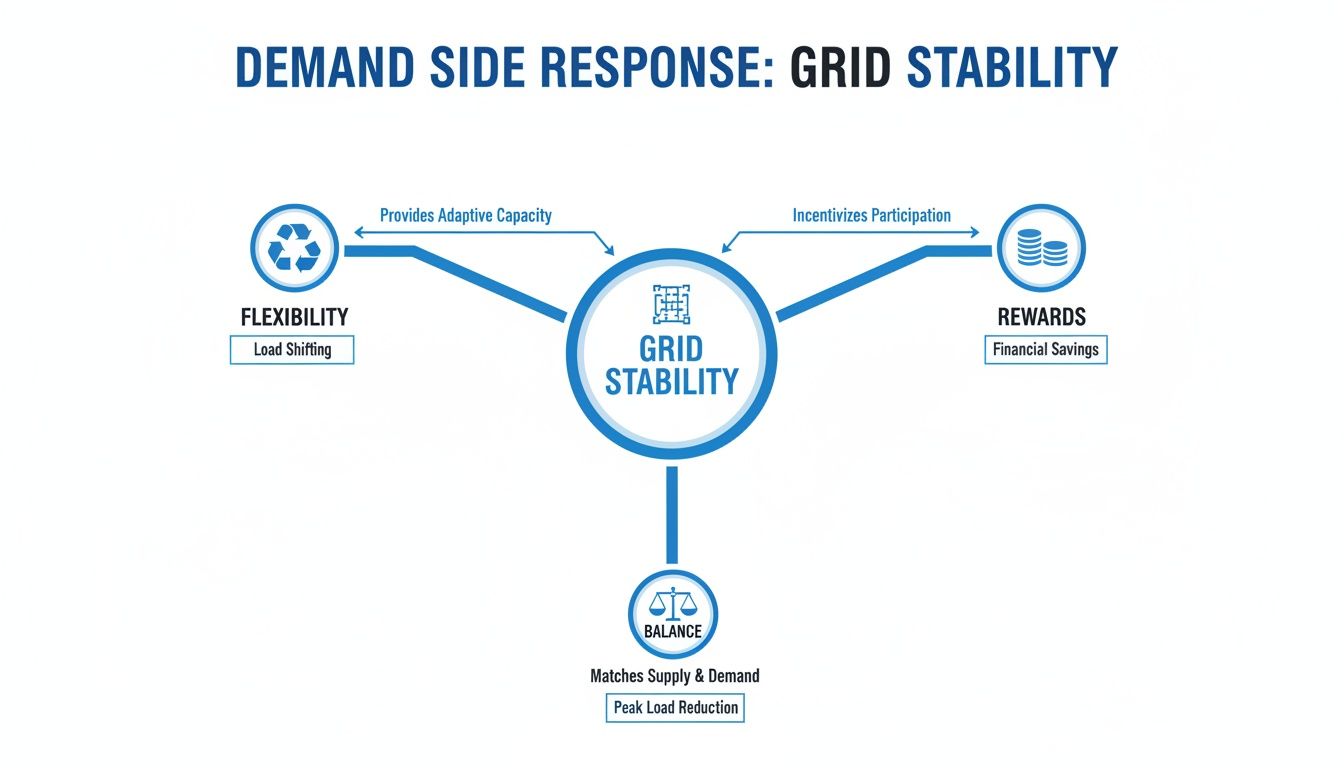
As you can see, the central idea is that by offering flexible energy usage, your business can earn new revenue while actively helping to create a more reliable power system for everyone.
Key UK DSR Schemes
Let's break down the main programmes available to businesses in the UK:
- The Capacity Market: This is the grid’s long-term insurance plan. Businesses are paid a steady retainer just for being on standby, agreeing to reduce their energy use if needed during times of extreme system stress.
- The Balancing Mechanism: Think of this as the grid’s real-time control room. National Grid uses it to balance supply and demand minute-by-minute, calling on flexible assets like grid-scale batteries or EV charging hubs to react quickly to sudden changes.
- Frequency Response Services: These are absolutely critical for keeping the grid's frequency stable at 50Hz . If a big power station suddenly trips offline, assets must respond in seconds to either inject power or cut demand to prevent blackouts.
DSR isn't about shutting down your operations. It’s about intelligently shifting or reducing non-critical loads—like briefly pausing rapid EV charging or discharging your on-site batteries—in exchange for payment. It's all managed seamlessly in the background.
The UK's need for these services is growing fast. As we push towards Net Zero, the flexibility market is expanding to manage the ups and downs of renewable energy. Projections show we'll need 10-12GW of DSR capacity by 2030 —that's a fourfold increase on today's levels. To hit the government's Clean Power 2030 target, DSR capacity needs to triple from under 4GW to nearly 12GW .
The Role of Aggregators
For many businesses, trying to participate directly in these complex markets is a non-starter. This is where aggregators come in.
An aggregator acts as an expert partner. They bundle the smaller, flexible loads from multiple businesses into a much larger block that can be offered to National Grid. They handle all the complex bidding, contracts and compliance, making it much easier for businesses to get involved.
This opens the door for a much wider range of companies to access DSR revenues without needing their own in-house energy trading team. It means assets like EV charging hubs, on-site battery storage and combined renewables can start earning their keep. Understanding how ZPN's energy solutions support grid stability and resilience is a great next step in seeing how these assets can be put to work.
Your Smartest Assets: EV Charging and Battery Storage
Demand Side Response really comes alive when you connect it to physical assets. For most businesses, the smartest and most flexible assets are often already on-site or in the pipeline: electric vehicle charging infrastructure and Battery Energy Storage Systems (BESS).
These aren't just operational necessities; they are intelligent, grid-interactive assets just waiting to generate revenue. Stop seeing EV chargers as a simple utility and start thinking of them as active players in the energy market. The same goes for any grid-scale batteries or combined on-site renewables. These technologies are the foundation of a modern, flexible energy strategy, capable of turning a standard commercial property into a dynamic energy hub.
It’s this synergy where the true potential of DSR is unlocked, particularly for businesses dealing with rapid EV charging from constrained grid connections.
Transforming EV Charging into a Grid Asset
An electric vehicle fleet is, in essence, a huge battery on wheels. With intelligent management, this stored energy can be put to work. Instead of vehicles charging randomly whenever they’re plugged in, smart charging gives you control and flexibility.
- Smart Charging (V1G): This is the most straightforward form of flexible charging. Rather than an EV drawing power at maximum speed the moment it’s connected, V1G technology intelligently manages the session. It can automatically shift charging to off-peak hours when electricity is cheapest (and often greenest), or pause charging for a few minutes during a DSR event to support the grid. This is applicable to both static and mobile EV charging solutions.
- Vehicle-to-Grid (V2G): This is the real game-changer. V2G technology allows electric vehicles not only to draw power from the grid but to export it back. During periods of peak demand, a connected fleet can act like a distributed power plant, discharging a small, managed amount of energy to help stabilise the grid and earn significant revenue for doing so.
For businesses looking to get their EV fleet DSR-ready, choosing the right hardware is essential. You can explore a range of EV charging stations built to support this kind of smart energy management.
The Power of Battery Energy Storage Systems
Battery Energy Storage Systems (BESS) are arguably the most versatile tool you can have for DSR participation. A BESS is basically a large, rechargeable battery that puts you in complete control of your site’s energy.
A BESS lets you play the energy market: buy low and sell high. It charges up when grid electricity is cheap (like overnight or when wind and solar generation is high), then discharges that stored power during peak times to run your site or sell back to the grid for a profit.
This capability, known as energy arbitrage, is just the start. When you pair a BESS with on-site renewables like solar panels, you create a powerful distributed energy resource. You can store any excess generation for later, maximising your self-consumption and making you far less reliant on the grid.
It’s also a lifeline for sites with constrained grid connections, as a BESS can supply the power needed for rapid EV charging without forcing you into expensive grid upgrades. To get a deeper understanding, discover more about how battery energy storage systems can support UK grid and EV charging.
Unlocking Revenue and Resilience for Your Business
Think of your business's energy strategy. Is it just another line item on the expense report? With Demand Side Response, it's time for a rethink. Participating in DSR fundamentally changes your relationship with energy, turning what was once a simple cost centre into a dynamic, revenue-generating asset.
This isn't just theory. The benefits hit your bottom line directly through new income streams, significant cost savings and a welcome boost to your operational security.
By offering the flexibility of your on-site assets—like grid-scale batteries, combined renewables or your managed EV charging infrastructure—you can earn reliable payments from grid operators. This creates a predictable new revenue stream, effectively improving the return on investment for the green technologies you've already put in place.
But it's not all about direct earnings. DSR is also a powerful tool for slimming down your overall energy expenditure. The most immediate win comes from sidestepping those eye-watering peak-time tariffs and network charges.
Cost Savings and Energy Security
By intelligently managing when and how you use energy, you can perform peak shaving . This simply means using stored battery power or shifting your EV charging schedules to avoid drawing expensive electricity from the grid when tariffs are at their highest. It's a proactive approach that can make a real dent in your energy bills, especially when managing rapid EV charging from constrained grid connections.
On top of that, on-site assets like a Battery Energy Storage System (BESS) add an invaluable layer of energy security. If a grid outage hits, your BESS can seamlessly switch to backup power mode, keeping your critical operations humming along without interruption. In a world of uncertainty, that kind of resilience is a major competitive advantage, preventing costly downtime.
By participating in DSR, you are not just an energy consumer; you become a crucial partner to the National Grid. This active role helps build a more stable, decarbonised energy system for the entire country.
A Powerful Sustainability Story
Finally, getting involved in DSR significantly strengthens your company’s commitment to sustainability. By helping to balance the grid, you're directly enabling the integration of more distributed energy resources like wind and solar.
This gives you a compelling corporate social responsibility (CSR) narrative, demonstrating a tangible contribution to the UK's Net Zero ambitions.
For any business considering DSR, understanding the financial returns is, of course, absolutely crucial. For an idea of the financial models involved, you can explore Nextbid AI's ROI insights to see how these benefits translate into concrete figures. Embracing DSR isn't just an operational tweak; it's a strategic decision that delivers financial rewards, operational resilience and a greener brand identity.
Untangling the UK's Evolving Energy Rules
The rulebook for Demand Side Response (DSR) might look complicated but the good news is it's changing fast—and in favour of businesses like yours. The UK’s energy landscape is going through a massive shift, with new developments making it easier and more profitable than ever to get involved. This isn't about getting tangled in red tape; it's about spotting the commercial opportunities created by a smarter, more flexible grid.
The whole trend is about knocking down old barriers. Regulators are actively prying open the energy markets, which means more businesses can offer up their flexibility and get paid for it. This creates a much more lively and competitive market, which is good for everyone, from the grid operators right down to the end consumer.
Key Changes Opening Up the Market
One of the biggest recent moves is something called BSC Modification P415 . In simple terms, this change gives independent aggregators a direct line to wholesale energy markets, letting them bypass the traditional route through big energy suppliers.
This is a genuine game-changer. It means an aggregator, acting as a 'Virtual Lead Partner', can dispatch their customers' flexible assets—like your EV charging hub or grid-scale battery system—straight into the day-ahead and intra-day markets. This one rule change is supercharging DSR in the UK, creating more ways for you to stack revenues from different schemes like the Capacity Market, the Balancing Mechanism and various frequency response services. You can get more great insights on these market shifts from industry players like Drax.
The takeaway for your business is simple: the regulatory tide is turning in your favour. Changes like P415 are specifically designed to make it more straightforward and lucrative for your assets to help balance the grid.
The Bigger Picture: A Push for Simplicity
Beyond specific market rules, there's a wider push towards standardisation that’s making everything a bit smoother. Frameworks like PAS 1878 , which lays out the requirements for energy smart appliances, are a perfect example of this.
While that particular standard is aimed at domestic gadgets, it points to a much bigger move towards creating a common language for smart, grid-connected tech. This standardisation is absolutely vital for making sure different bits of kit, from mobile EV chargers to massive grid-scale batteries, can all talk to the grid without any hiccups.
- Easier Integration: Common standards slash the technical headache of connecting your assets to DSR programmes.
- Better Teamwork: It ensures equipment from different manufacturers can all play nicely together in an aggregated portfolio.
- Smarter Investments: Choosing assets that already meet these emerging standards means they’ll stay valuable and eligible for DSR schemes for years to come.
With all these regulatory and technical changes happening, there has never been a better time for businesses to see what demand side response can do for them. The path to getting involved is becoming clearer and the financial rewards are getting bigger, making this a strategic moment to jump in.
So, you’re ready to put theory into practice? Getting started with Demand Side Response isn’t about flipping a switch; it’s a clear, logical process that begins with understanding what you already have and then finding the right partner to make it work for you.
Think of it as unlocking the hidden value in your existing energy assets and turning them into active, revenue-generating participants in the grid. It starts with an internal look at your operations and then moves to partnering with specialists who know the energy markets inside and out.
Start with a Thorough Energy Audit
First things first, you need a clear picture of how you use energy and where your flexibility lies. An energy audit for DSR is more than just a cost-saving exercise; it’s a discovery mission to find processes and equipment that can be adjusted without disrupting your core business.
You’re looking for energy-hungry assets that have a bit of wiggle room in their operation. Good candidates often include:
- EV Charging Infrastructure: Shifting or briefly pausing charging sessions for both rapid and mobile chargers is often a simple and effective source of flexibility.
- On-site Battery Storage: A Battery Energy Storage System (BESS), from small-scale to grid-scale, is the perfect DSR asset, built to respond in an instant.
- Combined On-site Renewables: Integrating solar or wind with battery storage creates a highly flexible, distributed energy resource.
- HVAC Systems: Small adjustments to heating, ventilation, and air conditioning cycles can free up significant energy without anyone even noticing a change in temperature.
Uncovering even a small amount of flexibility is the key that opens the door to DSR. The aim is to find wattage that can be shifted, not switched off entirely.
Choose the Right Aggregator Partner
Let’s be realistic: for most businesses, trying to participate directly in the UK’s complex energy markets is a non-starter. This is where an experienced aggregator becomes your most valuable ally. They’re the experts who manage the entire process for you.
A good partner will handle all the heavy lifting. They’ll assess your assets, figure out which DSR schemes are the best fit and manage all the bidding and compliance. By bundling your flexibility with that of other businesses, they create a large enough block of energy to offer the National Grid, making it possible for you to get involved without the technical headaches.
Before we move on, it's worth understanding the different ways you can work with an aggregator. The relationship can be structured in a few different ways, depending on how hands-on you want to be and what kind of assets you have.
Comparing DSR Participation Models
Here’s a quick breakdown of the common models for engaging with DSR schemes in the UK.
| Participation Model | How It Works | Best Suited For |
|---|---|---|
| Fully Managed Service | The aggregator handles everything: asset assessment, market bidding, dispatch and settlement. Your involvement is minimal. | Businesses new to DSR or those who want a completely hands-off, "set-and-forget" approach. |
| Shared Revenue Model | You and the aggregator agree on a percentage split of the revenue generated from DSR participation. The aggregator still manages the process. | Companies with significant flexible assets who want to share in the upside while still outsourcing the operational complexity. |
| Technology-Led Partnership | The aggregator provides the control platform and market access but your team has more visibility and some control over dispatch parameters. | Larger businesses with in-house energy management teams who want to integrate DSR into their broader energy strategy. |
Choosing the right model is about finding a balance between control, risk and reward that fits your business. A good aggregator will walk you through these options to find the best fit.
Implement Automated Control Systems
Here’s the crucial part: successful DSR participation should be invisible to your day-to-day operations. You shouldn't have to manually shut things down. This is all made possible by smart, automated control systems that work quietly in the background.
These systems link directly to your EV chargers, batteries, or other distributed energy resources, allowing them to respond to grid signals automatically and instantly. This means your assets can take part in a DSR event without anyone on your team having to do a thing. It’s this automation that makes the whole process seamless, efficient and truly effortless.
Got Questions About Demand Side Response?
To wrap things up, let's tackle a few of the most common questions we hear from businesses dipping their toes into the world of demand side response.
How Does DSR Affect My Daily Operations?
A properly designed DSR strategy should have zero noticeable impact on your day-to-day business. Think of it as a smart, automated system working quietly in the background.
It’s all managed by control systems making tiny, precise adjustments. For instance, it might pause a rapid EV charging cycle for a few minutes or draw a small amount of power from a grid-scale battery. The key is that it all happens automatically, without you or your team ever needing to lift a finger.
Is My Business Too Small to Participate?
Not at all. This is where aggregators come in. Their job is to bundle the flexibility from lots of smaller sites—like yours—into a single, larger portfolio that’s big enough to offer to the National Grid.
This means businesses of almost any size can get involved and earn revenue, even if their individual flexible load is pretty small. It’s not about having a massive energy bill; it's about having a flexible asset that can be called upon, such as mobile EV charging units.
The real value of DSR lies in its ability to democratise grid services. Assets like mobile EV charging stations, small-scale batteries, and even HVAC systems can all be combined to contribute to a stronger, more flexible energy system.
What Are the Biggest Risks Involved?
The main risk is what’s called non-performance—when an asset is called upon by the grid operator but fails to respond. It sounds serious but this is exactly what a good aggregator partner is there to prevent.
They manage this risk by operating your assets conservatively and ensuring the automated systems are rock-solid and reliable. They sweat the small stuff so you can focus on running your business, not worrying about grid compliance.
Ready to turn your energy assets into a revenue stream? ZPN Energy provides advanced battery-backed rapid EV charging and BESS solutions designed for seamless DSR participation, even on sites with constrained grid connections. Discover our unique approach at https://www.zpnenergy.com.