Arc Fault Detection Device: A Critical Safety Component for EV Charging and Battery Systems
An arc fault detection device, or AFDD, is a specialist piece of safety equipment designed to prevent fires by spotting dangerous electrical arcs that standard circuit breakers simply cannot see. This technology is becoming essential for high-power systems like EV charging and battery storage where the sheer electrical stress massively increases the risk of hidden fire hazards.
The Hidden Fire Risk in Modern Electrical Systems
You can stare at a perfectly normal-looking socket all day and have no idea of the danger lurking behind it—a danger responsible for thousands of UK fires every single year. That danger is an electrical arc fault, a tiny but intensely hot spark that jumps the gap between damaged or loose conductors. It is often completely invisible, hidden away behind walls, inside appliances, or deep within an EV charger.
Picture this: a single wire terminal inside a busy rapid EV charger is just slightly loose. Day in and day out, the constant heating and cooling from heavy use—thermal expansion and contraction—makes that connection just a little bit worse. Eventually, a microscopic air gap forms. Before you know it, electricity starts arcing across that gap, generating incredible heat that can top 5,000°C .
This is not some big, dramatic short circuit that would trip a normal breaker. It is a slow-burn threat, a persistent smoulder that gradually carbonises the insulation around it until, one day, it bursts into flame.
Why Standard Protection Is Not Enough
The safety devices you already have, like Miniature Circuit Breakers (MCBs) and Residual Current Devices (RCDs), are absolutely vital but they are completely blind to this specific type of threat. They are built to look for entirely different problems.
- MCBs are on the lookout for overloads and short circuits, situations where a huge, sudden surge of current floods the system.
- RCDs are designed to spot earth faults where current is leaking away to the ground, which is what protects you from a nasty electric shock.
An arc fault, however, often draws far too little current to bother an MCB and because it does not involve any leakage to earth, the RCD just sits there, completely unaware. This is the crucial protection gap that the arc fault detection device (AFDD) was created to fill. It is the only technology engineered to recognise the unique electrical signature—the "noise"—of a dangerous arc, shutting the circuit down long before a fire can ever take hold.
Think of an arc fault as a stealthy firestarter, operating below the radar of traditional safety systems. The AFDD is the specialist firefighter, the one trained to detect the faint electrical smoke signals of an arc before the blaze even begins.
This technology is no longer just a ‘nice to have’; it is a critical layer of safety, especially for today's high-load systems. The demands of EV charging, the complexities of on-site renewables, and the rise of grid-scale batteries all place immense stress on our electrical infrastructure. To head off these dangers, it is vital to build in multiple layers of safety, including strategies like these Effective Workplace Fire Prevention Tips. As UK safety standards continue to evolve, the AFDD is cementing its place as an indispensable safeguard for these powerful, modern systems.
How an Arc Fault Detection Device Actually Works
The best way to think about an arc fault detection device is not as a simple switch but as an intelligent smoke alarm for your electrical wiring. It is constantly ‘listening’ to the electricity flowing through your circuits, analysing its unique signature for the tell-tale signs of trouble. It is a digital guardian for your entire electrical system.
This constant monitoring is what really sets an AFDD apart. A standard circuit breaker is a blunt instrument; it waits for a massive, overwhelming event like a short circuit or overload before it acts. An AFDD is far more sophisticated. It is programmed to recognise the subtle but incredibly dangerous electrical ‘noise’ created by a hazardous arc.
Distinguishing Safe Sparks from Dangerous Arcs
Imagine your electrical current as a smoothly flowing river. When you flick a light switch or unplug an appliance, you create a small, harmless ripple—a normal, momentary spark. An AFDD, with its on-board microprocessor, is smart enough to see this everyday event and simply ignore it.
A dangerous arc fault, on the other hand, is like chaotic, violent rapids suddenly appearing in the river. It creates an erratic, high-frequency electrical disturbance that looks nothing like a normal operational spark. The AFDD detects this signature chaos in milliseconds and kills the power instantly. This stops the arc before its intense heat can ignite nearby materials like timber framing, insulation, or wiring.
The diagram below shows just how easily a standard wall socket can become a fire hazard if an arc fault goes undetected.
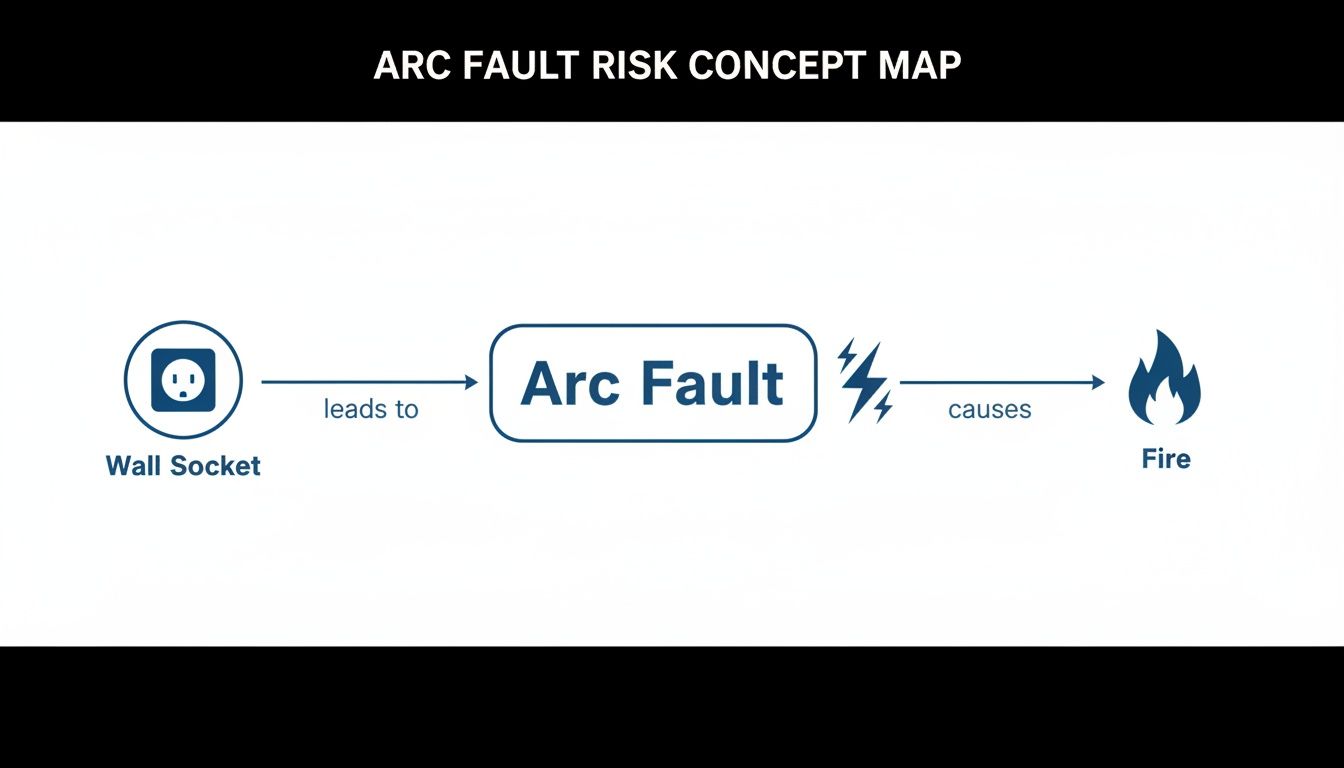
It is a stark reminder of how an everyday fixture can turn into a serious threat, highlighting why we need technology that can step in long before a fire has a chance to start.
Understanding Series and Parallel Arcs
Not all arc faults are the same but they all pose a serious fire risk. An AFDD is designed to spot the two main types, both of which are completely invisible to standard circuit breakers.
- Series Arcs: This happens when there is a break along a single wire. A classic example is a damaged EV charging cable where the copper conductor is frayed or partially severed. Electricity will try to jump that tiny gap, creating a localised arc that generates extreme heat along that one cable.
- Parallel Arcs: This is when current jumps between two different conductors —like a live and a neutral wire. It is often caused by cracked or worn insulation and creates a type of short circuit, but one that might not draw enough current to immediately trip a conventional breaker.
Both are major fire hazards that traditional safety devices just were not built to see.
Before we go further, it is worth clarifying exactly where AFDDs fit in. While they sound similar to the MCBs and RCDs found in every modern consumer unit, their job is fundamentally different.
Comparing AFDDs with Traditional Protective Devices
| Protective Device | Primary Function | Detects Arc Faults? | Best Application |
|---|---|---|---|
| MCB (Miniature Circuit Breaker) | Protects against overloads (too much current) and short circuits (massive current surge). | No | Prevents wires from overheating due to excessive load and protects against catastrophic short circuits. |
| RCD (Residual Current Device) | Protects against electric shock by detecting imbalances between live and neutral currents (i.e., current leaking to earth). | No | Prevents fatal electric shocks if someone touches a live part. |
| AFDD (Arc Fault Detection Device) | Protects against fire by detecting the unique electrical signatures of dangerous series and parallel arcs. | Yes | Prevents fires caused by damaged cables, loose connections, and faulty equipment—risks that MCBs and RCDs cannot see. |
As the table shows, an AFDD is not a replacement for MCBs or RCDs; it is an essential third layer of protection that targets the specific risk of electrical fires caused by arcing.
Think of it this way: a series arc is like a slow-burning fuse hidden inside a cable, while a parallel arc is a more direct, volatile short. An AFDD is the only device equipped to spot the distinct electrical signatures of both, offering complete protection where others have a blind spot.
This capability is especially vital for the DC circuits found in battery energy storage systems, on-site renewables like solar installations, and EV chargers. DC arcs are notoriously difficult to extinguish once they start, which makes an AFDD a non-negotiable safety component in any modern, high-power energy system.
Navigating UK Regulations for AFDD Installation
The landscape of UK electrical safety took a sharp turn with the arrival of Amendment 2 to the BS 7671 wiring regulations. This was not just a minor tweak; it was a fundamental shift in how the industry must tackle fire prevention in certain buildings. The decision to mandate the arc fault detection device was not made lightly—it was a direct response to some pretty sobering safety data.
Years of evidence pointed to a clear and present danger. Back in 2016/2017, UK Government statistics revealed a stark reality: over 13,000 fires were traced back to electrical appliances and distribution systems. This worrying trend prompted action, leading to the 29th March 2022 update that made AFDDs compulsory for AC final circuits supplying socket-outlets up to 32A in specific high-risk residential buildings.
This was not just about adding another device to the consumer unit. It was about moving from a reactive "trip switch" mentality to a proactive strategy of preventing fires before they can even start.
Mandatory AFDD Installation Locations
The new rules are not a blanket requirement for every building. Instead, they are laser-focused on places where a fire would be most catastrophic and evacuation most difficult. It all comes down to risk to life.
AFDDs are now mandatory in:
- Higher-Risk Residential Buildings (HRRBs) : Think tall buildings—structures at least 18 metres high or with seven or more storeys, containing at least two homes.
- Houses in Multiple Occupation (HMOs) : This includes any property rented out to at least three people from different 'households' who share facilities like a kitchen or bathroom.
- Purpose-Built Student Accommodation : These buildings house a dense, often transient population, which inherently elevates the fire risk.
- Care Homes : Protecting vulnerable residents, many with mobility challenges, is the absolute priority, making this technology essential.
The principle behind Amendment 2 is crystal clear: where the potential for human tragedy is highest, our level of electrical fire protection must also be at its peak. An arc fault detection device is now a non-negotiable part of that protection.
Beyond Mandates: The Role of Risk Assessment
While the regulations are specific, their impact is felt far more widely. The legal mandate has set a new benchmark for best practice, encouraging a much broader adoption of AFDDs based on professional judgement and thorough risk assessments. To get this right, it is vital to understand what a fire risk assessment entails for any given property.
This proactive mindset is especially crucial for modern, high-power systems. We are seeing designers and electricians recommend an arc fault detection device in a growing number of commercial settings, even where it is not legally required. Think about it: the high currents and dynamic loads of an EV charging hub, particularly one with rapid chargers, create the perfect conditions for arc faults to occur.
It is a similar story for properties with on-site renewables and battery energy storage. These advanced distributed energy systems, which include a wide array of electric vehicle supply equipment , introduce new complexities and potential points of failure. For these installations, fitting AFDDs is simply becoming standard professional practice—a smart move to protect high-value assets and ensure the entire energy ecosystem is safe and reliable for the long haul.
Why High-Power Systems Magnify Arc Fault Risks
When you are dealing with modern energy systems like rapid EV chargers or grid-scale batteries, you are not just increasing the load—you are fundamentally changing the nature of electrical risk. The sheer power involved magnifies the conditions where arc faults thrive, turning tiny imperfections into major fire hazards.
High-power applications like rapid EV charging introduce immense thermal stress. Every time a vehicle plugs in, the system pulls a huge current, causing components to heat up. Once the charge is done, they cool back down. This constant cycle of expansion and contraction puts mechanical strain on every single terminal and connection.
Over time, this thermal cycling can cause screw terminals to loosen or crimped connections to weaken. All it takes is a microscopic gap for electricity to jump across, creating a persistent, high-temperature arc. This is a classic trigger for electrical fires yet it often operates below the radar of traditional circuit breakers.
The Challenge of EV Charging Environments
The real-world environment for EV chargers—from busy public hubs to mobile EV charging units—introduces a unique set of challenges that make an arc fault detection device essential. These systems are not sitting quietly in a controlled room; they are subject to dynamic and often harsh conditions.
Just consider these factors:
- Mechanical Vibration: Public chargers are often installed near busy roads, while mobile EV charging units are constantly on the move. This sustained vibration can gradually work connections loose.
- Dynamic Loads: EV charging demand is erratic, not a steady industrial load. The fluctuating current creates inconsistent thermal stress, which further aggravates any weak points in the wiring.
- Cable Wear and Tear: Charging cables get a lot of abuse. They are handled constantly, dropped, and even driven over. This can cause internal damage to the conductors, creating the perfect setup for a dangerous series arc that standard protection would miss.
These factors combine to create fertile ground for arc faults. The data on electrical fires really brings this home. UK fire statistics from 2017/18 showed that nearly 23% of all domestic electrical fires were started by faulty appliances and leads, with another 12% originating in the distribution system itself. It is a stark reminder of why an arc fault detection device is such a vital safety layer, especially for high-use systems like EV chargers.
DC Arcs in Battery and Renewable Systems
The risk profile shifts dramatically when we move into battery energy storage systems (BESS), grid-scale batteries, and combined on-site renewables like solar. These systems run primarily on direct current (DC) and a DC arc fault is a far more stubborn and dangerous beast than its AC cousin.
In an AC system, the current naturally passes through zero 100 times every second . This brief interruption often gives an arc a chance to extinguish itself.
DC current, however, is a relentless, continuous flow. Once a DC arc is established, there is no zero-crossing point to help put it out. It becomes a self-sustaining plasma jet that will burn with incredible intensity until the circuit is physically broken.
This makes DC arc detection a non-negotiable safety feature for any system involving batteries or solar panels. In a grid-scale battery installation or one of ZPN Energy’s battery-backed EV charging solutions, an undetected DC arc could lead to a catastrophic thermal runaway event. This is why a specialised, DC-rated arc fault detection device is not just a recommendation; it is a fundamental part of safe system design. To get a better handle on high-power DC systems, our guide to rapid EV charging takes a deeper look.
Safeguarding Constrained Grid Connections
Finally, AFDDs play a crucial role in protecting distributed energy projects connected to constrained or unstable grids. The reality is that much of our local grid infrastructure was never designed for the massive power demands of rapid EV charging or for handling power exported from large renewable installations.
This mismatch can lead to voltage fluctuations and instability, which puts extra stress on all connected electrical components, from inverters to switchgear. This electrical strain increases the probability of insulation breakdown and connection fatigue, dialling up the risk of arc faults.
By constantly listening for the unique electrical "noise" of an arc, an AFDD acts as a final line of defence. It ensures that even if grid instability pushes a component to its breaking point, the system is shut down safely before a fire can ever start. This protects not only the high-value assets of the EV charging station or BESS but also the integrity of the local grid connection itself.
Selecting and Installing the Right AFDD
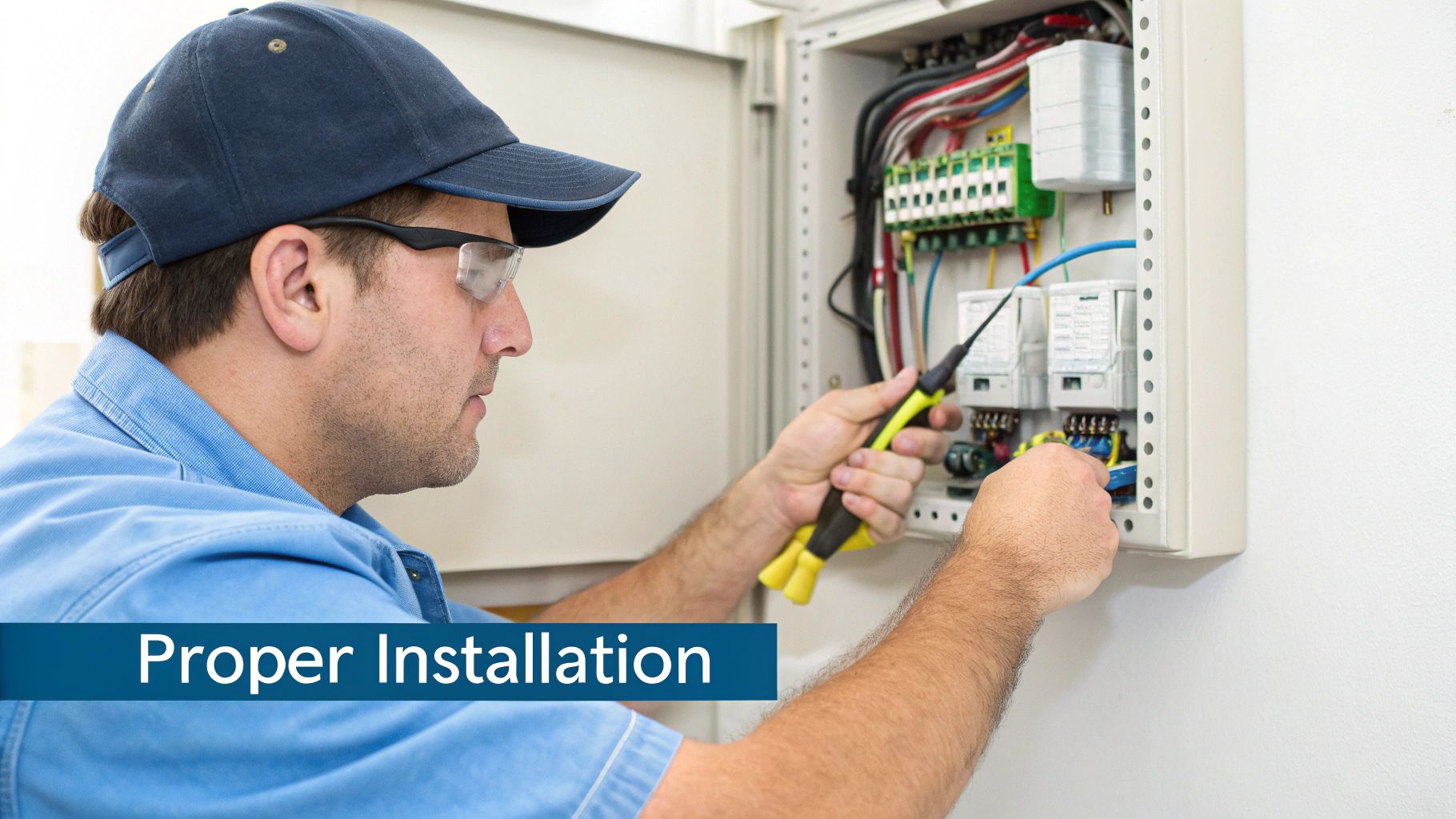
Choosing the right arc fault detection device is not a box-ticking exercise; it is a critical decision that directly impacts the safety and reliability of any high-power electrical system. For professionals designing and installing EV charging infrastructure or battery energy storage systems (BESS), this is one of those moments where getting it right from the start is non-negotiable.
Simply grabbing a device off the shelf will not cut it. The first job is to match the AFDD to the specific electrical characteristics of the circuit it is there to protect. This goes way beyond just voltage and current; it means getting under the bonnet of the system’s operational demands.
Core Selection Criteria for AFDDs
When you are specifying an arc fault detection device, several key factors have to be front and centre. Each one is vital for the safety of systems like rapid EV chargers, where the electrical stresses can be immense.
- Current Rating: The AFDD's amperage rating must be a perfect match for the circuit's maximum load. If you undersize it, you will be dealing with constant nuisance tripping. Oversize it and you risk compromising its sensitivity, meaning it might not even detect a genuine arc fault.
- AC vs DC Suitability: This is arguably the most critical distinction. AC AFDDs are built for standard mains circuits. DC-rated devices, on the other hand, are essential for the circuits you find in combined on-site renewables, battery storage, and the DC side of EV chargers. Using the wrong type gives you a false and dangerous sense of security, as they operate on completely different principles.
- Compatibility with System Components: Inverter-based systems, which are the heart of BESS and distributed energy setups, can produce a fair amount of electrical noise. The AFDD you choose must be compatible with the specific inverter to avoid false alarms, ensuring it can tell the difference between normal operational chatter and a dangerous arc.
Getting this selection process right is fundamental. It is the difference between genuine protection and a constant source of operational headaches.
Installation Best Practices
An AFDD is only as good as its installation. The irony is that poor installation practices, like loose connections, can introduce the very faults the device is designed to detect. Following a meticulous process is therefore essential.
A proper installation starts with ensuring every connection is clean, secure, and torqued to the manufacturer’s precise specifications. A calibrated torque screwdriver is not a luxury here; it is a vital tool. Over-tighten a terminal and you can damage it and the conductor. Under-tighten it and you have just created a high-resistance connection—a textbook cause of arcing.
An improperly torqued terminal on an AFDD installation is the electrical equivalent of leaving the fire escape blocked. It undermines the very safety system you are putting in place, creating a new hazard while trying to mitigate an old one.
Correct wiring configuration is also crucial. The line and neutral conductors must pass through the device in the right way for it to monitor the circuit's electrical signature accurately. Get the wiring wrong and the device might not function at all or could trip the second it is energised. This is especially true in complex setups like ZPN Energy's battery-backed EV charging solutions, where precise integration is key to system stability and safety.
Commissioning and Testing Procedures
Once installed, the AFDD must be properly commissioned and tested. Modern devices come with a self-test button that simulates an arc fault, allowing the installer to verify that the tripping mechanism and internal electronics are working correctly. This should always be the final check before handing the system over.
Knowing how to interpret the device's feedback is another important skill. Many advanced AFDDs have diagnostic LEDs that tell you the reason for the last trip—whether it was an overload, a short circuit, or a genuine arc fault. This helps electricians get to the root of a problem quickly instead of just resetting the device and hoping for the best.
The evolution of these devices in the UK has been driven by a clear need to tackle specific fire risks. The mandatory adoption of AFDDs through 2022 regulations directly targets the 12% of 2017/18 electrical fires that started in distribution systems like wiring and plugs. Amendment 2 to BS 7671:2018 now requires them for socket-outlets 32A and below in high-risk residential buildings, targeting faults caused by poor terminations—a problem that correct installation practice solves. This regulatory backing just underscores how important it is to get both the selection and installation right, every single time.
The Future of Proactive Electrical Safety
Our journey through the world of electrical safety has shown one thing clearly: the arc fault detection device is no longer a niche component but a cornerstone of modern electrical protection. We've moved from understanding the hidden, slow-burn threat of an arc fault to seeing the practical solution that neutralises it before a fire can even begin. This technology is fundamental to safeguarding today's powerful electrical systems.
The future of this protection lies in smarter integration. We are moving towards a reality where an arc fault detection device does more than just trip a circuit. Soon, these devices will be fully integrated with smart building management systems, providing real-time data and predictive maintenance alerts directly to facility managers.
Towards Predictive Maintenance
Imagine a system that does not just react to a fault but warns you about a weakening connection weeks in advance. This is the next logical step for AFDD technology. By analysing subtle changes in a circuit's electrical signature over time, future systems will be able to identify degrading components long before they become critical failures.
This proactive approach offers huge benefits for real-world applications like:
- Rapid EV Charging Hubs: Preventing downtime by flagging potential issues in high-use chargers before they fail.
- Grid-Scale Batteries: Ensuring the long-term reliability and safety of incredibly high-value energy assets.
- Distributed Energy Sites: Maintaining stability in complex systems that combine on-site renewables, EV charging and battery storage.
The ultimate takeaway is simple: investing in an arc fault detection device is a proactive decision. It provides an essential level of fire protection, safeguarding not just high-value assets but, more importantly, human lives in our increasingly electrified world.
Frequently Asked Questions About AFDDs
It is natural to have questions when a new piece of safety technology comes along. To help clear things up, here are answers to the most common queries about arc fault detection devices, especially when they are used in high-power systems like EV charging and battery storage.
Are AFDDs Mandatory for All New UK Installations?
No, they are not required for every single new installation. The key thing to know is that BS 7671 Amendment 2 now mandates them on single-phase AC final circuits supplying socket-outlets (up to 32A ) in certain high-risk locations.
These high-risk properties include:
- Higher-Risk Residential Buildings (HRRBs)
- Houses in Multiple Occupation (HMOs)
- Purpose-built student accommodation
- Care homes
Even where it is not a legal requirement, an arc fault detection device is fast becoming best practice. It makes a lot of sense for any circuit where a fire would be particularly disastrous, like those powering rapid EV charging hubs, mobile EV charging units, or grid-scale battery systems.
Does an AFDD Replace My Existing RCD or MCB?
Absolutely not. An AFDD works with your RCDs and MCBs, adding another, very specific, layer of protection. Think of them as a team of specialists; each one is looking for a completely different kind of danger.
- An MCB is your bodyguard against overloads and short circuits.
- An RCD is there to prevent electric shock from earth faults.
- An AFDD is the firefighter, looking for the electrical arcs that can ignite a blaze.
Each device is essentially blind to the hazards the others are designed to catch. To be properly protected against the main electrical dangers, you really need all three working together.
Why Are DC Arcs a Big Risk for Batteries and Renewables?
DC arcs, which are the type you get in battery storage and combined on-site renewables like solar, are particularly nasty because they are self-sustaining. An AC current naturally flips direction and passes through zero volts 100 times a second, which often helps to extinguish an arc on its own.
DC current is a completely different beast. It provides a constant, relentless flow of energy. Once a DC arc strikes, it becomes a continuous plasma jet that simply will not stop until the power is manually cut off. This makes it far more destructive and much harder to control than an AC arc.
What Causes an AFDD to Trip Unnecessarily?
Nuisance tripping was definitely a headache with the early models but it is much less of an issue now with modern, well-engineered devices. When it does happen, the root cause is usually down to the installation itself or specific types of connected equipment.
The most common culprits are poor wiring terminations or loose connections, which can create electrical noise that tricks the device into thinking it sees a real arc. The simplest fix is prevention: ensuring a qualified installer correctly torques every terminal. Modern AFDDs have also got a lot smarter, using advanced algorithms to tell the difference between a harmless, normal spark (like a motor starting up) and a genuinely hazardous arc fault.
For today's complex distributed energy systems, integrating advanced protective devices is not just a good idea—it is essential. ZPN Energy specialises in designing and deploying battery-backed EV charging and energy storage solutions where safety and reliability are non-negotiable. Discover how our innovative approach can safeguard your high-value energy assets by visiting us at https://www.zpnenergy.com.