Unlocking limited grid connections: Rapid EV charging for UK sites
For any UK business looking to get into rapid EV charging, there’s a familiar, frustrating reality: the national grid often just can’t keep up. The single biggest hurdle we see holding back high-power charger deployments is the limited grid connection . This one issue creates project delays that can drag on for years and spark upgrade costs that easily run into six figures.
It's a problem that forces far too many great sites to give up on their EV plans before they've even really started.
The Grid Connection Problem Holding Back EV Charging
The push to electrify transport has put an incredible strain on the UK's electrical infrastructure. Let's be honest, much of it was designed decades ago for a completely different world. The sudden surge in demand for chunky, high-power connections—for rapid EV charging, grid-scale batteries and on-site renewables—has created a massive bottleneck.
This isn't just a minor headache; it's a fundamental barrier to progress. Many commercial and industrial sites simply don't have the spare capacity needed to support the 150kW+ chargers that modern EV drivers expect. The moment you apply for a grid upgrade, the true scale of the challenge often becomes painfully clear.
The Real-World Consequences of a Constrained Grid
When you discover your site has a weak grid connection, you’ll likely run into a few major roadblocks:
- Eye-Watering Costs: The price tag for upgrading a local substation or laying new cables can be staggering—we’re talking hundreds of thousands of pounds. This alone makes many otherwise brilliant projects financially impossible from day one.
- Painfully Long Timelines: The queue for grid upgrades is incredibly long. It’s not unusual for businesses to be quoted timelines of several years before the DNO can even start the work.
- Projects Getting Scrapped: Faced with sky-high costs and indefinite delays, many organisations are left with no choice but to shelve or completely abandon their EV charging ambitions.
The scale of this issue is enormous. In the UK, limited grid connections have created a gigantic backlog. Renewables make up 378GW (43%) of the queue while energy storage constitutes another 268GW (33%) . This overwhelming demand, highlighted in the latest data from the Energy Networks Association, shows just how squeezed our existing grid really is.
But here’s the thing: instead of seeing this as a dead end, we need to view it as an opportunity to think differently. The solution isn’t waiting for the grid to catch up. It’s about bypassing its limitations with intelligent, on-site energy systems.
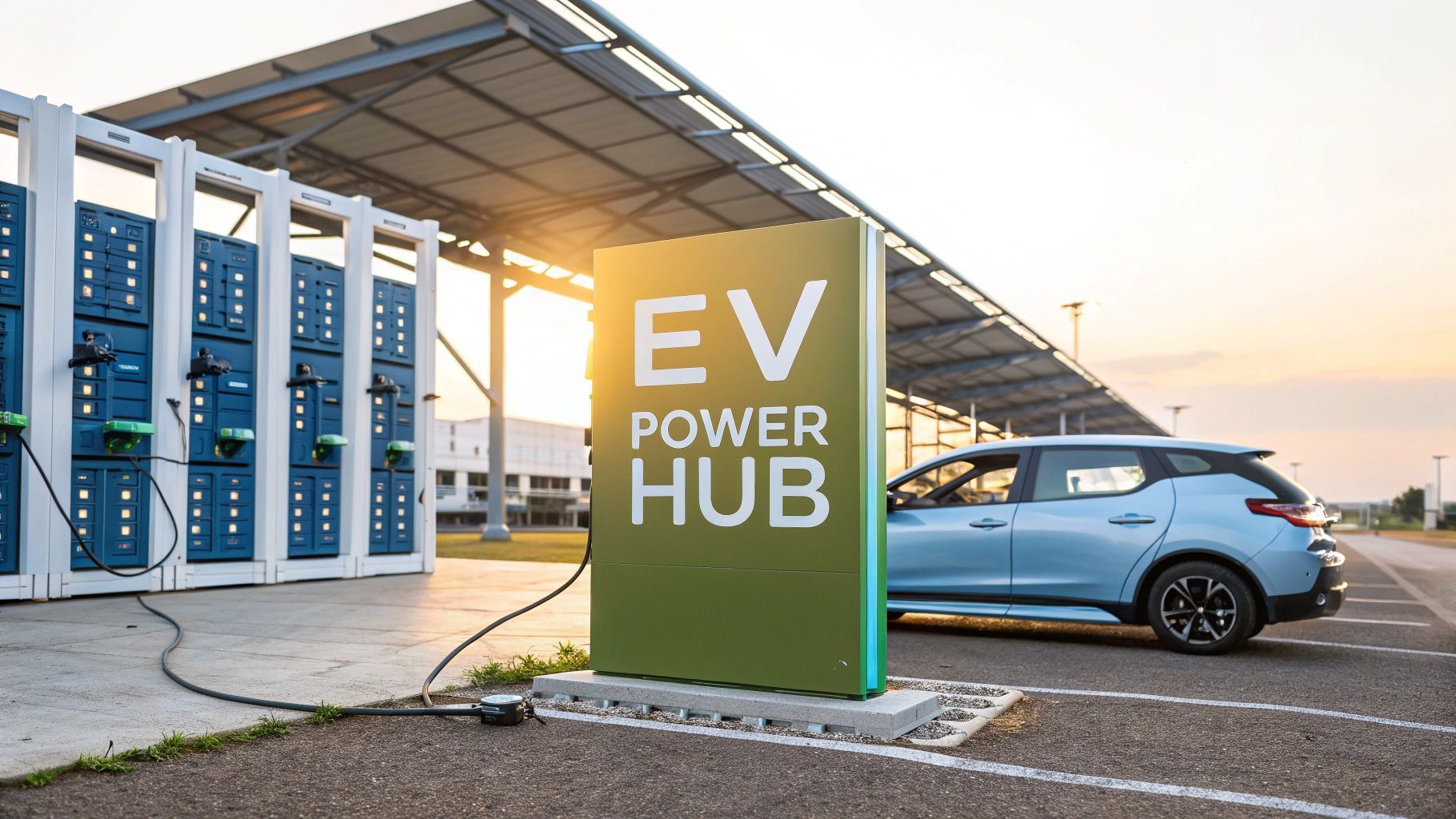
By using innovative approaches like integrating Battery Energy Storage Systems (BESS) with combined on-site renewables (think solar panels), you can create a self-sufficient charging hub. These systems can trickle-charge from even a weak grid connection during cheap, off-peak hours, storing that energy to unleash powerful, rapid charging whenever it’s needed.
This clever strategy turns a grid-constrained site into a profitable, future-proof asset. We've seen it work time and again, including in challenging projects like the Electric Seaway, which successfully overcame marine limited grid connections.
This guide will walk you through exactly how to do it.
How to Properly Assess Your Site's Energy Potential
Before a single charger is installed or a battery ordered, every successful project begins with a solid site assessment. I've seen it time and again: jumping ahead without this crucial groundwork is a recipe for unforeseen costs and delays. A proper evaluation of your site's true potential, especially when you're dealing with a limited grid connection, gives you the essential data to design a system that works in the real world and makes commercial sense.
This process is about more than just glancing at your latest electricity bill. It involves a deep dive into your existing infrastructure, understanding your real-world energy consumption patterns and forecasting future demand with a healthy dose of realism. Only then can you build a powerful business case.
Measuring Your Existing Grid Capacity
First things first, you need a clear, data-driven picture of your current grid connection. This means looking past the headline number on your supply agreement to understand what capacity is genuinely available for new loads like rapid EV charging.
You need to establish your Maximum Import Capacity (MIC) —the absolute upper limit of power you can draw from the grid. However, the figure that really matters is your actual peak demand. By installing temporary metering equipment for a few weeks, you can capture a precise profile of your site's energy usage, day and night.
This data reveals the critical insights you need:
- True Peak Load: What’s the highest amount of power your site currently uses and when does it happen?
- Baseload: What is the minimum level of continuous power draw, typically overnight?
- Available Headroom: The difference between your MIC and your true peak load is your available capacity. This is the space you have to play with for EV charging before needing a costly grid upgrade.
Analysing Usage Patterns and Forecasting Demand
With your current energy profile mapped out, the next step is to analyse these patterns and look ahead. A static snapshot just won't cut it; you need to understand the rhythm of your site's energy consumption. Is your demand spiky with sharp peaks or is it relatively flat? Are there big differences between weekdays and weekends or between seasons?
This analysis is absolutely vital for sizing your battery energy storage system (BESS) correctly. For instance, a site with high daytime peaks and low overnight demand is a perfect candidate for 'peak shaving'. The BESS can trickle-charge using cheap off-peak electricity overnight and then discharge that stored energy to power the chargers during the day. This flattens your demand profile and helps you swerve those painful network charges.
Forecasting future demand means asking some direct questions about who you're serving:
- Who are you charging for? Is it a private fleet of commercial vans returning to base overnight or the general public needing a rapid top-up during the day?
- What vehicles will be charging? The power needed for a fleet of electric HGVs is a world away from what you’d need for employee cars.
- What are your growth ambitions? You should be planning for the charging demand you expect in three to five years, not just for what you need today.
A common mistake I see is underestimating future demand. Believe me, it is far more cost-effective to design a scalable system from the outset than to try and bolt on a larger battery or more chargers later on.
Engaging Your Distribution Network Operator Early
Finally, and this is a step many people overlook to their detriment, you must engage with your Distribution Network Operator (DNO) as early as possible. Your DNO manages the local electricity network and any application for a new or upgraded connection has to go through them. Don't wait until your plans are set in stone to have this conversation.
An early, informal discussion can provide invaluable intelligence about the local network's health. You can learn about any known constraints, planned upgrades in the area or potential alternative connection points. This simple dialogue transforms the DNO from a potential obstacle into a collaborative partner, helping you understand the real-world constraints and opportunities long before you commit any serious capital.
Architecting Your Battery-Assisted Charging System
When your grid connection just can't keep up, a Battery Energy Storage System (BESS) becomes the technical heart of your EV charging project. Think of it as an energy reservoir, effectively decoupling your rapid chargers from the direct constraints of a weak grid. This setup is what allows you to deliver high-power charging even when your connection can only provide a trickle of energy in real-time.
The core principle is simple but incredibly powerful. Instead of trying to pull a massive 150kW or more directly from the grid every time a car plugs in—which is often impossible—the system uses a much smaller, consistent draw. This gentle 'trickle charge' tops up the BESS over several hours, often overnight when electricity is cheapest.
When a driver needs a rapid charge, the system unleashes the stored energy directly from the battery, not the grid.
Choosing Your System Configuration
How you connect your battery, chargers and any on-site renewables has a big impact on both efficiency and cost. The two main approaches are AC-coupled and DC-coupled systems. Choosing the right one really depends on your site's specific needs and what you're working with.
An AC-coupled system is often the go-to for retrofitting existing infrastructure. In this setup, different components (like solar panels, batteries and EV chargers) all connect to the main AC electrical panel. It's a versatile approach but it does involve multiple energy conversions from DC to AC and back again, which can lead to minor efficiency losses along the way.
A DC-coupled system , on the other hand, is generally more efficient. Here, components like solar panels and the battery are connected on the DC side of the system before the inverter. This minimises energy conversion losses, making it an excellent choice for new-build sites where you can design the entire energy ecosystem from the ground up for maximum performance.
This flowchart gives a simple overview of how to approach the initial site assessment.
As you can see, a successful project is always built on a foundation of solid data—measuring what you have, analysing what you need and forecasting future demand.
Mastering Peak Shaving and Load Shifting
The real financial magic of a BESS lies in a strategy called peak shaving . This is simply the process of using stored battery power to handle moments of high electricity demand, letting you avoid the expensive peak charges levied by your energy supplier.
Instead of your site's demand profile showing a huge, costly spike when multiple EVs start charging, the BESS smooths it all out. As far as your grid connection is concerned, it only sees a low, steady draw as the battery quietly recharges itself.
Peak shaving does more than just lower your electricity bills. It fundamentally changes your relationship with the grid, turning a major operational constraint into a manageable, predictable cost.
This strategy is often combined with load shifting . You can programme the BESS to charge during specific off-peak windows—usually overnight when tariffs are at their lowest. The system then stores this cheap energy for deployment during peak hours. This means you can sell electricity to drivers at a premium while your own input costs remain rock-bottom.
You can learn more about the specifics of how battery-backed EV charging works and its advantages in overcoming these all-too-common grid limitations.
Integrating Renewables for True Energy Independence
Things get really interesting when you combine your BESS with combined on-site renewables, like a solar PV array. This creates a powerful, self-reliant energy ecosystem and turns your charging hub into a proper piece of distributed energy infrastructure.
During sunny periods, the solar panels can simultaneously power the EV chargers and top up the battery. Any excess solar generation that might otherwise be exported back to the grid for a pittance is instead stored in your BESS for later use.
This synergy offers several massive benefits:
- Reduced Operational Costs: Using free solar energy drastically cuts your reliance on grid electricity, directly lowering your running costs and improving your ROI.
- Enhanced Resilience: If there's a local power outage, a properly configured system can use the stored solar energy to keep your chargers operational—a huge competitive advantage.
- Improved Green Credentials: Powering EVs with on-site renewable generation sends a powerful message about your commitment to genuine sustainability, not just ticking a box.
By architecting your system this way, you move beyond simply solving a grid connection problem. You create a sophisticated microgrid that is cheaper to run, more resilient and ultimately better for the environment.
Using Smart Energy Management to Maximise Performance
The physical hardware—the chargers and the batteries—is only half the story. To truly overcome the challenge of limited grid connections and create a profitable charging hub, you need an intelligent software layer to orchestrate everything.
This is the crucial role of a modern Energy Management System (EMS). Think of it as the brain that transforms individual components into a coordinated, high-performance operation.
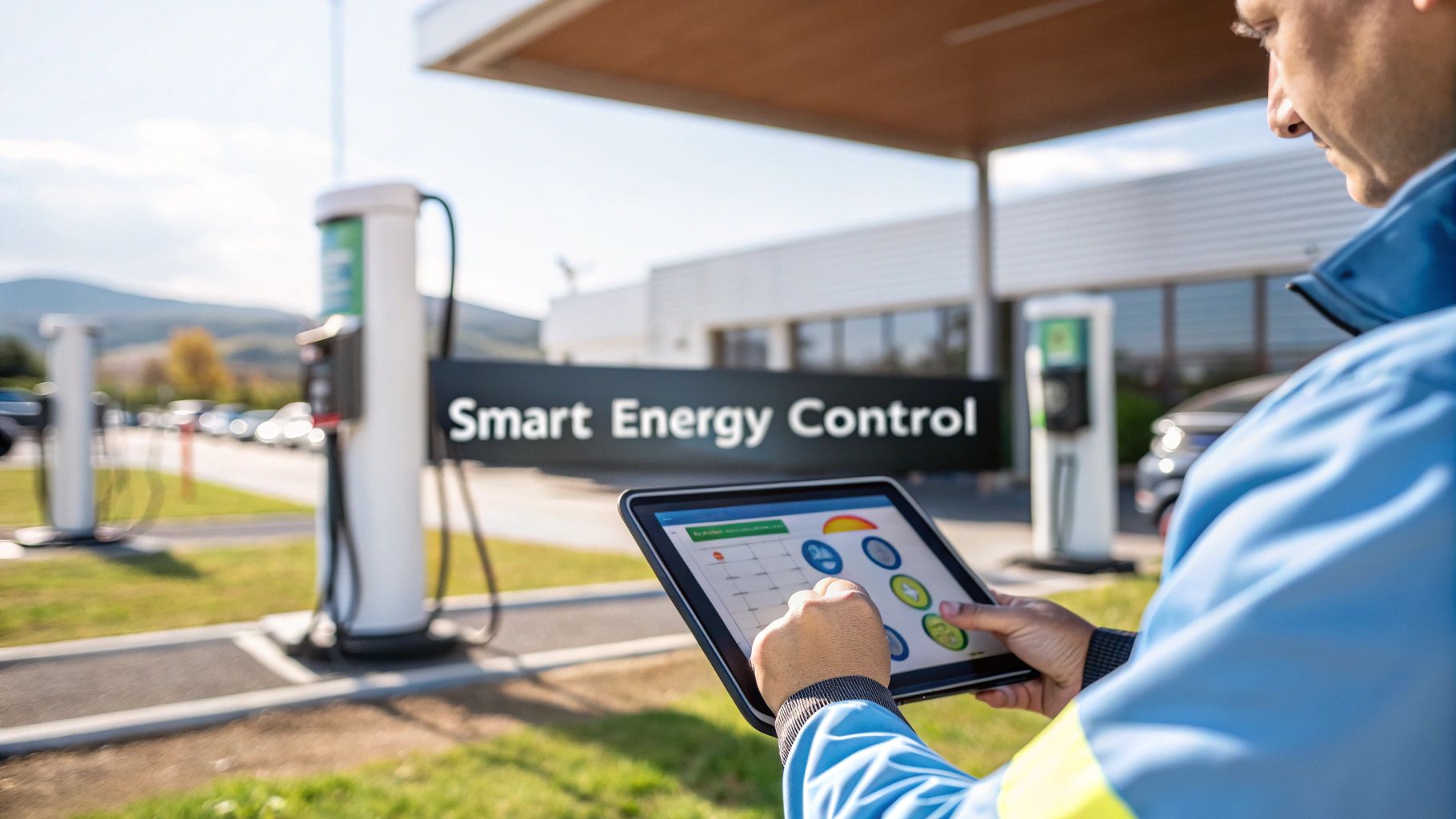
Without this smart control, you're left with a collection of powerful but uncoordinated assets. The EMS ensures that every kilowatt of available energy—whether from the weak grid connection, the on-site battery or your solar panels—is used in the most efficient and cost-effective way possible. It’s constantly making real-time decisions to balance supply and demand.
This intelligent oversight is what makes delivering consistent rapid EV charging from a constrained grid feed not just possible but also profitable.
Intelligent Control with Dynamic Load Balancing
One of the most powerful tools in an EMS is dynamic load balancing . This is an advanced control strategy that moves far beyond simple on/off commands. It continuously monitors the entire energy ecosystem on site, making tiny, constant adjustments to maintain perfect equilibrium.
Imagine a busy forecourt with several vehicles plugged in. The EMS is assessing multiple factors in real-time:
- Grid Availability: How much power is currently being drawn from the limited grid connection?
- Battery State of Charge: What is the energy level in the grid-scale batteries?
- Renewable Generation: How much power is being produced by on-site solar at this moment?
- Vehicle Demand: What is the state of charge and requested power for each connected EV?
Based on this live data, the system intelligently distributes the available power. If the battery is full and the sun is shining, it can deliver maximum charging speeds across all units. But if the battery is depleting and grid power is expensive, it might slightly reduce the output to certain vehicles to ensure the entire site remains stable and operational without exceeding its grid limit. This is what prevents tripping breakers and guarantees a reliable service for every customer.
For an in-depth look at these control strategies, you might find it useful to check out our guide to dynamic power management for EV charging.
Building Resilience with Distributed Energy and Ring Topology
A battery-backed charging hub is a perfect example of a distributed energy resource. Instead of relying on a single, distant power station, you’ve essentially created your own localised microgrid. This setup offers tremendous resilience but its true potential is unlocked with an advanced network design like a 'ring topology'.
In a traditional 'hub and spoke' model, each charger has a single point of failure. If its connection to the central power source goes down, that charger is offline. A ring topology, however, creates a much more robust and fault-tolerant network.
In a ring topology, each charger and battery unit is connected to its neighbours, forming a continuous loop. If one connection in the ring fails, power can be rerouted the other way around the loop, ensuring every charger stays online.
This approach, unique to ZPN Energy systems, guarantees exceptional uptime and service continuity. It means a single cable fault won't take your entire charging operation offline, protecting your revenue and reputation.
The Power of Coordinated Systems
Ultimately, the goal is to get all your assets working together. A sophisticated EMS allows you to integrate various elements into a single, optimised system that maximises performance and profitability.
Here’s how these pieces fit together to support rapid EV charging from constrained grid connections:
- Mobile EV Charging: The EMS can coordinate mobile charging units, treating them as flexible extensions of your fixed BESS and deploying them to manage peak demand or serve temporary locations.
- EV charging and batteries: The system seamlessly manages the flow of energy between the grid, the battery and the chargers, executing peak-shaving and load-shifting strategies automatically.
- Combined on-site renewables: It prioritises the use of free solar energy, directing it to either charge vehicles directly or store it in the battery for later use, dramatically reducing your operational costs.
This layer of intelligent software management is what makes the entire system commercially viable. It ensures you extract the maximum value from your hardware investment, turning a site with a limited grid connection into a resilient and highly profitable charging destination.
Calculating Your Project's True Return on Investment
Putting in an EV charging hub, especially one that includes a battery energy storage system (BESS), is a serious investment. To build a solid business case, you have to look past the headline figures and understand the complete financial picture. Calculating the real return on investment (ROI) isn't just about guessing charging revenue; it means taking a clear-eyed look at all your capital and running costs and weighing them against the powerful new revenue streams you can unlock by sidestepping a weak grid connection.
When you lay it all out in a transparent financial model, you quickly see that the upfront cost for hardware and installation is often dwarfed by the long-term savings and new income opportunities. The biggest financial win, by a huge margin, is the massive avoided cost of a grid upgrade . That one factor can completely change the economics of a project, turning what was a non-starter into a very profitable venture.
Breaking Down the Complete Project Costs
To get your ROI forecast right, you first have to account for every bit of capital expenditure. And it’s not just about the chargers. A proper budget for a battery-assisted system has several moving parts.
- Hardware Costs: This is your biggest initial outlay. It covers the rapid EV chargers, the grid-scale batteries (BESS), any renewables you’re adding like solar panels and the switchgear needed to pull it all together.
- Software and Management Systems: The Energy Management System (EMS) is the brain of the operation. It’s a critical, value-adding component that comes with its own cost.
- Installation and Commissioning: This bucket includes all the civil works, cabling, grid connection fees and the specialist teams needed to get the system commissioned safely and running efficiently.
- Ongoing Maintenance: It’s smart to factor in a service and maintenance contract from the start. This protects your investment for the long haul, ensuring the system stays reliable and performs at its peak.
Don’t forget the administrative costs, either. Navigating UK regulations and securing grid connection agreements involves fees and professional time. Budgeting for these hurdles realistically from day one will save you from any nasty financial surprises later on.
Factoring in Every Revenue Stream
Once you’ve got the costs nailed down, it’s time to project your income. A battery-backed charging hub on a constrained connection opens up several distinct revenue streams and each one helps you reach ROI faster.
The most obvious is direct charging revenue . By offering reliable, rapid charging, you generate income from every kilowatt-hour you sell to drivers. Simple enough.
But the real financial genius of this setup comes from its flexibility. By avoiding a six-figure grid upgrade, you are effectively banking a colossal amount of capital that would otherwise be sunk into the network operator's assets. This ‘avoided cost’ is a huge piece of your ROI calculation.
The ability to bypass multi-year delays for grid upgrades is a massive commercial advantage. While competitors are stuck in a queue, your site is operational and generating revenue. This speed-to-market is a critical, though often overlooked, financial benefit.
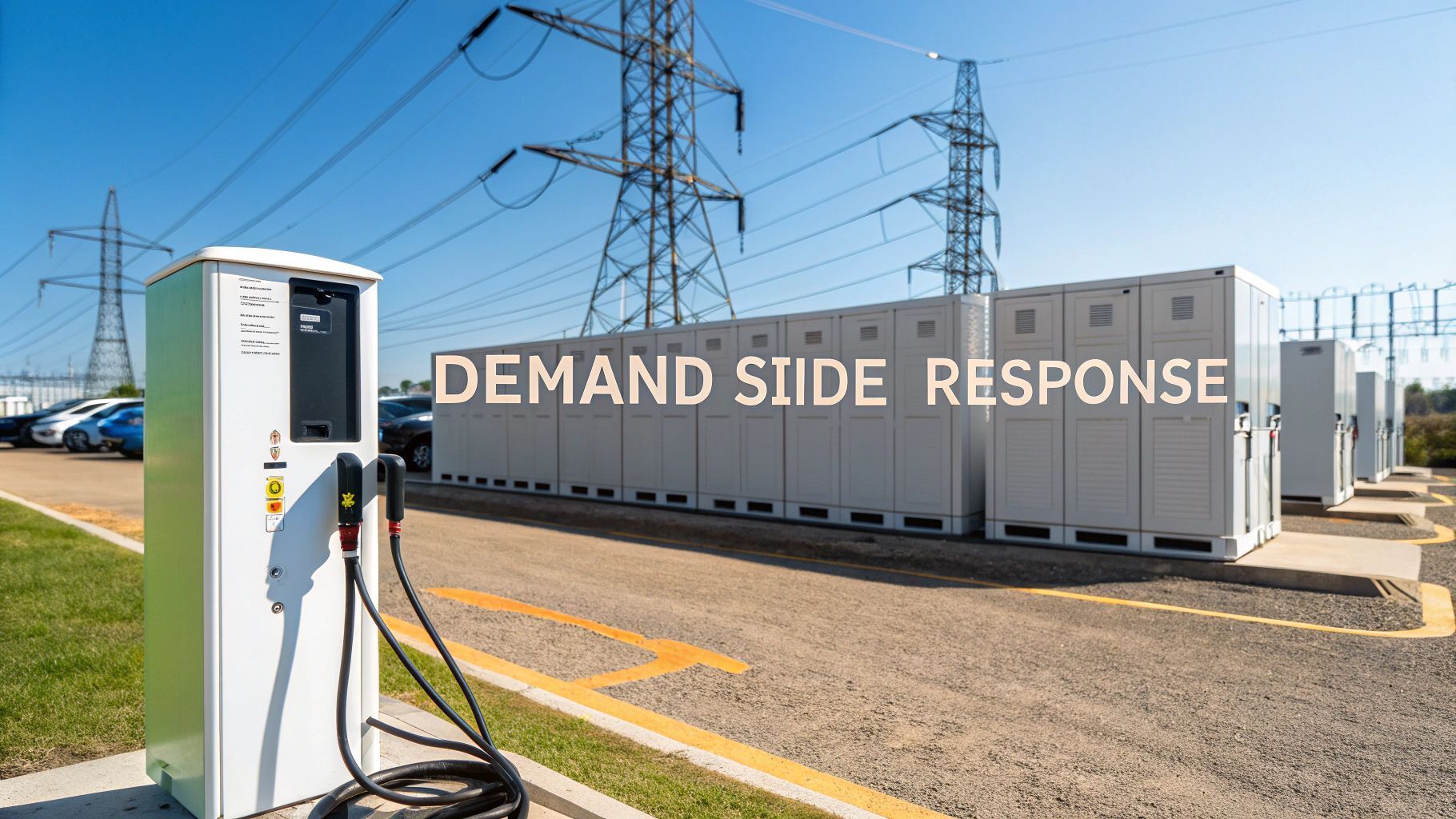
On top of that, a BESS opens the door to earning money from valuable grid balancing services . You can join schemes that pay you to help stabilise the national grid, either by soaking up excess energy or pushing power back when demand is high. This turns your charging hub from a simple service point into an active, revenue-generating asset for the entire energy network.
A Real-World ROI Calculation
Let's look at a practical example. A retail park wants to install four 150kW rapid chargers but their grid connection is maxed out. They get a quote from the DNO for a grid upgrade: £500,000 with a two-year wait time.
Instead, they go for a BESS-backed solution. Yes, the total project cost is higher than it would be for grid-tied chargers alone but it's significantly less than paying for that grid upgrade. By charging the batteries overnight on a cheap tariff and selling that power to drivers during the day—plus avoiding that £500,000 bill—the project’s ROI becomes incredibly compelling. The payback period is slashed and the site starts earning from day one, not two years down the line.
This isn't an isolated problem. The UK's electricity distribution networks are facing acute limitations that are holding back nearly 1,000 large-scale energy projects. Connection delays caused by capacity shortages are severely hampering growth in low-carbon sectors like EV charging. You can explore a wealth of data on these network limitations and see for yourself how they are holding back progress across the country.
Your Essential Procurement and Installation Checklist
Moving from a detailed plan to a fully operational charging site is where the rubber really meets the road. This isn't just about buying kit; it's about careful management of procurement and installation to avoid the common slip-ups when deploying rapid EV charging on a weak grid connection.
Think of this as your roadmap from strategy to a live, working site.
The first move is always to pick the right technology partners. You need more than just a hardware supplier. You need a team with proven, hands-on experience delivering complex, battery-backed charging projects from start to finish. I'd always recommend looking for a UK-based company that actually designs and manufactures its own systems—it means you get much deeper technical knowledge and far better long-term support.
To make sure you're evaluating potential suppliers on a level playing field, using a comprehensive RFP checklist can be a game-changer. It forces a proper like-for-like comparison.
Specifying and Procuring Your Hardware
Once you have a partner lined up, the focus shifts to getting the hardware specification spot on. This goes way beyond just looking at a charger's kilowatt rating.
- Battery Energy Storage System (BESS): The capacity (kWh) and power output (kW) of your battery have to be perfectly matched to your site's load profile and what you want to achieve. Undersizing the BESS is a classic, costly mistake that will absolutely cripple your site's performance when demand gets heavy.
- Rapid EV Chargers: Look for chargers built for the grind of high-throughput commercial use. Features like integrated, theft-resistant recoiling cables and full compliance with accessibility standards like PAS 1899 aren't just nice extras; they are vital for a safe, reliable and user-friendly experience.
- Energy Management System (EMS): This is the brains of the entire operation. You need to ensure it can handle advanced features like dynamic load balancing, integrates cleanly with any on-site renewables you have and is built on open standards like OCPP 2.0.1 to keep your options open for the future.
Navigating Installation and Commissioning
With your hardware on its way, the final phase is the physical installation and, crucially, coordination with your Distribution Network Operator (DNO). Even with a battery-backed system designed to soften the grid impact, you will still need to formalise your connection agreement.
Engaging with your DNO and a qualified installer early is non-negotiable. Clear, upfront communication prevents costly misunderstandings about site requirements, access and commissioning timelines. It's what ensures a smooth handover from a construction site to a live, revenue-generating charging hub.
Your installation partner needs specific, demonstrable experience with both high-power EV chargers and grid-scale batteries. Don't be shy about asking for case studies of similar projects, especially ones involving constrained grid connections. Doing this due diligence is what ensures your investment is installed correctly, safely and is ready to deliver from day one.
A Few Common Questions
We get asked a lot about how to deploy rapid EV charging, especially when the grid connection is less than ideal. Here are some of the most common questions we hear.
How Can I Possibly Offer Rapid Charging With Only a Slow Grid Connection?
This is the classic grid-constraint problem and it's where a Battery Energy Storage System (BESS) completely changes the game. Think of it as decoupling your charging speed from your grid's capacity.
The BESS quietly sips power from your weak grid connection over many hours, often taking advantage of cheap overnight electricity tariffs. When an EV driver plugs in, they get a powerful surge of energy directly from the battery, not the grid. This simple shift in architecture lets you deliver 150kW+ charging speeds while your grid connection only ever feels a small, manageable load.
Is a BESS Just More Expensive Than a Grid Upgrade?
It's a fair question. While a BESS is a significant piece of kit, it's very often a fraction of the cost of the six-figure sums we see quoted for new substations and major cabling work.
But it's not just about the initial outlay. When you factor in the avoided cost of a grid upgrade and the fact you can start earning revenue right away—instead of waiting months or even years for the DNO—the battery-backed route frequently delivers a much faster and more attractive return.
Can I Bring Solar Panels into the Mix with a BESS and EV Chargers?
Absolutely, and you definitely should. Combining on-site renewables like solar PV with a BESS and chargers creates a genuinely powerful, self-sufficient energy system. The solar can charge the batteries and power the chargers directly during sunny periods, which drastically cuts your reliance on grid electricity and slashes your operating costs.
This integrated approach effectively turns your site into a resilient microgrid. You're not just cutting energy bills; you're boosting your green credentials by powering EVs with clean, on-site generation.
Any solar power you don't use immediately gets stored in the battery for later, making sure not a single kilowatt-hour of free energy goes to waste.
Ready to turn your grid-constrained site into a profitable charging hub? ZPN Energy delivers cutting-edge, battery-backed EV charging solutions designed and manufactured right here in the UK. Find out how our patented technology can solve your grid connection headaches by visiting us at https://www.zpnenergy.com.