A Guide to the UK DC Fast Charger
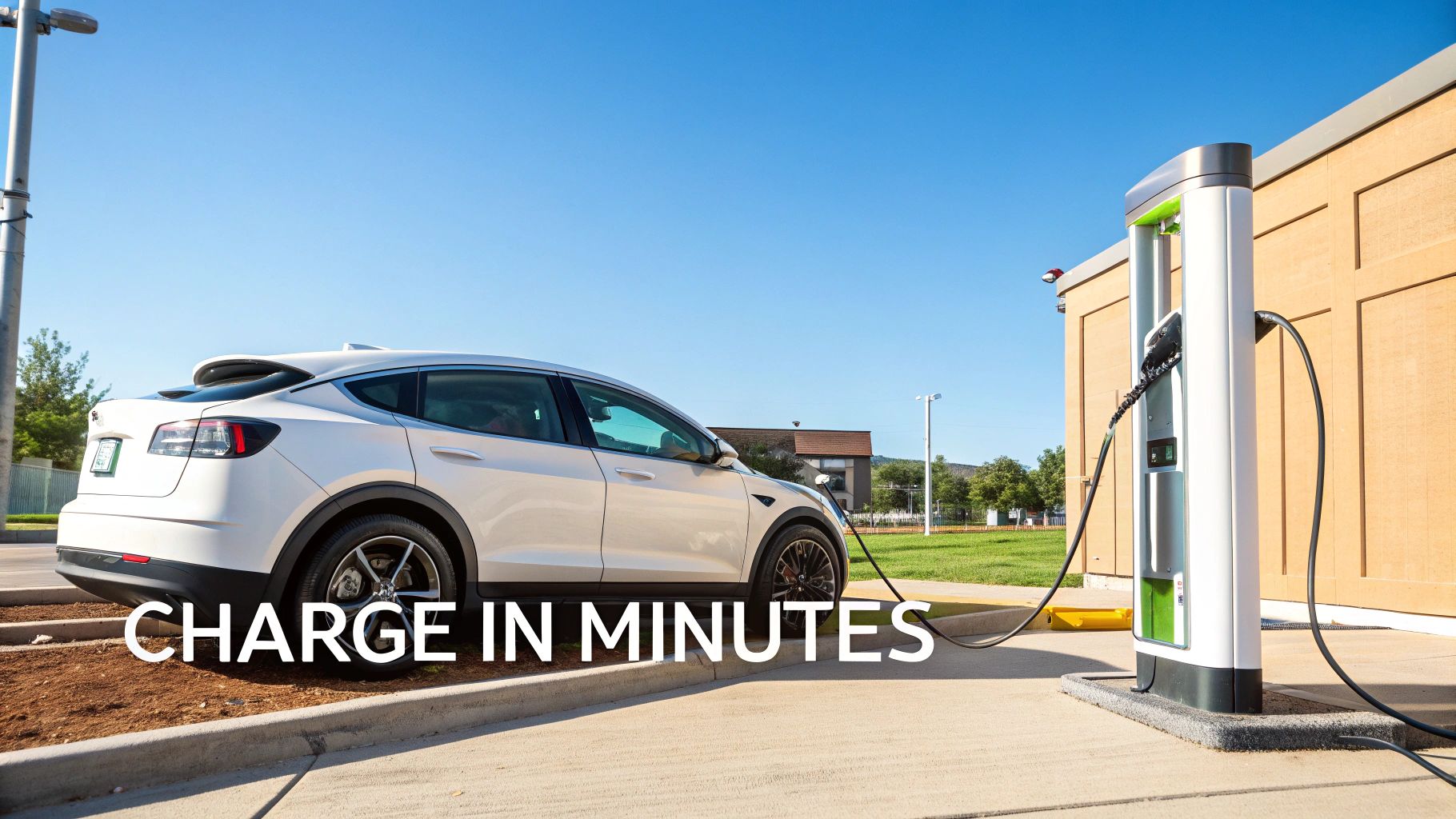
A DC fast charger works by sending powerful Direct Current (DC) straight to an electric vehicle's battery, completely bypassing the car's much slower onboard converter. This direct-to-battery connection is the secret behind rapid EV charging , slashing charging times from hours down to mere minutes. It is what makes long-distance electric travel a genuine reality for UK drivers.
Why DC Fast Charging Is a Game Changer
The shift to electric vehicles is gathering serious momentum across the United Kingdom and it is the convenient, high-speed charging infrastructure that is really fuelling the change. For businesses, fleet managers and commercial property owners, getting to grips with DC fast charging is no longer just a good idea—it is absolutely vital for staying ahead of the curve.
Unlike the slower AC chargers you might have at home, which feed Alternating Current (AC) into the vehicle's own internal converter, a DC fast charger handles all the conversion work externally. This is a crucial difference because it means a much higher volume of power can be delivered directly into the battery system.
Think of it like filling a swimming pool. An AC charger is like using a standard garden hose—it will get the job done but it is going to take a very long time. A DC fast charger, on the other hand, is like hooking up a fire hydrant. The pool fills in a tiny fraction of the time. This raw power is what makes topping up on the go so practical, closely mirroring the quick stop at a traditional petrol station.
The Foundation of Modern EV Networks
The rollout of DC fast chargers across the UK has been dramatic, reflecting the country's commitment to building a robust network for the ever-growing number of EVs. In fact, the UK has installed thousands of ultra-rapid chargers (rated 150 kW or higher), with an incredible 23% increase in just one year. This is not a fluke; it is part of a sustained push, with hundreds of new ultra-rapid chargers joining the public network every single month. If you are interested, you can find out more about the growth of UK charging infrastructure and what these numbers really mean for drivers.
This rapid expansion is unlocking brand-new opportunities for businesses. By installing DC fast chargers on your property, you can:
- Attract high-value customers who drive EVs.
- Support the crucial electrification of commercial and fleet vehicles.
- Create new, reliable revenue streams from charging sessions.
For any commercial operator, a DC fast charger is much more than just another facility; it is a powerful business asset. It enables high vehicle throughput, keeps driver dwell time to a minimum and firmly positions your business at the leading edge of the sustainable transport movement.
But getting this powerful technology on the ground involves a lot more than just buying the hardware. A successful deployment demands a strategic plan that accounts for everything from constrained grid connections and combined on-site renewables to grid-scale batteries and sophisticated distributed energy management. This guide is designed to build your understanding step-by-step, taking you from these core concepts to the advanced strategies you will need for a profitable and future-proof EV charging operation.
Decoding Power Levels and Connector Types
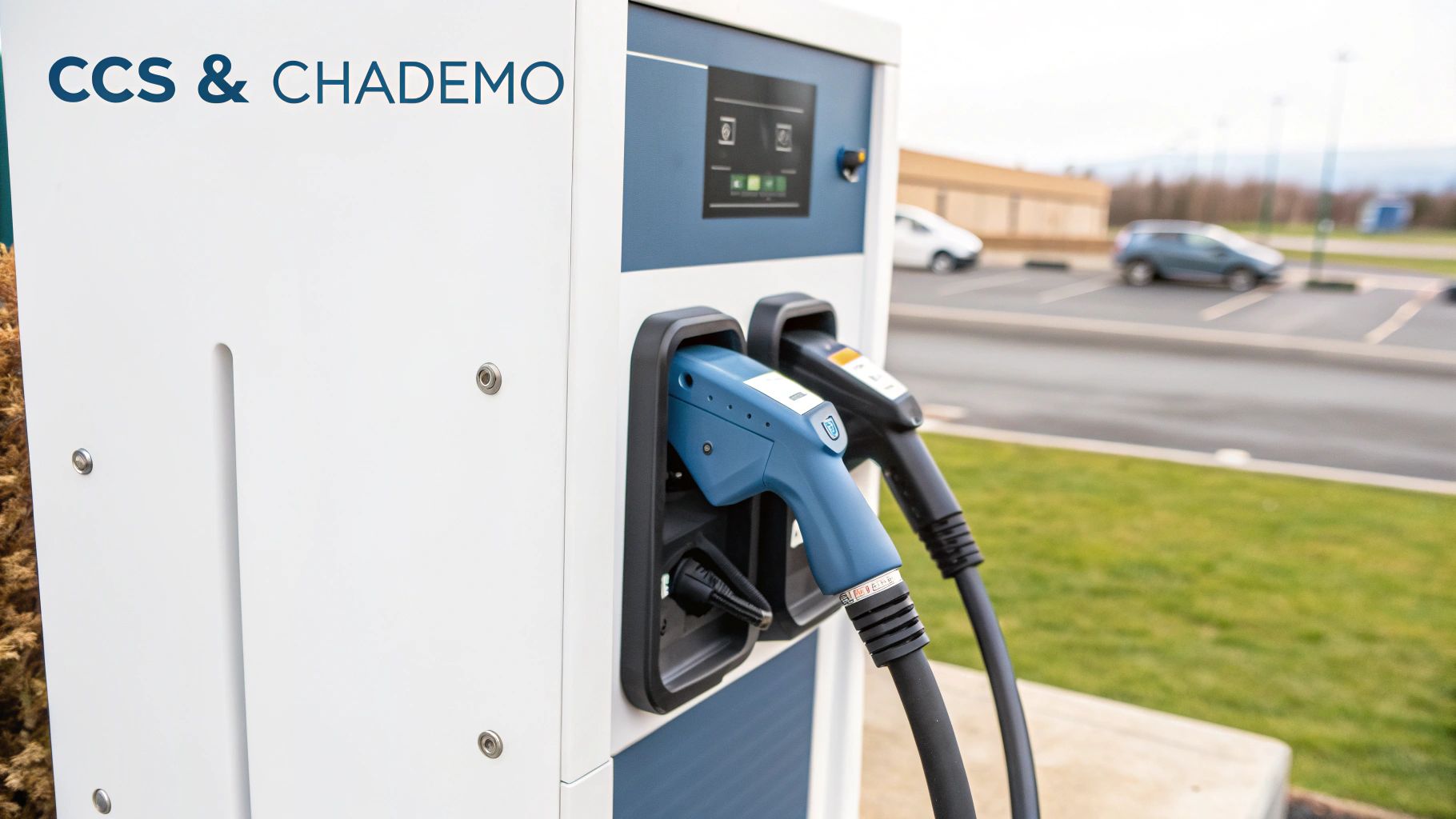
Choosing the right hardware is one of the most fundamental decisions you will make for any commercial EV charging project. The world of rapid EV charging is not a one-size-fits-all affair and getting to grips with the differences in power levels and connector types is essential for making a sound investment. Get it right and you will serve today's drivers perfectly while preparing your site for tomorrow.
The power level of a DC fast charger, measured in kilowatts (kW), is the single biggest factor dictating how quickly it can push energy into a vehicle's battery. This speed directly impacts driver satisfaction, the number of vehicles you can service and ultimately, your revenue. Higher power means faster charging and shorter dwell times, allowing you to serve more customers.
Rapid vs Ultra-Rapid Charging Power
Here in the UK, DC fast chargers generally fall into two main camps based on their power output. Each is best suited to different commercial setups and driver expectations.
-
Rapid Chargers (50kW): Think of these as the reliable workhorses of many public charging networks. A 50kW unit can typically add around 100 miles of range in about 30-40 minutes , making it a perfect fit for places where drivers plan to stick around for a bit, like supermarkets, retail parks or leisure centres.
-
Ultra-Rapid Chargers (150kW+): This is the top tier, with chargers pushing out 150kW , 350kW or even more. They are built for pure speed, capable of adding 100 miles of range in as little as 10-15 minutes . These are non-negotiable for sites focused on quick turnarounds, such as motorway service areas and dedicated charging hubs.
The choice really comes down to your business model. If you run a destination where customers stay for an hour, 50kW chargers might be perfectly adequate. But if you are on a major transport artery, you need to offer ultra-rapid speeds to stay competitive.
To put these speeds into context, here is a quick breakdown of what you can expect from different DC charger power levels.
DC Fast Charger Power Levels and Typical Charging Times
| Power Level (kW) | Charger Type | Approx. Time to Add 100 Miles | Ideal Use Case |
|---|---|---|---|
| 50kW | Rapid | 30–40 minutes | Supermarkets, retail parks, leisure centres, workplaces (longer dwell times). |
| 150kW | Ultra-Rapid | 10–15 minutes | Motorway services, petrol forecourts, dedicated charging hubs (quick stops). |
| 350kW | Ultra-Rapid | <10 minutes | High-traffic transit corridors, fleet depots, future-proofed hub locations. |
As you can see, the power level dramatically changes the driver experience and the type of location where the charger makes sense.
It is also crucial to remember that a vehicle will only charge as fast as its own onboard systems allow.
A car with a maximum charge acceptance rate of 100kW will not charge any faster at a 350kW station. However, installing higher-powered units is a smart way to future-proof your investment as vehicle technology inevitably catches up.
Understanding Connector Standards in the UK
Beyond raw power, the physical plug connecting the charger to the car is just as important. In the UK and Europe, there are two main standards you will come across for DC fast charging. Having the right connectors is vital for compatibility and attracting the widest possible customer base.
-
CCS (Combined Charging System): This is now the undisputed standard for almost every new electric vehicle sold in Europe. It is used by major brands like Volkswagen, BMW, Ford and Hyundai. Frankly, a charger without a CCS connector today is a charger that cannot serve the vast majority of modern EVs on the road.
-
CHAdeMO: This standard was made popular by early Japanese models, most notably the Nissan Leaf. While its use is fading in new vehicles, it is still important for serving the significant number of older EVs that are still in circulation.
To avoid turning away customers, most modern DC fast chargers are equipped with both CCS and CHAdeMO connectors, ensuring maximum compatibility. As the market continues to evolve, the dominance of CCS will only grow, cementing its position as the must-have connector for any new commercial installation in the UK.
For a deeper dive into the technical nuts and bolts, you can explore our comprehensive guide to fast charger electric vehicle technology. It provides much more detail on how these critical systems work together.
Overcoming Grid Constraints with Battery Storage
One of the biggest hurdles in rolling out an ultra-rapid DC fast charger network is not the charger technology itself—it is the grid that has to power it. Many of the best commercial spots, like busy retail parks, rural service stations or city-centre car parks, just do not have the high-capacity electrical connection needed for multiple rapid chargers firing up at once.
In the past, the only fix was a painfully expensive and slow grid upgrade. This meant getting tied up in lengthy negotiations with the local Distribution Network Operator (DNO), digging up roads and facing months of delays. For a lot of businesses, these barriers made installing powerful chargers from constrained grid connections a complete non-starter, leaving prime locations underserved.
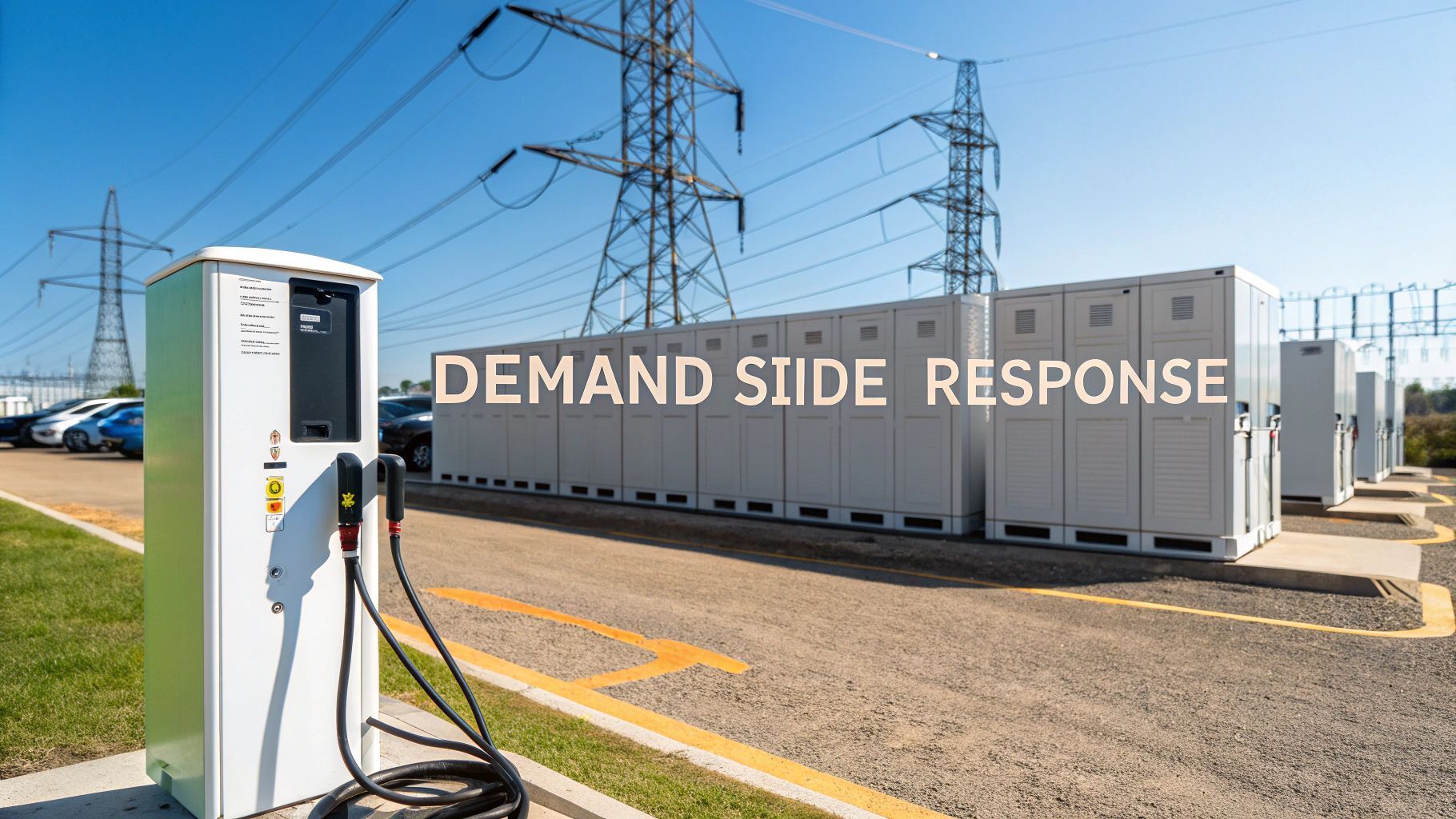
This is where Battery Energy Storage Systems (BESS) or grid-scale batteries completely change the game. A BESS acts as a local energy reservoir, effectively decoupling your charging speeds from the limitations of your grid connection, and also enables mobile EV charging solutions.
How Battery Storage Unlocks Charging Potential
Think of a BESS as a massive buffer tank for electricity. It can be slowly "trickle-charged" from a weak or constrained grid connection, steadily drawing power during off-peak hours when demand is low and electricity is at its cheapest. This slow, steady intake puts minimal stress on the local network.
But when a driver plugs in their EV, the system’s behaviour flips entirely. Instead of yanking a huge surge of power directly from the grid, the DC fast charger draws from the fully charged battery. The BESS can unleash its stored energy at an incredibly high rate, delivering the 150kW or 350kW needed for an ultra-rapid charge, even if the grid connection can only supply a fraction of that.
This clever approach means you can offer the fastest possible charging speeds to your customers without ever overloading the local grid. It transforms previously unsuitable sites into profitable, high-throughput charging hubs.
This technology is becoming more vital by the day as the UK’s charging network scrambles to meet demand. Ultra-rapid chargers are a cornerstone of the national EV strategy, with installations growing by an incredible 23% in a single year.
The Strategic Advantages of Battery-Backed Charging
Integrating a BESS with your DC fast charger installation does more than just solve a grid problem. It unlocks a whole suite of commercial and operational benefits that create a more resilient and profitable business model.
- Avoid Expensive Grid Upgrades: You can sidestep the high costs, complex planning and long lead times that come with DNO-led grid reinforcement projects.
- Reduce Operating Costs: By charging the battery with cheap off-peak energy (like overnight) and using it during peak hours, you can dramatically lower your electricity bills through energy arbitrage.
- Unlock New Revenue Streams: A BESS can provide services back to the National Grid, like frequency response, earning you income just for helping to keep the network stable.
- Maximise Renewable Energy: If you have solar panels on-site, a battery lets you store excess energy and use it for EV charging later, instead of exporting it back to the grid for a low price.
This integrated approach to EV charging and batteries is fundamental to building a sustainable and economically sound charging ecosystem. For anyone interested in the technical nuts and bolts, our detailed guide on battery-backed EV charging provides a much deeper dive.
The idea of using batteries to manage high power loads is already well-established. To get a better handle on the core concepts, it is worth reading this essential guide to home battery backup systems. While it focuses on residential use, it clearly explains the principles of energy storage and resilience that are simply scaled up for commercial applications. By adopting this technology, businesses can confidently deploy the rapid EV charging infrastructure customers are crying out for, wherever it is needed most.
Building a Sustainable Charging Ecosystem
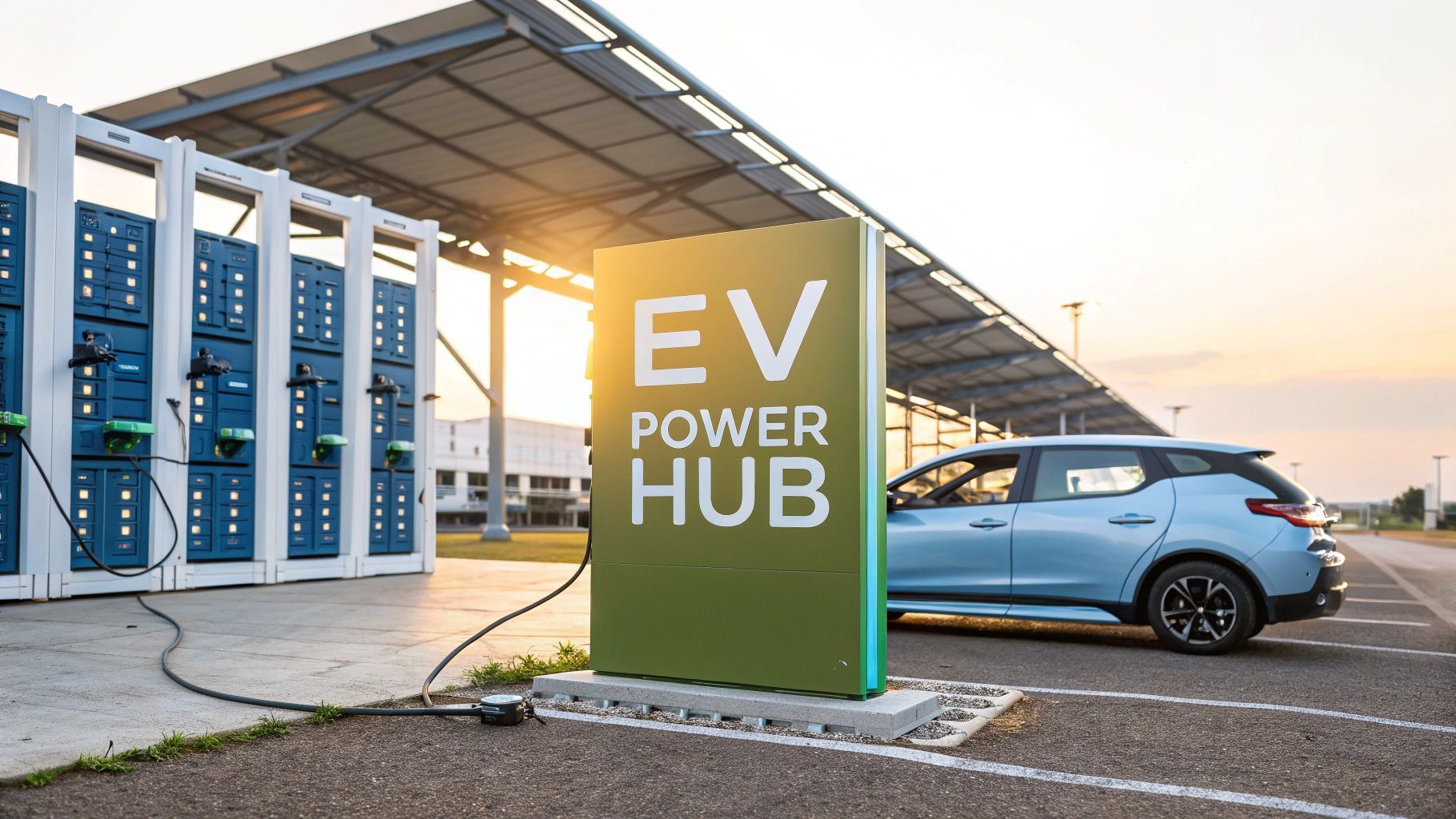
For businesses truly committed to sustainability and predictable energy costs, the ultimate goal is not just to offer EV charging—it is to create a self-sufficient system. This is where combining a DC fast charger with combined on-site renewables like solar panels and battery storage comes in, creating a powerful, independent microgrid right at your location.
This approach completely changes your relationship with the grid. Instead of just being a passive consumer, your site becomes an active player in a distributed energy network, able to generate, store and deploy its own clean power.
Powering Chargers with On-Site Renewables
Picture this: solar panels on your building's roof or covering your car park, capturing clean energy all day. That power can be used to run your operations directly or, far more strategically, to fill up your on-site battery system.
This stored, zero-cost energy can then be released to power your rapid EV charging stations whenever they are needed. This move drastically cuts your reliance on expensive grid electricity, especially during those peak price periods when tariffs go through the roof.
This strategy does not just slash your running costs; it massively boosts your green credentials. For environmentally conscious customers and corporate clients, seeing a charging station powered by on-site renewables is a powerful statement that makes your business stand out.
The diagram below shows exactly how a battery acts as the crucial middleman between a weak grid connection and a high-power DC fast charger.
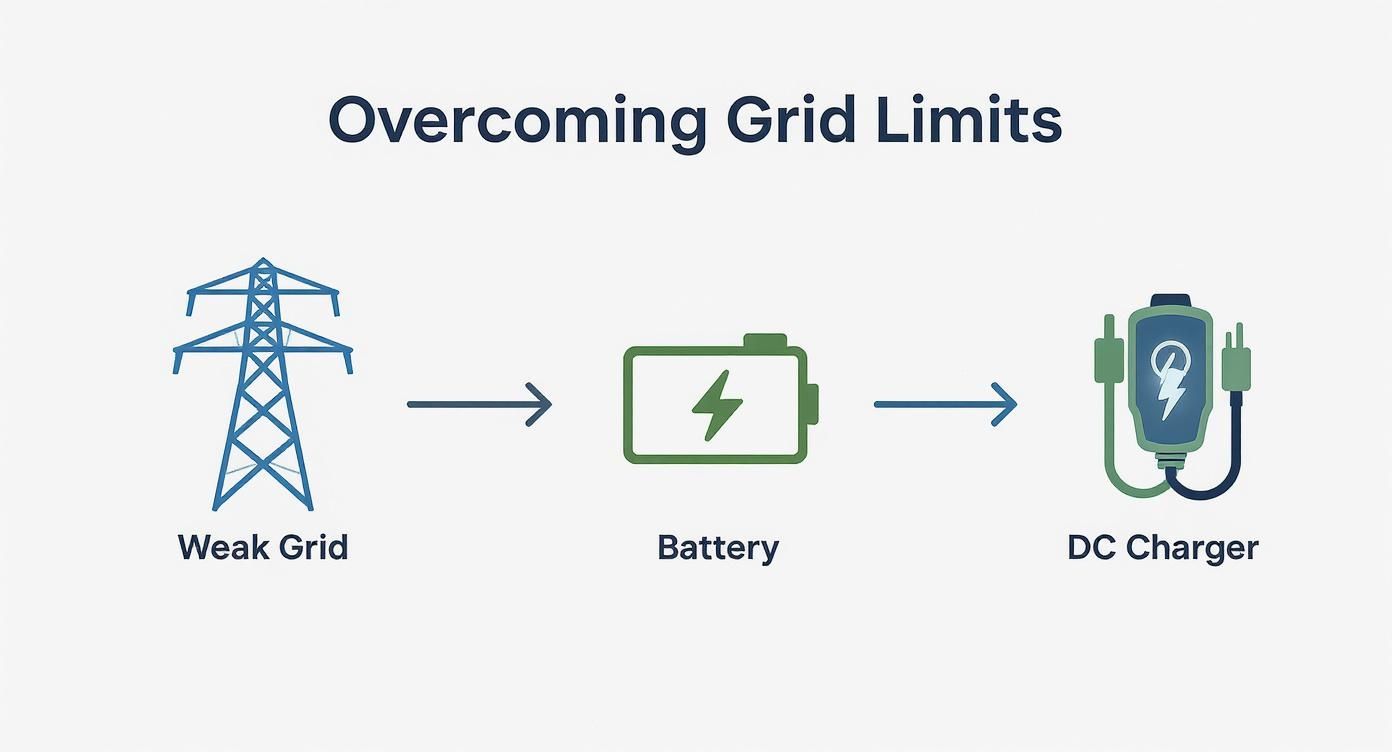
As you can see, even if the grid supply is limited, the battery can gather energy over time and then discharge it at high power. This makes rapid charging possible in places where it would otherwise be a non-starter.
Sizing Your Microgrid System Correctly
Pulling this ecosystem together requires careful planning. Getting the sizing of the components right—the solar array, the battery capacity and the charger's power level—is absolutely vital to maximising both your financial and environmental returns.
Here are the key things you need to think about:
- Anticipated Charging Demand: How many vehicles do you realistically expect each day? What are their typical charging habits and how much energy will they need?
- Solar Generation Potential: Your site's location, the amount of usable roof space and local weather patterns all dictate how much solar energy you can actually generate.
- Grid Connection Capacity: Even with a battery, your existing grid connection sets the speed limit for how quickly you can recharge your storage during times of low solar generation.
- Business Energy Profile: When does your business use the most power? Aligning EV charging with times of high solar generation or low business consumption is the key to efficiency.
A properly sized system ensures you have enough stored energy to meet driver demand without having to constantly dip back into expensive, peak-rate grid power.
Intelligent Energy Management
The brain of this whole operation is an intelligent energy management system (EMS). This is the software platform that makes real-time decisions to optimise the flow of energy, ensuring every single kilowatt-hour is used in the most cost-effective way possible.
A smart EMS will automatically:
- Prioritise Solar: It directs solar energy where it is needed most—whether that is for immediate EV charging, powering your site or storing in the battery for later.
- Charge Strategically: It tells the battery to charge from the grid only when electricity prices are at their absolute lowest, which is usually overnight.
- Discharge for Profit: It releases stored energy to power the DC fast charger during peak times, letting you dodge high grid tariffs and get the most value out of your stored energy.
This combination of EV charging and batteries , fuelled by renewables and steered by smart software, is the future of sustainable transport infrastructure. It is a move beyond just providing a service; it transforms your site into a resilient, profitable and green energy hub. For any business serious about building a future-proof charging network, this integrated approach is essential.
Unlocking Revenue from Your Charging Hub
Installing a DC fast charger is not just about providing an amenity; it is an investment in a new, revenue-generating asset. But to truly maximise your return, you need to think beyond a simple pay-per-charge model. Commercial operators have a whole host of income streams to explore that can turn a charging station into a genuinely profitable hub.
This means getting creative with pricing strategies. You can move from straightforward pay-per-use tariffs to more structured subscription plans, which are often a perfect fit for local businesses with electric fleets or for regular drivers who appreciate predictable costs.
Diversifying Your Income Streams
The most obvious way to make money is, of course, the direct sale of electricity. This model is simple enough to get started with, but it is really just the beginning of what is possible for a modern charging hub.
A truly successful commercial model builds multiple layers of income on top of that basic charging fee. With a bit of creative thinking, you can transform your site from a simple utility into a multi-faceted financial asset.
Here are the main ways you can start generating revenue:
- Pay-Per-Use Charging: This is the bread and butter. Drivers pay for the energy they use (per kilowatt-hour) or the time they spend plugged into the DC fast charger . It is flexible and dead simple for casual users to understand.
- Subscription and Membership Plans: Offer regulars, like local delivery fleets or taxi services, a monthly or annual fee for discounted charging rates. This creates a steady, recurring revenue stream and builds real customer loyalty.
- Overstay Fees: Nobody likes a bay-hogger. Implement penalty fees for vehicles that stay parked after their charging session is complete. This encourages driver turnover, keeps your chargers available and makes sure your asset is constantly working for you.
To make all of this work smoothly, implementing payment gateway integration is absolutely essential. A seamless and reliable payment system is the foundation for a good customer experience and efficient revenue collection.
Advanced Revenue from Grid Services
The most forward-thinking commercial models are the ones that bring integrated battery storage into the picture. When your rapid EV charging site is equipped with a Battery Energy Storage System (BESS), it can do so much more than just serve cars.
Your charging hub can actively participate in grid services , earning revenue directly from the National Grid just by helping to stabilise the network. This is a powerful way to add an entirely new income stream that works completely independently of how many drivers show up.
By engaging in grid services like frequency response, your charging site gets paid to help balance supply and demand on the national electricity network. Your battery can absorb excess power when there is a surplus and inject it back when there is a shortfall, earning you money around the clock.
This completely changes the game. Your site is no longer just a passive energy consumer—it becomes a dynamic, distributed energy asset. You are not just selling electricity to drivers anymore; you are selling stability services to the grid operator. This dual-purpose function dramatically strengthens the business case for your investment.
Maximising Your Return on Investment
When you combine these different revenue streams, you create a robust financial model that truly maximises your return on investment. You are earning from drivers using your DC fast charger , from subscribers and from payments for supporting the grid.
This multi-layered approach provides fantastic financial resilience. Even during quiet periods with lower driver traffic, your site can still be generating significant income by participating in grid services. This makes your charging hub a far more reliable and profitable long-term asset. For a closer look at the numbers, our analysis on how to earn from rapid EV chargers breaks down the financial potential in more detail.
Ultimately, a successful charging hub is one that looks beyond the simple transaction at the plug. By integrating flexible pricing, smart battery technology and grid service participation, you can unlock the full commercial potential of your investment.
A Practical Plan for Your Installation
Bringing a DC fast charger project to life is not just about bolting hardware to the ground. It requires a clear-headed, methodical plan to get you from a good idea to a fully operational charging hub that customers can rely on from day one.
The journey starts with finding the right spot. A great location is more than just an empty car park space; it is a strategic asset. You need high visibility to catch the eye of passing trade, easy access for every kind of EV and ideally, it is close to amenities that give drivers a reason to stop and stay a while.
Site Assessment and Grid Connection
Before a single shovel hits the dirt, you need a frank assessment of your site’s electrical setup. It is vital to understand the capacity of your local grid connection, as this single factor will dictate whether installing a high-powered rapid EV charging system is even feasible.
This means getting in touch with your local Distribution Network Operator (DNO) right at the beginning. This conversation will tell you exactly how much power is available and what, if any, upgrades are needed. For many sites with a constrained grid connection , this is where the conversation pivots to battery energy storage. It is often the key to sidestepping costly and painfully slow grid reinforcement work.
Navigating Permissions and Physical Works
Once you know what your site can handle electrically, the next stage is wading through the necessary permissions. This usually involves a planning application to your local council, where they will look at how your project fits into the local environment.
With planning permission in hand, the physical work can get underway. This is where your plans become reality and it happens in a few key stages:
- Civil Engineering: This covers all the groundwork—preparing concrete bases for the chargers and digging trenches for the crucial power and data cables.
- Hardware Installation: The charger units themselves are put in place and connected up, along with any battery storage systems or switchgear needed to manage the power flow.
- Electrical Commissioning: A qualified electrical engineer will then safely connect everything to the grid, followed by rigorous testing to ensure it all works exactly as it should, safely and efficiently.
A successful installation is one that anticipates challenges. Partnering with someone who truly understands the ins and outs of DNO engagement and planning laws is the best way to keep your project on track and on budget.
Ensuring Long-Term Reliability
The final and arguably most important piece of the puzzle is putting a solid operational and maintenance plan in place. A DC fast charger is a fantastic asset, but only when it is working. For building customer trust and keeping them coming back, reliability is everything.
Your plan should cover everything from routine inspections and software updates to having a clear process for rapid-response repairs when things go wrong. By investing in proactive maintenance, you are not just protecting your hardware; you are guaranteeing high uptime and building a reputation for dependability. This is what turns a one-off project into a successful, long-term business.
Your Questions Answered
We get a lot of questions about DC fast charging, and rightly so. Getting the details right is the difference between a successful, profitable charging hub and a costly mistake. Here are some of the most common queries we help businesses navigate.
How Long Does a DC Fast Charger Really Take to Charge an EV?
It is the classic "how long is a piece of string?" question, but we can give you a pretty good idea. The real-world time depends on the charger's power output, the car's own maximum charge rate and how full the battery is to begin with.
For a compatible EV, an ultra-rapid 150kW charger can add about 100 miles of range in just 10-15 minutes. Drop down to a more common 50kW rapid charger and you are looking at around 30-40 minutes to get that same 100 miles.
Can Any Electric Car Use Any DC Fast Charger?
Not quite. It all comes down to the car's charging port. Here in the UK, the industry has thankfully settled on a dominant standard: CCS . Almost all new EVs you see on the road today will use this connector.
However, you will still find some older models, like the much-loved Nissan Leaf, that use the CHAdeMO standard. When planning your site, it is vital to know your target audience and install chargers with the right connectors to serve them.
What is the Main Advantage of Using Battery Storage?
In a word: freedom. The key benefit of adding a battery energy storage system (BESS) is overcoming the limitations of the local electricity grid. This is a massive issue for businesses across the UK.
A BESS allows you to install a truly powerful DC fast charger on a site where the grid connection is otherwise too weak. The battery trickle-charges slowly from the constrained grid connection and then, when a car plugs in, it unleashes that stored energy in a powerful, fast charge. This completely sidesteps the need for eye-watering grid upgrade costs and long delays.
What are the Key Costs of a Commercial Project?
The charger itself is just one piece of the puzzle. When you are budgeting for a commercial installation, the total cost goes far beyond the hardware.
You need to account for the charger unit, professional installation and commissioning, any necessary civil engineering work, the DNO connection fees (which can be substantial), software subscriptions and ongoing maintenance plans. While integrating a battery and renewables like solar adds to the initial outlay, it can dramatically slash your long-term grid reliance and energy costs, turning a cost centre into a revenue generator.
For businesses ready to build a resilient and profitable EV charging network, ZPN Energy provides the UK's leading battery-backed DC fast charger solutions that overcome grid constraints and maximise revenue. Discover our advanced systems.