A Guide to the UK's Top Electric Car Charger Manufacturers
Picking the right partner from the UK's diverse pool of electric car charger manufacturers is a huge strategic decision for any business, fleet operator or local authority. This guide is designed to give you a high-level view of this booming market, looking beyond just the hardware to explore the complete energy ecosystem solutions now on offer.
Navigating the UK's EV Charger Manufacturing Landscape
Choosing an electric car charger manufacturer is not just about buying a piece of kit anymore. It is a fundamental choice about your long-term energy strategy. The market has grown up; we have moved past selling standalone units and are now firmly in the era of delivering intelligent, grid-aware energy assets. This shift demands a much deeper understanding of how charging infrastructure fits into the wider energy ecosystem.
For businesses, fleet managers and government bodies, the conversation has to cover a whole range of advanced topics. These technologies are what will make or break your charging network, determining whether it is future-proof, cost-effective and sustainable enough to handle whatever comes next.
Beyond the Box: Core Considerations
The modern landscape for electric car charger manufacturers is all about integration and intelligence. Success is not measured by how many chargers you have installed but by how efficiently they operate within a complex energy environment. The key areas of focus have shifted:
- Rapid EV Charging: The demand for faster turnarounds means Direct Current (DC) rapid and ultra-rapid charging is no longer a luxury, especially for public hubs and commercial fleets that cannot afford to wait.
- Mobile EV Charging: Sometimes you need a charger where a permanent one just will not work. Flexible, mobile options are a game-changer for events, emergency services or temporary sites.
- EV Charging from Constrained Grid Connections: Let's face it, many of the best locations for EV chargers have limited grid capacity. Leading manufacturers are now offering clever solutions that work around these constraints, saving you the time and expense of major grid upgrades.
- Combined On-site Renewables and Grid-Scale Batteries: The real magic happens when you combine chargers with on-site solar and grid-scale batteries. This creates a self-sufficient energy hub that cuts your reliance on the grid and slashes operating costs.
EV Charging, Batteries and Distributed Energy
When you start seeing EV chargers as part of a distributed energy system, you unlock serious value. This perspective transforms the asset from a simple cost centre into a potential revenue generator. This fast-growing EV charger manufacturing sector is also deeply connected to progress in the wider automotive sector , sparking new ideas for how vehicles and infrastructure can work together.
The most forward-thinking manufacturers are not simply selling chargers; they are providing the keys to a decentralised energy future. This involves a seamless blend of EV charging, battery storage and intelligent energy management.
Ultimately, the goal is to build an infrastructure that balances performance with sustainability. By getting to grips with these interconnected technologies, you can properly evaluate electric car charger manufacturers and pick a partner who can deliver a complete, resilient and financially viable solution. This guide will unpack these critical concepts to get you ready for that important decision.
Understanding Core EV Charging Technologies
To pick the right partner from the crowded field of electric car charger manufacturers, you first need a solid grasp of the core technologies they are offering. The industry is full of jargon but the fundamentals are actually pretty straightforward—and knowing them is crucial for making a smart decision for your business fleet or public infrastructure project.
At its heart, the conversation really boils down to two things: how quickly you can deliver power to a vehicle and where.
The most basic distinction is between Alternating Current (AC) and Direct Current (DC) charging. Here is a simple way to think about it: AC charging is like a standard garden hose filling a bucket; it is steady and reliable but it takes time. DC charging is like a high-pressure fire hose; it gets the job done incredibly quickly.
This difference is key because an EV's battery can only store DC power. When you plug into an AC charger, the vehicle’s own onboard converter has to do the work of changing the AC electricity from the grid into DC. That little converter has its limits, which is why AC charging is always the slower option. DC chargers, on the other hand, bypass the car's internal converter and feed power straight into the battery, allowing for much, much faster charging speeds.
The Different Levels of Charging Speed
Manufacturers categorise their products by the speed and power they can deliver. Getting your head around these levels helps you match the technology to its real-world use, whether that is for overnight depot charging or rapid on-the-go top-ups for the public.
-
AC Charging (Slow to Fast): This is the most common type you will find in homes, workplaces and places like shopping centres or hotels. Power outputs typically range from 3.7kW to 22kW . A 7kW unit is a popular choice for home and office use, providing a full charge overnight. A 22kW charger is faster but usually requires a three-phase electrical supply, which is more common in commercial buildings.
-
DC Charging (Rapid to Ultra-Rapid): This is the high-power solution for public charging hubs and commercial fleets where time is money. Rapid DC charging starts at 50kW and can add around 100 miles of range in about 30-40 minutes. Ultra-rapid chargers take things to another level, delivering 150kW or more and cutting that time down to as little as 10-15 minutes for a similar boost. To really get into the weeds on this, you can explore our ultimate guide to rapid EV charging.
Mobile EV Charging: A Flexible Solution
Beyond fixed installations, a growing area of focus for electric car charger manufacturers is mobile EV charging . Think of these as powerful chargers on wheels, often built into vans or trailers. They offer a flexible way to deliver rapid charging wherever it is needed, without being tied to a permanent spot.
This technology is a genuine game-changer for several situations. It is perfect for roadside assistance when an EV runs out of juice. It is also ideal for providing temporary charging at events, festivals or construction sites where putting in permanent infrastructure just does not make sense. For fleet operators, a mobile unit can be a lifeline, supplementing depot charging during peak times or supporting vehicles operating in remote areas far from a charging point.
Overcoming Grid Constraints with Integrated Systems
One of the biggest headaches when deploying rapid charging is the local grid connection. So many otherwise perfect sites simply do not have the electrical capacity to handle multiple high-power chargers running at once. This is where the truly capable manufacturers really stand apart from the pack. They do not just sell a charger; they offer integrated solutions.
By pairing rapid EV chargers with grid-scale batteries and on-site renewables like solar panels, a business can create its own microgrid. This setup allows you to store cheap off-peak energy or self-generated solar power and deploy it for EV charging when needed, avoiding costly grid upgrades and high peak-time electricity tariffs.
This approach is absolutely central to building a charging network that is both resilient and cost-effective. It transforms a simple charger into a smart energy asset that can manage power flow intelligently. For any business looking to scale up its EV operations without being hamstrung by grid limitations, this capability is a critical factor when evaluating electric car charger manufacturers.
Identifying the Key Players in the UK Market
The UK’s electric vehicle charging market is a busy, competitive space. To make the right call for your business, you need to understand not just the products but the real market dynamics and where the leading electric car charger manufacturers actually stand. It is a diverse field, with established industrial giants working alongside nimble challengers who are pushing the boundaries of what the technology can do.
Getting to grips with this landscape means looking beyond a simple list of names. The market is split into different arenas. Certain manufacturers dominate public charging networks, while others have carved out a niche providing complex solutions for private residential sites or sprawling fleet depots. Each player brings a unique mix of tech, strategic partnerships and market focus to the table.
This section gives you the market intelligence needed to see the bigger picture. We will break down who is leading the charge, what really sets them apart and how this competitive environment is shaping the future of EV infrastructure right here in the UK.
First, let's look at the main types of charging technology that manufacturers tend to specialise in.
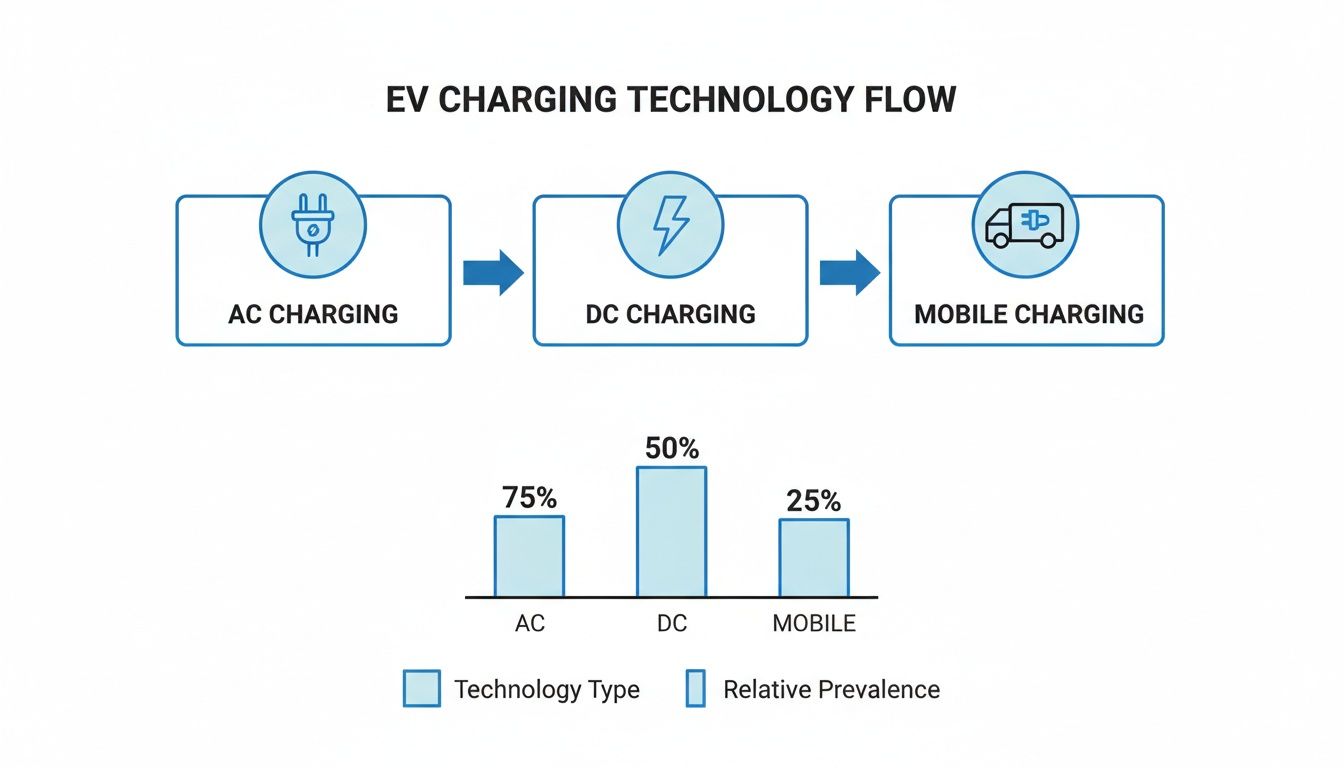
As you can see, manufacturers are catering to very different needs—from the slower AC charging perfect for homes and workplaces, to the rapid DC and flexible mobile units designed for public and commercial use.
To get a clearer view of who's who, here is a snapshot of the major players in the UK's public charging network.
UK Public EV Charger Manufacturer Market Share Snapshot
This table provides a comparative overview of the top electric car charger manufacturers in the UK based on the number of public charging stations.
| Manufacturer | Number of Public Stations (Jan 2024) | Key Specialism |
|---|---|---|
| Char.gy | 2,946 | On-street residential and destination charging |
| CityEV | 2,525 | Lamppost and urban charging infrastructure |
| Alfen | 2,036 | Smart charging for public, business and home use |
| EVBox | 1,720 | AC & DC solutions for public and commercial sectors |
| Ubitricity | 1,557 | Integrated lamppost and street furniture charging |
| ABB | 1,061 | High-power DC rapid and ultra-rapid charging systems |
This data shows how a few key companies have carved out significant portions of the public network through different strategies, whether by focusing on urban density or high-power hubs.
Public Charging Leaders and Innovators
When you look at public charging infrastructure, a few names have clearly secured a major foothold. Char.gy stands out, leading the market with 2,946 public charging locations across the UK as of January 2024. That gives them a 16% lead over their closest competitor and proves their strategy of embedding chargers in residential areas and popular destinations is working. You can dig into more numbers from the latest UK EV charging statistics on Uswitch.com.
This concentration shows how a handful of players are shaping public access to EV charging. Their success often comes down to strong partnerships with local authorities and businesses, making them a familiar sight for everyday EV drivers.
Following closely are other major players who add to the network's density. Companies like CityEV and Alfen have also built up substantial networks by focusing on reliability and a solid user experience to win their share of the market. These established names are often joined by global industrial players like ABB, who bring a wealth of engineering experience to the high-power, rapid-charging sector.
Specialists in Fleet and Commercial Solutions
While public charging gets most of the headlines, the fleet and commercial sector is a completely different ball game, with its own unique challenges and opportunities. Here, manufacturers are not just selling hardware; they are delivering integrated energy solutions. The conversation shifts from single charge points to entire ecosystems that manage energy flow, vehicle telematics and operational efficiency.
For fleet and commercial operators, the best manufacturer is a long-term energy partner. They provide solutions that tackle major operational hurdles like constrained grid connections, high peak energy costs and the absolute need for guaranteed uptime.
This is where specialists in battery energy storage systems (BESS) and sophisticated energy management software really shine. These manufacturers understand that just installing a charger is the first step. The real value is in creating a system that can:
- Store cheap off-peak or solar energy in batteries to use later.
- Intelligently manage charging schedules to avoid overloading the local grid.
- Provide a resilient power source that keeps vehicles on the road, even during a grid outage.
Companies focusing on these integrated systems, like ZPN Energy, are talking to a clientele that needs more than just a plug. They design bespoke solutions for logistics depots, business parks and local authorities that need to electrify fleets without facing massive grid upgrade costs. Their expertise in combining rapid EV charging with BESS and onsite renewables makes them key players in enabling large-scale electrification.
Integrating EV Charging with Renewables and Batteries
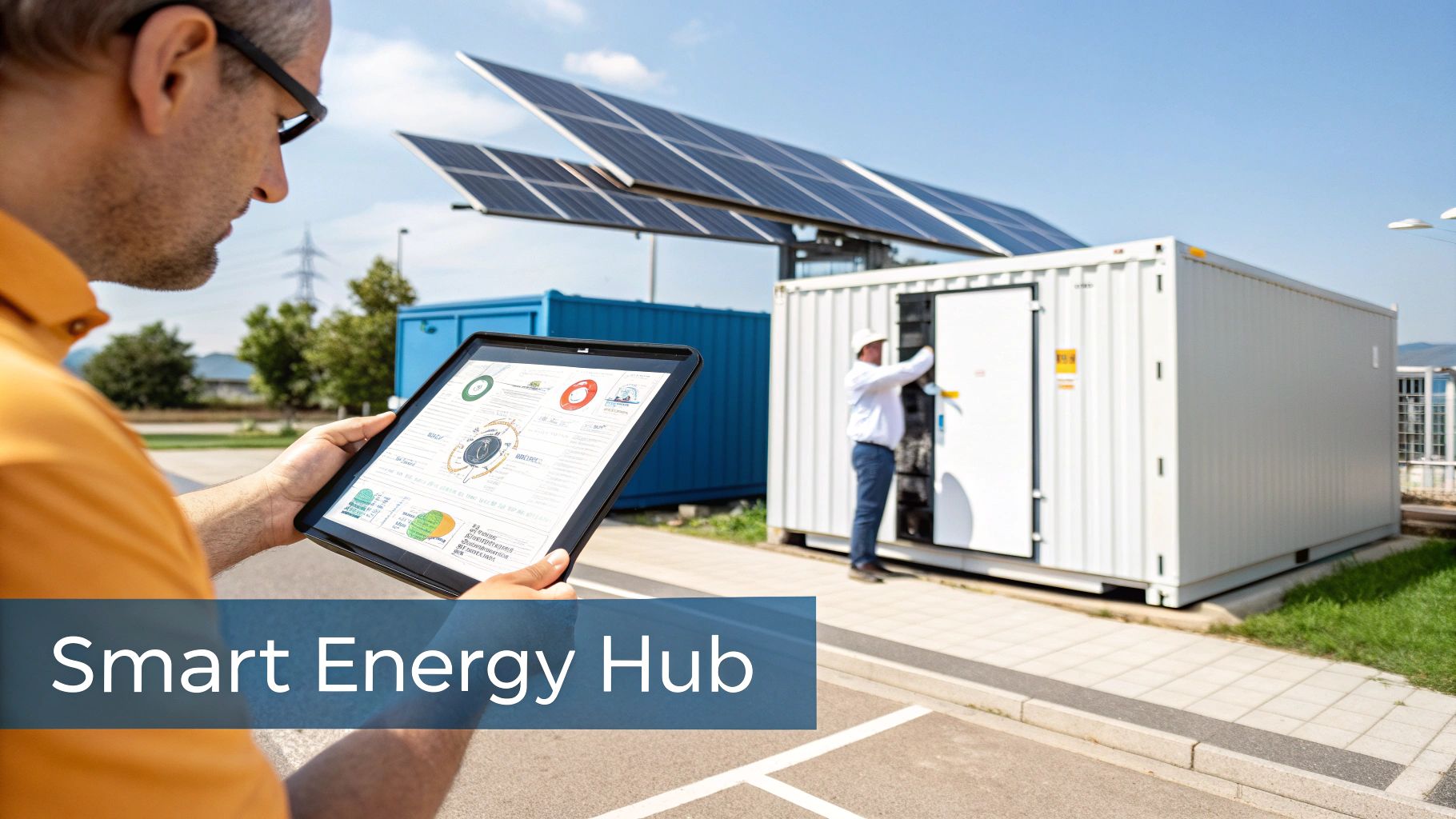
These days, modern EV charging is about much more than just pulling power from the grid. It is about intelligent energy management. For any business, especially those with a shaky or maxed-out grid connection, trying to install a bank of rapid chargers can quickly turn into a logistical and financial nightmare.
This is exactly where the most forward-thinking electric car charger manufacturers are changing the game. They are moving beyond standalone chargers to offer fully integrated systems that bring charging, onsite renewables and battery storage together.
The result is a self-sufficient energy ecosystem on your own site. It is a way to sidestep the physical limits of your local grid connection without having to bankroll costly and painfully slow network upgrades. Instead of being completely at the mercy of the grid, you can generate, store and use your own power exactly when and where you need it most.
The Role of BESS in Smart EV Charging
The cornerstone of this whole approach is the Battery Energy Storage System , or BESS. The easiest way to think of a BESS is as your site’s own private energy reservoir. It is there to capture and hold onto electricity, whether that is from your solar panels during the day or from the grid during cheap, off-peak hours overnight.
This stored power can then be released to your EV chargers during peak times when grid electricity prices are at their highest. This tactic, known as peak shaving , can make a huge dent in your operating costs.
More importantly, it provides the massive burst of power needed for rapid EV charging without tripping the breakers on a weak grid connection. The skill to manage these systems effectively is a critical difference between charger manufacturers. You can dig deeper into how these systems work with the grid and charging infrastructure in our dedicated article on Battery Energy Storage Systems in the UK.
A BESS transforms a charging station from a passive energy consumer into a dynamic, grid-interactive asset. It provides the power and flexibility needed for reliable rapid charging, even on sites with significant electrical constraints.
This technology is absolutely essential for unlocking the true potential of commercial and fleet charging. It makes sure vehicles get the fast turnaround they need to stay on the road, all while keeping a firm grip on your energy bills.
Unlocking New Revenue with Vehicle-to-Grid Technology
Once you have these smart energy systems in place, even more advanced opportunities open up, like Vehicle-to-Grid (V2G) technology. V2G creates a two-way street for power, meaning EVs can not only take energy from the grid but also give it back.
Picture a fleet of delivery vans parked up for the night. With V2G, their combined batteries can be grouped together to act as one giant, virtual power plant. When the national grid is under strain, that stored energy can be sold back to the network operator, creating a brand-new revenue stream for your business.
Suddenly, your EV fleet shifts from being a running cost to a revenue-generating asset. The manufacturers at the forefront of this space are building V2G compatibility directly into their hardware and software, giving businesses a real way to participate in the UK’s evolving distributed energy market.
The Brains of the Operation: The Energy Management System
Connecting chargers, batteries and solar panels is one thing. Getting them all to work together intelligently is another challenge entirely. This is the job of the Energy Management System (EMS) . Think of the EMS as the central brain, the sophisticated software platform that orchestrates the flow of energy across the entire site.
A truly powerful EMS will handle all the complex decisions for you:
- Optimise Charging Schedules: It automatically lines up vehicle charging with times of low energy prices or high solar generation, keeping costs to a minimum.
- Manage Load Balancing: The system cleverly distributes the available power between all connected chargers to make sure the site’s main grid connection is never overloaded.
- Provide Detailed Analytics: It gives you real-time data on energy use, charging patterns and cost savings, helping you make sharp, informed decisions about your operations.
The quality of the EMS is a make-or-break factor when you're sizing up electric car charger manufacturers. The best platforms offer a seamless, automated solution that squeezes every drop of efficiency and financial return from your hardware, without you needing to constantly babysit it. This intelligent control is what ties the whole system together and delivers a charging setup that is genuinely ready for the future.
Your Practical Checklist For Choosing A Manufacturer

So, how do you pick the right partner from a field of capable electric car charger manufacturers? It takes a structured, thorough approach that goes way beyond flashy brochures and sales pitches. You need a solid procurement framework that scrutinises every detail, from the nuts and bolts of the hardware to the long-term financial health of the supplier. This is the only way to ensure your investment is both future-proof and operationally sound.
A well-defined checklist is your most powerful tool here. It lets you compare different manufacturers on an equal footing, helping you make an evidence-based decision that truly aligns with your goals—whether that is electrifying a fleet or launching a public charging network.
Hardware And Software Evaluation
First things first: assess the core product. The hardware has to be durable, reliable and fully certified to meet all UK safety standards. Look for manufacturers who can back up their claims with low failure rates and offer robust warranties that actually provide peace of mind.
But the hardware is only half the story. The software platform, or Energy Management System (EMS) , is the real brain of the operation. Key criteria to dig into include:
- Load Management Capabilities: Can the system intelligently balance power across multiple chargers? This is critical to avoid overloading your grid connection and incurring hefty upgrade costs.
- Payment Processing: Does it support the flexible payment options drivers expect, like contactless, app-based payments and roaming agreements?
- User Interface: Is the platform intuitive for everyone involved—from your back-end operators to the drivers plugging in their cars?
- Interoperability: Does it use open standards like OCPP? This is vital to avoid being locked into a single provider's ecosystem. For a deeper dive on this, check out our guide on choosing EV charger manufacturers in the UK.
As you build out your checklist, it is also worth getting your head around different OEM and ODM manufacturing models. Understanding these arrangements can tell you a lot about a potential partner's supply chain and resilience.
Calculating The Total Cost Of Ownership
Focusing only on the initial price tag is one of the most common—and costly—mistakes we see. The Total Cost of Ownership (TCO) gives you a far more accurate picture of what you're really signing up for financially. Your TCO calculation has to account for every single expense over the charger's entire lifespan.
The true cost of a charging network is revealed not at purchase but over years of operation. A lower upfront cost can easily be erased by high maintenance fees, expensive grid upgrades and inefficient energy consumption.
Your evaluation must therefore include:
- Installation and Commissioning Costs: This covers all the groundwork, electrical works and the final setup.
- Grid Connection Fees: Securing enough power from the Distribution Network Operator (DNO) can be a significant—and often overlooked—expense.
- Ongoing Maintenance and Service: What are the terms of the Service Level Agreement (SLA)? What is covered and what is not?
- Software Licences and Transaction Fees: These recurring costs can eat into your profitability if you are not careful.
- Energy Costs: A smart system that optimises for off-peak energy will have a much lower TCO in the long run.
Assessing A Manufacturer's Financial Stability
Finally, remember you are not just buying a product; you are entering a long-term partnership. It is absolutely vital to assess the financial health and track record of any potential manufacturer.
A strong balance sheet, a history of successful projects and glowing client testimonials are all signs of a reliable partner who will still be around to support you for years to come. The UK EV charging market is booming, with a valuation of USD 1,040.3 million in 2024 and a forecast to triple by 2030, making it an attractive but fiercely competitive space. You want a partner who is built to last.
The Future of EV Charging and Distributed Energy
If you take one thing away from the world of electric car charger manufacturers, let it be this: EV chargers are no longer just plugs on a wall. They have become vital pieces of a much smarter, more flexible energy system that is taking shape right across the UK.
Choosing a manufacturer today is less about the box and more about finding a partner for your entire energy transition. This shift in thinking requires you to see chargers as intelligent assets—the crucial link between the electric vehicles on our roads and the decentralised energy grid of tomorrow. All the major trends, from the relentless push for faster charging speeds to deeper integration with on-site solar and batteries, are pointing in this direction.
The Rise of Distributed Energy Resources
The future is all about managing distributed energy resources (DERs) and sophisticated software is quickly becoming the brain of the operation. It is what orchestrates how power is generated on-site, stored in batteries and used by vehicles. This intelligence is a game-changer, allowing businesses to bypass seriously constrained grid connections and power rapid EV charging with stored energy, avoiding enormous grid upgrade costs.
The momentum is undeniable. Official UK government statistics show public charging devices hit 82,002 as of 1 July 2025—a 27% jump in just one year. This rapid build-out, led by key manufacturers, shows a market gearing up for a future where millions of EVs are interacting with the grid every single day. You can dig deeper into these trends on the official UK government statistics page.
Crucially, this growth is not just about quantity. It is about capability. The number of ultra-rapid chargers (150kW+) shot up by 51% year-on-year, proving that high-power charging is becoming the standard.
Finding Your Long-Term Energy Partner
Looking ahead, the need for a truly strategic partnership is paramount. The right manufacturer will do far more than just supply you with reliable hardware. They will act as a collaborator in your long-term energy strategy, guiding you through the complex but genuinely exciting world of distributed energy.
The ultimate goal is to build a resilient and profitable charging infrastructure. This is not achieved by just buying chargers. It is done by investing in an integrated energy ecosystem that combines charging, battery storage and intelligent management.
This kind of partnership is essential for navigating the innovations that will define the next decade of electrification. By choosing a manufacturer with proven expertise in battery storage, renewables and smart energy software, you are not just preparing for the future—you are actively building it. It is a strategic approach that is critical for hitting your operational goals and contributing to the UK's ambitious net-zero targets.
Got Questions? We've Got Answers
When you start digging into the world of electric car charger manufacturers, you will find the same questions pop up time and again. It is not just about the hardware; it is about the practical side of installation, software and what happens years down the line. Getting straight answers is the only way to make a solid decision.
We have gathered some of the most common queries we hear from businesses to give you the clear, straightforward information you need.
What Are the Biggest Headaches During Installation?
Almost every time, the biggest hurdle is the site's existing electrical capacity. A lot of commercial properties, especially older buildings, simply were not built to handle the power demands of multiple rapid EV chargers. This often leads to a constrained grid connection that needs a clever workaround.
Another classic problem is the physical gap between your electrical panel and where you actually want the chargers. Long cable runs can cause a voltage drop, which means you will need thicker, more expensive cabling to make up for it. Any decent manufacturer will insist on a thorough site survey to spot these issues early and engineer a solution before a single shovel hits the ground.
How Does the Software Side of Things Work?
Modern EV charging is not just about plugging in a car; it is all managed by a central software platform, often called an Energy Management System (EMS). This is the brain of the operation and it talks to the chargers using open protocols like OCPP (Open Charge Point Protocol) .
Why does that matter? Because it saves you from being locked into one manufacturer’s ecosystem forever. Your EMS should also connect seamlessly with payment gateways for public charging and ideally with your existing building management or fleet telematics systems. This allows everything to share data and run as one efficient, optimised operation.
The quality of the software is every bit as important as the hardware. It dictates how you manage energy, set prices, monitor every charging session and balance the load across your entire network. A powerful, intuitive platform is not a "nice-to-have"—it is a must.
What Should I Look for in a Maintenance Contract?
A long-term maintenance contract, or Service Level Agreement (SLA), is your insurance policy for charger uptime. Whether you are running a commercial fleet or a public charging hub, reliability is everything.
Here is what to check for:
- Guaranteed Response Times: If a charger goes down, how quickly will an engineer be on-site to fix it? Minutes and hours matter.
- Remote Diagnostics: Can the provider spot and fix software glitches from their end, without needing a site visit? This saves a massive amount of time.
- Included Parts and Labour: Get clarity on what is covered. You do not want to be hit with unexpected bills for common repairs.
- Proactive Monitoring: The best partners do not wait for you to call. They monitor your chargers 24/7 and often fix problems before you even realise there was one.
For businesses ready to move past grid constraints and build a truly future-proof charging infrastructure, ZPN Energy delivers fully integrated solutions. We combine rapid EV charging, on-site battery storage and intelligent management systems to make it all work. Explore our advanced energy solutions to see how we can power your transition.
Frequently Asked Questions About Choosing an EV Charger Manufacturer
Choosing the right partner for your EV charging infrastructure is a big decision and it is natural to have a lot of questions. This table tackles some of the most common queries we hear from businesses, offering clear answers to help guide your selection process, from the initial installation to long-term support.
| Question | Answer |
|---|---|
| Do I need to upgrade my grid connection to install rapid chargers? | Not always. While a direct grid upgrade is an option, manufacturers with integrated battery storage can bypass this issue. The battery can be trickle-charged during off-peak hours and then discharge rapidly to the vehicle, allowing you to install powerful chargers even on sites with limited grid capacity. |
| What happens if a charger stops working? How quickly can it be fixed? | This depends entirely on your Service Level Agreement (SLA). Look for a provider that offers remote diagnostics to fix software issues instantly and guarantees on-site engineer response times—ideally within a few hours for critical locations—to ensure maximum uptime. |
| Am I locked into your software if I buy your hardware? | You should not be. Insist on hardware that uses the Open Charge Point Protocol (OCPP). This industry standard ensures your chargers can communicate with any OCPP-compliant management software, giving you the freedom to switch platforms in the future without replacing your hardware. |
| How can I manage electricity costs with multiple chargers running? | Through a smart Energy Management System (EMS). A good EMS will allow you to implement load balancing to distribute power efficiently, schedule charging to take advantage of cheaper off-peak tariffs and integrate with battery storage to use stored, low-cost energy during peak times. |
| What kind of support is available after the warranty period ends? | Reputable manufacturers offer comprehensive, long-term maintenance contracts that extend well beyond the initial warranty. These contracts should cover preventative maintenance, software updates, 24/7 monitoring and access to technical support to protect your investment for years to come. |
Having these conversations upfront ensures you find a partner who can deliver not just the hardware but a complete, reliable solution that meets your operational and financial goals for the long haul.