EV Charging Infrastructure UK: A Commercial Guide
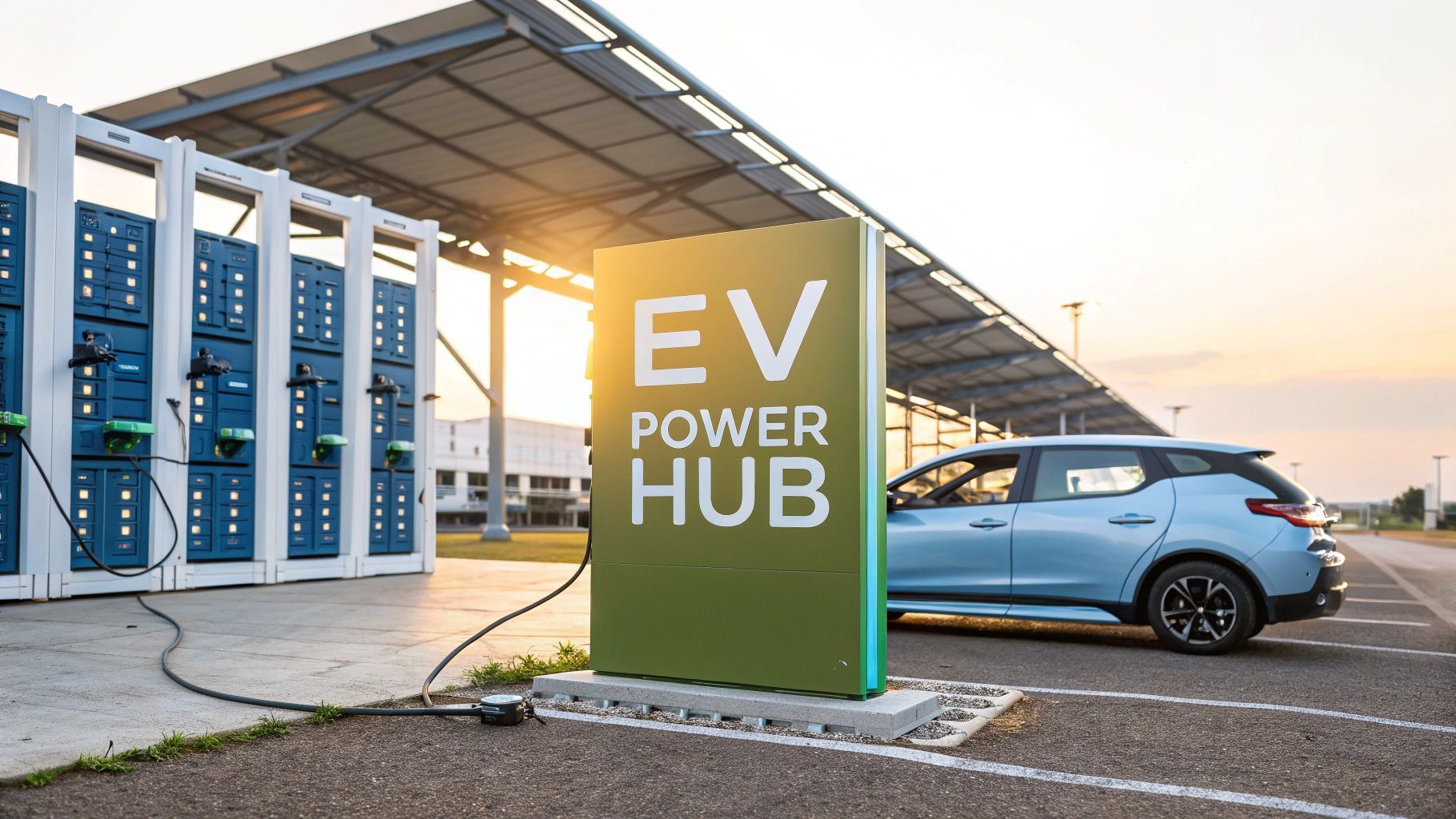
The UK's electric vehicle charging infrastructure is growing at a phenomenal pace, a surge fuelled by massive consumer demand and the government's own ambitious targets. This is not just an environmental shift; it is creating a huge commercial opportunity for businesses, fleet operators and investors who are ready to be part of the country's clean energy future. The first step to getting involved is understanding just how dynamic this market really is.
The UK EV Charging Landscape Explained
At first glance, the UK's EV charging map can seem complicated but the story behind it is simple: consistent, rapid growth. As more consumers and commercial fleets make the switch to electric, the need for a solid public and private charging network becomes more urgent every day. This momentum is building a vibrant ecosystem packed with opportunities.
The sheer scale of this expansion is impressive. We have seen unprecedented growth across the UK's charging infrastructure, with a particularly dramatic acceleration in 2025. It is a direct response to the government's 2030 target to phase out new petrol and diesel cars and there are no signs of it slowing down.
This infographic gives you a snapshot of where the UK's charging network is right now, breaking down the number of locations, devices and the remarkable daily installation rate.

As the data shows, it is not just about adding more chargers. It is about building a resilient and accessible infrastructure that can support a fast-growing fleet of EVs.
Market Dynamics and Key Players
The market is made up of a wide range of network operators, each with its own strategy and regional focus. Some concentrate on "destination charging" at places like supermarkets and retail parks while others are busy building high-power rapid charging hubs along major motorways. Getting to know these players is the key to spotting gaps and opportunities in the market.
If you want to dig deeper into who's running the charge points you see on the streets, our guide to the UK electric vehicle charging networks explained is a great place to start.
This competitive environment is a good thing for businesses, as it opens up different partnership and investment models. For example, a hotel might team up with one network to offer guest charging, while a logistics firm might install its own private depot charging managed by another.
The real challenge—and where the opportunity lies—is in deploying the right type of charging technology in the right place to meet what users actually need. That could be a slow overnight charge for a local resident or an ultra-rapid top-up for a driver on a long journey.
The Numbers Behind the Growth
The statistics paint a very clear picture of a sector that is firing on all cylinders. The table below summarises just how quickly things are moving.
| UK EV Charger Installation Growth |
| :--- | :--- | :--- | :--- |
| Year
| Total New Chargers
| Average New Chargers per Month
| Key Trend
|
| 2023 | 16,585 | 1,382 | Steady, consistent growth establishing a strong baseline. |
| 2024 | 18,970 | 1,581 | Growth accelerates as market confidence builds. |
| 2025 (H1) | 8,670 | 1,445 | Sustained high-velocity deployment, on track to surpass previous years. |
As of June 2025 , the UK had 82,369 public charging devices spread across 40,479 locations . The growth continued to pick up speed into 2025, with an average of 1,445 new chargers installed each month in the first half of the year. That works out to roughly 48 new chargers being deployed every single day .
This incredible pace shows the scale of investment and the commercial confidence flooding into the sector. For businesses, this data is a signal that now is the time to develop an EV charging strategy. Waiting on the sidelines is no longer an option, as the infrastructure is taking shape fast and the early movers are snapping up the most valuable locations.
Getting to Grips with Core Charging Technologies
To make smart decisions about EV charging infrastructure, you first have to understand the hardware that makes it all tick. The technology you choose has a direct impact on everything from the driver's experience and your site's suitability to, most importantly, your return on investment.
The main difference boils down to how electricity gets into a vehicle’s battery.
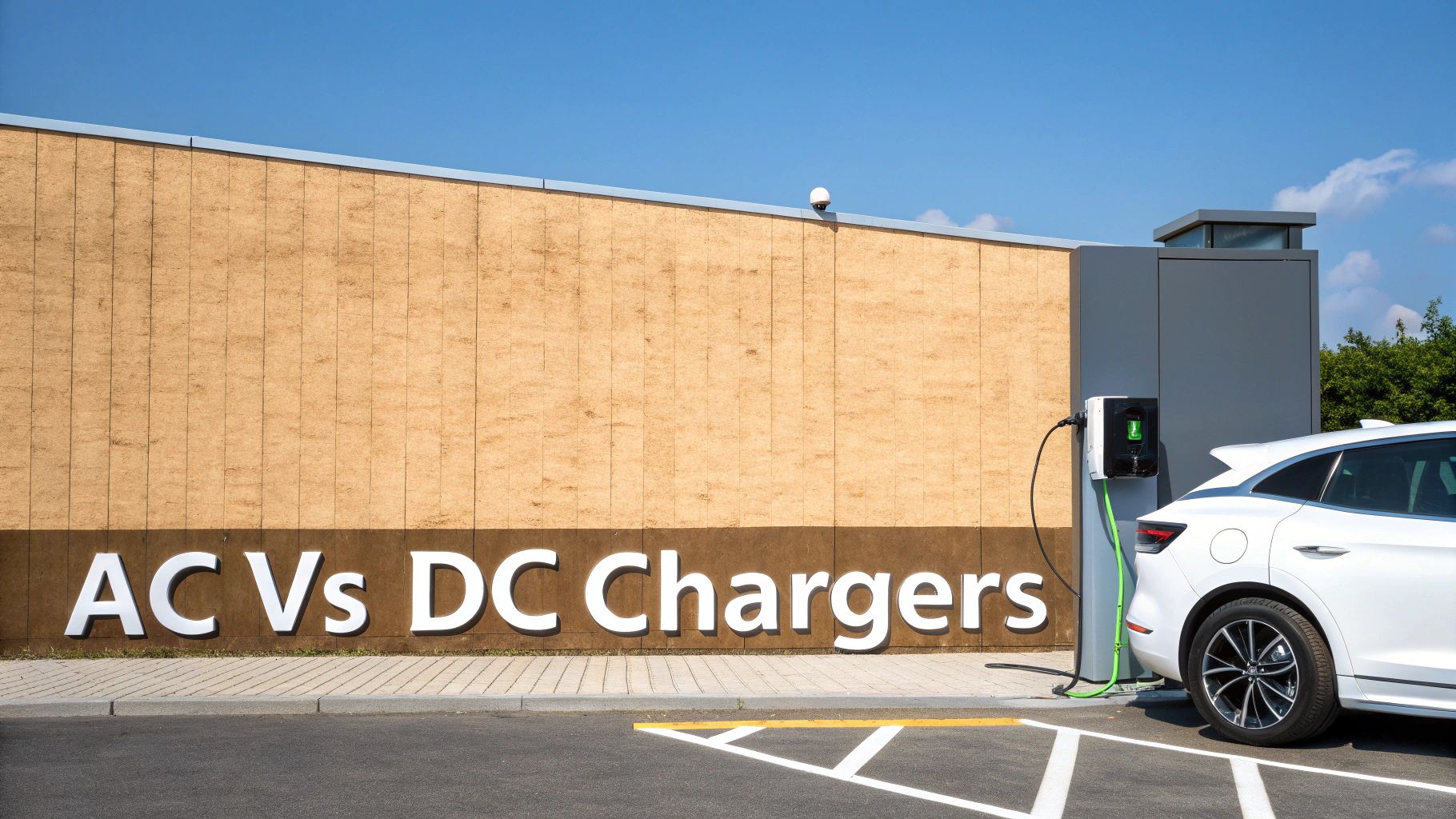
Think of it like filling a swimming pool. You could use a regular garden hose – steady but it will take a while. Or, you could call in a fire engine and use its hose for a much, much faster fill. This is the fundamental difference between Alternating Current (AC) and Direct Current (DC) charging.

AC Charging: The Marathon Runner
AC charging is the most common form out there. It’s the garden hose. The power flowing from the National Grid is always AC, so when an EV plugs into an AC charger, the vehicle’s own on-board converter has to do the heavy lifting of changing this alternating current into direct current before it can be stored in the battery.
This conversion process is the real bottleneck. The charging speed is not just limited by the charge point; it is capped by the size and power of the car's internal converter. This makes AC chargers perfect for places where vehicles are going to be parked for a good while.
- Slow Charging (Up to 3kW): This is what you get from a standard three-pin plug socket at home. It is a slow trickle charge, best for overnight top-ups.
- Fast Charging (7kW to 22kW): You will find these in public car parks, workplaces and retail spots. They are great for adding a significant chunk of range over a few hours.
DC Charging: The Sprinter
DC rapid EV charging is the fire hose in our analogy. These units are the real powerhouses. They contain a massive converter within the charger itself , completely bypassing the car’s slower on-board converter. This allows them to pump DC power straight into the battery, resulting in ridiculously fast charging speeds.
For any business looking to attract customers who are just passing through or needing to service a fleet with high vehicle turnover, DC charging is not just nice to have—it's essential.
DC chargers slash charging times from hours down to mere minutes. This makes them absolutely vital for en-route charging on motorways and at busy commercial hubs where keeping vehicle downtime to a minimum is the name of the game.
These powerful units are the bedrock of a truly functional national EV charging infrastructure, tackling the big issue of range anxiety head-on for drivers on long journeys. You can dive deeper into the specifics in our guide to UK DC fast charging.
The power delivery in these systems is managed by some seriously sophisticated electronics, ensuring the energy flow is both safe and efficient. For anyone interested in the nitty-gritty of the power electronics involved, looking into variable frequency drive basics for power electronics can provide some great foundational knowledge.
Mobile EV Charging: The Flexible Friend
Beyond the fixed chargers bolted to the ground, a new category is starting to make waves: mobile EV charging. Think of them as rapid chargers on wheels, offering a flexible, go-anywhere solution for very specific needs.
Imagine a fleet operator needing to charge vehicles at a temporary construction site. Or a roadside assistance service that needs to give a stranded EV driver an emergency boost to get them to the next service station. That is where mobile EV charging shines.
These units offer an incredibly agile way to deliver power exactly where it is needed, without the cost and commitment of digging up the ground for a permanent installation. They are especially useful for:
- Emergency Services: Getting power to incident sites quickly.
- Fleet Operators: Supporting vehicles at remote depots or special event locations.
- Events and Festivals: Providing temporary charging facilities for thousands of attendees.
This adaptability makes mobile charging a brilliant part of a wider infrastructure strategy, filling in the gaps where fixed chargers just are not practical. At the end of the day, matching the right technology to your specific operational needs is the secret to a successful EV charging project.
Overcoming Grid Constraints with BESS and Renewables
The ambition to blanket the UK with rapid EV chargers runs into a very real, very expensive problem: the local electricity grid. Many of the most logical spots for charging hubs—think rural service stations or older industrial estates—simply do not have the electrical muscle to power multiple DC rapid chargers at once.
Trying to upgrade a grid connection is often a slow and eye-wateringly expensive ordeal. We are talking months, sometimes years, and costs that can easily spiral into the tens of thousands. This single issue is often the biggest roadblock that stops perfectly viable projects in their tracks, leaving big gaps in the UK’s charging map.
This is a major challenge for rapid EV charging and EV charging from constrained grid connections but there is a powerful way to sidestep this entirely, making high-power charging possible almost anywhere.
Introducing Grid Scale Batteries
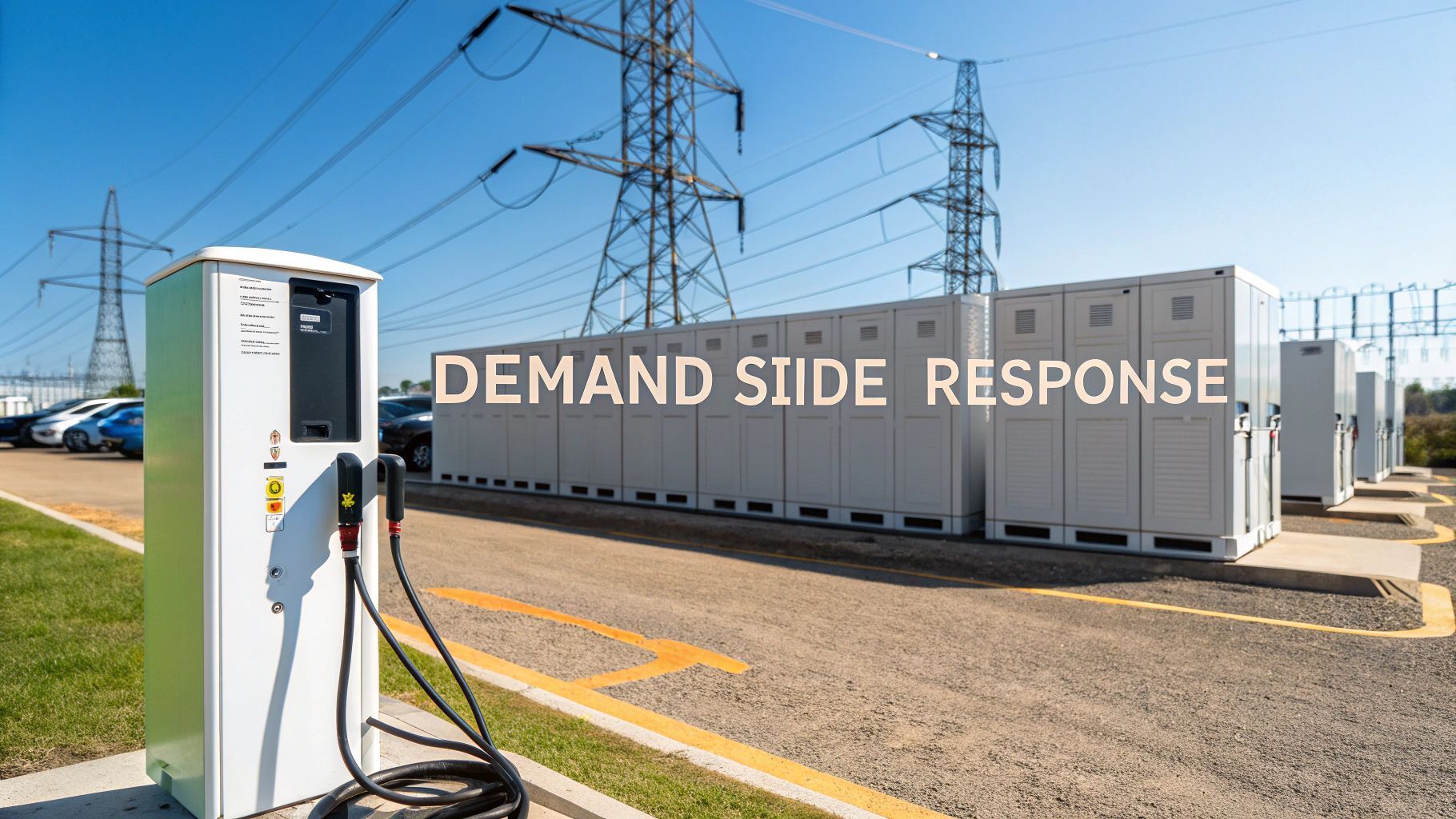
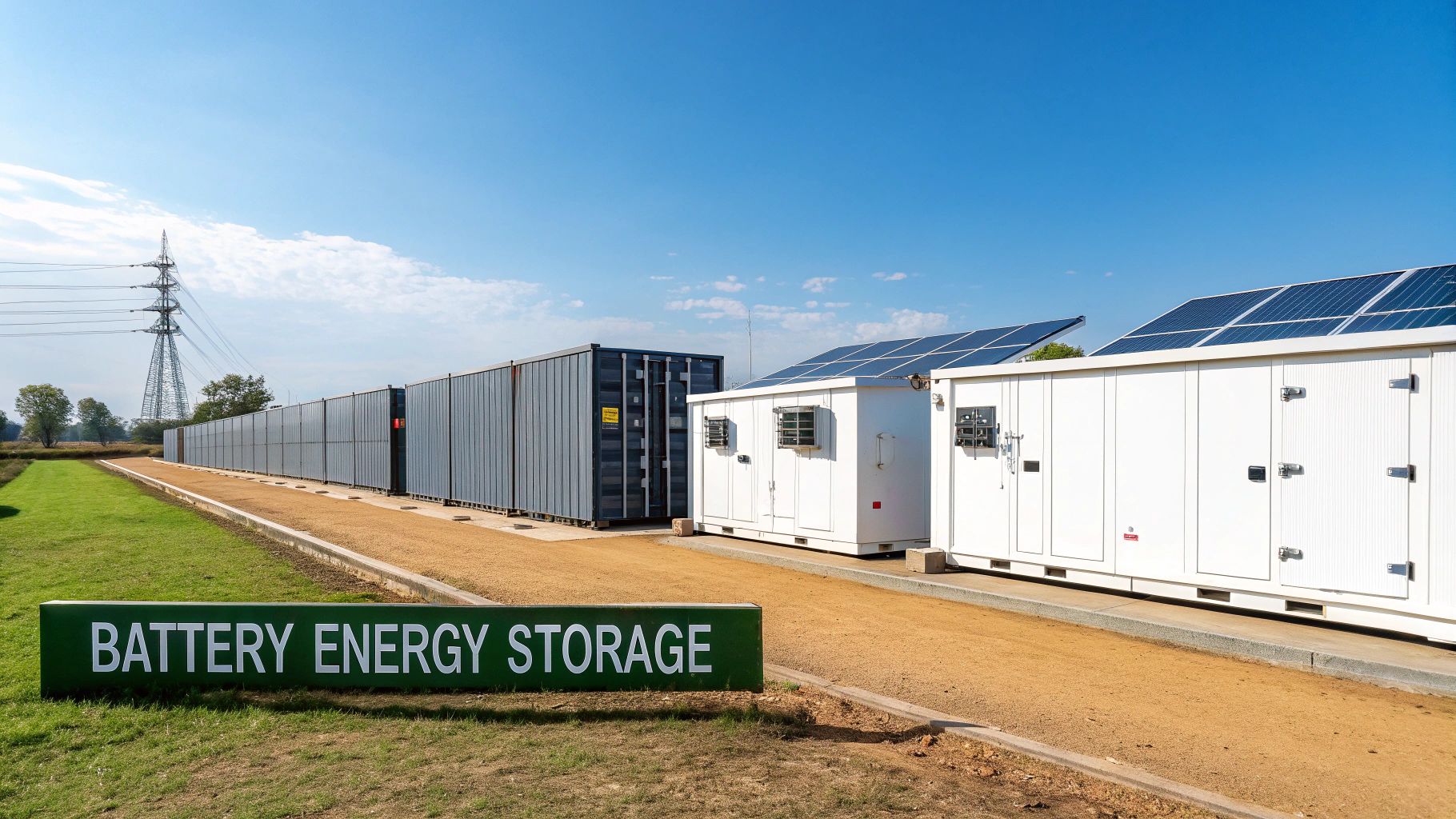
The secret is to decouple the act of charging a car from the real-time capacity of the grid. This is where a Battery Energy Storage System (BESS) , or grid scale batteries, come in. This technology completely changes the rules of the game for EV charging.
Think of a BESS as a big reservoir for electricity. Instead of needing a massive pipe (a high-capacity grid connection) to fill lots of buckets (EVs) at the same time, you can use a small hose (a weak grid connection) to slowly fill the reservoir over many hours. When cars show up needing a fast charge, you open the reservoir's main gate, unleashing a powerful flow of stored energy far greater than the small hose could ever deliver on its own.
This is exactly how a BESS works. It trickles charge from a weak grid connection, often during off-peak hours when electricity is cheapest, and stores it. When an EV plugs in, the BESS discharges this stored energy at a high rate, delivering a rapid charge without ever stressing the local grid.
The relationship between EV charging and batteries is the key to unlocking rapid EV charging in areas previously written off as unfeasible. It gives businesses the power to offer high-demand services without being held hostage by their existing grid limitations.
Creating a Self-Sufficient Charging Hub
A BESS on its own is a game-changer but its true potential is unlocked when you pair it with on-site renewable energy generation, like solar panels or wind turbines. This combination of distributed energy creates a charging ecosystem that is largely self-sufficient, green and incredibly cost-effective.
By adding combined on site renewables into the mix, you can generate your own clean electricity to fill the BESS. This dramatically cuts your reliance on the grid, slashes energy bills and gives you a powerful green credential that today's EV drivers actively look for.
A combined system gives you several powerful advantages:
- Grid Independence: Generate and store your own power, insulating your site from grid outages and volatile energy prices.
- Cost Savings: Use free energy from the sun or wind to charge the BESS, significantly lowering your day-to-day operating costs.
- Revenue Generation: During periods of high grid demand, you can even sell your stored energy back to the network, opening up a whole new income stream.
- Enhanced Sustainability: Offer genuinely carbon-neutral charging—a major selling point for environmentally conscious customers and fleets.
This integrated approach transforms a simple charging point into a sophisticated local energy hub. You can learn more about how BESS technology is supporting the UK grid and EV charging in our detailed guide.
For any business or fleet operating from a site with a constrained grid, the combination of BESS and renewables offers a clear and commercially sound path forward. It turns a huge technical barrier into a genuine strategic advantage.
Building a Profitable EV Charging Business Model
Installing chargers is one thing; making them profitable is another beast entirely. Moving beyond the pure technology, the real success of any EV charging project hangs on a solid business model. Simply having the hardware on-site is not enough – you need a clear strategy to generate revenue, attract drivers and turn your capital investment into a powerful, profitable asset.
The good news is that there are multiple roads to profitability. The model you choose will come down to your location, your target audience and your ultimate commercial goals. Getting your head around these options is the first step toward building a sustainable revenue stream from the UK's growing EV charging infrastructure.
Core Revenue Generation Strategies
At its most basic level, your business model is simply how you charge drivers for using your equipment. This can be structured in a few different ways, each with its own pros and cons.
- Pay-As-You-Go (PAYG): This is the simplest model out there. Drivers pay per kilowatt-hour ( kWh ) of energy used, often with an added connection fee or a time-based charge. It is completely straightforward and appeals to transient drivers who value convenience over any long-term commitment.
- Subscription Services: For your regulars, a subscription model can offer fantastic value. Drivers pay a monthly or annual fee for discounted charging rates or a set number of inclusive charging hours. This approach creates a predictable, recurring revenue stream and is great for building customer loyalty.
- Hybrid Models: Many of the shrewdest operators combine PAYG and subscriptions, offering a baseline price for occasional users while providing much better value for members. This approach allows you to capture the widest possible market.
To make sure your EV charging venture is actually financially viable, it is vital to understand how to accurately calculate your return on investment. This calculation will be fundamental in deciding which pricing strategy is right for your particular site.
Ancillary Revenue and Indirect Benefits
Let us be clear: profitability is not just about the direct income from charging sessions. For many businesses, the indirect benefits are just as valuable – if not more so. Installing chargers can be an incredibly powerful tool to attract and retain customers.
Think about retail parks, hotels and service stations. Offering EV charging acts as a magnet, increasing customer footfall . While drivers wait for their vehicles to charge—often for 30 minutes or more with a rapid charger—they are a captive audience, highly likely to spend money in your adjacent cafes, shops or restaurants. This turns the charger into a potent driver of secondary spend.
For these kinds of destination businesses, the charging service itself does not even need to be a major profit centre. Its main job is to enhance the customer experience, increase dwell time and boost sales across the entire site.
The Fleet and Depot Charging Model
For commercial fleet managers, the business model looks different but it is just as compelling. The goal here is not public revenue but razor-sharp operational efficiency and a lower total cost of ownership (TCO) .
By installing private chargers at a depot, fleets can tap into much cheaper overnight electricity tariffs, drastically cutting their "refuelling" costs compared to diesel. This controlled environment also ensures vehicles are always fully charged and ready for the day's work, maximising vehicle uptime and route efficiency. Here, the return on investment comes from massive long-term savings on fuel and maintenance, making depot charging a cornerstone of any profitable electric fleet operation.
Finding the Right Funding for Your EV Charging Project
Getting the numbers to stack up is the first big hurdle for any EV charging project. The initial capital needed can look daunting but there are plenty of financial routes available that make installation a smart commercial move. The key is understanding these options to build a solid business case that takes your project from paper to reality.
The good news? There is a mix of public and private funding out there to help expand the UK’s EV charging network. Whether you are a small business owner, a commercial landlord or running a large vehicle fleet, there is a financial model designed to fit. You just need to know where to look.
Government Grants and Schemes
The UK government, through its Office for Zero Emission Vehicles (OZEV), is actively pushing the transition with several grant programmes. These schemes are designed to take the sting out of the initial investment and get more charge points in the ground.
A big one for businesses is the Workplace Charging Scheme (WCS) . It is a straightforward voucher-based system that helps cover the upfront cost of buying and installing EV chargers.
- Who is it for? Any UK business, charity or public sector organisation can apply.
- What does it cover? The WCS gives you up to £350 per charging socket. You can claim for up to 40 sockets across all your sites, meaning you could get up to £14,000 in total support.
- Are there any catches? Just a couple. The chargers need to be for your staff or fleet, not the general public. You will also need your own off-street parking.
This grant can make a real difference, particularly for smaller businesses wanting to support employees making the switch to electric or for those just starting to electrify their own fleet.
Commercial Finance: Owning vs. Partnering
While government grants are a great start, they rarely foot the entire bill. That is where commercial finance comes in, offering a few different ways to fund your project depending on how much capital you want to invest and how much risk you are willing to take on.
Picking the right commercial model is just as important as choosing the right hardware. It shapes your cash flow, your day-to-day responsibilities and your long-term return.
The options boil down to two main paths: you either own the hardware yourself or you let a third party handle the investment.
Buy and Operate It Yourself
This is the most direct route. You purchase the charging hardware outright and manage the installation.
- The upside? You keep 100% of the revenue and have total control over everything – from pricing and access to how it looks on your site.
- The downside? It demands the most significant upfront cash injection and you are on the hook for all the ongoing maintenance and operational tasks.
Fully-Funded 'Charging-as-a-Service'
If you want to offer EV charging without the upfront cost and operational headaches, a fully-funded model is a brilliant alternative. Here, a specialist charge point operator (CPO) pays for the equipment, installation and all the maintenance. In return, they take the lion's share of the charging revenue, usually paying you a simple ground rent for using your location.
This model is a perfect fit for places with high footfall, like retail parks or service stations. The main goal is not charging revenue but attracting EV drivers who will then spend money in your shops or cafes. It turns your car park into an asset that draws in a valuable, modern customer base – all at zero cost to you.
Your Action Plan for Deploying EV Charging
Putting a plan on paper is the first step but turning a site into a valuable piece of the UK’s EV charging infrastructure takes a structured, practical approach. Moving from an idea to a fully operational charging hub is not something you can rush; it involves several critical stages, each building on the last.
Think of this as your playbook. It lays out a clear, step-by-step process that de-risks your investment and makes sure your final installation is fit for purpose from day one. This is your roadmap to getting EV charging right and making your site a go-to destination for drivers.
Step 1: Site Feasibility and Grid Assessment
Before a single shovel hits the ground, you need to understand what you are working with. This is the discovery phase, all about gathering the hard data to build a solid business case.
Start by looking closely at your location. Who are you serving? Are they employees who need slow overnight charging or are they customers in a hurry, demanding rapid top-ups? The answer will dictate the kind of technology you need.
Next comes the most critical piece of the puzzle: the grid connection. You need to contact your local Distribution Network Operator (DNO) to find out your site's maximum import capacity. This one number will define the entire scope of your project. A weak connection will steer you towards solutions involving grid scale batteries and distributed energy , while a strong one might allow you to plug rapid EV charging hardware straight in.
Step 2: Technology and Partner Selection
Once you have a clear picture of your site's potential, it is time to choose the right tools and, just as importantly, the right team. This is where you match your operational needs to specific hardware.
Your DNO assessment is your guide here.
- Constrained Grid: If your grid connection is limited, a Battery Energy Storage System (BESS) is not just an option—it’s essential. A BESS lets you install powerful rapid chargers by storing up energy from a weak grid connection or from combined on site renewables like solar.
- Unconstrained Grid: Got plenty of power from the grid? Great. You can install DC rapid chargers directly. But even here, adding a BESS can be a smart move, helping you slash peak demand charges and even earn revenue from grid balancing services.
- Operational Flexibility: For specific jobs like roadside assistance or powering temporary events, mobile EV charging units offer a brilliant, versatile alternative to digging up the ground for fixed installations.
Choosing a technology partner is about more than just buying a box. You need a specialist who truly gets the interplay between EV charging and batteries . Look for an end-to-end provider who can deliver a fully integrated system—someone like ZPN Energy, who can handle everything from the initial design and grid application right through to installation and ongoing support.
Step 3: Future-Proofing for Scalability
The final step is to make sure your investment is built for the long haul. The EV market is growing at a phenomenal rate and a system that is perfect today could be struggling to keep up in just a few years.
Design your site layout with expansion in mind from day one. Can you easily add more charging bays without a complete redesign? Is your software platform ready to manage a much larger network? Thinking about scalability now saves a huge amount of cost and disruption later on.
Most importantly, you have to prioritise smart energy management. An intelligent system that can balance charging loads, work seamlessly with your solar panels and even sell energy back to the grid is not a luxury anymore. It is absolutely essential for long-term profitability. By future-proofing your deployment, you secure your place in the evolving EV charging infrastructure UK drivers and businesses will depend on.
Got Questions? We've Got Answers
Here are some quick answers to the questions we hear most often about developing EV charging infrastructure in the UK . We have put together the clear, straightforward details businesses and fleet operators need to move forward with confidence.
Can My Site Handle Rapid Chargers?
First things first, you will need a Distribution Network Operator (DNO) assessment. This tells you the maximum power your site can draw from the grid. A specialist provider can handle this entire process for you, taking the headache out of it.
What if the connection is not strong enough? This is where a Battery Energy Storage System (BESS) becomes your secret weapon.
A BESS completely sidesteps the need for slow and expensive grid upgrades. It can 'trickle charge' itself from even a weak connection, then unleash that stored power at high speeds to the chargers. This makes almost any site viable for rapid EV charging.
This integrated approach, combining EV charging and batteries , is the key to unlocking rapid charging, especially in areas where the grid is already under strain.
What's the Difference Between Fixed and Mobile EV Chargers?
Think of a fixed charger as the backbone of the network. It is permanently installed in one place, like a public car park, service station or a dedicated fleet depot. These are the reliable, everyday charging points drivers depend on.
On the other hand, mobile EV charging is all about flexibility. These are portable units, often mounted on a vehicle, designed to deliver a charge wherever it is needed. They are perfect for emergency roadside assistance, powering temporary events or for fleets that do not operate from a single, fixed depot.
Are There Any Commercial Grants Available?
Yes, absolutely. The UK government offers a number of grants to encourage the rollout of EV charging points. For businesses, the big one is the Workplace Charging Scheme (WCS) , which provides solid financial support for installing chargers for staff and fleet vehicles. There is also the EV chargepoint grant for landlords .
The world of funding can shift quickly, so it is always a good idea to check the official government website or speak with an infrastructure expert for the latest on what is available and who is eligible. This support can make a huge difference to the business case for getting new chargers in the ground.
For a fully integrated solution that brings together rapid EV charging , grid-scale batteries and on-site renewables, you need an expert partner. ZPN Energy delivers complete, end-to-end energy systems built for the future of UK transport. Explore our solutions at ZPN Energy.