The Essential Arc Protection Device Guide
An arc flash is essentially a miniature lightning strike inside your electrical equipment. It is a violent, dangerous electrical explosion that happens when a high-current fault arcs through the air between conductors, releasing a massive wave of thermal and pressure energy. In these critical moments, an arc protection device is your first line of defence—a specialised safety system designed to detect the first signs of a flash and cut the power in milliseconds, well before a catastrophic failure can occur.
Understanding the Critical Risk of an Arc Flash
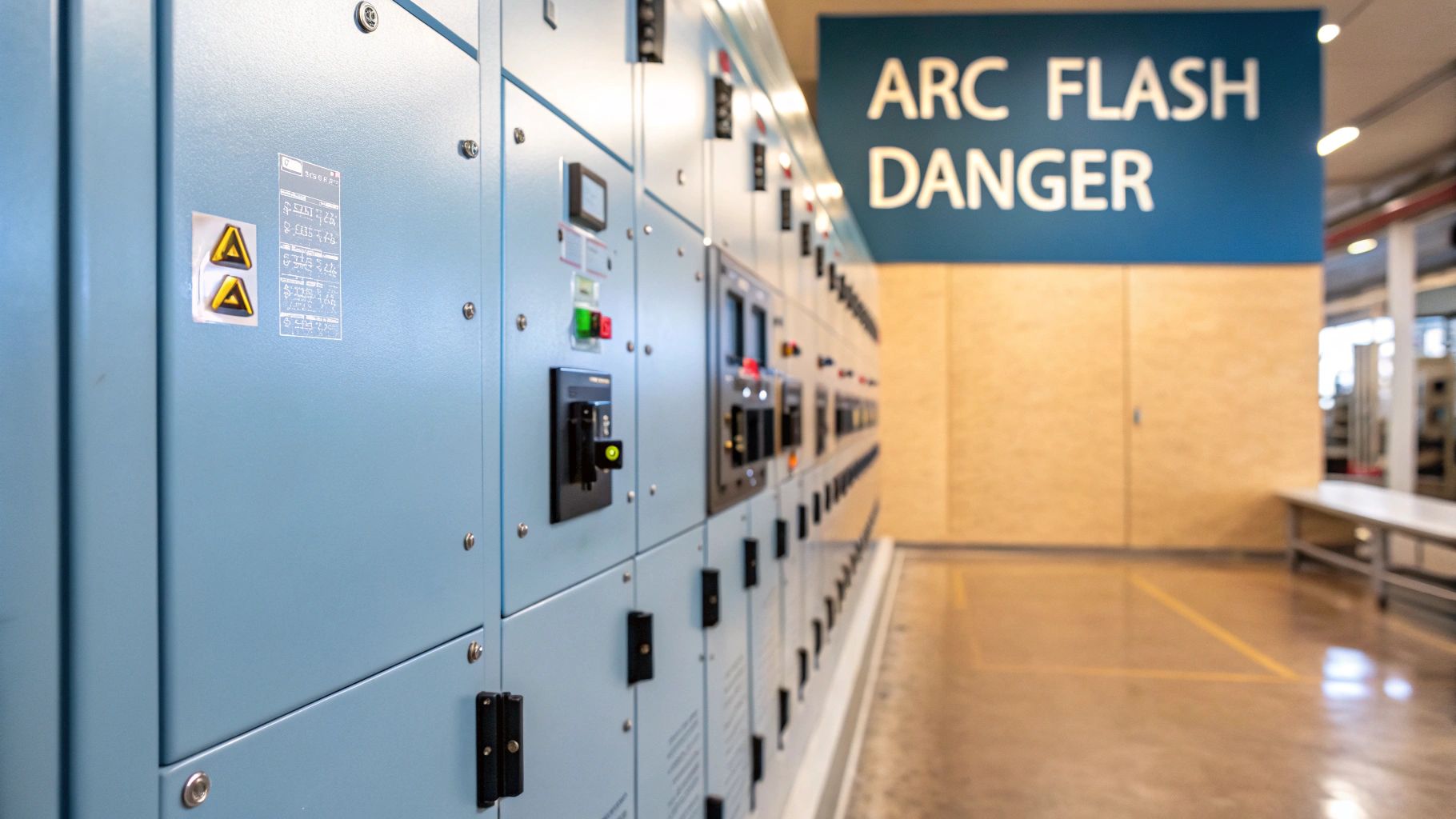
Think of an arc flash as the ultimate short circuit. Instead of the current flowing where it should, it takes a shortcut through the air, creating a plasma arc with temperatures that can rocket past 20,000°C . That’s hotter than the sun’s surface.
This extreme heat instantly vaporises copper conductors, triggering a high-pressure blast wave that throws molten metal and shrapnel at lethal speeds. The aftermath is not just about immediate safety risks; the intense heat can obliterate switchgear, busbars and control cabinets, leading to crippling equipment damage, eye-watering replacement costs and prolonged operational downtime.
Why Modern Energy Systems Are Uniquely Vulnerable
This is not a theoretical problem. The risk of an arc flash is amplified in today's high-power, distributed energy systems. These modern setups concentrate enormous amounts of electrical energy, creating the perfect storm where a simple fault can escalate into a disaster with terrifying speed.
We are seeing this vulnerability in several key areas:
- Rapid EV Charging Hubs: To charge multiple vehicles quickly, these sites handle immense power levels. This sheer concentration of energy dramatically increases the potential fuel for an arc flash.
- Grid-Scale Batteries: Battery Energy Storage Systems (BESS) store and discharge huge amounts of direct current (DC). Unlike AC, a DC arc can sustain itself for longer, leading to far more destructive outcomes.
- EV Charging from Constrained Grid Connections: Sites with weak grid connections often depend on a mix of on-site generation and storage. The complex switching between these sources introduces more potential points of failure.
- Combined On-site Renewables, EV Charging and Batteries: When you integrate solar, batteries and EV charging, you create a complex distributed energy ecosystem. A fault in just one component can cascade through the entire system with devastating consequences.
An arc flash study is essential for quantifying the specific level of hazard at any point where a worker might interact with an electrical system. It provides the data needed to implement appropriate safety measures, including the correct arc protection device.
To get a full picture of the severity and the necessary mitigation strategies, it is vital to be familiar with standards like the NFPA 70E electrical safety guidelines.
For any project manager or engineer working with EV charging, BESS or distributed energy systems, recognising these risks is the first step. The next is understanding a hard truth: traditional circuit breakers are often too slow to prevent a disaster. This is exactly why a dedicated arc protection device is not a luxury—it is an indispensable component for protecting people, assets and operational continuity.
How Arc Protection Devices Stop Catastrophes
While the circuit breakers in your switchgear offer a solid first line of defence against overcurrent, they’re simply not built to win a race against an arc flash. They’re too slow.
An arc protection device, on the other hand, operates on a completely different principle. It’s built for one thing and one thing only: speed. At its heart is a brilliantly simple “detect and trip” mechanism designed to neutralise a fault before it has the chance to become a disaster.
Think of it as a hyper-vigilant security guard inside your switchgear, one equipped with two very specific senses: sight and touch. Instead of patrolling, it uses strategically placed optical sensors (its eyes) and current transformers (its hands) to constantly monitor the electrical system.
Any electrician who has seen an arc flash knows it produces two tell-tale signatures: an incredibly intense, blinding burst of light and at the exact same moment, a massive surge in electrical current. The arc protection device is engineered to look for both of these things happening at once.
The Power of Dual-Criteria Detection
This dual-criteria approach is the secret sauce to its reliability. It needs to see the bright flash of an arc and feel the abnormal current spike to be triggered. This clever design all but eliminates false alarms and the costly, unnecessary shutdowns that come with them.
For instance, a stray camera flash from a maintenance crew might set off the light sensors but it won’t create a current surge. In the same way, a normal operational spike in current – like a large motor kicking into life – won’t be accompanied by an intense light flash. Only a genuine arc flash ticks both boxes, prompting an instantaneous response.
The real value of an arc protection device lies in just how fast it reacts. While a standard circuit breaker might take a sluggish 30 to 50 milliseconds to trip, an arc protection device slams the brakes on in just 2 to 5 milliseconds . That tiny fraction of a second is the difference between a minor, contained fault and a catastrophic equipment meltdown.
Speed is Everything
This incredible speed is the game-changer. By cutting the power almost instantly, the device starves the arc of the energy it needs to grow. It essentially snuffs out the fire before it can become an inferno.
This proactive intervention is absolutely critical for distributed energy resources, where the integrity of the whole system is paramount. For high-value assets like rapid EV charging hubs, grid-scale batteries or microgrids with combined on-site renewables, stopping an arc before it fully develops is key. It protects expensive equipment, ensures the lights stay on and most importantly, safeguards people from devastating injury.
The United Kingdom has shown real leadership in adopting these advanced safety systems. By 2025, the UK is expected to make up 23.6% of the global arc flash protection market, a figure that’s projected to stay strong through to 2035. This is no accident; it’s driven by a robust approach to workplace safety, with bodies like the Health and Safety Executive (HSE) and the Institution of Engineering and Technology (IET) shaping industry best practices. You can explore more data on the global arc flash protection market to see these trends for yourself.
Protecting EV Charging Infrastructure from Arc Faults
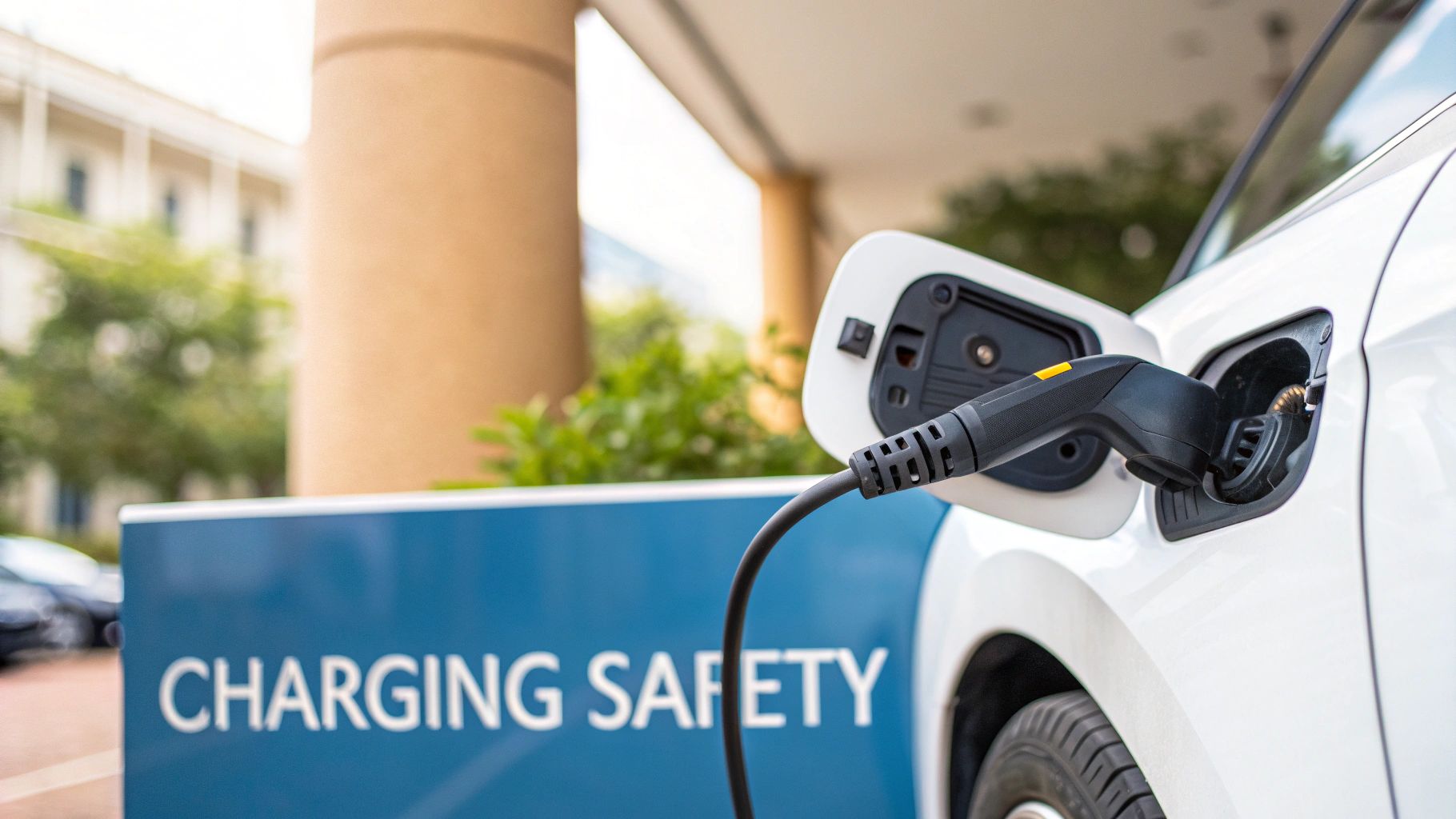
As electric vehicle charging infrastructure expands at a blistering pace, so do the electrical safety stakes. A single rapid or ultra-rapid EV charger is already handling immense power levels to get drivers back on the road quickly. Now, picture a hub with multiple units concentrating that energy. It creates a high-risk environment where a seemingly minor fault can snowball into a major catastrophe.
This intense power demand, coupled with the daily cycle of plugging and unplugging, puts the entire electrical system under considerable stress. Every connection is a small but real opportunity for wear and tear on cables and connectors, which is often the first step towards a dangerous fault. An arc protection device is built for precisely these high-stakes situations, acting as a silent guardian against disaster.
And the risks are not just inside the charger itself. A potential fault can pop up at numerous points across the entire charging ecosystem.
Common Arc Fault Scenarios in EV Charging
An arc fault can spring from several weak points in a charging setup, which is why a blanket approach to protection is so important. The sheer speed and intensity of rapid EV charging amplify the energy that can be unleashed during a fault, highlighting the absolute need for a safety system that reacts in the blink of an eye.
Here are the key areas of vulnerability:
- Internal Charger Electronics: The complex power electronics that convert AC grid power to DC for the vehicle's battery are the heart of the charger and they operate under a heavy load. A failure here is a primary cause of internal arc faults.
- High-Voltage Cabling: Those heavy-duty cables linking the charger to the switchgear, or the charging cable itself, can get damaged over time from physical strain or harsh weather, creating a serious fault risk.
- Grid Connection Point: The switchgear where the charging station taps into the local grid is a critical junction. A fault at this point will not just damage the charging assets; it can disrupt the local power supply for everyone.
This demand for robust safety is not limited to fixed installations, either. Mobile EV charging units, which give fleets and roadside assistance crews incredible flexibility, come with their own set of challenges. Their portable nature and ever-changing connection points demand the same level of protection. Likewise, installing chargers on sites with grid constraints often requires complex electrical work, multiplying the potential failure points. For all these systems, an arc protection device is a non-negotiable layer of safety.
In every one of these scenarios, an integrated arc protection device is the key to ensuring the safety of the public, maintenance crews and the valuable charging assets themselves. Its power to detect and snuff out an arc in milliseconds is what prevents catastrophic equipment failure and secures the long-term reliability of the investment.
Integrating Batteries and Renewables
Many forward-thinking EV charging projects now bring grid-scale batteries and on-site renewables like solar panels into the mix. This helps manage energy costs and sidestep grid limitations, creating a sophisticated distributed energy system. The downside? A fault could now cascade between the different components. You can learn more about how these systems work in this comprehensive overview of battery-backed EV charging.
In an integrated setup like this, the arc protection device becomes even more vital. It acts as a centralised safety brain, monitoring the entire system and instantly isolating a fault before it can jump from the charger to the battery, or vice versa. Getting the integration right is absolutely crucial and consulting an expert EV charger installation guide is vital for ensuring total safety. Ultimately, this rapid-fire response is what underpins the safety and operational continuity of the entire site.
Protecting BESS and Distributed Energy Systems
Battery Energy Storage Systems (BESS) and decentralised distributed energy systems are fast becoming the backbone of our modern energy infrastructure. They are what make everything from grid-scale frequency response to rapid EV charging from a constrained grid connection possible. But with this great power comes a unique and potent risk: arc flash.
The heart of the problem is their reliance on direct current (DC). Unlike the alternating current (AC) in our homes that naturally hits zero volts many times a second—which helps extinguish an arc—a DC arc is a stubborn, relentless beast. Once it starts, it does not want to stop. It just keeps pumping out a devastating amount of thermal energy, which is why a specialised arc protection device is absolutely essential in these DC-heavy environments.
Even with the UK's advanced safety regulations, arc flash incidents remain a serious issue. The Health and Safety Executive (HSE) officially records around 1,000 electrical incidents at work each year, with roughly 25 of those being fatal. Industry insiders, however, will tell you the real number of arc flash events is much higher, as countless smaller incidents go unreported. You can get a feel for just how overlooked this risk is from discussions among leading UK electrical engineering communities.
Preventing Thermal Runaway in Battery Banks
One of the scariest scenarios in any BESS installation is thermal runaway . It’s a catastrophic chain reaction where a rise in temperature in one cell causes it to release more energy, which heats up its neighbours, leading to an uncontrollable fire that can be explosive. A common trigger? An internal arc fault right inside the battery bank.
An arc flash inside a battery module or connection cabinet can generate the intense, focused heat needed to damage a cell and set off that disastrous domino effect. Your standard fuse or circuit breaker is simply not fast enough to intervene.
An arc protection device, with its millisecond-level reaction time, is the only technology that can detect the initial flash and cut the DC supply before the heat has a chance to compromise a battery cell. It’s the critical failsafe that stops a small electrical fault from spiralling into a dangerous and unstoppable chemical event.
This rapid response is not just a safety feature; it is fundamental to the operational health and longevity of these high-value assets. But protecting the batteries is only one piece of the puzzle.
Safeguarding Inverters and Switchgear
BESS and distributed energy systems are complex ecosystems. They are a web of critical components—inverters, switchgear, control panels—all working together to manage energy flowing between solar arrays, batteries, EV chargers and the grid. Every single one of these connection points is a potential arc flash hazard.
Think about it: an arc fault in the main switchgear that connects a BESS unit to the grid could wipe out the entire control system. That could take the asset offline for weeks and lead to eye-watering repair bills. Likewise, a fault inside a large-scale solar inverter could not only destroy the unit but also send a damaging surge back to the battery or out into the wider grid.
- Protecting Inverters: The device monitors the AC/DC conversion point, a high-stress area where faults are common.
- Securing Switchgear: It provides high-speed protection for the main breakers and busbars that act as the central nervous system for the distributed energy system.
- Ensuring Grid Stability: By isolating a fault in an instant, it prevents a local problem from causing wider grid disturbances.
A correctly specified arc protection device throws a blanket of high-speed protection over all these crucial components. It ensures that a fault anywhere in the system is contained immediately, safeguarding the whole network. You can explore how all these parts fit together in our guide to UK battery energy storage systems for 2024. This proactive approach to safety is what truly underpins the reliability and financial success of modern energy projects.
How to Select the Right Arc Protection Solution
Choosing the correct arc protection device is not a one-size-fits-all exercise. The right solution is a carefully considered choice, based on the unique electrical DNA of your project. Getting this decision right is vital for ensuring the system delivers the high-speed safety it promises, whether you are protecting an outdoor rapid EV charging depot, a constrained grid connection or a containerised BESS.
For any project manager or engineer, the task is to analyse several core factors to specify a device that aligns perfectly with the operational realities of the site. Think of this selection process as a decision-making framework, ensuring your investment provides maximum protection and integrates smoothly with your existing infrastructure.
Assessing Your System's Technical Requirements
The first step is always a technical deep dive into your electrical system. Different environments present distinct challenges and the arc protection device you choose must be robust enough to handle the worst-case scenario.
Key technical specifications you need to evaluate include:
- System Voltage: The device has to be rated for the maximum voltage of your system. This could be a 400V AC setup for commercial EV chargers or a much higher 1500V DC system for a grid-scale battery.
- Prospective Fault Current: You absolutely must know the maximum fault current your system can produce. The device’s current transformers and crucially, the connected switchgear must be able to withstand and interrupt this massive level of energy.
- Physical Environment: An indoor BESS container has completely different environmental demands from an outdoor switchgear cabinet exposed to the British weather. You need to consider temperature ranges, humidity and potential contaminants when selecting sensor types and relay enclosures.
Matching the Device to the Application
Beyond the raw numbers, the application itself dictates very specific needs. A mobile EV charging unit, for instance, has a different risk profile compared to a static, grid-scale battery tied into on-site renewables. Your selection has to account for these operational nuances.
A rapid EV charging hub with frequent public interaction, for example, demands the fastest possible tripping times to minimise any potential exposure. In contrast, a large BESS might need a more complex, multi-zoned protection scheme with numerous optical sensors to pinpoint the exact location of a fault within multiple battery racks.
This decision tree shows how arc flash risks in a BESS can stem from either the DC or AC side of the system, each requiring its own specific protection strategies.
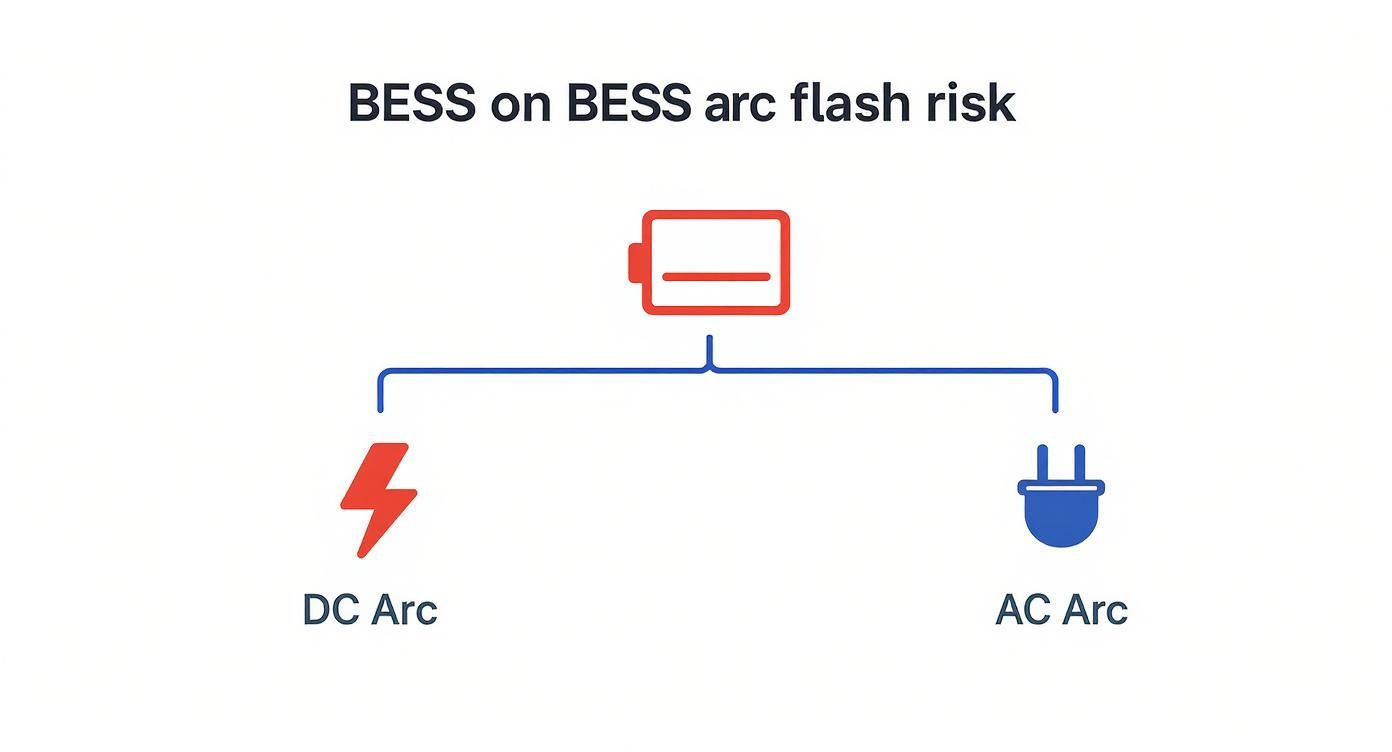
As the diagram highlights, both the battery packs (DC) and the inverters/grid connection (AC) are critical points of failure. This really reinforces the need for comprehensive sensor coverage across the entire installation.
To bring this together, let’s look at how these criteria play out across different common applications. The priorities shift depending on the environment and the primary risks involved.
Arc Protection Device Selection Criteria for Key Applications
| Selection Criterion | Rapid EV Charging Hub | Grid-Scale BESS | EV Charging from Constrained Grid Connection |
|---|---|---|---|
| Primary Safety Goal | Protect public users and maintenance staff from exposure. | Prevent catastrophic fire/explosion and protect high-value assets. | Ensure grid stability and protect upstream infrastructure. |
| Key Technical Spec | Ultra-fast trip time (typically < 4ms ) is paramount. | Multi-zone detection to isolate faults within specific racks or containers. | High fault current withstand and interruption capability. |
| Sensor Type | Point optical sensors in switchgear and charger cabinets. | A mix of point and fibre optic loop sensors for broad coverage. | Robust point sensors and reliable current transformers. |
| Integration Needs | Simple trip signal to main incomer; potential for charger-level isolation. | Deep integration with EMS and Battery Management System (BMS) for diagnostics. | Communication with SCADA and Distribution Network Operator (DNO) systems. |
| Environmental Demands | Outdoor-rated enclosures ( IP65 +) to handle weather exposure. | Controlled indoor environment, but requires monitoring for off-gassing. | High durability for outdoor substation or switch-room environments. |
This table illustrates that while the core technology is similar, the way you specify and deploy it has to be tailored to the job at hand. The "best" device for a BESS might be overkill for a simple grid connection point, or inadequate for a public EV hub.
Ensuring Seamless System Integration
An arc protection device does not work in isolation. Its effectiveness hinges on its ability to communicate flawlessly with the wider energy ecosystem, particularly your main switchgear and any Energy Management System (EMS).
Seamless integration is non-negotiable. The arc protection relay must send an unambiguous trip signal to the main upstream circuit breaker in milliseconds. Any delay or communication error completely negates the benefit of high-speed detection.
Because of this, compatibility is a crucial selection criterion. The relay you choose must have outputs that are compatible with your breaker’s trip coil. For distributed energy systems, its ability to integrate with the EMS is also key for remote monitoring, fault logging and diagnostics. This ensures that when a safety event does occur, your operations team is notified instantly and has the data needed to respond effectively.
Best Practices for Installation and Maintenance
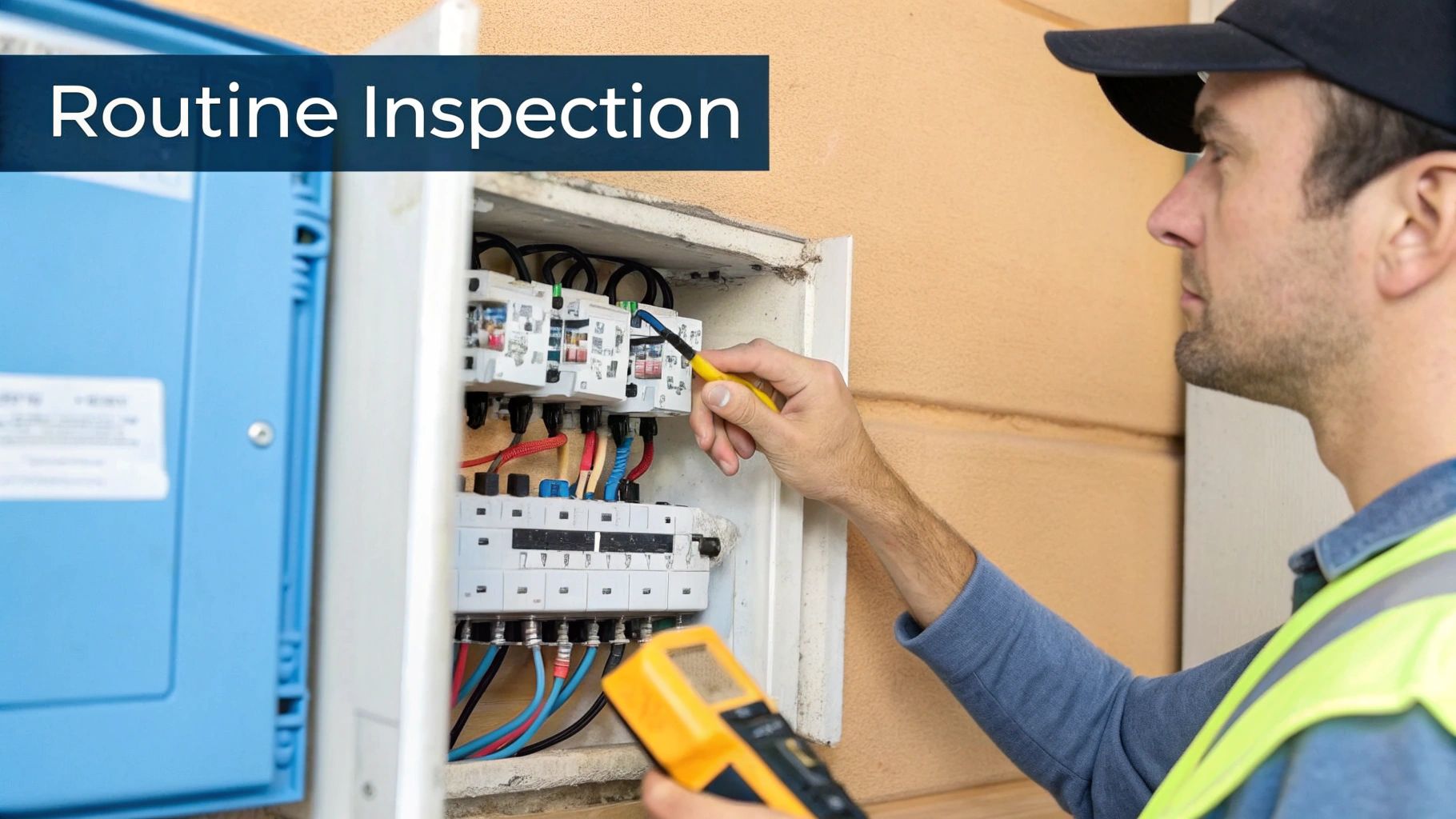
An advanced safety system like an arc protection device is only as reliable as its installation and upkeep. Even the most sophisticated relay is useless if it’s wired incorrectly or left unchecked. For facility managers and technicians, this means sticking to a strict set of best practices to ensure the device offers unwavering protection for its entire service life.
A proper installation is the bedrock of dependable performance. It’s a meticulous process where every detail, from sensor placement to final commissioning, is paramount.
Key Installation Practices
Getting the installation right is about more than just mounting a relay in a panel. It’s a strategic exercise to make sure every component works in perfect harmony, ready to detect and kill a fault in milliseconds. This precision is what safeguards high-value assets like rapid EV chargers and grid-scale batteries.
Here are the essential steps for a flawless setup:
- Strategic Sensor Placement: Optical sensors need a clear line of sight to all potential arc hot spots inside a switchgear compartment. Think busbars, cable terminations and circuit breaker connections. Any obstruction creates a dangerous blind spot.
- Correct CT Installation: Current transformers (CTs) must be fitted to the right incoming feeders and oriented properly to measure current flow accurately. Get this wrong and the system might completely miss the overcurrent condition needed to trigger a trip.
- Secure Trip Wiring: The wire running from the arc relay’s trip output to the upstream circuit breaker's shunt trip coil is the single most critical link in the chain. This connection must be secure, direct and correctly rated to guarantee the breaker gets the signal, no exceptions.
Commissioning is not just a final tick-box exercise; it is a vital verification process. You must perform a full functional test using a test lamp or flash simulator to trigger the light sensors, alongside primary or secondary injection to test the current inputs. This confirms the entire "detect and trip" sequence works exactly as designed.
Creating a Proactive Maintenance Schedule
Once installed, your arc protection device needs a consistent maintenance schedule to verify its integrity and ensure it meets UK safety standards. This is not a huge burden—just a manageable routine of periodic checks and tests. A proactive approach to maintenance ensures the device remains a reliable guardian for your EV charging infrastructure and distributed energy assets.
Developing a solid servicing plan is crucial for long-term safety. For a wider view on looking after your assets, you might find our insights on a complete guide to UK EV charger servicing helpful in shaping your overall maintenance strategy.
A typical maintenance schedule should include a few key activities to keep the system in peak condition.
- Annual Visual Inspection: A technician should visually inspect every component—relay, sensors and wiring—for any signs of damage, corrosion or loose connections. Pay close attention to sensor lenses to make sure they’re clean and free from any dust or debris that could block light.
- Functional Testing: At least once every three years , a full functional test should be repeated, just like the one done during commissioning. This re-verifies that the sensors, relay logic and trip circuit are all operating within their specified parameters.
- Record Keeping: Keep meticulous records of all installation, commissioning and maintenance activities. This logbook provides a complete health history of the system and is essential for proving due diligence and compliance with regulations like the Electricity at Work Regulations 1989 .
Frequently Asked Questions
When you are dealing with high-power systems, practical questions always come up. Whether you are a project developer, site owner or engineer, getting clear answers is essential for moving forward. Here, we tackle some of the most common queries we hear, especially from those managing rapid EV charging hubs, mobile EV charging fleets and battery storage projects across the UK.
Is an Arc Protection Device Required by UK Regulations for EV Charging Sites?
There is not a single regulation that points to EV charging sites and says, "you must install an arc protection device". However, that is not the whole story. The real driver here is the Electricity at Work Regulations 1989 , which puts the responsibility on you to conduct a thorough risk assessment and ensure your systems are safe.
For any high-power setup—think rapid EV charging hubs or sites blending grid-scale batteries with on-site renewables—the risk of an arc flash is very real. Installing an arc protection device shifts from being a "nice-to-have" to an essential part of demonstrating due diligence. It shows you’ve taken every reasonably practicable step to mitigate a known and potentially catastrophic hazard. For most commercial-scale distributed energy projects, it’s a critical layer of defence.
How Does an Arc Protection Device Differ from a Standard Circuit Breaker or RCD?
This is a great question because it gets to the heart of what makes these devices so effective. A standard circuit breaker or fuse is designed to trip on overcurrent but by the time it reacts, an arc flash event is already well underway and causing damage. An RCD (Residual Current Device) is different again; it’s there to protect people from electric shock by detecting tiny imbalances in current but it won’t do a thing against a powerful line-to-line arc fault.
An arc protection device plays a completely different game. It uses a combination of optical light sensors and current sensors . This dual approach allows it to spot the tell-tale intense flash of an arc at the instant it ignites and trip the main breaker in just a few milliseconds. That incredible speed is what stops the arc in its tracks before it can destroy your equipment.
The core difference is speed and detection method. Breakers and RCDs react to current irregularities, which is often too late. An arc protection device is proactive, using light as the primary trigger to act almost instantly and prevent the incident from escalating.
Can I Retrofit an Arc Protection Device into My Existing Switchgear?
Absolutely. In fact, retrofitting is one of the most common and cost-effective ways to bring older sites up to modern safety standards, particularly those utilising EV charging from constrained grid connections or integrating on-site renewables. Arc protection relays are specifically designed to be integrated into existing switchgear panels without a complete overhaul.
The process is pretty straightforward:
- Optical sensors are installed inside the high-risk compartments of your switchgear.
- Current transformers are connected to the main electrical feeders to monitor current flow.
- The relay's trip output is wired directly into your main circuit breaker's shunt trip coil.
This adds a modern, high-speed safety system without the massive cost and downtime of replacing the entire switchgear assembly. It’s the perfect solution for giving older but still perfectly functional infrastructure a vital safety upgrade.
At ZPN Energy , we specialise in creating bespoke, battery-backed energy solutions that prioritise safety and reliability. From rapid EV charging infrastructure that works on constrained grid connections to advanced grid-scale BESS and combined on-site renewables, our distributed energy systems are engineered for the future. Discover how our integrated approach can safeguard your energy assets.