UK Electric Car Running Cost Calculator
Thinking about swapping your petrol car for an electric one? The first thing people look at is the fuel savings but that’s only a tiny part of the story. To get the real financial picture you need an electric car running cost calculator.
This isn't just about comparing prices at the pump versus your home electricity bill. It's a tool that digs into your specific driving habits, charging routines and energy tariffs to paint an honest picture of your true cost of ownership.
Understanding Your True EV Running Costs
To really get to grips with what an EV will cost you month-to-month and year-to-year you have to think beyond the sticker price. That’s where the concept of Total Cost of Ownership (TCO) comes in. It’s a much smarter way of looking at the numbers.
TCO covers every single expense you’ll face over the car's lifetime. We're talking about the energy you use obviously but also insurance, regular maintenance and even future tax changes like the upcoming Vehicle Excise Duty (VED) for EVs. It all adds up.
Key Variables in Your Calculation
A few crucial factors will swing your final running costs one way or the other and any decent calculator will need these details to give you an accurate forecast.
- Your Annual Mileage: This is the big one. The more you drive the more you stand to save on fuel but your charging costs will naturally be higher. It’s the starting point for any meaningful calculation.
- Electricity Tariffs: This is where it gets interesting. Your home energy tariff makes a massive difference, especially if you can get an off-peak or EV-specific rate for overnight EV charging. Public rapid EV charging is a different beast altogether and costs a lot more.
- Charging Habits: Where you charge is just as important as when. A simple mix of cheap, convenient home top-ups and the occasional expensive rapid charge on a long journey will determine your average cost per mile. Shifting even a small percentage of your EV charging to home can unlock huge annual savings.
The Financial Reality of UK EV Ownership
When you run the numbers the case for going electric in the UK is pretty strong. Take a typical petrol car doing 10,000 miles a year – that’s likely to set you back around £1,565 in fuel alone.
Now compare that to an EV driving the same distance. With a sensible mix of home and public EV charging you could be looking at an electricity bill of just £600 . That’s a potential saving of nearly £1,000 every single year.
If you want to dive deeper and ensure you're accounting for every variable it helps to adopt the mindset used for building robust financial models. This approach helps you build a comprehensive forecast, whether it's for your personal car or an entire commercial fleet.
Getting the Right Numbers for Your Calculation
Any good electric car running cost calculator is only as sharp as the data you put into it. To get beyond vague estimates and create a proper financial forecast you need to pull together some specific figures about your car and how you drive. This groundwork is vital, whether you're a private owner trying to get a handle on monthly costs or a fleet manager planning a major rollout.
First up the most important metric: your vehicle's efficiency. This is measured in miles per kilowatt-hour (kWh) , the electric version of miles per gallon. You’ll find this in your car’s manual or on the manufacturer's website but always remember that real-world efficiency changes with your driving style, the weather and even the terrain.
Next you need an honest look at your annual mileage. Don't just pluck a number out of the air. Check past MOT certificates or even better track your mileage for a month and multiply by twelve. This number is the foundation of your entire calculation as it drives everything from your total energy use to your servicing schedule.
Pinpointing Your Energy Costs
Your electricity tariff is where the biggest savings are either made or missed. Just using the standard rate from your supplier won't cut it for an accurate picture. You need to dig out a recent bill and find the exact price per kWh you're paying.
Many energy companies now offer specialist EV tariffs which give you access to much cheaper electricity during off-peak hours—usually overnight. If you're on one of these you’ll need two figures:
- The peak rate per kWh (your standard daytime price).
- The off-peak rate per kWh (the cheaper overnight price).
It's worth remembering that a dedicated EV tariff can slash your EV charging costs by more than 70% compared to a standard flat rate. Scheduling your charging to fall exclusively in these cheaper windows is the single best thing you can do to keep running costs low.
Getting your head around the term kWh is fundamental to this whole process. If you need a quick refresher our guide on what kWh means explained simply breaks it all down. This knowledge is key to making sense of your energy bills and charging expenses.
Factoring in Public and Rapid EV Charging
While EV charging at home is always the cheapest way to go you're bound to need public chargers for longer trips. The costs here can vary wildly so a little research is needed. Think about the major routes you travel and identify the rapid EV charging networks you're most likely to use then check their pricing.
Costs for public rapid EV charging can be anywhere from 55p to 89p per kWh , a significant jump from home charging. For your calculation you'll need to estimate the split between charging at home versus on the public network. For many UK drivers a split of 80% at home and 20% on the road is a realistic starting point.
Looking Beyond the Electricity Bill
A true running cost calculation goes beyond just the charger. You also need to gather the other key expenses that come with EV ownership. They're often lower than for a petrol or diesel car but they must be included for an accurate total.
First look at insurance. Get a few quotes for your specific EV model as premiums can differ from their internal combustion engine counterparts. Next is maintenance. While EVs have fewer moving parts and generally cost less to service you should still budget for an annual check-up, tyres and brake fluid changes.
Finally think about Vehicle Excise Duty (VED) or road tax. While EVs are currently exempt new rules mean that from April 2025 newly registered EVs will have to pay. For your forecast you should include the standard rate which is planned to be £195 per year after the first year. Bringing all these figures together gives you the inputs needed to build a comprehensive and reliable cost model.
Calculating Your EV Charging Expenses
When you switch to an electric vehicle the fuel cost is replaced by electricity. This is easily the biggest running expense you'll have but it's also where you'll find the most significant savings compared to running a petrol or diesel car. To get a real sense of what you'll be spending you need to look at where you charge, what you're paying for electricity and how efficiently your car uses that power.
Let's start by breaking down the basic calculation that sits at the heart of any good running cost forecast: your cost per mile.

As you can see getting an accurate forecast is all about combining your car's efficiency with your mileage and specific electricity tariff.
Nailing Your Home Charging Costs
For most EV drivers EV charging at home is by far the cheapest and most convenient option. To work out the cost you just need two key figures: what you pay for electricity (in pence per kWh) and your car's efficiency (in miles per kWh).
The formula is pretty simple: Cost per Mile (£) = Electricity Price per kWh (£) / Vehicle Efficiency (miles per kWh)
Let's run through a quick example. Imagine your standard electricity rate is £0.25 per kWh and your EV averages 3.5 miles per kWh .
- The calculation is: £0.25 / 3.5 miles = £0.07 per mile .
If you cover 10,000 miles in a year your total charging cost comes out to £700 . Straight away you can see how much cheaper that is than filling up with petrol.
The Real Savings: Off-Peak and EV Tariffs
But here's where it gets really interesting. The true game-changer for home EV charging is switching to an off-peak or a dedicated EV electricity tariff. These tariffs give you access to much cheaper electricity overnight when demand on the national grid is low.
Let's plug a typical off-peak rate of £0.08 per kWh into our formula.
- The new calculation: £0.08 / 3.5 miles = £0.023 per mile .
Suddenly that annual cost for driving 10,000 miles drops to just £230 . It’s a massive saving and it shows just how vital smart, scheduled charging is for keeping your running costs to an absolute minimum.
What About Public and Rapid Charging?
Of course you won't always be charging at home. For longer journeys you'll need to rely on the public EV charging network and this is where costs can vary wildly. The price you pay depends on the network you use and crucially the speed of the charger.
- Destination Chargers (7-22kW): You'll find these at places like supermarkets or public car parks. They're slower but often much cheaper – some are even free to use while you shop.
- Rapid & Ultra-Rapid Chargers (50kW+): These are the ones you'll find at motorway service stations. They're designed for speed but that convenience comes at a price, often between £0.55 and £0.89 per kWh .
Let's see what a rapid charge at £0.75 per kWh does to our cost per mile:
- The calculation: £0.75 / 3.5 miles = £0.21 per mile .
That’s nearly ten times more expensive than charging on an off-peak home tariff. It's a stark reminder that relying exclusively on the rapid EV charging network isn't a great financial strategy. If you want to dive deeper our guide on the UK electric vehicle charging networks explained is a great place to start.
The Blended Cost: Getting a Realistic Figure
In the real world most drivers use a mix of EV charging methods. You'll do the bulk of your charging at home but top up on the public network when needed. To get a truly accurate budget you need to calculate a "blended" cost per mile that reflects this reality.
Let's imagine a typical scenario for a UK driver:
- 80% of charging is done at home on that cheap off-peak tariff ( £0.08/kWh ).
- 20% of charging uses public rapid EV chargers ( £0.75/kWh ).
To work out the blended rate you just weight each cost by how much you use it.
- Home Cost: £0.08/kWh * 0.80 = £0.064
- Public Cost: £0.75/kWh * 0.20 = £0.150
- Blended Rate: £0.064 + £0.150 = £0.214 per kWh
Now we can calculate our true, blended cost per mile:
- Blended Cost per Mile: £0.214 / 3.5 miles = £0.061 per mile .
- Annual Cost (10,000 miles): 10,000 miles * £0.061 = £610 .
This blended approach gives a much more dependable figure for your annual electricity spend. It balances the incredible value of home charging with the occasional, higher cost of topping up on the road.
To make this clearer here’s a table showing how a blended charging strategy breaks down over a year for an EV driver covering 10,000 miles.
Sample EV Charging Cost Calculation Based on Charging Mix
| Charging Type | Percentage of Use | Cost per kWh | Annual kWh Used | Annual Cost |
|---|---|---|---|---|
| Home Off-Peak | 80% | £0.08 | 2,286 | £182.88 |
| Public Rapid | 20% | £0.75 | 571 | £428.25 |
| Total / Blended | 100% | £0.214 | 2,857 | £611.13 |
As the table shows even with a portion of expensive rapid EV charging the overall annual cost remains incredibly low compared to a petrol or diesel equivalent. This is the power of a smart, mixed charging routine.
Factoring in Costs Beyond the Charger
While the cost of electricity is obviously a huge part of the running cost equation a true financial picture only emerges when you look beyond the charger. To get a handle on the Total Cost of Ownership you have to account for all the other expenses that come with keeping a car on the road.
These are the costs that often get overlooked but make a massive difference to your long-term budget.
Fortunately this is where EVs often pull even further ahead of their petrol and diesel counterparts. The savings don't just stop at the 'pump'; they extend into maintenance, tax and other day-to-day expenses.
Maintenance and Servicing Savings
One of the most significant long-term benefits of owning an EV is the dramatically lower maintenance bill. An internal combustion engine is a complex beast with hundreds of moving parts—pistons, valves, spark plugs, belts and exhaust systems—all of which wear out and need regular, often expensive, attention.
An electric motor by contrast is beautifully simple with very few moving parts. This straightforward design means there are far fewer things that can go wrong.
- No oil changes: Forget annual engine oil replacements.
- No exhaust system: You'll never have to pay for a new catalytic converter or silencer.
- Fewer filter changes: Air and fuel filters are a thing of the past.
- Reduced brake wear: Regenerative braking does most of the work, using the electric motor to slow the car. This significantly reduces wear and tear on your brake pads and discs.
Because of this the annual service for an EV is often up to 50% cheaper than for an equivalent petrol car. Over the lifetime of the vehicle these savings can easily add up to thousands of pounds.
Upcoming Changes to Vehicle Excise Duty
For years EV drivers in the UK have enjoyed a welcome exemption from Vehicle Excise Duty (VED) or 'road tax'. It’s been a great incentive but it’s about to change.
From 1st April 2025 new electric cars registered on or after this date will be required to pay VED. In the first year they will pay the lowest rate which is currently £10 . From the second year they’ll move to the standard annual rate currently £195 .
While this adds a new expense it simply brings EVs in line with other vehicles and is still far lower than the VED for higher-emission petrol cars. When you're looking at the full picture it's also important to understand the taxable benefits associated with company cars, including electric vehicles.
Looking further ahead the government is planning a new 'pay-per-mile' system. From April 2028 EV owners will likely pay around 3p per mile . For a typical driver covering 8,500 miles annually that adds about £255 to £260 per year. Although it’s an increase it remains a fraction of the 12–15p per mile that petrol drivers currently pay in fuel duty alone.
Insurance and Depreciation Factors
Insurance premiums for electric vehicles have at times been a bit higher than for comparable petrol models. This is often down to their higher purchase price and the specialist skills and parts needed for repairs, particularly for the battery pack. But as more EVs hit the road and the repair network matures these price differences are beginning to narrow.
Depreciation—the value a car loses over time—is the single biggest cost for most new car owners. In the early days EVs depreciated faster than petrol cars due to rapidly evolving tech and worries over battery longevity.
This trend has now completely flipped. Strong demand for used EVs and much longer battery warranties mean that many popular electric models now hold their value better than their petrol or diesel equivalents, protecting your investment for longer.
To bring all this together the table below gives a clearer picture of how the annual running costs stack up for a typical family car, showing exactly where the EV savings really make a difference.
Annual Running Cost Comparison Petrol vs Electric Vehicle
| Cost Category | Petrol Car (Annual Cost) | Electric Vehicle (Annual Cost) |
|---|---|---|
| Fuel / Electricity | £1,565 | £610 |
| Maintenance & Servicing | £400 | £200 |
| Vehicle Excise Duty (VED) | £195 | £195 (from year two) |
| Insurance (Illustrative) | £750 | £850 |
| Total Annual Running Cost | £2,910 | £1,855 |
As you can see even when factoring in slightly higher insurance and the new VED rules the savings on fuel and maintenance create a significant gap. An EV owner in this scenario is looking at saving over £1,000 every single year .
Advanced Strategies for Commercial Fleets
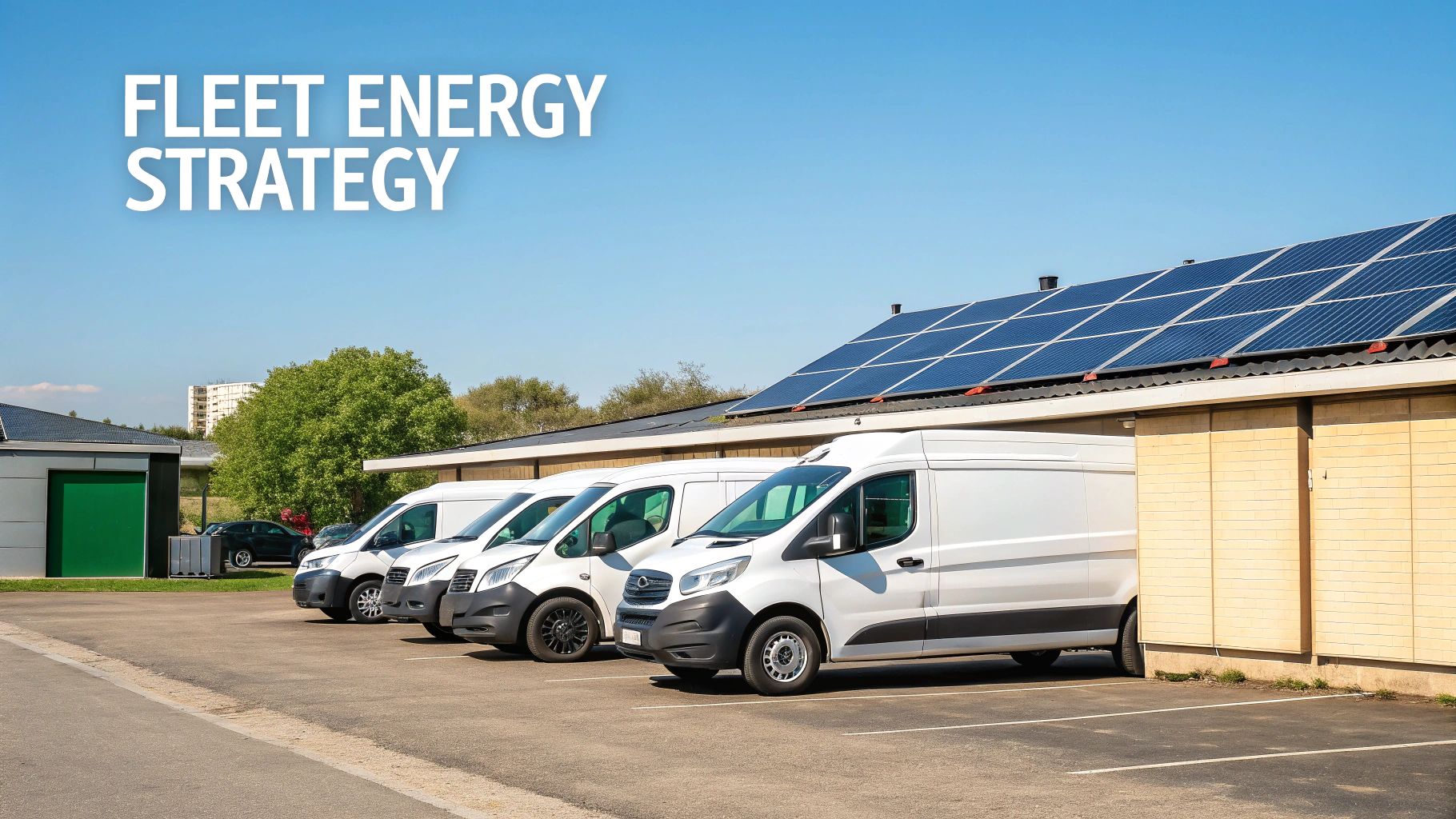
When you're running a commercial fleet calculating EV costs is a whole different ball game. It’s less about individual vehicles and more about large-scale energy management.
Imagine this: your entire fleet returns to the depot at 5 pm and plugs in. The sudden demand can put immense strain on your grid connection, leading to eye-watering upgrade costs and crippling demand charges from your supplier.
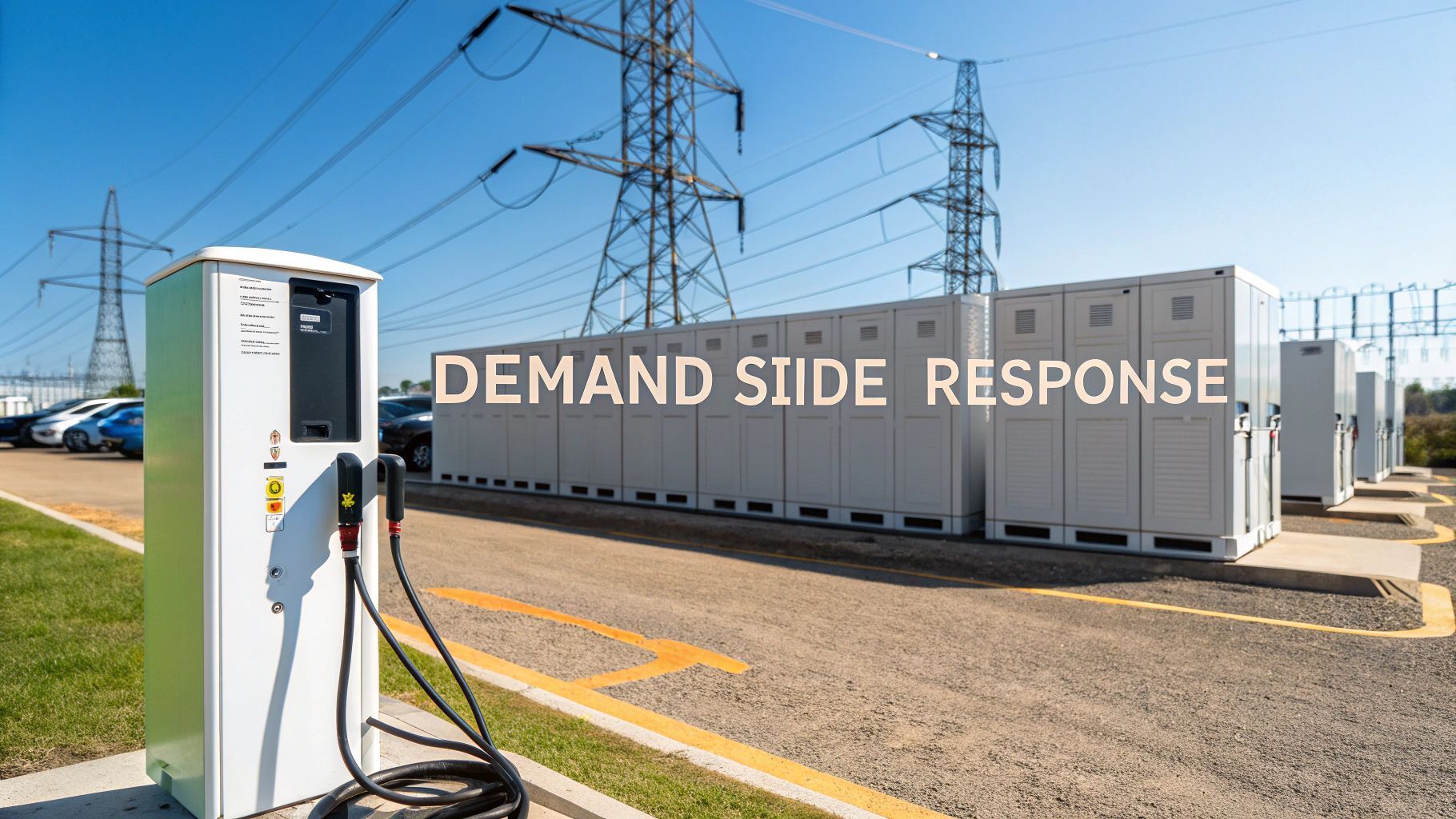
But with a strategic approach this challenge becomes a serious competitive advantage. By treating your charging infrastructure as an integrated energy asset you can slash operational costs and even open up new revenue streams. We're moving beyond a simple cost calculator and into a total energy cost model focusing on distributed energy resources.
The trick is to stop thinking about simple unmanaged EV charging and start building a smarter, more dynamic system.
EV Charging from Constrained Grid Connections
Many commercial depots are working with a constrained grid connection. There just isn't enough power available to rapid-charge an entire fleet at once. The go-to solution—a costly and time-consuming grid upgrade—often isn't a practical option.
This is where smart charging and load balancing come into their own. Instead of every charger firing up at full power simultaneously a smart system intelligently shares the available electricity. It can prioritise vehicles that need to be out first or have the lowest battery levels, ensuring every van is ready for its next shift without tripping the main breaker.
A business can often deploy a huge number of chargers on its existing grid connection simply by managing the electrical load dynamically throughout the night. This strategy alone can save tens or even hundreds of thousands of pounds in avoided infrastructure upgrades.
Grid Scale Batteries and Combined On-Site Renewables
Ready to take your cost savings to the next level? Start generating and storing your own power. Combining on-site renewables like solar panels with grid scale batteries in a Battery Energy Storage System (BESS) completely rewrites the economics of fleet EV charging and batteries.
During the day solar panels can generate huge amounts of free, green electricity. A BESS is there to capture every spare kilowatt that isn’t immediately used by the building or for vehicle charging. Come evening you can unleash that stored solar power to charge the fleet, bypassing expensive peak-rate grid electricity entirely.
A BESS gives fleet operators some powerful tools:
- Peak Shaving: Store cheap energy—from your solar panels or off-peak grid tariffs—and use it during the most expensive peak demand periods.
- Grid Independence: It acts as a buffer against power cuts, making sure your fleet operations continue without a hitch.
- Revenue Generation: You can even use a BESS to provide grid balancing services, selling stored energy back to the grid when it's most needed and creating a valuable income stream.
Your depot transforms from a simple energy consumer into an active player in the energy market. For a deeper look at the practicalities our guide to fleet EV charging for UK businesses maps out the entire process.
The Power of Mobile EV Charging
For many fleets vehicle uptime is everything. Taking a vehicle off its route and sending it back to a depot just to charge is a drain on efficiency and profits. This is where mobile EV charging solutions can deliver a huge operational win.
Instead of the vehicle returning to a central hub the charger comes to the vehicle. A mobile EV charging unit, often powered by a substantial battery, can be deployed to a vehicle's location during its scheduled downtime—while the driver is on a lunch break or during loading for instance.
This approach keeps your vehicles on their routes for longer, maximising productivity and revenue-generating hours. It also means you don't need all your EV charging infrastructure crammed into a single, potentially grid-constrained depot.
For businesses where every minute of vehicle availability counts mobile EV charging is more than a convenience; it's a core strategic tool. By integrating these advanced energy strategies fleet operators can drive down running costs to the absolute minimum, turning electrification into a powerful engine for profitability.
Answering Your Top Questions on EV Running Costs
Even after running the numbers you're bound to have a few lingering questions about the day-to-day realities of EV ownership. It's only natural. So let's tackle some of the most common queries we hear, moving beyond the spreadsheet to give you the practical answers you need.
We’ll dig into the real-world issues that can hit your wallet, from the upfront cost of getting a charger set up at home to how your EV might handle a classic British winter.
What Does It Really Cost to Get a Home EV Charger Installed?
Getting a dedicated charge point installed at home is one of the first things you'll sort out as a new EV owner. In the UK you can typically expect to pay somewhere between £800 and £1,200 for a standard installation.
Of course that price can shift a bit. It depends on the power of the charger you choose (most homes go for a 7kW unit) and how complex the installation is. If the cable has to be routed a long way from your fuse box for example the cost might nudge upwards.
While the government grants for most homeowners have ended support is often still available if you live in a flat or rented accommodation. Think of this one-off investment as unlocking the key to the cheapest electricity rates—it pays for itself many times over through the savings you'll make compared to public charging.
Will I Have to Replace the EV Battery? And How Much Would That Cost?
This is a huge worry for a lot of people thinking about making the switch but honestly it’s an incredibly unlikely expense. Electric car batteries are built to last the entire life of the vehicle.
Manufacturers stand by this with hefty warranties, usually for eight years or 100,000 miles . This guarantees the battery will keep a high percentage of its original capacity (typically around 70% ), giving you peace of mind.
- Degradation Is Slow: A battery's health doesn't just fall off a cliff. It declines very gradually over many, many years.
- Total Failure Is Rare: It's unusual for a whole battery pack to fail. More often a single faulty cell might need replacing which costs far less than a full pack replacement.
- The "What If" Cost: In the rare event a battery needed replacing outside its warranty you could be looking at £5,000 to over £15,000 , depending on the car. But for the vast majority of owners this is a cost they will simply never encounter.
Is Rapid EV Charging Always the Expensive Option?
In a word yes. Public rapid and ultra-rapid chargers are consistently the priciest way to top up your battery. You could be paying anywhere from 55p to nearly 90p per kWh . That's a massive jump from the 7p to 10p per kWh you might pay on an overnight home tariff.
The higher price tag reflects the serious costs of running these sites—the high-power hardware is expensive, grid connection fees are substantial and they require ongoing maintenance. They're absolutely essential for long-distance trips but relying on them for your daily EV charging would send your running costs soaring.
How Much Does Cold Weather Affect My Running Costs?
Cold weather definitely pushes up an EV's running costs and it's something every UK driver needs to budget for in winter. This happens for two main reasons.
First the battery chemistry itself is just less efficient when it's cold. This can cut your vehicle’s range by 10% to 30% . You'll need to use more electricity—and spend more money—to cover the same distance.
Second heating the cabin uses a lot of power straight from the main battery. The best way to minimise this is to "pre-condition" the car (pre-heat it) while it's still plugged in. Using your heated seats and steering wheel is also much more energy-efficient than blasting the cabin heater. Your cost-per-mile will inevitably be higher during the colder months so it pays to be smart about it.
Understanding these advanced energy dynamics is key to unlocking the full financial potential of electrification. At ZPN Energy , we specialise in creating integrated systems that turn your charging infrastructure into a powerful asset. From battery-backed rapid chargers that work on constrained grid connections to large-scale energy storage solutions, we build the technology that drives down costs and builds energy resilience. Discover our tailored solutions at https://www.zpnenergy.com.