Your Business Guide to the UK DC EV Charger Revolution
A DC EV charger works by sending high-power direct current (DC) straight to an electric vehicle's battery. This direct connection means significantly faster charging times compared to the standard AC chargers most people have at home. For businesses this is the entire game. Rapid EV charging turns long frustrating waits into quick convenient stops for customers and fleets alike.
Why DC EV Chargers Are Powering UK Businesses Forward
As the UK pushes forward with its transition to electric transport understanding the difference between Alternating Current (AC) and Direct Current (DC) charging is crucial for any business shaping its EV strategy. However the real game changer is battery backed options that mean grid constraints are less of an issue to the point of disappearing. In addition when this is combined with zero ground work solutions the impact on business can be transformative.
Think of it like filling a swimming pool. AC charging is like using a garden hose—slow steady and perfectly fine for topping up a car overnight at home. In stark contrast, a DC EV charger is like opening a fire hydrant. It delivers a massive volume of power directly and most importantly quickly. However, this is only true if you have a sufficient supply, think of it a bit like broadband, the speed is proportionate to the supply unless you have a reservoir, think in this case like a hot water storage tank in your home.
This speed isn't just a nice-to-have; it's a core commercial advantage. The market for these powerful chargers is booming right alongside EV adoption helped along by supportive government policies. In fact the UK's DC fast charger market has already hit a valuation of around USD 444.29 million with forecasts showing a healthy annual growth of 27.4% . This points to a huge economic appetite for rapid charging that can actually keep up with modern life. You can explore more data on the UK EV charging market to get a sense of the scale.
To make this distinction clearer let's break down the key differences in a simple table.
AC vs DC Charging: A Quick Comparison for Your Business
This table summarises the key typical differences between AC and DC charging to help you quickly understand their commercial applications.
| Feature | AC Charging (Level 2) | DC Charging (Rapid/Ultra-Rapid) |
|---|---|---|
| Typical Speed | 3-22 kW ; adds about 10-60 miles of range per hour. | 50-350+ kW ; adds 100+ miles of range in as little as 10-30 minutes. |
| Best Use Case | Overnight charging at home, long-stay workplace parking or destinations with long dwell times. | Public charging hubs, motorway services, retail parks, fleet depots and locations needing high throughput. |
| Technology | Delivers AC power to the car's onboard charger which then converts it to DC for the battery. | Converts AC to DC power within the charger itself bypassing the car's onboard converter to charge the battery directly. |
| Cost & Complexity | Lower initial cost, simpler installation and less demanding on the grid connection. | Higher initial cost, more complex installation and often requires a significant grid upgrade. |
As you can see while AC has its place DC is the only real option when speed and high vehicle turnover are the goals. Battery Backed DC charging takes rapid charging to a new level and has one key difference, that the charger is DC/DC as it is fed from the battery. This improves efficency.
The Commercial Case for Speed
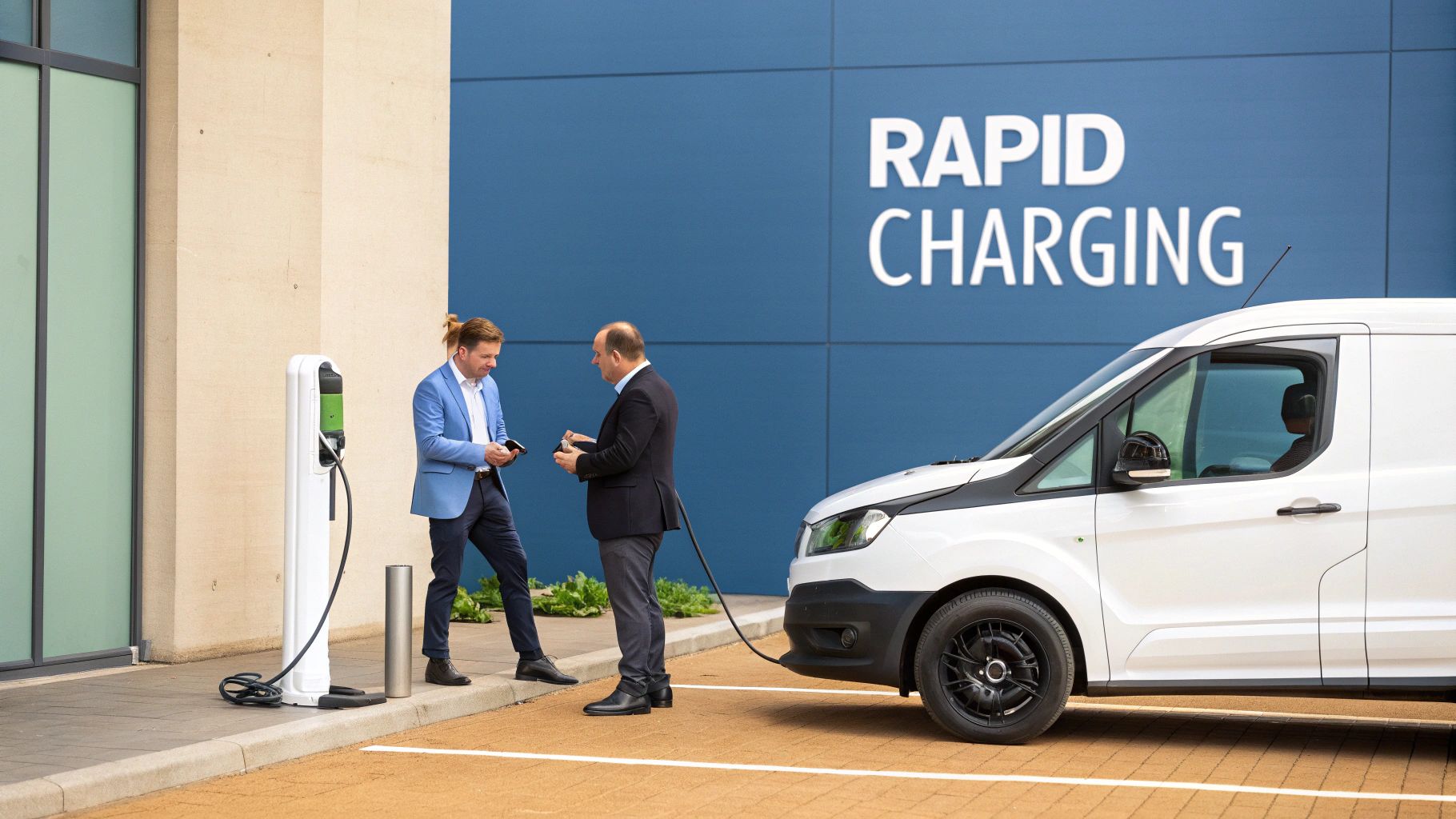
For any business 'rapid EV charging' now means DC technology. It directly tackles the biggest hurdle for many would-be EV drivers: charging time. By slashing this downtime DC chargers unlock some powerful commercial opportunities:
- Retail and Hospitality: Attract high-value customers who can get a full charge while they shop or eat. This boosts footfall and encourages them to spend more time (and money) on-site.
- Commercial Fleets: Get your electric vans and lorries back on the road in minutes not hours. This keeps your operations running smoothly and maximises the uptime of your most valuable assets.
- Workplace Charging: Offer a fantastic perk for employees particularly those who can't charge at home or need a quick top-up between meetings.
- Customer Facing: Any car park can become a value and revenue producing asset
EV Charging from Constrained Grid Connections
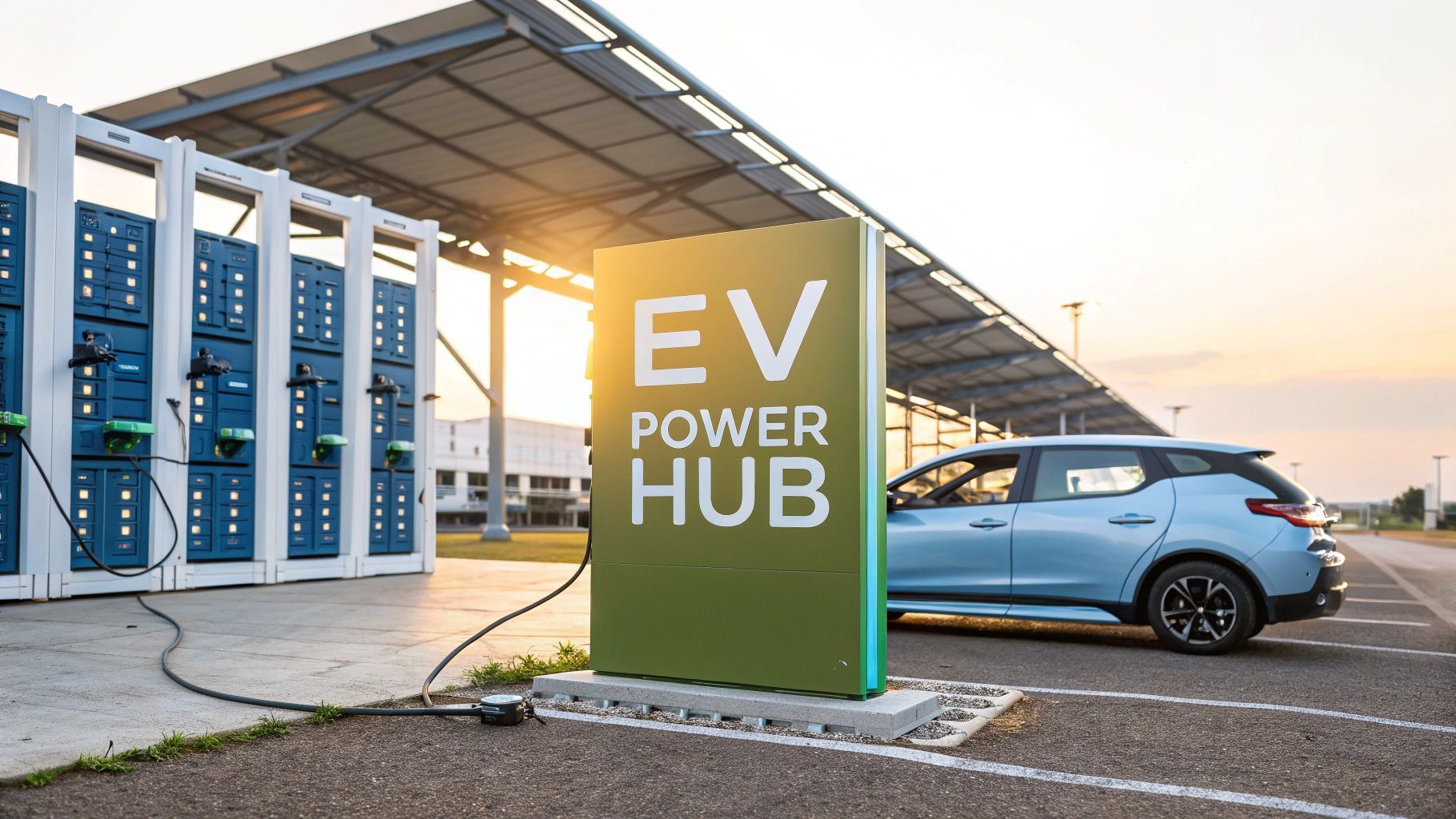
One of the most important things to understand is that modern DC charging solutions are also getting smarter about tackling infrastructure headaches. Many commercial sites simply don't have a grid connection beefy enough to handle the immense power draw of rapid chargers. This is where integrated systems combining DC chargers with grid-scale batteries and on-site renewables like solar are changing the game.
By storing energy from the grid during cheap off-peak hours or from your own solar panels a battery-backed DC EV charger can deliver ultra-rapid speeds without needing a costly and time-consuming grid upgrade. This approach turns a potential roadblock into a strategic energy asset.
This integration of what we call distributed energy resources transforms a simple charger into a smart energy hub. It offers grid independence and creates a more resilient cost-effective charging solution. For any forward-thinking UK business getting to grips with the power and flexibility of DC technology is the first step toward capitalising on the EV revolution.
Choosing the Right DC Charger Power and Standard
Picking the right DC EV charger means looking beyond the tech specs at the power levels and charging standards. It’s not just about the hardware; it's about making a strategic investment that lines up with your business goals whether that’s getting fleet vehicles back on the road in minutes or encouraging retail customers to stay a little longer.
The jargon can feel a bit much but it really all comes down to one key metric: kilowatts (kW) . The easiest way to think about kW is as the speed of the energy flow. A higher number means a vehicle's battery gets filled up faster which directly impacts how quickly you can serve drivers. For any business thinking about installing a DC EV charger getting your head around these power tiers is the first most important step.
Rapid vs Ultra-Rapid Charging
Here in the UK DC chargers are generally split into two main camps based on how much power they can deliver. Each one serves a very different commercial need so your choice will depend entirely on your day-to-day operations and the kinds of vehicles you’ll be serving.
- Rapid Chargers (Typically 50kW): These are the established workhorses of the public charging network. A 50kW DC EV charger can add about 100 miles of range in 30-35 minutes . This makes it a fantastic option for places where people tend to stick around for a bit like supermarkets retail parks or leisure centres.
- Ultra-Rapid Chargers (150kW+): This is the top tier for charging speed. An ultra-rapid charger can deliver that same 100 miles of range in as little as 10-15 minutes . These are non-negotiable for sites where every second counts such as motorway service stations or dedicated fleet depots where vehicle downtime is a critical cost.
The rapid growth in these high-power units tells you everything you need to know about market demand. The UK now has over 82,000 public charging devices. Of those more than 16,600 are 50kW or higher now making up 20% of the total. The vast majority of these are DC fast chargers providing the speedy top-ups that are essential for making EVs a practical choice for everyone. You can discover more about the UK's charging infrastructure growth from recent government statistics.
Understanding the CCS Standard
Power is one thing but the physical plug is just as important. In the UK and across Europe the Combined Charging System (CCS) is the undisputed standard for DC rapid charging. Pretty much every new electric vehicle sold here—from family cars to commercial vans—comes with a CCS port.
For businesses standardising on CCS is a strategic move. It ensures maximum compatibility with the vast majority of vehicles on the road today and for the foreseeable future future-proofing your investment and guaranteeing you can serve the widest possible customer base.
Choosing a DC EV charger with a CCS connector just makes life simpler. It eliminates the hassle of multiple cable types or clunky adapters creating a smooth and straightforward experience for drivers.
Matching Power to Purpose
It’s all well and good to talk theory but what really matters is how this applies to your business in the real world. The DC charger you choose should be a direct reflection of your business model and how your customers behave.
Take a retail park for example. It benefits most from 50kW rapid chargers. A customer can easily get a meaningful charge during a 45-minute shopping trip. The slightly longer charge time isn't a drawback here; it actually encourages them to spend more time—and money—on site.
On the other hand a logistics depot running a fleet of electric delivery vans needs maximum throughput. For them 150kW or even 350kW ultra-rapid chargers are a necessity. The entire goal is to get vehicles charged and back out on their next run in the shortest time possible. Every minute saved is money earned.
If you're ready to dive deeper into the nuances of this technology you might be interested in our ultimate guide to rapid EV charging.
Solving the Grid Connection Puzzle for Your Project
So you’ve picked out the perfect DC charger for your site. That’s the easy part. The real challenge for most projects and the one that catches many businesses out is the electrical grid itself. Securing a connection powerful enough to run your new hardware is a critical step often packed with hidden costs and surprisingly long waits that can derail the best-laid plans.
Let's be blunt: your existing business electricity supply probably isn't up to the job even if you’re already running heavy machinery. A single 150kW ultra-rapid charger can gulp down as much power as a small office block. This almost always means you’ll need to apply for an upgraded connection from your regional Distribution Network Operator (DNO).
The process hinges on a concept called import capacity . Think of it as the maximum amount of power the grid allows your site to draw at any one time. A bank of new DC chargers demands a huge increase in that capacity and the DNO has to give you the green light before anything can happen.
Why Grid Upgrades Are Often Needed
When you ask the DNO for more power they don't just flick a switch. They have to study the local network to see if it can actually deliver what you’re asking for. In many areas both urban and rural the existing cables and substations are already stretched to their limits. If your project is the final straw the DNO will mandate grid reinforcement works .
This isn’t a small job. It could mean anything from digging up roads to lay thicker cables all the way to your site to building a brand-new local substation just for you. These are major civil engineering projects and they come with hefty price tags and timelines that can stretch from months into years.
A common pitfall is focusing solely on the cost of the charger hardware. That figure is usually predictable. The DNO’s quote for grid reinforcement however can sometimes be ten times the cost of the charger itself. It's absolutely vital to get an estimate for this work as early as you possibly can.
The type of charger you choose has a direct impact on how much power you'll need as this flowchart shows.
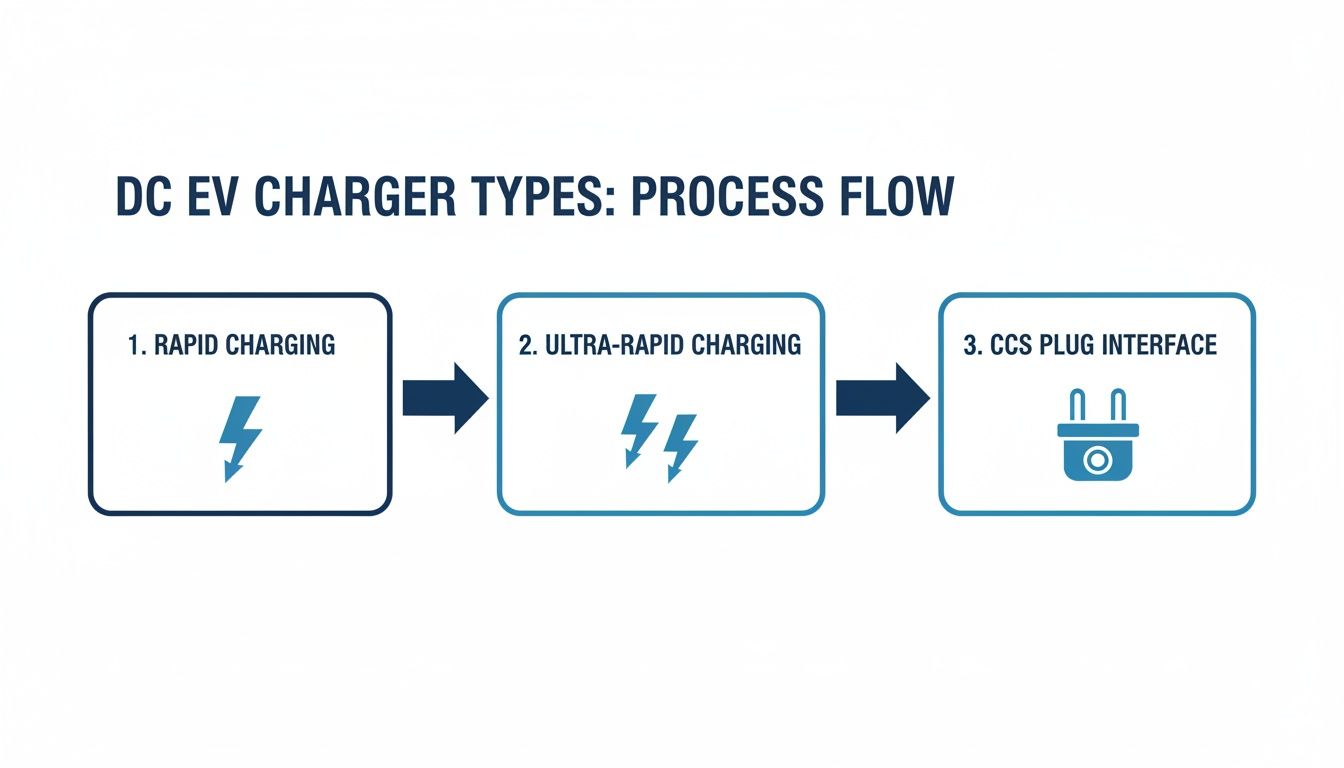
As you can see jumping from rapid to ultra-rapid charging drastically increases the demand on the grid making a significant—and costly—upgrade much more likely.
Navigating the DNO Application Process
Engaging with your DNO is a formal step-by-step process. While the fine print might differ slightly between operators the journey from initial enquiry to getting the power switched on follows a pretty standard path.
To give you a clearer picture here’s a breakdown of the typical stages and what to expect.
The Grid Connection Process Key Stages and Timelines
| Stage | Key Activities | Typical Timescale |
|---|---|---|
| 1 Feasibility & Budget Quote | Initial site survey to assess viability. Submit a high-level enquiry to the DNO for a non-binding budget estimate for the connection. | 2–6 weeks |
| 2 Formal Application | Submit a detailed application with site plans, load requirements and technical specifications for the proposed DC EV charger installation. | 4–12 weeks for DNO quotation |
| 3 Quotation Acceptance | Review the DNO's formal offer which will detail the scope of works, the final cost and the projected timeline. Accept the offer and pay any deposits. | N/A |
| 4 Design & Wayleaves | The DNO finalises the engineering designs. If work is needed on third-party land legal agreements called 'wayleaves' must be secured. | 3–9 months (can be longer) |
| 5 Construction & Energisation | The DNO and your own contractors carry out the required civil works, install equipment and make the final connection. The new supply is tested and energised. | 2–6 months |
As the table makes clear the entire process can easily take over a year from start to finish. This is why getting your DNO and a specialist installation partner involved at the very beginning is essential for keeping your project on track and on budget. A constrained grid connection doesn’t have to kill your EV ambitions but it does demand careful planning and a serious look at clever solutions like battery-backed charging systems.
Unlocking Energy Independence with Batteries and Solar
While getting a powerful grid connection is the traditional route for installing a DC EV charger it’s far from the only way forward. For many businesses the eye-watering costs and long delays of grid upgrades can kill a project before it even starts.
This is where a smarter more resilient approach comes in—one that pairs rapid EV charging with on-site energy generation and storage.
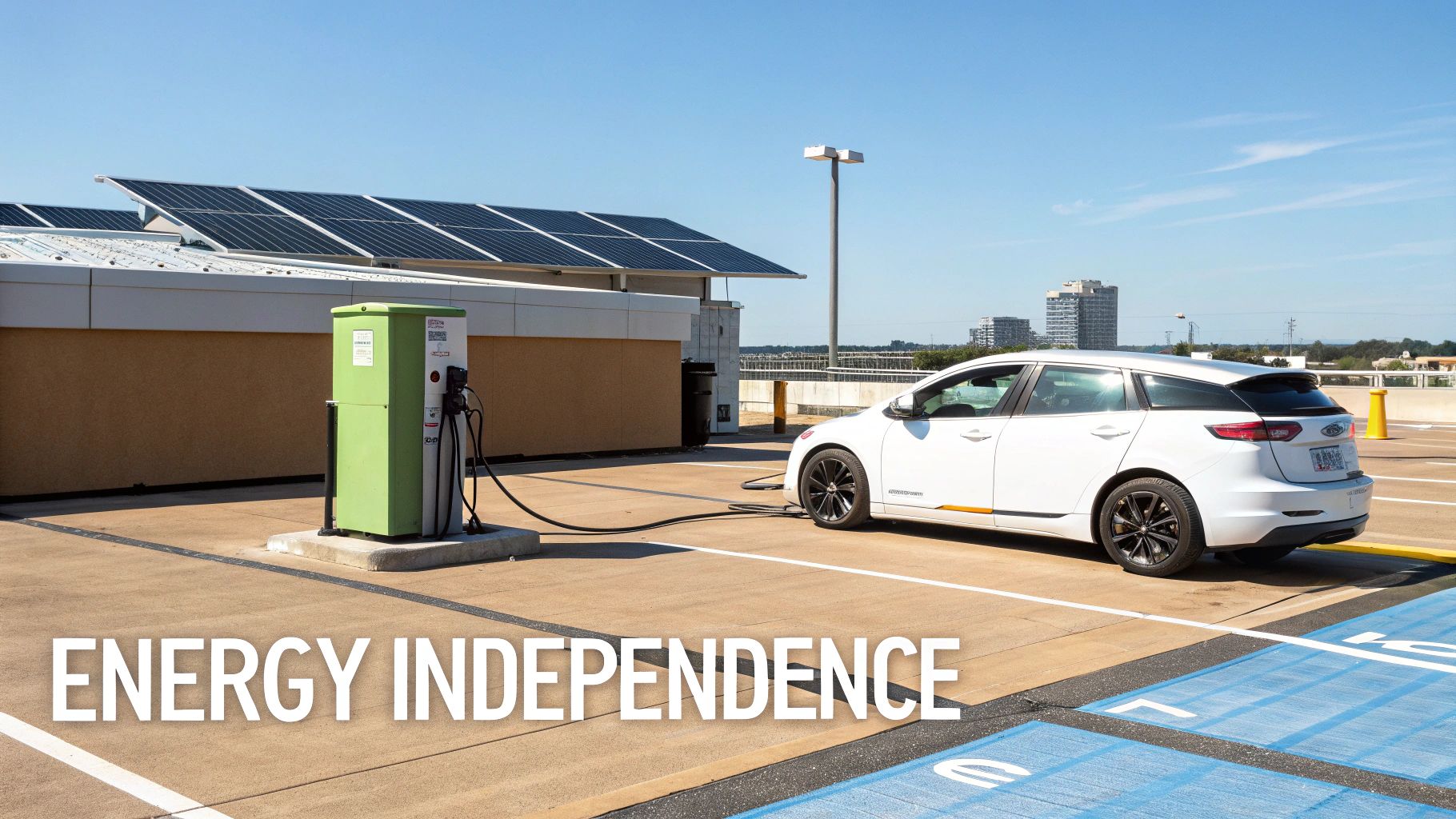
This strategy turns your charging station from a simple power drain into a sophisticated self-sufficient energy asset. By bringing grid-scale batteries (Battery Energy Storage Systems or BESS) and on-site renewables like solar panels into the mix you can sidestep the biggest grid-related headaches and build a more cost-effective sustainable operation.
Overcoming Grid Constraints with Battery Storage
A Battery Energy Storage System (BESS) is the key to delivering rapid EV charging on sites with a weak or maxed-out grid connection. Think of it as an energy reservoir for your charging hub.
Instead of trying to pull a massive surge of power from the grid the moment a car plugs in the BESS steps in to provide that instant high power needed for a fast charge.
The battery itself can be refilled slowly from your existing limited grid connection—usually during off-peak hours when electricity is cheapest. This slow steady ‘trickle charge’ puts minimal strain on the local network but the stored energy can be unleashed in a powerful torrent when a driver needs it.
This setup completely decouples your charging speed from your grid capacity. You can deliver 150kW ultra-rapid charging to a vehicle even if your site's grid connection is only capable of supplying 30kW . The BESS acts as the essential buffer bridging the gap and saving you from a potentially six-figure grid upgrade bill.
This approach not only solves the infrastructure problem but also introduces major cost savings by letting you buy and store energy when it's at its absolute cheapest.
Integrating On-Site Renewables Like Solar
The next logical step towards true energy independence is to generate your own power. Combining your DC EV charger and BESS with on-site renewables like a solar panel array on your roof or a car park canopy creates a powerful synergy.
During daylight hours your solar panels can either power the EV chargers directly or more often fill up the BESS with clean free energy. This stored solar power can then be used anytime day or night to charge vehicles.
This dramatically cuts your reliance on grid electricity and slashes your running costs. It also gives your business’s green credentials a serious boost—a huge selling point for environmentally conscious customers. To dig deeper into this you can learn about the specifics of battery-backed EV charging and how it transforms site viability.
This distributed energy model of generating and storing energy locally is fast becoming central to building resilient and profitable charging networks across the UK.
Advanced Strategies for Revenue and Resilience
Once you have a BESS and solar working with your DC EV charger you can look beyond simple cost savings and start opening up new revenue streams. Your charging hub is now an active player in the energy market.
Here are a few advanced strategies this system unlocks:
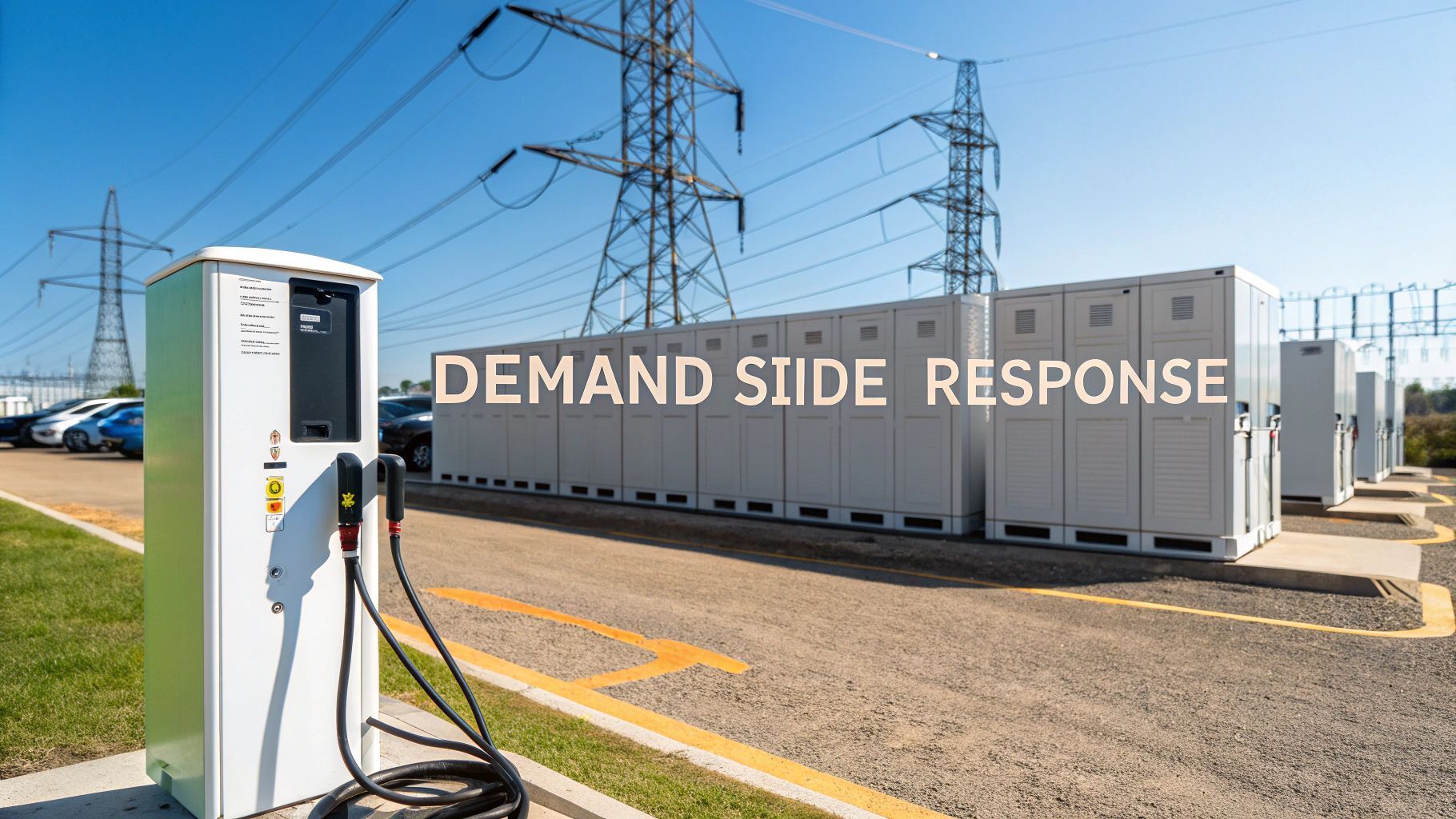
- Peak Shaving: Use the energy stored in your battery to power your entire site during peak grid demand when electricity prices soar. This practice known as ‘peak shaving’ can make a huge dent in your overall energy bills.
- Grid Services: The National Grid often pays businesses to help keep the network stable. Your BESS can provide these ‘grid services’—like frequency response—by exporting power back to the grid for short periods. This creates an entirely new source of income.
- Mobile EV Charging: An integrated system isn't just for fixed locations. Mobile EV charging units which are essentially a BESS and a DC charger on wheels offer incredible flexibility. They can be deployed to support fleet vehicles in remote locations provide temporary power at events or offer roadside assistance all without a grid connection.
By combining these technologies a DC EV charger installation stops being just another expense. It becomes a strategic investment in a distributed energy system that delivers cost savings new revenue and a powerful hedge against volatile energy markets.
Building Your Business Case and Revenue Streams
It's easy to get caught up in the technology but investing in a DC EV charger is really a business decision. The hardware is just one piece of the puzzle. The real value comes from how you weave it into your operations to drive profit elevate the customer experience or boost efficiency.
Of course the benefits and revenue models look different for every sector but the core principle is the same: turning a charging station into a valuable commercial asset.
Let’s dig into how different businesses can build a compelling case for rapid EV charging.
Sector-Specific Use Cases
A DC charger isn't a one-size-fits-all solution. Its value is unlocked only when you match its speed and availability to the specific needs of the people you want to attract.
- Retail and Hospitality: For supermarkets shopping centres and hotels the goal is simple: attract and keep high-value customers. A DC EV charger acts as a powerful magnet drawing in EV drivers who often have more disposable income. While their car gets a quick top-up over 20-40 minutes they’re spending that time—and money—in your establishment. It's a proven way to increase footfall and average customer spend.
- Logistics and Fleets: In the world of commercial transport time is literally money. Electric fleets are entirely dependent on keeping their vehicles on the road. Ultra-rapid DC chargers at the depot are non-negotiable allowing vans and lorries to get back out there in minutes instead of being parked for hours. Here the business case is all about operational efficiency not direct charging revenue.
- Workplace Charging: Offering rapid charging as an employee perk is a huge draw for attracting and retaining talent. It’s a genuinely valuable service for staff who can't charge at home or need a quick boost between client meetings. While it can certainly generate revenue its primary value is often in boosting employee satisfaction and reinforcing your company's sustainability goals.
Direct and Indirect Revenue Models
Once your DC EV charger is up and running it can generate income in a few different ways. The right choice depends entirely on your business objectives and who you’re serving.
The most successful charging strategies blend direct revenue from usage with the huge indirect value of increased customer engagement and loyalty. The charger becomes more than just a utility; it's a strategic tool for business growth.
Here are the most common approaches:
- Pay-Per-Use: This is the most straightforward model. Drivers pay for the electricity they use (per kilowatt-hour) often with a small session fee or an overstay penalty to keep the bays turning over. For those looking to really maximise profit dynamic pricing—adjusted for time of day or grid demand—is the way to go.
- Subscription and Membership: If you have regular users like a fleet or employees a subscription model offers predictable recurring revenue. Drivers pay a flat monthly fee for a certain amount of charging which builds a loyal user base and a steady income stream.
- Indirect Revenue (Amenity Charging): In many retail or hospitality settings the charger’s main financial benefit isn't direct. By offering convenient charging you attract more customers who then spend money on your core products or services. Some businesses even offer free charging to high-spending customers as a powerful loyalty reward.
To get a real sense of the full financial potential it's worth exploring detailed breakdowns of how businesses can earn significant returns from rapid EV chargers.
The Crucial Role of Management Software
You can't just install a DC EV charger and walk away. Smart management software is the brain of the entire operation and it's absolutely essential for optimising your pricing managing who gets access and ensuring everything runs smoothly for the user.
A good platform lets you monitor your chargers from anywhere set flexible pricing tariffs and process payments automatically. It also provides invaluable data on usage patterns showing you when demand is highest so you can adjust your strategy on the fly.
For EV drivers a reliable and user-friendly software interface usually via a mobile app is what separates a frustrating experience from one they’ll come back to. It ensures they can find your charger check its availability and pay without any hassle—all of which is critical for building a successful charging network.
Your Blueprint for a Successful DC Charger Deployment
Turning the vision for a rapid charging hub into a functioning real-world asset is where the rubber really meets the road. This is the part where careful planning and a solid understanding of the deployment process come together guiding your DC EV charger project from a concept on paper to a successful compliant launch. Getting this stage right is crucial for avoiding common pitfalls and ensuring a smooth installation.
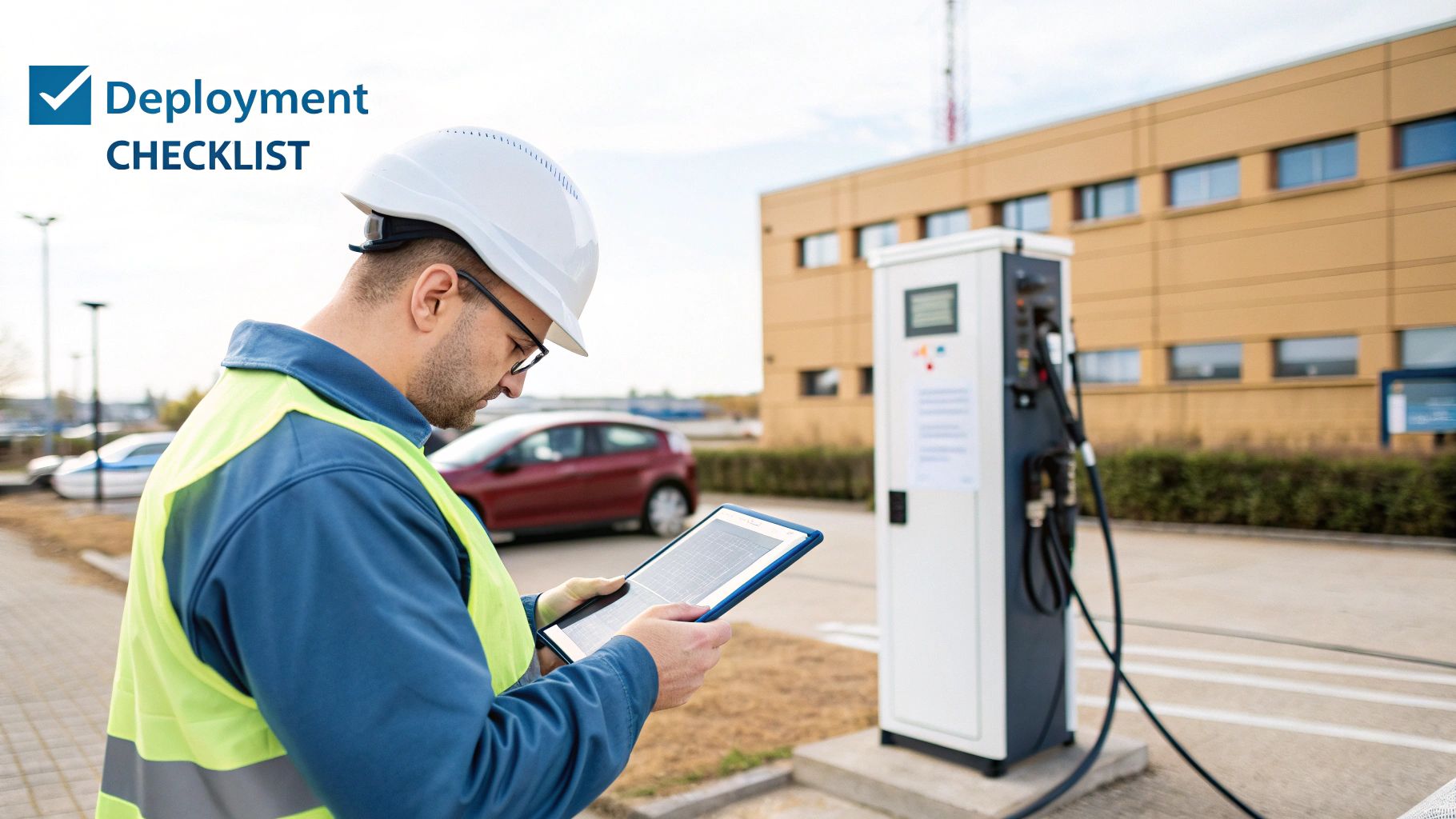
First things first you need to define exactly what your project needs to achieve. Think about the types of vehicles you’ll be serving the charging speeds you want to offer and how the whole system will fit into your existing operations. This detailed brief is the foundation for selecting the right hardware and just as importantly the right installation partner. A specialist partner will be invaluable for navigating the complexities of site surveys grid applications and regulatory hurdles.
Selecting the Right Hardware and Partners
When you’re comparing DC EV charger models look beyond just the raw power output. The details matter. You should be asking about reliability metrics the quality of after-sales support and what maintenance contracts are in place to guarantee uptime.
Software is another critical piece of the puzzle. Make sure any hardware you're considering supports open standards like OCPP (Open Charge Point Protocol) . This is a big one as it prevents you from getting locked into a single software provider for the life of the charger.
Your choice of installation partner is just as vital. You need a team with a proven track record in commercial DC charger projects and a deep understanding of the specific health and safety regulations that come with them.
A successful deployment hinges on a partnership approach. Your installer should act as a guide helping you navigate everything from planning permissions and DNO applications to ensuring the final installation meets all UK safety and accessibility standards.
Navigating UK Regulations and Compliance
You simply cannot afford to overlook the legal and regulatory landscape in the UK. Getting this wrong can stop a project in its tracks. Key considerations for any DC EV charger installation include:
- Planning Permission: Many commercial installations will require planning consent from your local authority.
- Building Regulations: All electrical work must comply with strict standards including Part P and Part S of the Building Regulations.
- Health & Safety: You have a legal duty of care under the Health and Safety at Work Act 1974 to ensure the installation is safe for both public and employee use.
The market for this equipment is growing incredibly fast. With the government aiming for 300,000 public chargers by 2030 the market is set to expand at a rate of 21.32% annually. While planning your own project it can be useful to see how others approach similar installations even for different brands by looking at resources that discuss Tesla EV charger installation considerations.
Answering Your Key Questions
When UK businesses start looking into DC fast charging a few common questions always come up. Let's tackle them head-on.
What’s the Real-World Cost of a Commercial DC EV Charger?
This is the big one and the honest answer is: it varies enormously. The final figure depends on the charger's power how complex your site is and most importantly your grid connection.
While you might see the hardware and basic installation for a 50kW rapid charger quoted somewhere between £25,000 and £50,000 that’s just the tip of the iceberg. The real wildcard is the grid upgrade. That cost can easily add tens or even hundreds of thousands of pounds to the project.
Because of this you absolutely must get a detailed site survey and a firm quote from your Distribution Network Operator (DNO) right at the start. Don't move forward without it.
How Fast Can a DC Charger Actually Charge a Car?
It all comes down to a simple relationship: the charger's power (in kW) versus the car's battery size and how fast it’s designed to accept a charge.
- A standard 50kW rapid charger will give a typical EV about 100 miles of range in roughly 30-35 minutes .
- Step up to an ultra-rapid 150kW charger and for a compatible car you can get that same 100-mile top-up in just 10-15 minutes . That kind of speed is a game-changer for places with high turnover like motorway service stations.
Are There Any UK Government Grants to Help Businesses?
Yes the government has several grant schemes in place to help businesses install the EV infrastructure they need. The two main ones to look at are:
- Workplace Charging Scheme (WCS): This provides direct financial support for buying and installing charge points for your staff or company fleet.
- EV infrastructure grant for staff and fleets: Aimed at smaller businesses this grant can help with the broader installation costs including that all-important grid connection work.
A word of advice: always check the latest government guidance. These schemes and their eligibility rules can change as the market and technology evolve.
Can I Install a DC Charger if My Grid Connection is Weak?
Absolutely. This is a common problem but one that has a very effective solution. Instead of going through the pain of a slow and expensive grid upgrade you can pair your charger with a Battery Energy Storage System (BESS) .
Think of a BESS as a buffer. It sips power from your limited grid connection during off-peak hours (when electricity is cheap) and stores it. When a car plugs in the BESS unleashes that stored energy at high power delivering a rapid charge the grid could never handle on its own. It’s a smart way to bypass grid limitations and make rapid EV charging possible almost anywhere.
At ZPN Energy we specialise in exactly these kinds of battery-backed DC EV charger solutions. We help you overcome grid constraints and turn your charging hub into a powerful energy asset. See how our unique approach to rapid charging works at https://www.zpnenergy.com.