Your Guide to Fast Charger Car Solutions
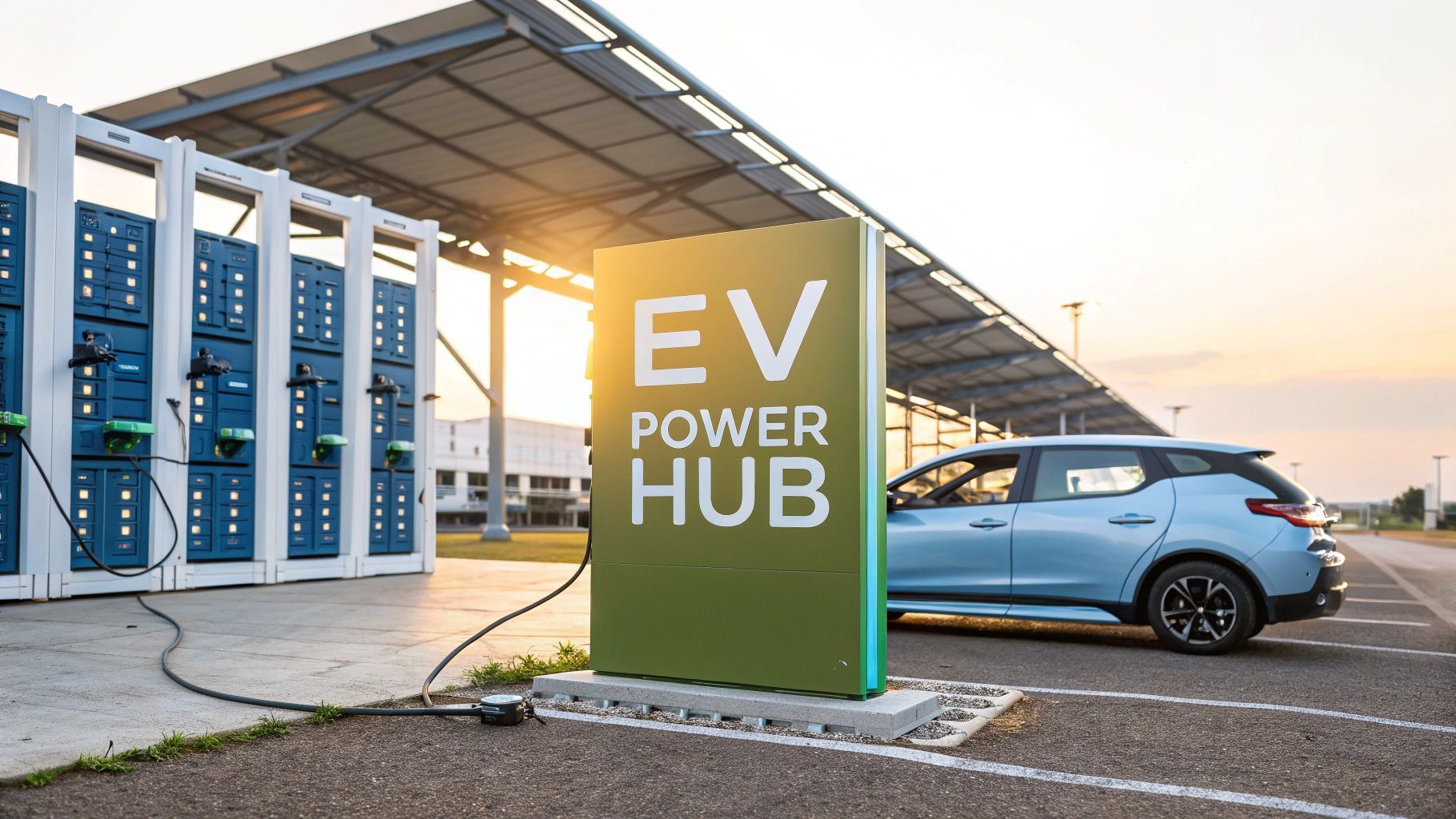
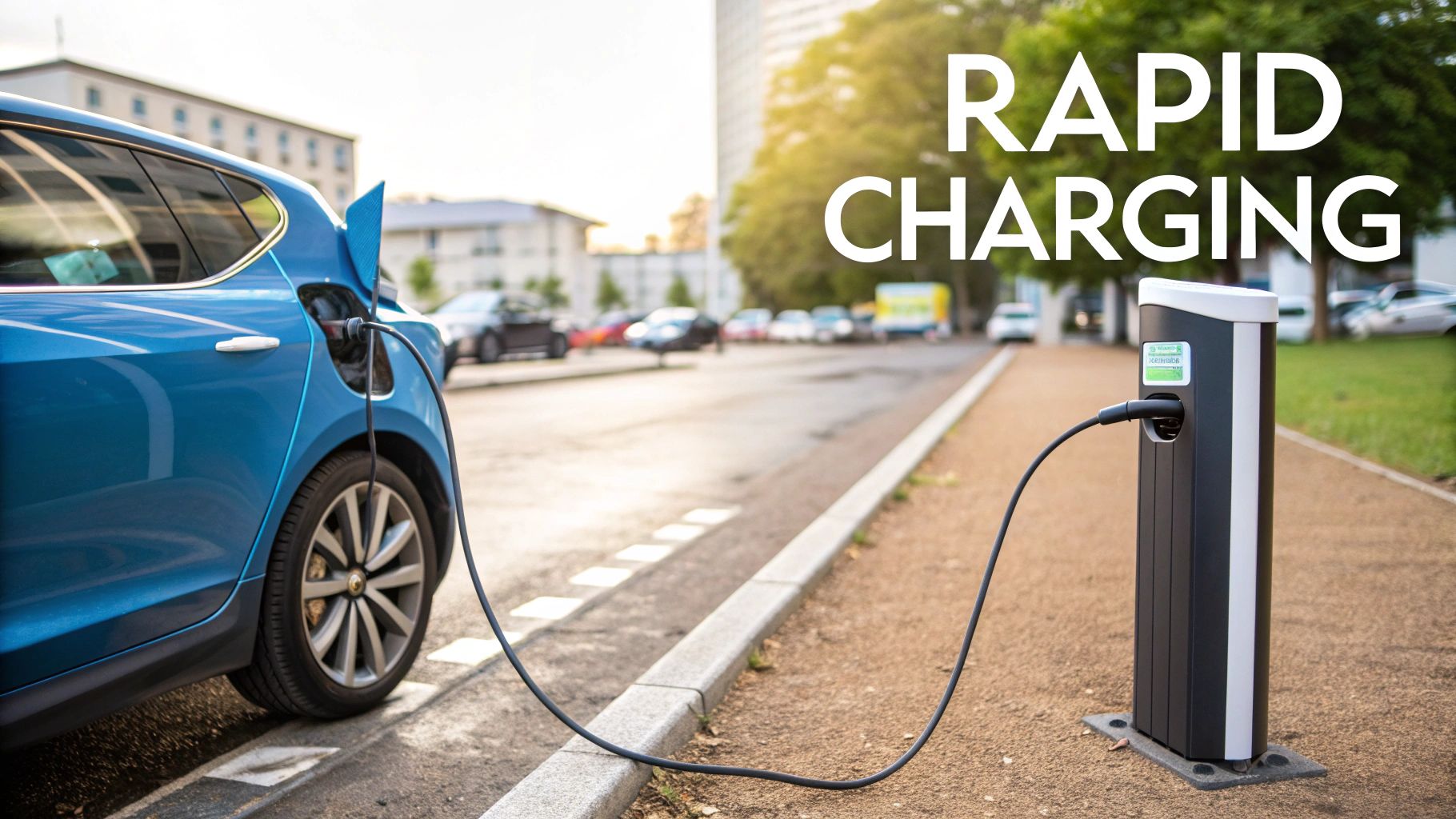
A fast charger for a car is not just a fancy plug. Think of it more as a complete, intelligent energy ecosystem designed to refuel an electric vehicle in a hurry—often in well under 30 minutes .
This kind of speed is a game-changer for any business that cannot afford to have vehicles sitting idle. Commercial fleets need a quick turnaround to stay productive and retail sites are quickly discovering that fast, reliable charging is a powerful magnet for customers. The secret ingredient is often combining high-power chargers with technologies like battery storage, which helps get around the all-too-common problem of a constrained grid connection.
Unlocking the Potential of Rapid EV Charging
For any modern UK business, installing a 'fast charger car' solution is a strategic leap, not just an added amenity. It is about investing in an integrated energy asset built for the high-speed, high-demand world of electric vehicle refuelling. This shift is becoming less of a choice and more of a necessity as the UK's EV market continues its rapid expansion.
This kind of advanced infrastructure is proving essential across multiple sectors. Fleet operators depend on it to slash vehicle downtime and keep their operations running like clockwork. For retail parks, service stations and hospitality venues, offering rapid EV charging is a proven way to attract high-value customers and encourage them to stay longer. At its heart, it is all about delivering serious power, quickly and reliably.
This is not about a standalone box on a wall. A true rapid EV charging solution is the hub of a connected energy network.
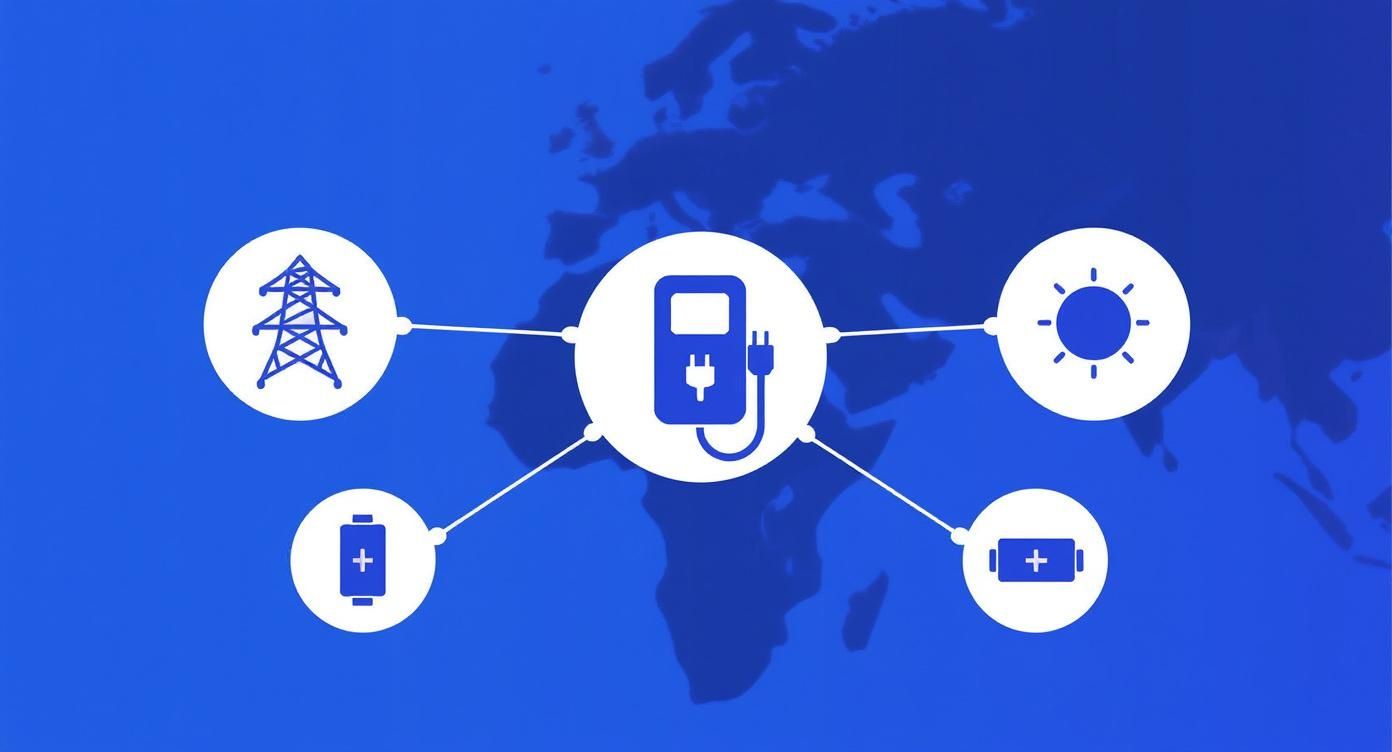
As you can see, the system intelligently pulls power from multiple sources. It can draw from the national grid, on-site renewables like solar panels and—critically— grid scale batteries to provide a seamless charging experience for every driver.
Beyond the Plug: A Complete Distributed Energy System
A proper rapid EV charging solution is a symphony of interconnected parts all working in concert. Getting your head around this ecosystem is the first step to a successful project. These key elements often include:
- Mobile EV Charging: Giving you the flexibility to charge vehicles wherever they are, perfect for fleets or temporary sites where fixed infrastructure just is not practical.
- EV Charging from Constrained Grid Connections: Using battery storage to neatly sidestep the need for slow and costly grid upgrades.
- Combined On-site Renewables: Integrating your own solar or wind power to cut energy costs and genuinely boost your green credentials.
- Distributed Energy Management: In effect, creating your own localised microgrid that cleverly optimises the flow of power between your chargers, batteries, renewables and the wider grid.
By combining EV charging and batteries, businesses can turn a potential grid headache into a profitable energy asset. This approach not only solves power limitations but also opens up new revenue streams through grid services.
Understanding Rapid EV Charging Technology
To make the right investment in a fast charging solution for your business, you first need to get to grips with the technology that powers it. It all starts with one fundamental difference: Alternating Current (AC) versus Direct Current (DC). This distinction is the bedrock of EV charging speeds.
Think of AC charging as a garden hose. It provides a steady but relatively gentle flow of power, which is perfectly fine for topping up overnight at home when time is not an issue. The catch is that the car’s onboard charger has to convert this AC power from the grid into DC to fill the battery and that process creates a bottleneck, limiting the speed.
DC charging , on the other hand, is like a firefighter's hose. It blasts a huge volume of power directly into the vehicle's battery, completely bypassing the car's much slower onboard converter. This direct delivery is what unlocks the seriously fast charging times that are essential for commercial operations and drivers on the go.
For a really deep dive, you can explore our ultimate guide to rapid EV charging .
Decoding Power Levels and Connectors
The term 'fast charger' actually covers a whole spectrum of power outputs, measured in kilowatts (kW). Each tier offers a different charging speed and is suited to different commercial scenarios, so knowing the lingo is key to choosing the right hardware.
- Rapid Chargers (50kW to 149kW): These are the workhorses of the UK's public network. A standard 50kW unit can take a compatible EV from 20-80% charge in around 40-60 minutes . This makes them a great fit for places like supermarkets, retail parks or short-stay car parks where customers are dwelling for a while.
- Ultra-Rapid Chargers (150kW+): Now we are talking serious speed. These chargers can deliver that same 20-80% charge in as little as 15-30 minutes . The most powerful units, pushing 350kW , are built for the next generation of EVs and are absolutely vital for motorway service areas and dedicated charging hubs where getting drivers back on the road ASAP is the top priority.
Of course, all that power is useless without the right plug. In the UK and across Europe, the Combined Charging System (CCS) has become the go-to standard for DC rapid charging. It cleverly combines AC and DC pins into a single, convenient connector. While you might still see the older CHAdeMO standard on some Japanese vehicles, CCS is firmly the future for almost all new cars and vans.
To help you visualise where each type fits, here’s a quick comparison:
EV Charger Types Compared
| Charger Type | Power Output | Typical Charge Time (20-80%) | Ideal Business Use Case |
|---|---|---|---|
| AC Fast Charger | 7kW - 22kW | 3 - 5 hours | Workplaces, long-stay car parks, hotels, fleet depots (overnight) |
| DC Rapid Charger | 50kW - 149kW | 40 - 60 minutes | Supermarkets, retail parks, public car parks, leisure centres |
| DC Ultra-Rapid Charger | 150kW+ | 15 - 30 minutes | Motorway services, dedicated charging hubs, taxi ranks, logistic fleets |
Choosing the right charger type really comes down to understanding your customer's typical dwell time and the charging speed they expect at your location.
The UK's Growing Appetite for Speed
This demand for faster charging is not just a vague trend—it is actively reshaping the UK's public charging landscape. The growth has been nothing short of remarkable.
As of June, the total number of public rapid and ultra-rapid chargers hit 16,698 , a massive 33% jump in just one year. This is not happening in a vacuum; it is a direct response to the booming EV market, with electric vehicles now making up over 21.6% of all new car sales.
What's particularly telling is that for the first time, ultra-rapid chargers ( 150kW+ ) now outnumber the standard rapid units on the network. The message from drivers is loud and clear: they want to charge up and move on, quickly. You can discover more insights about the UK's EV charging expansion on Willow Leasing.
But deploying this technology successfully is not just about bolting powerful hardware to the ground. The most effective rapid EV charging systems lean heavily on advanced data analytics and IoT capabilities. This intelligence allows for smart energy management, predictive maintenance and a genuinely seamless user experience, turning a simple charger into a smart, connected asset for your business.
Solving Grid Constraints with Battery Storage
So, you are ready to install a powerful fast charger but you have hit a brick wall. It is a story we hear all the time: the perfect location, a solid business plan, but the site’s grid connection just cannot handle the immense power draw of a 150kW ultra-rapid charger. This is a massive roadblock for countless sites across the UK, from rural forecourts to dense urban centres.
Putting in a single 150kW charger is like adding a whole new commercial building to the local grid. For a network that is already stretched thin, that sudden demand is often a non-starter without a significant—and eye-wateringly expensive—upgrade. This means getting the Distribution Network Operator (DNO) involved, leading to massive costs and delays that can stretch from months into years, completely derailing a project.
This is where smart technology offers a far more elegant solution. Instead of digging up roads for new substations, businesses can use an integrated system that cleverly manages energy flow, solving the grid problem from their side of the meter.
Introducing Battery Energy Storage Systems
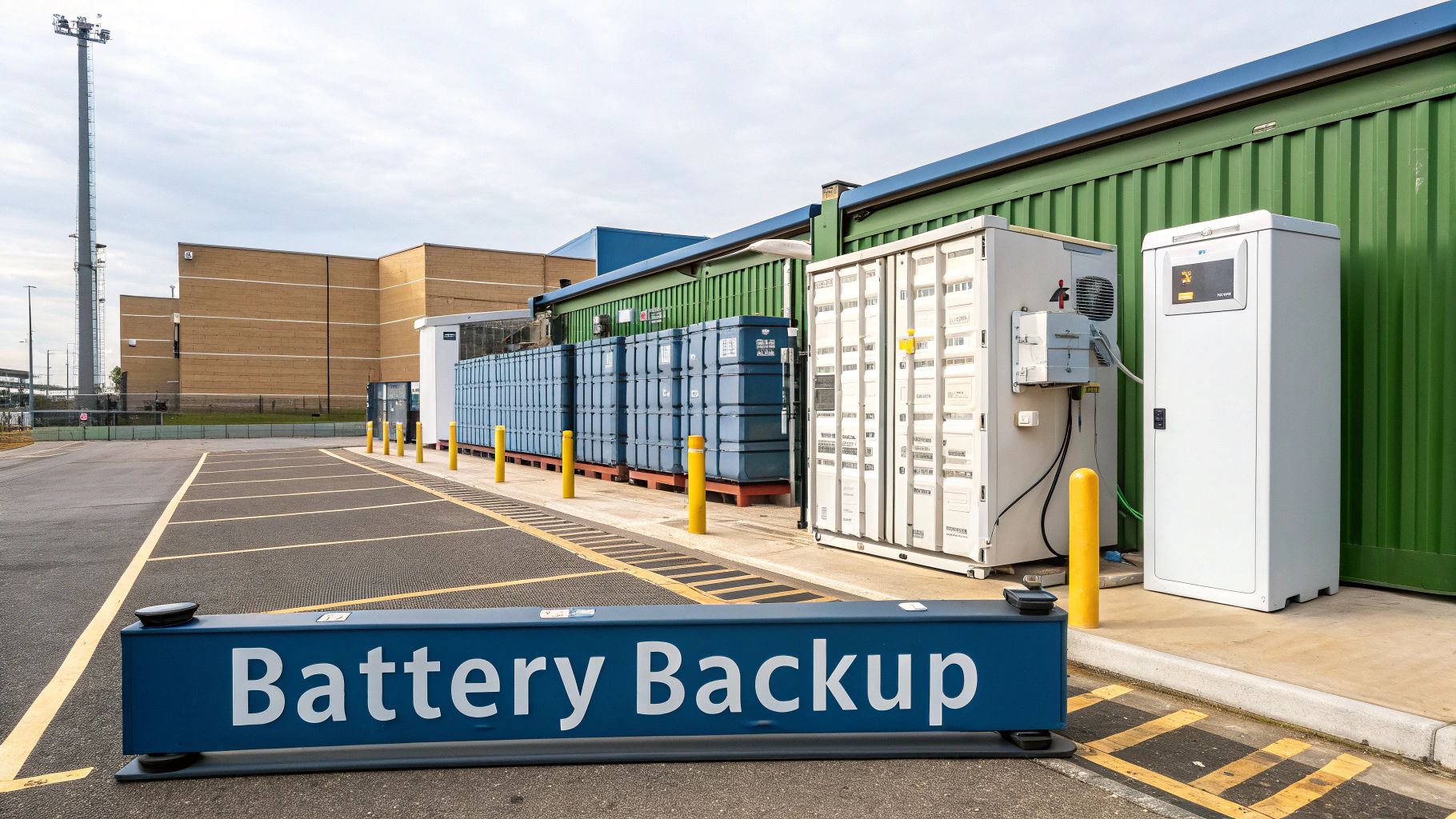
The game-changer here is a Battery Energy Storage System (BESS) . Think of a BESS as a large-scale rechargeable battery working in tandem with your EV chargers. It acts as an intelligent energy buffer, effectively bypassing the limitations of a weak grid connection.
Imagine your BESS is a large reservoir behind a dam. The weak grid connection is like a small stream, slowly trickling water into that reservoir overnight when electricity is cheap and demand is low. The reservoir gradually fills, storing a huge amount of potential energy.
When an EV pulls up needing a top-up, it is like opening the floodgates. The BESS can unleash a colossal torrent of stored power, far more than the small stream could ever provide on its own. This is how you deliver an ultra-rapid 150kW charge, even if your grid connection can only supply a fraction of that power.
This technology effectively decouples the charging speed you offer from the power you can draw from the grid at any given moment. It is a fundamental shift that makes rapid EV charging possible in thousands of previously unviable locations.
The Financial Power of Peak Shaving
Beyond simply enabling the installation, a BESS brings a massive financial advantage through a process called peak shaving . Commercial electricity tariffs often include hefty 'demand charges', calculated based on the single highest point of power your site draws from the grid, usually within a 30-minute window.
A fast charger without a battery creates enormous power spikes. The second a car plugs in, your site's demand skyrockets, triggering these punitive charges. In many cases, these charges can account for a staggering 30-70% of a commercial electricity bill .
A BESS smooths these peaks out completely. By using stored battery power to meet the charging demand, it shields the grid from that sudden spike. Your site continues to draw only a low, steady amount of power, keeping you well clear of high demand charges and dramatically improving the economics of your charging hub. To see how this works in practice, you can learn more about the specifics of battery-backed EV charging and how it transforms the business case.
This clever use of distributed energy does not just save you money; it also reduces the strain on the local electricity network, making your operation a better grid neighbour. It is this combination of enabling technology and smart financial management that makes battery storage an indispensable part of any serious fast charger strategy.
Creating a Sustainable Charging Ecosystem
Combining on-site renewables, batteries and EV chargers is not just about solving grid constraints; it unlocks a powerful new strategy. It is about creating a self-sufficient, sustainable and highly cost-effective charging hub that no longer lives at the mercy of the grid. This transforms a simple charging point into a dynamic energy asset.
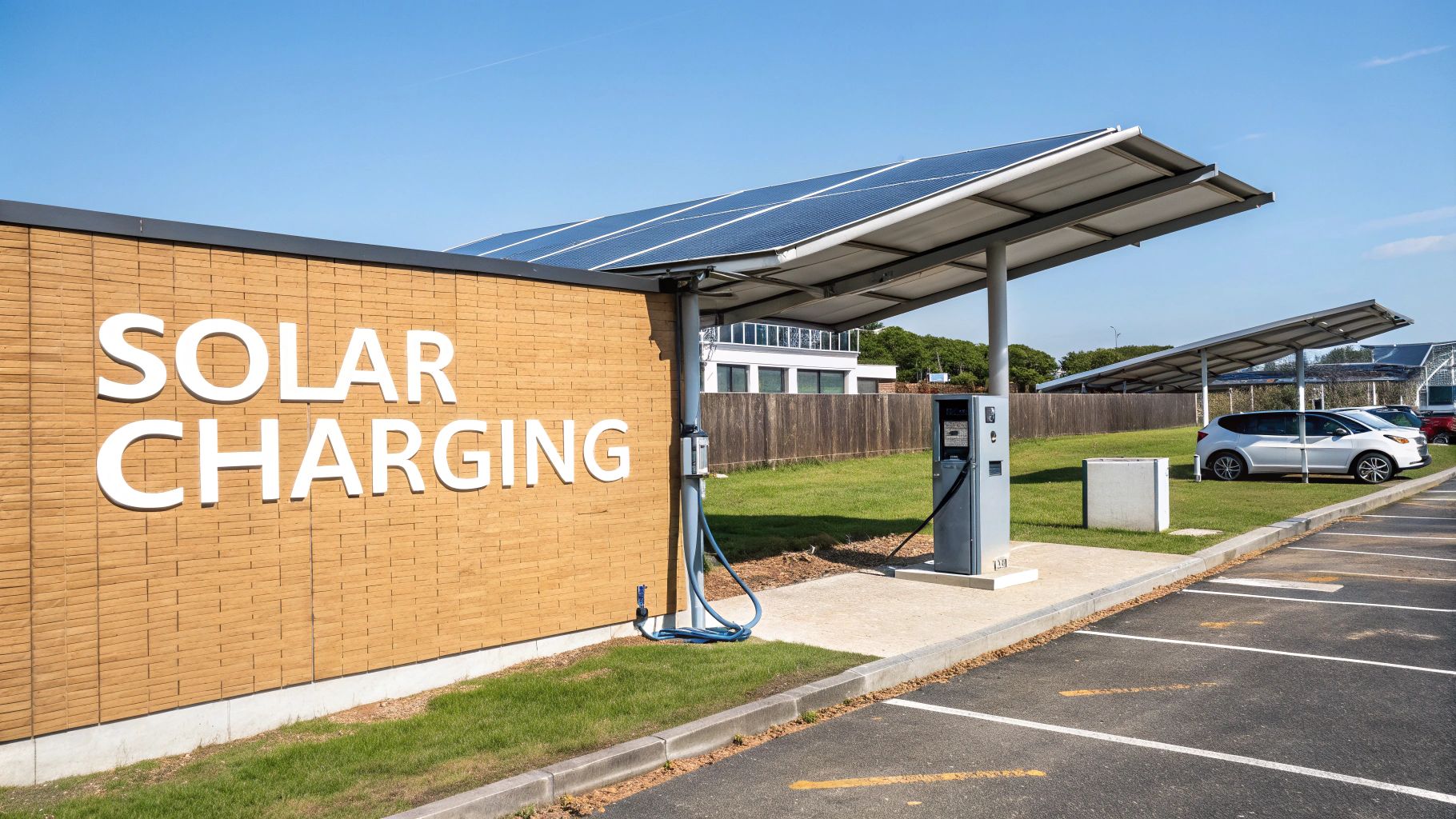
The core of this ecosystem is the synergy between generating your own clean power and storing it for when you need it most. By installing solar panels on your roof or a car park canopy, you can capture free, zero-carbon electricity all day long. This energy can power a fast charger car session directly while the sun is shining.
But the real magic happens when you add battery storage to the mix. Any surplus solar energy that is not immediately used by your building or the chargers gets stored in your battery system, rather than being exported to the grid for pennies. This captured energy can then be deployed later to charge vehicles in the evening or during overcast periods.
From Energy Consumer to Microgrid Operator
This combination of generation (solar), storage (battery) and load (EV chargers) effectively creates a small-scale microgrid . This setup gives you unprecedented control over your site's energy, allowing you to operate as a self-contained energy island when needed.
For any business where operational continuity is critical, this capability offers some serious advantages.
- Enhanced Resilience: If there is a local power cut on the national grid, your microgrid can carry on independently, keeping your EV chargers online and your business running without a hitch.
- Reduced Energy Costs: By maximising the use of your own free solar power, you drastically slash your reliance on expensive grid electricity, delivering substantial savings on your operational costs.
- True Sustainability: This model ensures the electricity powering vehicles at your site is genuinely green, providing a powerful and verifiable boost to your company’s environmental credentials.
A microgrid transforms your charging infrastructure from a passive consumer of electricity into an active, intelligent participant in the energy system. It is the ultimate expression of energy independence.
Tapping into New Revenue Streams
An integrated energy system does more than just power cars and save you money; it can also become a source of revenue. The National Grid and other energy market players are willing to pay for the flexibility that assets like grid-scale batteries provide.
By participating in grid services , your battery system can help balance supply and demand across the network. For instance, it can absorb excess energy when there is too much generation (like on a windy day) or discharge power back to the grid during periods of high demand to prevent blackouts. These services provide valuable income streams that further strengthen the business case for your fast charger project.
The demand for rapid charging is undeniable and growing. Data shows that UK drivers have a strong preference for speed, especially on longer journeys. During the first quarter of the year, over 7.6 million public charging sessions took place and an incredible 62% of these were at rapid or ultra-rapid chargers of 50kW or more. Fast charging points are the most heavily used, with some locations seeing up to four charging sessions per day, compared to just one for slower units. This highlights the clear commercial opportunity for businesses that can provide the high-power charging drivers are actively looking for. To see these trends in more detail, you can find more information about UK EV market statistics on EVision EVs.
Building a Business Case for Fast Charging
Beyond the technical hardware and grid connections lies the most important question for any business: does investing in a fast charger actually make financial sense? The answer is an emphatic yes, provided you approach it as a strategic asset rather than just another cost centre. Installing a fast charger car solution opens up multiple, proven commercial avenues that can generate substantial returns.
The key is to move beyond simply thinking of it as a plug. For a retail business, a rapid charger is a powerful magnet for high-value EV-driving customers, significantly increasing their dwell time . While their car charges for 20-30 minutes , they are far more likely to browse your store, visit your café or use your other facilities, leading directly to an uplift in sales.
For commercial fleets, the business case is even more direct. Time is money and rapid charging is all about maximising vehicle uptime. An electric van that can be topped up during a driver’s lunch break is a far more productive asset than one that needs to be parked up for hours. This efficiency gain translates directly into more deliveries, more completed jobs and a healthier bottom line.
Monetisation Models for Every Scenario
There is not a one-size-fits-all approach to monetising your charging infrastructure. The best model depends entirely on your business objectives—whether you are aiming for direct revenue, indirect benefits or a blend of both.
- Pay-As-You-Go (PAYG): This is the most straightforward model. Drivers pay per kilowatt-hour (kWh) of energy they consume, often via a contactless card reader or a dedicated app. It is a simple, transparent way to generate direct revenue.
- Subscription Services: For locations with regular users, like a fleet depot or a corporate car park, offering a monthly subscription can provide a predictable revenue stream while giving drivers better value.
- Hybrid Models: Many businesses offer a tiered system. For example, a supermarket might offer 30 minutes of free charging for customers who spend over a certain amount, with PAYG rates kicking in thereafter. This cleverly balances customer attraction with revenue generation.
Building a successful charging hub involves more than just setting a price. It requires smart software to manage different pricing tiers, monitor charger usage in real-time and seamlessly integrate with payment systems. This digital backbone is crucial for optimising your returns.
Calculating Your Return on Investment
A true return on investment (ROI) calculation looks far beyond the initial price tag of the hardware. To build a robust business case, you have to consider the entire financial picture over the lifetime of the asset. A proper analysis will always include these key cost and revenue pillars.
Key Cost Components:
- Hardware and Software: The cost of the charger, any battery storage and the management platform.
- Installation: This includes all the civil works, cabling and commissioning.
- Grid Connection: Potentially a major cost, though often mitigated by using battery storage.
- Operational Costs: Ongoing energy costs, maintenance and any software subscriptions.
Key Revenue and Benefit Streams:
- Direct Charging Revenue: Income generated from drivers paying to use the charger.
- Increased On-Site Spend: Additional sales from customers using your other services while they wait.
- Grid Service Payments: Revenue earned by your battery system for helping to stabilise the grid.
- Operational Savings: For fleets, this is the financial benefit of reduced vehicle downtime.
By carefully modelling these factors, businesses can get a clear picture of their payback period and long-term profitability. For those looking to create a significant public charging hub, the potential can be immense. To get a deeper insight, you can explore our analysis of how to earn £1M from rapid EV chargers , which breaks down the financial models for large-scale deployments. This strategic view is what separates a successful project from a simple installation.
Getting Your Fast Charger Project Off the Ground
Kicking off a fast charger project for your fleet or commercial site is a major step, but breaking it down into a clear process makes all the difference. The journey from a simple idea to a fully operational charging hub is built on careful planning, which starts with finding the right partners and technology for what you actually need.
Your first move should be to identify hardware suppliers and installation partners with a solid reputation. You will want companies with a proven track record here in the UK, especially those who have grappled with complex projects involving battery storage and tricky grid connections. That experience is invaluable because they already know how to navigate the challenges of deploying high-power infrastructure.
As you start looking at hardware, think about the specific features you will need. This includes options for secure charging units to protect both your investment and your users. A bit of due diligence here goes a long way in selecting a solution that is both robust and reliable.
The All-Important Site Assessment
Before a single piece of kit is ordered, a comprehensive site assessment is non-negotiable. This is not just about picking a spot in the car park; it is the very foundation of a successful project. A good partner will dig into several critical factors to make sure you do not run into costly surprises down the line.
Key steps in this assessment usually include:
- Grid Capacity Check: First, they will look at your existing electrical supply. Can it handle the chargers you want or will you need a battery system to bridge the gap?
- Physical Space Analysis: They will confirm there is enough room not just for the chargers, but also for any battery containers, switchgear and safe vehicle access.
- Planning Permission Scrutiny: It is vital to investigate local council requirements. Most commercial rapid charger installations will need formal planning consent and you do not want to get caught out.
Navigating the Grid Connection Maze
For many, connecting to the UK's electricity network is the most daunting part of the process. This is managed by the regional Distribution Network Operators (DNOs) , the companies responsible for the local infrastructure that brings power to your property.
You need to get in touch with your DNO as early as possible. They will assess how your proposed chargers will impact the local grid and tell you exactly what is needed for the connection. If your site’s connection is limited, this is where a battery-backed solution really shines, letting you sidestep what could be an expensive and time-consuming grid upgrade. Timelines for DNO approval can vary wildly, so building this into your project plan from day one is crucial for keeping everything on track.
If you take away two things, let it be these: a well-executed site assessment and early DNO engagement are the most important steps to de-risk your project. They prevent unexpected costs and delays, ensuring your fast charger installation goes smoothly and stays on budget.
The UK's investment in its EV network is only growing, making this an ideal time for businesses to get ahead by installing fast charging infrastructure. As of October, the UK had 17,356 charging devices rated at 50kW and above. We saw a 58% jump in ultra-rapid devices in the first half of the year alone.
Still, provision is patchy. Scotland is leading the way with 37 rapid devices per 100,000 people, while Northern Ireland has just 10.8 , highlighting some big regional gaps that need filling. You can discover more data about the UK's charging infrastructure on GOV.UK.
Got Questions About Fast Charging? We Have Answers.
When businesses start looking seriously at rapid EV charging, a few key questions always come up. Getting your head around these is the first step in planning a successful installation and making a solid business case for your project.
What Does a Commercial Fast Charger Actually Cost to Install?
Honestly, it varies massively. The final bill depends on the charger's power (a 50kW unit is a world away from a 350kW ultra-rapid charger), how complex your site is and whether you are including a battery energy storage system. Costs can run from tens of thousands to hundreds of thousands of pounds.
Often, the biggest single variable is the grid connection itself. If your site needs a major upgrade from the Distribution Network Operator (DNO), the price can shoot up. This is where an integrated battery system often makes a project viable, sidestepping that huge expense entirely.
Will I Need Planning Permission?
For most commercial setups in the UK, the answer is a firm yes. Putting in large, public-facing charging units almost always requires planning permission from the local council. Every authority has slightly different rules, so it is vital to talk to them—and your installation partner—right at the start.
While you might get away with permitted development for a small, low-power charger, a proper commercial rapid charging hub is a different beast. You will almost certainly need a formal application, so make sure you factor that time into your project plan from day one to avoid frustrating delays.
How Can Battery Storage Help My Weak Grid Connection?
Think of a battery energy storage system as an intelligent buffer between your charger and a weak grid connection. It quietly trickles power from your limited supply over many hours, often overnight when energy is cheapest, to fill itself up.
When an EV driver plugs in, the battery unleashes that stored power in a huge, short burst directly to the charger. This is how you can offer 150kW+ rapid charging from a connection that might only support 30kW , completely avoiding the cost and long wait for a grid upgrade.
What is the Real Return on Investment for a Public Fast Charger?
Your return on investment (ROI) hinges on a few things: how often the charger is used, your pricing model and what you pay for electricity. This is where integrating on-site renewables like solar and using batteries can seriously slash your running costs. Do not just think about charging revenue, either—factor in the extra income from increased footfall and customers staying longer.
For a well-placed charger with steady traffic, you are typically looking at a payback period of between three and seven years. And if your system includes battery storage, you can earn extra revenue by participating in grid services, which makes the business case even stronger.
At ZPN Energy , we specialise in solving these exact challenges. Our unique battery-backed rapid and ultra-rapid charging systems are designed to work with constrained grid connections, avoid costly upgrades and deliver the reliable, high-speed charging your customers expect. Discover our bespoke solutions at https://www.zpnenergy.com.