Energy Management for Businesses: A UK Guide
Managing your business's energy used to be simple: pay the bill and try to use a bit less next month. That's not the world we live in anymore. Today, effective energy management is a cornerstone of business strategy, essential for building resilience and sharpening your competitive edge. For firms across the UK, this means taking active control over how and when you use power, bringing assets like EV chargers and battery storage into the fold to secure your operations for the future.
The New Energy Landscape for UK Businesses
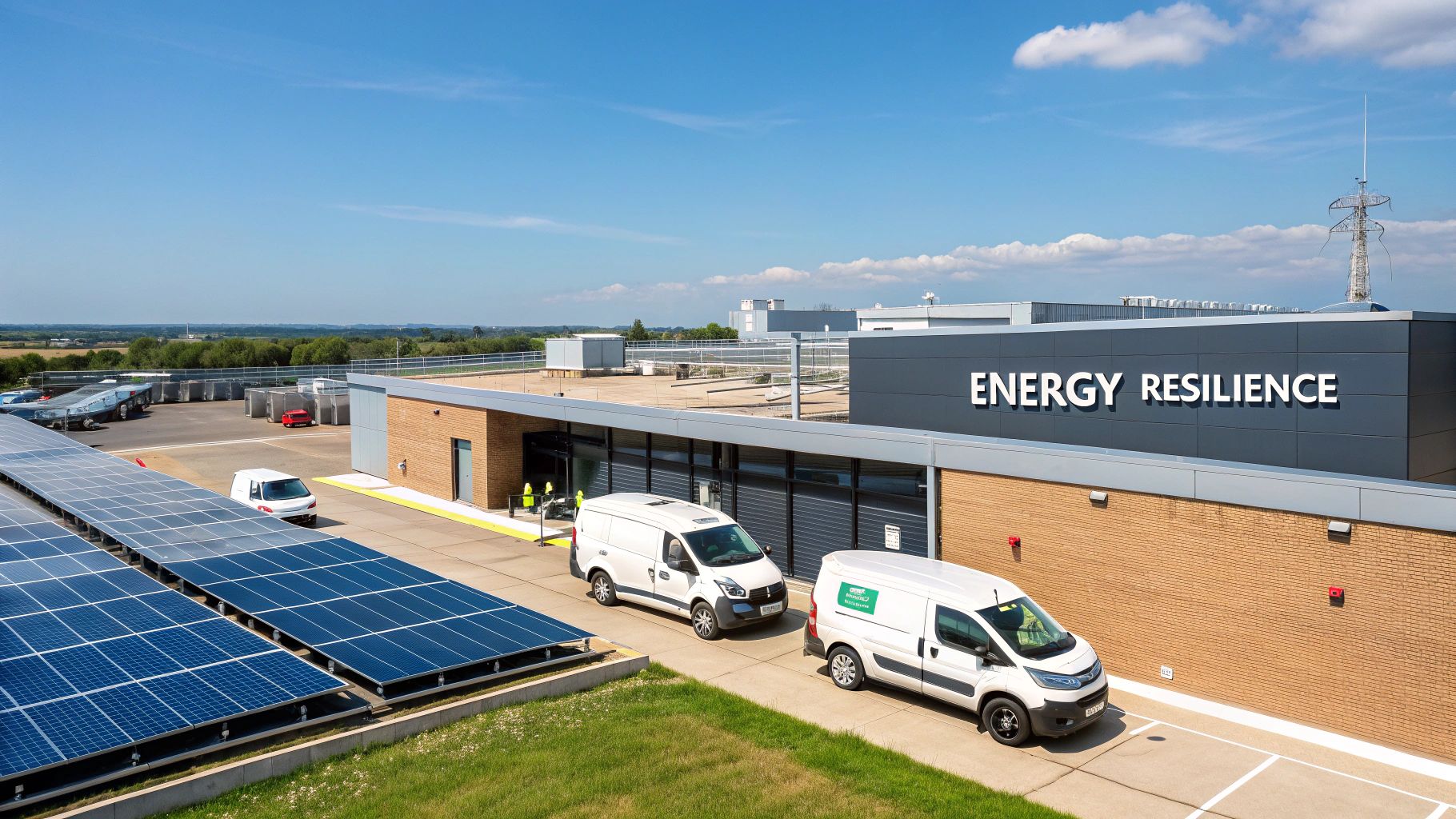
The conversation around energy in the UK boardroom has shifted dramatically. What was once a predictable line item on a spreadsheet has become a dynamic, often volatile, operational risk. This is not happening by chance; it is the result of powerful market forces converging to turn a simple utility into a complex challenge that demands a smarter response.
At the heart of this challenge are wildly fluctuating energy prices. As of early 2025, the UK's business energy market is valued at roughly £106 million. That is a staggering 72.3% increase from just over £61 million in 2012. This kind of financial pressure forces companies to look far beyond just turning off the lights. You can dig deeper into these business energy statistics to see the full picture.
Beyond Costs to Strategic Integration
While saving money is still a huge driver, the real story of modern energy management is much bigger. The move to electric vehicle (EV) fleets, for example, is placing massive new demands on electrical infrastructure. Businesses now need to provide not just standard but often rapid EV charging , frequently from grid connections that are already stretched to their limits.
This challenge, however, comes with a massive opportunity. It is about creating a cohesive, on-site energy ecosystem where key technologies work together, cutting your reliance on an unpredictable national grid.
An effective energy management system transforms your facility from a passive consumer into an active participant in the energy market. It is the difference between being at the mercy of price shocks and having the tools to navigate them successfully.
Key Drivers for a New Approach
The pressures on UK businesses are not just about cost and EVs. A strategic approach to energy tackles several critical needs at once:
- Operational Resilience: On-site generation from renewables paired with battery storage means you can keep the lights on and operations running, even when the grid goes down.
- Sustainability Goals: It is crucial for meeting corporate social responsibility targets and attracting environmentally-conscious customers and talent.
- Future-Proofing Infrastructure: You are building an energy system ready for tomorrow's demands, whether that is more EVs, mobile charging, or increased electrification across your operations.
- Creating Distributed Energy: This means developing a localised microgrid that gives you far greater control, efficiency and independence from centralised power generation.
This guide will lay out a clear roadmap for navigating this new landscape. We will explore how combining technologies like grid-scale batteries, on-site renewables and intelligent EV charging can build a powerful, resilient and financially sound energy future for your business.
The Building Blocks of a Modern Energy Strategy
Building a resilient, cost-effective energy strategy is about more than just shopping around for a better tariff. It means creating an on-site ecosystem where different technologies work in concert to give you genuine control over your power. These components are the foundation of modern energy management for businesses .
At the heart of this approach is the idea of shifting away from total reliance on a centralised, often expensive and vulnerable grid. Instead, power is generated, stored and used locally. Let us break down the key technologies that make this a reality.
Battery Energy Storage Systems: Your On-Site Reservoir
Think of a Battery Energy Storage System (BESS) as your business's private energy reservoir. Its function is simple but incredibly powerful: store electricity when it is cheap and plentiful, then release it when it is expensive or needed most.
This could mean charging the battery overnight on a low-cost, off-peak tariff. That stored energy is then used to power your operations during the day, letting you sidestep the peak-time charges that can seriously inflate your bills. A BESS acts as a crucial buffer between your business and volatile market prices.
On-Site Renewables: The Path to Energy Independence
Pairing a battery with on-site renewables like solar panels unlocks a completely new level of energy independence. Solar photovoltaic (PV) systems generate clean, free electricity right on your roof during daylight hours.
Instead of exporting that surplus power back to the grid for a minimal return, a BESS captures and stores it. This self-generated energy can then power your buildings in the evening or charge your electric vehicle fleet overnight. It is this synergy that creates a truly self-sufficient energy ecosystem. You can learn more about how to unlock the power of smart energy management with ZPN and see how these systems integrate.
By combining solar generation with battery storage, a business can achieve a self-consumption rate of over 70% . This drastically cuts grid dependence and insulates it from future price hikes.
EV Charging Infrastructure: The New Frontier
The shift to electric vehicles presents one of the biggest challenges—and opportunities—in business energy management. Providing reliable EV charging is no longer a perk; it is a necessity for fleets, employees and customers.
The problem is, many commercial sites have constrained grid connections that simply cannot handle the high power demands of multiple chargers, especially rapid EV charging units. Trying to install them can be slow, expensive and sometimes impossible without a major utility upgrade. This is where combining EV charging with batteries and on-site generation becomes essential.
- Rapid charging from a constrained grid connection: A BESS can be trickle-charged from a limited grid connection over several hours. When an EV plugs in, the battery delivers a high-power charge directly to the vehicle, bypassing the grid's limitations entirely.
- Mobile EV Charging: For ultimate flexibility, mobile EV charging units with integrated batteries can be deployed wherever needed—in remote areas of a depot or at temporary event sites—with no grid connection at all.
- Grid-scale batteries: For large fleet depots or logistics hubs, grid-scale batteries act as a central energy hub. They can manage the charging of dozens of vehicles at once while also providing stability services back to the local electricity network, creating a powerful new revenue stream.
These technologies are the cornerstones of any serious business energy strategy. While each component offers unique advantages, their true power is unleashed when they work together as a single, intelligent system. The table below summarises how each piece of the puzzle fits into the bigger picture.
Key Technologies in Business Energy Management
| Technology | Primary Function | Strategic Business Benefit |
|---|---|---|
| Battery Storage (BESS) | Stores low-cost or renewable energy for later use. | Reduces peak-time energy costs, enhances grid resilience and enables rapid EV charging. |
| On-Site Renewables | Generates clean electricity directly at your facility. | Lowers energy bills, provides energy independence and improves sustainability credentials. |
| Integrated EV Charging | Provides vehicle charging supported by on-site assets. | Overcomes grid constraints, lowers fleet running costs and future-proofs your infrastructure. |
By integrating these core components, a business transforms from being a passive energy consumer into an active manager of its own energy resources, gaining control over costs, resilience and its environmental footprint.
Integrating EV Charging with Battery and Renewables
Getting the right technologies on-site is only half the battle. Real strategic energy management happens when these components—EV charging, on-site renewables and battery storage—work together in perfect harmony. Think of it like a finely tuned orchestra; the real value is unlocked when every instrument plays its part to create something powerful.
This synergy creates a virtuous cycle of energy generation, storage and consumption right on your premises. It is a fundamental shift away from simply pulling power from the grid and towards actively managing your own energy resources. When you do this, you gain incredible control over your costs and operational resilience.
This diagram shows the core relationship between your business operations and these key energy assets.
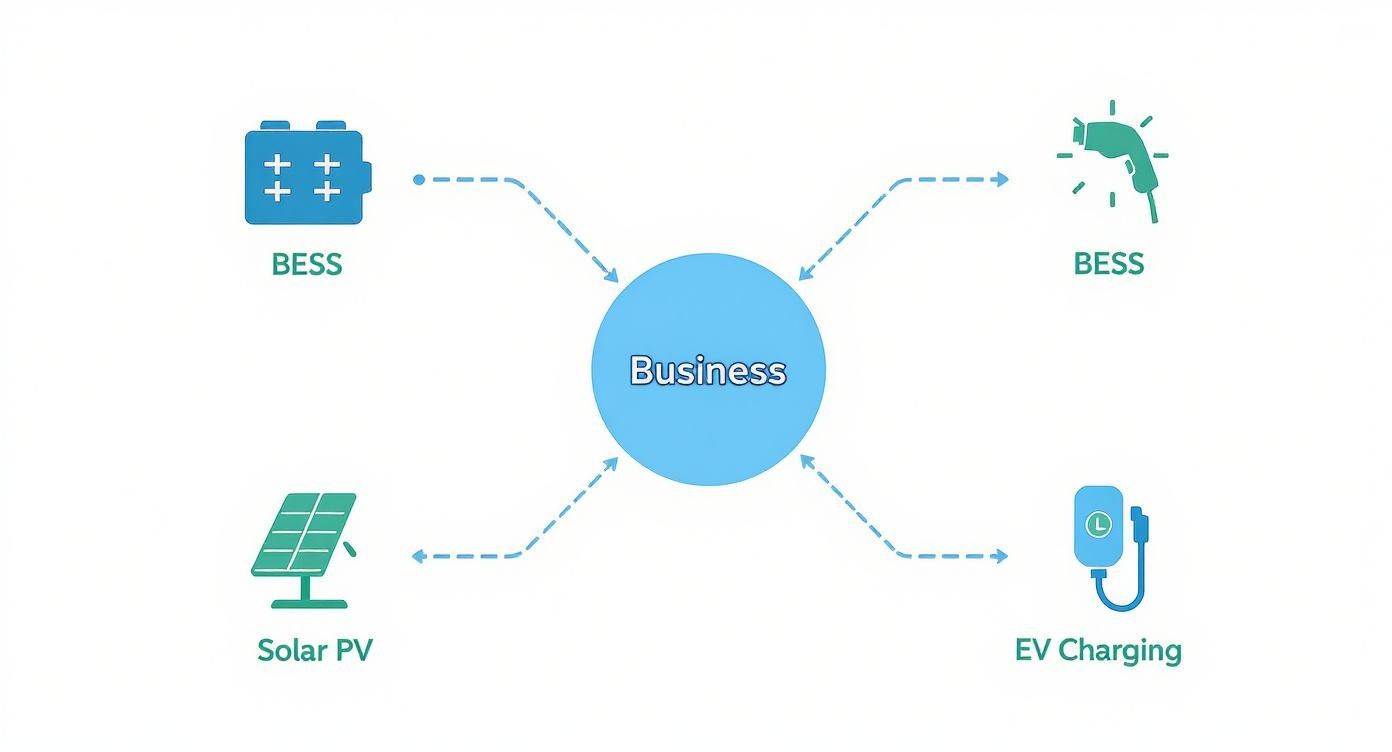
As you can see, a business can centralise its energy strategy: solar generates the power, battery storage holds it and EV charging deploys it, creating a self-sufficient loop.
A Practical Scenario: The Logistics Depot
Imagine a busy logistics depot with a growing fleet of electric delivery vans. The site has a huge roof, perfect for solar panels, but its connection to the grid is already stretched to its limit. It simply cannot handle the extra load from multiple rapid EV chargers .
Without an integrated system, the depot faces a massive problem. It either has to fund a costly and time-consuming grid upgrade or risk being unable to charge its fleet efficiently, putting daily operations on the line. But with an integrated approach, the entire picture changes.
- Daytime Generation: Throughout the day, the solar panels generate huge amounts of free, clean electricity.
- Energy Storage: Instead of being wasted, this solar energy is funnelled into a large, on-site battery system, charging it up during the sunniest hours.
- Overnight Fleet Charging: When the electric vans return in the evening, they plug in. But instead of drawing expensive, peak-rate electricity from the strained grid, the chargers pull power directly from the battery that was filled with free solar energy all day.
This setup not only solves the grid constraint problem but also slashes the fleet's running costs. It is a textbook example of how commercial solar and battery storage can completely transform business operations.
Overcoming Grid Constraints for Rapid Charging
This principle is a game-changer for any business wanting to install rapid EV charging where grid connections are weak. Whether it is a retail park adding customer chargers or an office providing them for employees, a battery system acts as the essential buffer.
The battery can be trickle-charged slowly from a weak grid connection over many hours. Then, when a vehicle arrives needing a fast charge, the BESS can discharge a massive amount of power in a very short time, delivering a rapid charge without ever overloading the local grid. This suddenly makes previously unsuitable sites perfectly viable for modern charging demands.
By decoupling the charging event from the grid's real-time capacity, businesses can offer high-value rapid charging services almost anywhere. This even opens the door to deploying mobile EV charging units for ultimate flexibility at events or in remote locations.
Turning Fleets into Revenue Streams with V2G
The integration can go even further with advanced concepts like Vehicle-to-Grid (V2G) technology. With V2G, the flow of energy becomes a two-way street. Suddenly, the batteries inside your electric vehicles become active participants in your energy network. For any business heading down this road, understanding EV battery technology and its potential is foundational.
During times of high national demand, like early evenings, the energy stored in your parked EV fleet can be sent back to power your own building. Better yet, it can be sold back to the grid for a profit.
This transforms your fleet from a simple operational cost into a dynamic asset that generates revenue. Your vehicles effectively become a mobile, grid-scale battery, ready to support the national energy system and earn you an income for doing so.
Unlocking Financial and Operational Benefits
Taking a strategic approach to energy is not just a technical upgrade; it is a fundamental business decision that delivers powerful financial and operational returns. When you look past the hardware, the real-world outcomes of effective energy management for businesses translate directly into a stronger, more resilient and more profitable operation.
The most immediate win is, of course, direct cost savings. By generating your own power with on-site renewables and storing it in batteries, you slash your reliance on expensive grid electricity, especially during peak price periods. It is a classic case of energy arbitrage: buying low and using high, storing cheap off-peak energy to sidestep costly daytime tariffs. A smart first step is always comparing business energy prices to get a clear baseline of what you could be saving.
Enhancing Resilience and Ensuring Business Continuity
Beyond cutting costs, a distributed energy system adds an invaluable layer of operational security. Grid outages, whether from extreme weather or infrastructure faults, can bring a business to a grinding halt. The result? Lost production, missed deadlines and significant financial damage.
An integrated system with on-site generation and battery storage acts as a powerful shield against this disruption. When the grid fails, your system can automatically take over, using stored energy to keep critical operations running. For businesses in manufacturing, logistics or data management, this ability to maintain continuity is not just a perk; it is a vital competitive edge.
Transforming Energy from a Cost to a Revenue Stream
This is where the real paradigm shift happens: turning what has always been an overhead into a strategic asset that actually generates new revenue. Modern energy systems allow businesses to actively participate in the energy market, helping to stabilise the grid—and getting paid for it. You stop being a simple consumer and become a valued partner.
Key opportunities to make money from your energy system include:
- Demand Side Response (DSR): National Grid and other operators run schemes that pay large energy users to temporarily cut their consumption or export stored power to help balance supply and demand. Your battery system can automatically export power during these high-value events.
- Frequency Response: These services require near-instantaneous power injection or reduction to keep the grid's frequency stable. Battery systems are perfectly suited for this, offering a rapid response that commands premium payments.
- Capacity Market: Businesses can bid to make their stored energy capacity available to the grid, providing a guaranteed income stream just for being on standby.
This new dynamic is driving rapid change. Recent UK business energy statistics show a remarkable 15% reduction in energy usage compared to the previous year, as nearly 80% of UK businesses are actively looking for ways to cut consumption and manage soaring bills. It is a clear signal that controlling energy is now central to financial health.
By participating in grid balancing services, a business can create an additional revenue stream that can offset the initial capital investment in as little as three to five years, effectively making the system pay for itself.
Ultimately, a modern energy strategy moves your business from a position of vulnerability to one of control. It unlocks direct savings, guarantees operational uptime and opens up entirely new ways to generate income. For those looking to dive deeper, our guide on how ZPN Energy's business energy management system drives revenue offers more insight into maximising profitability. This is how energy stops being a simple bill to be paid and becomes a dynamic asset to be managed.
Your Roadmap to Implementing an Energy System
Moving to an integrated energy system can feel like a massive undertaking, but it is actually a structured process. With a clear, step-by-step approach, any business can confidently deploy a solution that delivers on its cost, resilience and sustainability targets.
Breaking the journey down into distinct phases makes the entire project manageable. It ensures no critical details get missed along the way. This roadmap gives you the framework for a successful rollout, from the first analysis to a fully operational system, helping you avoid common pitfalls and get the most from your investment.
Step 1: Energy Audit and Assessment
Before you even think about buying equipment, you need to understand your current energy landscape in minute detail. An energy audit is the foundational first step—think of it as a diagnostic tool for your entire operation. It is all about creating a detailed picture of how, when and where you use power.
This means digging into historical energy bills to pinpoint when you use the most electricity and what you pay for it. The goal is to identify your peak load periods, which are the times of highest demand that often come with the most expensive charges. This data is absolutely crucial for sizing a battery system correctly.
Beyond the numbers, this phase also involves a thorough site feasibility assessment:
- Renewables Potential: Surveying your site to see if it is suitable for solar panels, considering roof space, orientation and any potential shading from nearby structures.
- Asset Placement: Identifying the best spots for a battery energy storage system (BESS) and EV charging points, making sure they meet both operational needs and safety standards.
- Grid Connection Review: Evaluating the capacity of your existing grid connection. This is especially critical for sites planning to install rapid EV chargers, which can place a significant new demand on your supply.
A detailed assessment is not just about spotting problems; it is about uncovering opportunities. It reveals precisely where an integrated energy system can deliver the biggest impact, from slashing peak demand charges to making fleet electrification possible.
Step 2: System Design and Procurement
With a clear understanding of your energy profile, the next stage is designing a system that meets your specific needs. This is no time for a one-size-fits-all solution. The right setup for a logistics depot with a big EV fleet will look completely different to that of a commercial office building with a constrained grid connection.
This is where you bring in the energy specialists. They will use the data from your audit to model different scenarios and engineer a system that balances performance, cost and future scalability. It is during this design phase that key decisions are made about the size of the battery, the number of solar panels and the type of EV charging infrastructure you will need.
Once the design is locked in, the procurement process begins. This involves selecting the right hardware and software from trusted suppliers. It is vital to choose components that are not only high-quality but are also designed to integrate seamlessly. A system where the solar panels, battery and EV chargers can all communicate flawlessly is essential for effective energy management for businesses .
Step 3: Integration and Commissioning
The final step is bringing your design to life. This phase covers the physical installation of all the hardware—solar panels, battery units, rapid or mobile EV chargers and all the associated cabling and control systems.
But the most critical part of this stage is the integration. The system’s software, often called an Energy Management System (EMS), is installed and configured. This software acts as the ‘brain’ of the operation, constantly monitoring energy generation, storage and consumption. It makes intelligent, real-time decisions to optimise performance—for example, telling the battery to charge from solar during the day and discharge to power your EV fleet at night.
Once installed, the whole system undergoes a rigorous commissioning process. Engineers test every component and connection to ensure it all operates safely and exactly as designed. They verify that the battery is talking to the solar inverter and that the EV chargers can draw power from both the grid and the battery when needed. The project is not finished until every part of the system is working in perfect harmony, turning your site into a truly efficient, distributed energy hub.
Proving the Value and Navigating the Rules
Putting an advanced energy system in place is a serious investment, so you need to be able to prove its worth with cold, hard data. Effective energy management for businesses is not just about looking at the top-line electricity bill; it is about digging into specific Key Performance Indicators (KPIs) that show the real impact on your bottom line.
When you track the right metrics, you get a clear picture of how your system is performing day-to-day. This is the evidence you need to justify the initial outlay and, just as importantly, to shape your future energy strategy. It is a data-led approach that transforms your energy assets from a simple cost centre into a measurable, optimisable part of the business.
Key Performance Indicators to Keep an Eye On
To really understand the success of your energy strategy, you do not need a mountain of data. Just focus on a handful of critical KPIs that reflect both cost savings and operational improvements. These are the numbers that paint a clear picture of your return on investment (ROI).
- Grid Import Reduction: This is a big one. It simply measures how much less electricity you are buying from the national grid. It is a direct indicator of your growing energy independence and the number one driver of cost savings.
- Renewable Energy Self-Consumption: This KPI shows how much of the energy you generate on-site (from solar, for instance) is actually used by your business instead of being sent back to the grid. A higher rate means you are getting the maximum value from your own free, green electricity.
- Cost Per Mile for EV Fleets: For any business running electric vehicles, this metric is vital. It calculates the real-world cost of charging your fleet using your own energy assets versus paying public charging fees or peak grid prices.
- System Payback Period: The ultimate financial yardstick. This calculation tells you exactly how long it will take for the money you have saved and generated to completely cover the initial cost of the system.
By keeping a close watch on these KPIs, you can quantify your success and make smart adjustments on the fly. For instance, a business hitting an 80% grid import reduction and a 90% self-consumption rate has undeniable proof of a powerful and financially savvy energy system.
Making Sense of UK Regulations and Incentives
Getting to grips with the UK’s regulatory and incentive landscape is absolutely essential if you want to maximise the financial return of your investment. There are several schemes out there designed to help businesses adopt greener tech, from grants that help with the purchase of equipment to capital allowances that offer major tax relief.
It is also crucial that you understand your grid connection agreement inside and out. These documents lay out the capacity and limitations of your connection, which has a direct impact on your ability to install assets like rapid EV charging or export power. Taking the time to navigate these agreements and leverage the support available can dramatically shorten your system's payback period and boost its overall ROI.
Got Questions About Business Energy Management?
Stepping into a new energy strategy always brings up a few questions. Let us tackle some of the most common ones we hear from businesses looking to bring technologies like EV charging and battery storage into their operations.
How Can My Business Install Rapid EV Chargers with a Constrained Grid Connection?
This is a classic problem and one we see all the time at commercial sites. The smartest way around it is to pair your charging setup with a Battery Energy Storage System (BESS). Think of it as a local power reservoir for your chargers.
The system works by slowly sipping power from your limited grid connection during quiet, off-peak hours, storing it up in the battery. Then, when a driver needs a rapid EV charge , the system unleashes a powerful surge directly from the battery. This completely bypasses your grid's limitations, letting you offer a top-tier charging service without the eye-watering cost and long delays of a grid upgrade.
What Is Mobile EV Charging and When Is It a Good Idea?
Simply put, mobile EV charging is about portable charging units, often with their own batteries built right in. You can move them and set them up wherever they are needed, giving you total flexibility without ever needing to plug into a fixed grid connection.
This comes in incredibly handy for:
- Fleet depots that need to charge vehicles parked in different spots across a large yard.
- Events or temporary worksites where installing permanent chargers just is not practical.
- Roadside assistance crews needing to give a stranded EV an emergency boost.
Can On-Site Renewables and Batteries Power My Entire Operation?
Going for 100% energy independence is a big goal but it is more achievable than ever. It all comes down to your site's energy appetite, how much space you have for solar panels and the size of your battery system.
A more common and practical target is to cover 70-80% of your energy needs with your own generation and storage. This move massively cuts your grid dependency, shields your business from unpredictable energy prices and gives your sustainability credentials a serious boost. You keep the grid as a reliable backup, giving you the best of both worlds: independence and security.
Pairing grid-scale batteries with your own renewables is a game-changer. It is not just about cutting costs; it is about turning your facility into a smart energy asset. You gain resilience, control your operational spending and truly take charge of your energy future.
Ready to take control of your business's energy future? ZPN Energy delivers fully integrated rapid EV charging, battery storage and energy management solutions designed for UK businesses. Discover how our technology can overcome grid constraints, reduce your operational costs and create new revenue streams. Visit us at https://www.zpnenergy.com to start building a more resilient and profitable energy strategy today.