Energy Management for Businesses That Cuts Costs
Staring at another unpredictable energy bill? You're not alone. For a long time, businesses treated energy as a fixed, unavoidable cost on the balance sheet but that passive approach just doesn't work anymore. Modern energy management for businesses is about a fundamental shift in thinking—it’s about building an integrated system to control precisely how you generate, store and use power.
This isn't just about switching off lights. It’s about transforming energy from a costly overhead into a powerful strategic asset.
Why Business Energy Management Matters Now More Than Ever
With volatile wholesale prices, an ageing national grid and growing pressure to operate sustainably, simply paying the bills is a risky strategy. Today, smart energy management is a cornerstone of operational resilience and a real source of competitive advantage.
It's all about taking direct control. Think of it as creating your company’s own miniature, intelligent power grid. This means combining on-site technologies into a cohesive ecosystem that works for your bottom line, insulating you from external shocks.
The New Energy Toolkit
What used to feel like futuristic concepts are now practical, off-the-shelf tools for any forward-thinking company. These core components work together to deliver energy security and financial stability.
To put it simply, here are the key pillars that make up a modern business energy strategy:
Key Pillars of a Modern Business Energy Strategy
This table breaks down the essential components, showing how they fit together to create a powerful, integrated system.
| Component | Primary Function | Business Benefit |
|---|---|---|
| Combined On-site Renewables | Generating clean, low-cost electricity right where it's needed (e.g., solar panels). | Reduces reliance on expensive grid power, especially during peak hours. |
| Grid Scale Batteries | Storing excess solar generation or cheap off-peak grid electricity for later use. | Acts as an energy reservoir, providing power when it's most valuable. |
| EV Charging | Fuelling the transition to electric fleets and supporting staff/customer vehicles. | Supports sustainability goals but also creates new on-site power demands. |
| Distributed Energy | Intelligently connecting your assets to the wider grid. | Allows you to sell surplus power back, creating new revenue streams. |
Each of these elements plays a crucial role but their true power is unlocked when they operate in concert, managed by a smart energy management system.
A proactive energy management strategy provides a direct answer to rising costs, grid instability and sustainability pressures. It transforms a boardroom headache into a source of new revenue and long-term business resilience.
This shift in mindset is already well underway. Faced with climbing costs, around 80% of UK businesses are now actively trying to lower their electricity and gas consumption. These efforts have already contributed to a collective 15% reduction in energy use compared to the previous year, proving a clear national trend towards greater efficiency.
Ultimately, an integrated approach builds a system that is far greater than the sum of its parts. By combining generation, storage and smart controls, businesses can slash costs, secure their power supply and tap into financial benefits that were previously out of reach. For a broader look at the topic, you can find many comprehensive energy management insights.
Building Your On-Site Energy Ecosystem
Taking control of your business’s energy future starts with building a robust, on-site energy ecosystem. It’s about more than just installing a few solar panels; it’s about assembling the right technologies to generate, store and intelligently use power. This approach turns your premises from a passive energy user into an active, independent energy hub.
The foundation is typically combined on-site renewables , most often with solar photovoltaics (PV). Think of a solar installation as your own private power plant, generating clean, low-cost electricity right where you need it. This immediately slashes your dependence on expensive grid power, especially during peak daytime hours when prices are at their highest.
But renewables aren't always available—the sun doesn't shine at night. This is where a Battery Energy Storage System (BESS) is a game-changer. A BESS acts as your energy reservoir, capturing surplus solar power that would otherwise be sold back to the grid for a pittance. You can also charge it with cheap, off-peak grid electricity overnight, ready to be deployed when it’s most valuable.
The Rise of Electric Vehicle Charging
The shift to electric vehicles adds a significant new electrical load to your site. A smart energy management strategy for businesses has to account for this, covering everything from standard fleet chargers to high-powered rapid EV charging stations needed for quick turnarounds.
For businesses with ever-changing needs, like construction sites or event companies, mobile EV charging units offer a brilliant, flexible solution without the headache of permanent installation. But all these chargers, particularly the rapid ones, can place a massive strain on your connection to the national grid.
This creates a serious hurdle for businesses operating from sites with EV charging from constrained grid connections . Trying to power a fleet of rapid chargers from a weak grid link can be impossible without a costly and time-consuming upgrade. This is where integrating renewables and battery storage becomes not just a nice-to-have but an absolute necessity.
By combining on-site solar generation with battery storage, a business can power its EV charging infrastructure using its own clean energy. This sidesteps the limitations of a constrained grid connection, turning a potential roadblock into a strategic advantage.
This diagram illustrates how these core components—solar, storage and EV charging—form the bedrock of a modern business energy strategy.
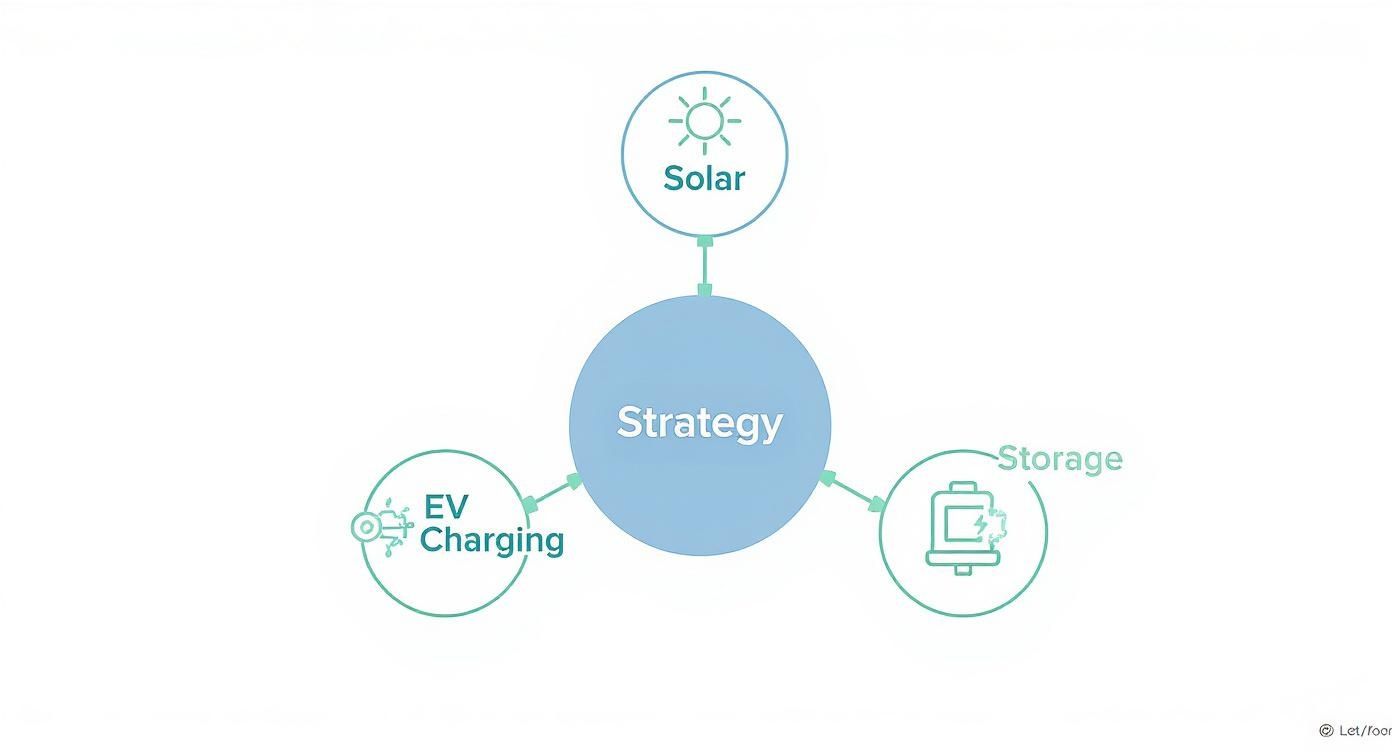
As you can see, a successful energy plan isn’t about isolated technologies. It’s about making them work together, intelligently.
Connecting to the Bigger Picture
When you combine these assets, you create a system of distributed energy . Your business is no longer just a point of consumption but an active participant in the wider energy network.
Here’s how these pieces fit together:
- Combined On-site Renewables and Batteries: On-site renewables and battery storage work in tandem to power your daily operations and EV fleets, dramatically cutting your reliance on grid electricity. To see this in action, you can learn more about how commercial solar and battery storage systems power businesses and EV fleets.
- EV Charging and Batteries: A BESS can absorb the high-power demands of rapid charging. This protects the local grid from instability and helps you avoid the steep demand charges your utility provider would otherwise hit you with.
- Grid Scale Batteries: For larger industrial sites or energy developers, grid scale batteries can provide stability services to the National Grid, turning a site’s energy assets into a new source of revenue.
Ultimately, this integrated ecosystem gives your business a powerful toolkit. It lets you generate your own clean power, store it for when you need it most and manage the huge new load from EV charging—all while creating opportunities to interact with the grid on your own terms.
Unlocking Benefits Beyond Lower Energy Bills
While direct cost savings are a powerful motivator, a modern energy management for businesses strategy delivers value that reaches far beyond a lower monthly bill. It’s really about building long-term operational strength, creating new financial opportunities and future-proofing your organisation against whatever the market throws at you.
The true advantages lie in resilience, revenue and reputation.
Imagine a sudden grid outage during a critical production run or at the peak of retail trading. For many businesses, the financial and reputational damage from that kind of downtime can be immense. This is where an on-site energy ecosystem provides its first major benefit: powerful energy resilience .
Creating Uninterruptible Operations
By combining combined on-site renewables like solar with a grid scale battery system, your business can effectively create its own independent microgrid. When the national grid goes down, your integrated system can seamlessly switch over, keeping the lights on, machinery running and data centres online.
This capability isn't just a convenience; it's a critical safeguard. A battery storage system, charged by your solar panels or cheap off-peak electricity, ensures your operations continue without a hitch, protecting your revenue and customer commitments.
Turning Energy Assets into a Profit Centre
Beyond just safeguarding your operations, this same infrastructure can generate entirely new revenue streams. Your energy assets don't have to sit idle; they can actively participate in grid-balancing services, turning a traditional cost centre into a dynamic profit centre.
This is made possible through distributed energy programmes where the National Grid actually pays businesses to help stabilise the network.
- Frequency Response: Your battery system can automatically discharge power to the grid in seconds to counteract frequency drops, a service for which you are compensated.
- Capacity Market: You can commit to providing power during periods of high national demand, receiving regular payments just for being available.
Essentially, your battery and control system become a tradable asset. This is a fundamental shift in how businesses can interact with the energy market, moving from a passive consumer to an active participant. Learn more about how a business energy management system drives revenue through these smart interactions.
Enhancing Sustainability and Brand Reputation
Today, a company’s commitment to sustainability is under intense scrutiny from customers, investors and regulators. A visible investment in renewables and battery storage is a powerful statement that directly supports your Environmental, Social and Governance (ESG) targets.
On-site solar generation drastically reduces your carbon footprint, while smart management of EV charging and batteries ensures your vehicle fleet runs on clean, low-cost energy. This commitment strengthens your brand, helping you attract environmentally conscious customers and talent.
A proactive energy strategy is about future-proofing your business for the inevitable shift towards electrified transport and heating, ensuring you stay ahead of regulatory curves and market expectations.
This trend is accelerating. A recent PwC survey revealed that 89% of UK private sector businesses saw their energy consumption rise in the last year. In response, 37% are now implementing smart energy management systems to get a grip on this escalating operational cost. You can explore the full PwC UK Energy Survey 2025 for more insights.
To properly demonstrate these benefits and continuously fine-tune your energy usage, robust data management and analytics solutions are essential for tracking performance and spotting further opportunities. The advantages are clear: from operational continuity and new income to a stronger brand, the right energy strategy delivers value across the entire business.
Solving the Constrained Grid Connection Problem
Have your plans to electrify your fleet or expand your operations been stopped dead in their tracks by a weak grid connection? It’s one of the most common and frustrating hurdles UK businesses run into.
A constrained grid connection is simply when your local part of the national electricity network can't supply the power you need, exactly when you need it.
This problem usually comes to a head when a business decides to install rapid EV charging points. A bank of high-powered chargers can draw a colossal amount of electricity in a very short burst—far more than most commercial sites were ever designed for. Applying for a grid upgrade is the obvious first step but that can lead to eye-watering costs and multi-year waiting lists, effectively putting critical projects on ice.
But there’s a powerful, intelligent way to sidestep this problem entirely. Effective energy management for businesses lets you work with your existing grid connection, not against it.
The Battery as a Local Energy Reservoir
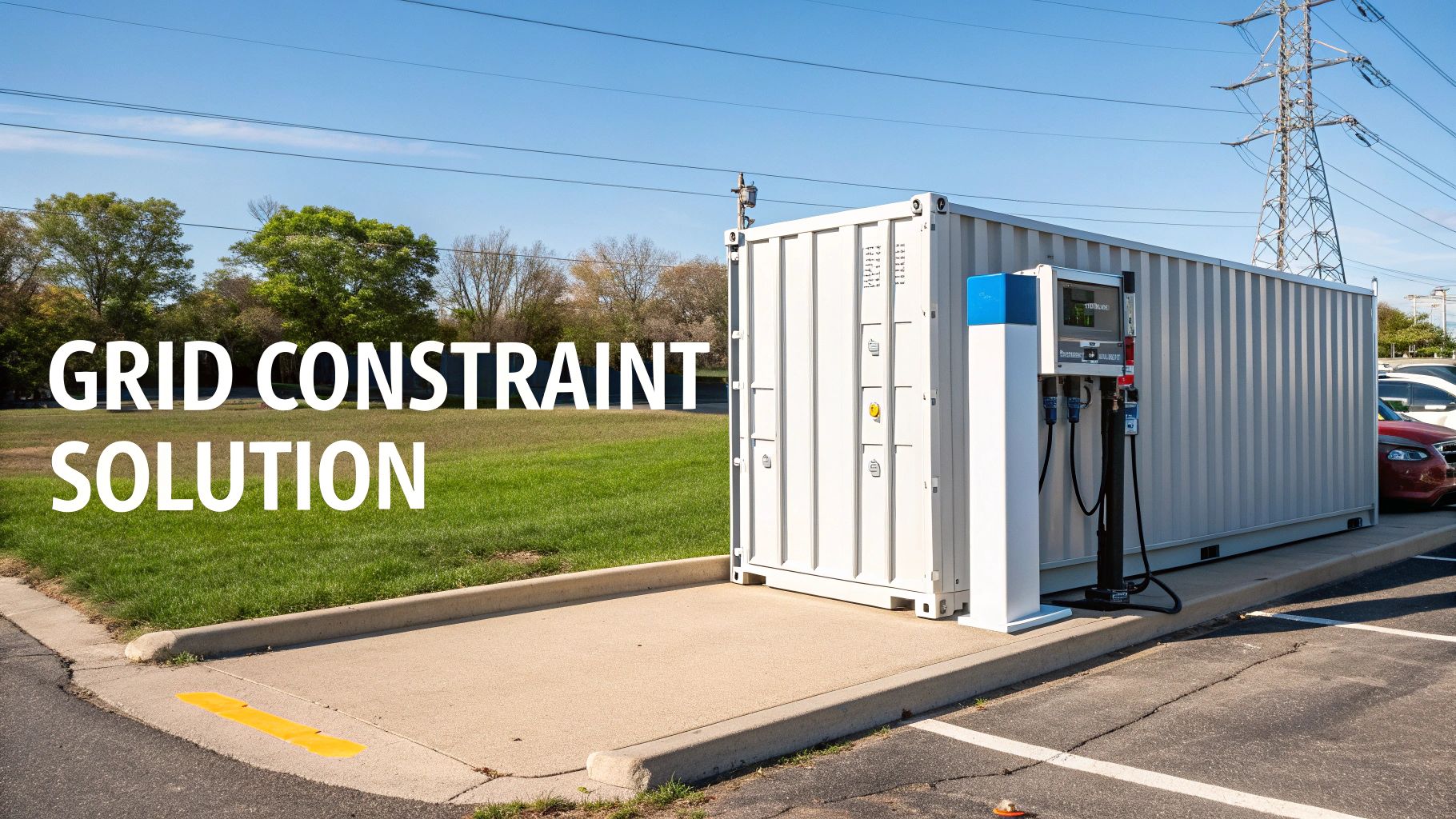
The key is pairing EV charging and batteries . Think of a Battery Energy Storage System (BESS) like a local water reservoir on your site. Your constrained grid connection is a small pipe that can only fill the reservoir slowly over time.
Once it's full however, that reservoir can open its floodgates and release a powerful torrent of water on demand. A BESS does exactly the same thing with electricity.
The battery system "trickle charges" by drawing power slowly from your weak grid connection during off-peak hours when demand is low and electricity is cheap. This stored energy can then be unleashed at a very high rate to power your rapid EV chargers during the day, all without ever maxing out your grid capacity.
This strategy cleverly decouples your site’s peak power demand from the grid’s limitations. It means you can deliver high-power services like rapid and even mobile EV charging without forking out for a slow and expensive grid upgrade.
A Real-World Example in Action
Imagine a logistics depot that wants to transition its entire HGV fleet to electric. The site's existing grid connection was nowhere near powerful enough to charge multiple heavy goods vehicles at once. The quote for an upgrade? Over £1 million with a two-year lead time.
Instead of waiting, the company built an integrated energy solution on-site.
- Combined On-site Renewables: A large solar panel array was installed on the warehouse roof to generate clean, low-cost power during the day.
- Grid Scale Battery: A containerised BESS was installed to store all the excess solar energy.
- Intelligent Charging: The BESS was also programmed to charge from the grid overnight using cheap, off-peak tariffs, topping up what the solar panels provided.
The result? The logistics company now powers its electric fleet almost entirely from its own stored energy. The slow-and-steady charge from the grid and the solar panels keeps the battery full, ready to deliver the high-power punch needed for vehicle charging during peak hours.
This approach completely bypassed the need for a grid upgrade, saving the company a fortune and fast-tracking its move to a sustainable fleet. It’s a perfect example of how combining renewables, distributed energy assets like batteries and smart management can overcome huge infrastructure roadblocks. By understanding these principles, businesses can unlock projects that once seemed impossible.
For a deeper dive, you can find more details on overcoming challenges in renewable energy management and what it means for the modern grid.
Your Step-by-Step Implementation Roadmap
Ready to take control of your energy? Moving from an idea to a fully working energy management system needs a clear, practical plan. The whole process is best broken down into distinct phases, making sure every decision is sharp and every pound invested is aimed at the best possible return.
Think of it like building a house; you need a solid blueprint before you even think about laying the first brick. This roadmap guides you from the first analysis all the way to ongoing fine-tuning, turning your energy strategy into a real business asset.
Phase 1: Energy Audit and Site Assessment
First things first, you need to get a handle on your current energy situation. An energy audit is a deep dive into your consumption patterns, identifying exactly where, when and how you use electricity. This isn’t just about reading meters; it's about finding the biggest energy drains and, more importantly, the biggest opportunities to save money.
A proper site assessment will look at:
- Load Profiles: Mapping your energy demand hour by hour to see the peaks and troughs.
- Existing Infrastructure: Checking out your current grid connection and seeing what physical space you have for new kit.
- Operational Needs: Figuring out the power demands for your core operations, including any future plans for rapid EV charging or fleet electrification.
This first phase gives you the hard data needed to build a business case and design a system that actually fits your business, uncovering hidden costs and setting the stage for a targeted, high-impact strategy.
Phase 2: System Design and Procurement
With a clear picture of your energy use, it's time to design the solution. This is where you select the right mix of technologies to hit your goals, whether that's cutting costs, building resilience or creating new revenue streams through distributed energy services. The design has to consider how different assets, like EV charging and batteries , will work together.
Procurement is about more than just buying hardware; it's about choosing the right partners. Look for suppliers with a proven track record, especially in integrating complex systems that combine combined on-site renewables with grid-scale batteries . A good partner will help you navigate specifications, warranties and performance guarantees, making sure you invest in quality assets built to last. This is where your strategic energy management for businesses plan starts to become a reality.
Phase 3: Integration and Commissioning
This is the technical heart of the project. It's where all the individual components are brought together to work as one ecosystem. Integration means physically installing the solar panels, battery systems and EV charging points. Crucially, it also means connecting everything to a central Energy Management System (EMS).
The EMS is the brain of the whole operation, controlling the flow of energy between your solar generation, battery storage, site loads and the grid.
Commissioning is the final, critical check before you go live. It’s a rigorous testing process to ensure every component is talking to each other correctly and the entire system operates safely and efficiently, just as it was designed. This guarantees your system performs as expected from day one.
This phase ties into the wider trend of greater industrial efficiency. In recent years, the UK industrial sector recorded its lowest energy consumption in over 50 years, falling by 1.2% to 19.5 million tonnes of oil equivalent . This drop is largely down to efficiency gains and a shift to less energy-intensive industries, proving the value of smart system integration. You can read more about UK energy consumption trends on GOV.UK.
Phase 4: Ongoing Optimisation and Maintenance
Flicking the switch isn't the end of the story. The final, ongoing phase is all about optimisation. Using the data gathered by your EMS, you can continuously tweak your energy strategy to squeeze every last drop of financial and operational benefit from it.
This involves:
- Performance Tracking: Keeping an eye on key metrics like energy savings, carbon reduction and ROI against your initial projections.
- Strategy Refinement: Adjusting the system’s algorithms to take advantage of changing energy tariffs or new grid service opportunities.
- Proactive Maintenance: Making sure all your hardware is regularly serviced to maintain peak performance and extend its life.
By constantly analysing performance data, you can adapt to new business needs—like adding mobile EV charging units or expanding your on-site generation—ensuring your energy system delivers value for years to come.
To make this process clearer, here’s a simple breakdown of the key stages and what to focus on at each step.
Roadmap to Implementing Your Energy Management System
| Phase | Key Actions | Primary Consideration |
|---|---|---|
| 1. Assessment | Conduct a detailed energy audit, analyse load profiles and evaluate existing infrastructure. | What are our actual energy needs and where are the biggest opportunities for improvement? |
| 2. Design | Select the right mix of technologies (solar, BESS, EV charging) and design a cohesive system. | Which combination of technologies will deliver the best return on investment for our specific goals? |
| 3. Procurement | Choose hardware suppliers and integration partners with a proven track record. | Are we partnering with experts who can guarantee performance and reliability? |
| 4. Integration | Install all physical assets and connect them to the central Energy Management System (EMS). | How do we ensure all components work together seamlessly and safely? |
| 5. Commissioning | Perform rigorous end-to-end testing of the entire system before going live. | Does the system operate exactly as designed under real-world conditions? |
| 6. Optimisation | Continuously monitor performance data to refine energy strategies and maximise value. | How can we adapt and improve to get even more from our investment over time? |
Following these steps methodically turns a complex project into a manageable process, ensuring you move from concept to a fully optimised energy asset with confidence.
Frequently Asked Questions
Getting started with a new energy strategy always brings up questions. Here are some straightforward answers to the queries we hear most often from businesses looking to take control of their energy.
What Is the Typical Return on Investment?
For a combined solar and battery system, most businesses see a payback period of between 5-10 years . The final figure really depends on your site's energy profile, local electricity prices and which incentives you can access.
But it’s vital to look beyond simple bill savings. The real return comes from a blend of lower costs, new revenue streams from grid services and the huge value of resilience—preventing expensive downtime during a power cut is a massive, often overlooked, financial benefit. A detailed site assessment is the only way to build a precise forecast.
Can I Install Rapid EV Chargers with a Weak Grid Connection?
Yes, absolutely. This is one of the biggest reasons businesses invest in battery storage in the first place. The battery acts as a buffer, sipping power from your constrained grid connection during cheap, off-peak hours.
When your EVs need a fast charge during the day, the battery then discharges that stored energy at a high rate to power the rapid EV charging points. This approach lets you bypass the major costs and long delays that come with applying for a grid capacity upgrade from the network operator.
How Complex Is Day-to-Day Management?
Modern Energy Management Systems (EMS) are designed to be almost completely automated. The smart software is constantly working in the background, optimising energy flows based on live electricity prices, solar generation forecasts and your own operational patterns.
For the most part, daily operation is completely hands-off. The system automatically makes the most profitable decision—whether that’s storing solar energy, using it on-site or selling it to the grid—to maximise your financial return. You can easily keep an eye on performance through a simple online dashboard.
What UK Government Incentives Are Available?
The UK government offers several schemes to encourage businesses to invest in cleaner energy infrastructure, and these can make a big difference to the business case.
A few of the key ones include:
- Capital Allowances: You can often deduct the full cost of qualifying energy-efficient equipment from your pre-tax profits in the year you buy it.
- Workplace Charging Scheme (WCS): This is a voucher-based scheme that helps cover the upfront cost of buying and installing EV charge points at your premises.
- Grants and Local Funding: Various regional and national grants pop up, especially for projects that involve combined on-site renewables and battery storage.
The incentive landscape is always shifting, so it's crucial to work with an energy specialist who can give you up-to-date advice on the grants, tax relief and schemes that apply to your specific project.
Ready to turn your energy from a costly overhead into a strategic asset? ZPN Energy delivers fully integrated energy management systems, from rapid EV charging to grid-scale battery storage, designed to cut costs and create new revenue for your business.
Discover your solution at https://www.zpnenergy.com.