Engineered Power Systems Explained
Think of it this way: you need to power a new fleet of electric vehicles but your building’s wiring is decades old. You cannot just plug in dozens of rapid chargers; the local grid connection would buckle under the sudden, massive demand for electricity.
This is the exact problem that engineered power systems are designed to solve.
What Are Engineered Power Systems?
Forget the simple power socket on the wall. An engineered power system is a bespoke, intelligent energy hub designed specifically for your site. These are not off-the-shelf products but custom-built solutions that create a powerful, localised microgrid.
Beyond the Wall Socket
At its heart, an engineered power system is all about control. It expertly coordinates different energy sources and demands to make sure you have the power you need, precisely when you need it—something that is becoming non-negotiable for modern commercial and industrial operations.
This technology is a game-changer for several key applications:
- Rapid EV Charging: It allows multiple high-power chargers to run at full tilt, even if the grid connection is weak.
- Mobile EV Charging: It provides deployable power for temporary locations or emergency roadside assistance where there is no grid connection at all.
- Grid-Scale Batteries: These systems can store huge amounts of energy to provide stability to the national grid or power large industrial sites.
- Combined On-Site Renewables: They seamlessly integrate assets like solar panels and battery storage to create a self-sufficient and resilient energy ecosystem.
These systems are the crucial bridge between the limitations of today's grid and the demands of tomorrow's technology, using a smart combination of hardware and software to manage energy flows.
An engineered power system essentially creates a private, localised grid. It can draw power slowly from a weak grid connection, store it in a battery and then release it in a powerful burst to support high-demand activities like rapid EV fleet charging.
Solving the Grid Constraint Puzzle
The primary job of these systems is to overcome the limitations of the local electricity network. For many organisations wanting to install rapid EV charging, the biggest hurdle is discovering their grid connection simply is not up to the job. A formal grid upgrade can take years and cost hundreds of thousands of pounds.
Engineered power systems offer a practical and immediate alternative. By integrating a Battery Energy Storage System (BESS) , they can 'trickle charge' from a low-capacity connection during off-peak hours when energy is cheaper.
This stored energy is then deployed during the day to power operations far beyond what the direct grid connection could ever support. It turns a significant, expensive problem into a manageable, intelligent solution.
The Building Blocks of a Modern Power System
To really get what makes these engineered power systems tick, we need to look under the bonnet at the core components working together. This is not just a random collection of parts; it is a finely tuned ecosystem where every element has a vital job to do. Think of it like a high-performance engine, where each component is chosen and calibrated to work in perfect harmony for maximum output and efficiency.
At the very heart of almost every modern power system is the Battery Energy Storage System (BESS) . You can think of a BESS as the system's energy reservoir. It’s essentially a large-scale, rechargeable battery that stores electricity to be used later, which is absolutely crucial for managing both the cost and reliability of a site's power.
A BESS can be charged up overnight when grid electricity is cheap or it can soak up excess energy from on-site renewables on a bright, sunny day. This stored energy is then unleashed during peak hours to power demanding operations like a fleet of EV chargers, letting you sidestep the utility provider's most expensive tariffs.
The Powerhouse and The Brain
On-site generation is the powerhouse of the whole setup, most often in the form of solar photovoltaic (PV) panels. These panels convert sunlight directly into clean, cheap electricity right where you need it, which massively cuts down your reliance on the grid. When you combine solar with a BESS, you create a powerful partnership, turning an intermittent energy source into a dependable, 24/7 power supply.
But having a big battery and some solar panels is not enough on its own. The real magic comes from the Energy Management System (EMS) . This is the sophisticated software brain that acts as the conductor for your entire energy orchestra.
The EMS is constantly making thousands of real-time decisions based on all sorts of factors:
- Energy Prices: It keeps an eye on grid electricity prices, deciding the best moments to buy, store or use energy to keep costs to an absolute minimum.
- Generation Levels: It tracks the output from your solar panels, deciding whether to use that power instantly, save it in the BESS or even sell it back to the grid.
- Site Demand: It anticipates your energy needs—like a fleet of EVs all plugging in at once—and makes sure the power is ready and waiting from the most cost-effective source available.
This infographic gives a great visual of how these key elements—the grid, on-site generation and heavy loads like EV charging—all interact within an engineered system.
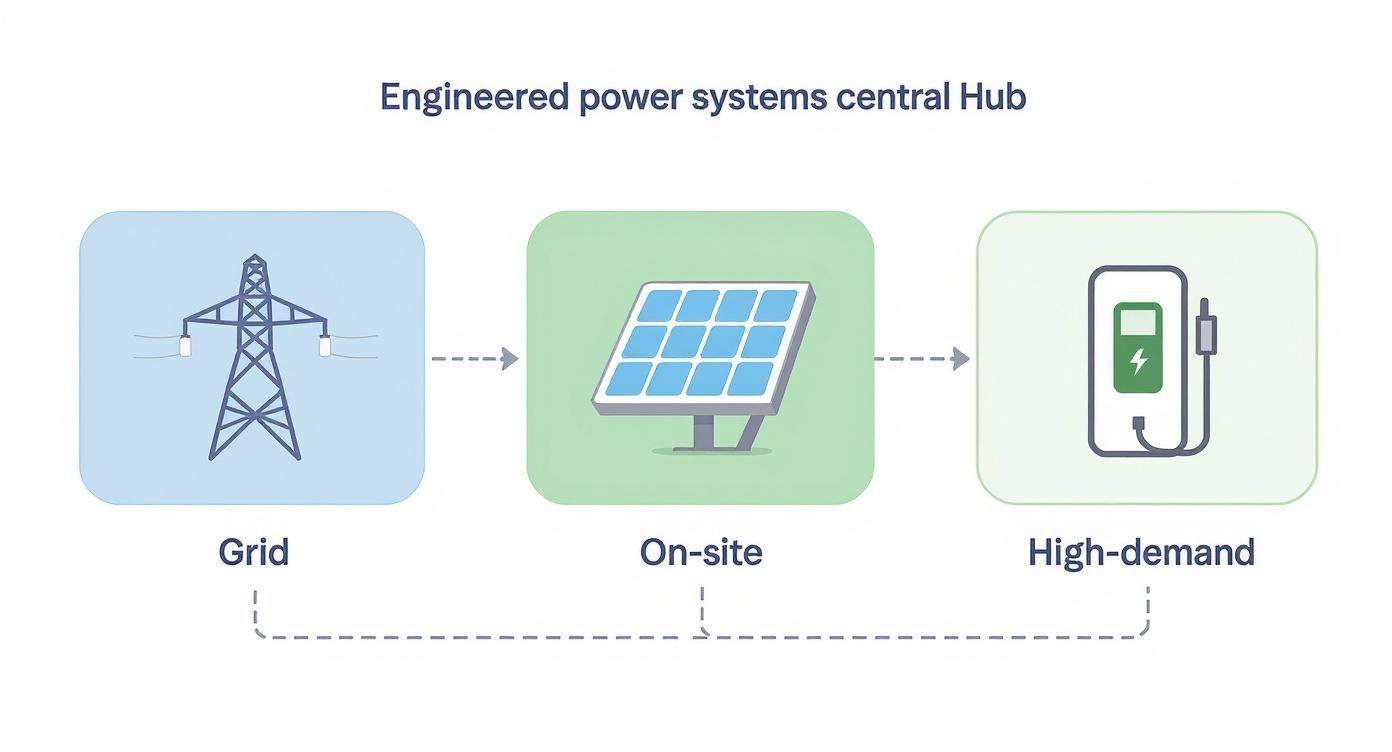
As you can see, the BESS and EMS act as the central hub, intelligently directing the flow of energy to build a resilient and highly efficient local power network.
To help clarify the role of each part, this table breaks down the main components and what they do.
Key Components of an Engineered Power System
| Component | Primary Function | Benefit for EV Charging & Renewables |
|---|---|---|
| Battery Energy Storage System (BESS) | Stores electricity from the grid or renewables for later use. | Allows for "peak shaving" by using stored, cheaper energy for EV charging during high-tariff periods. Ensures a stable supply even when the sun is not shining. |
| On-Site Generation (e.g., Solar PV) | Produces clean, low-cost electricity directly at the site. | Drastically reduces reliance on the grid and lowers the carbon footprint of EV charging. Provides a free energy source to charge the BESS. |
| Energy Management System (EMS) | The software "brain" that monitors and controls all energy flows. | Optimises when to charge the BESS, when to power the chargers and when to draw from the grid, all based on real-time data to minimise costs and maximise efficiency. |
| Inverters | Converts DC electricity (from solar/batteries) to AC electricity (for buildings/chargers). | Acts as the essential bridge, making the energy from renewables and the BESS usable by standard EV charging infrastructure and site facilities. |
| Switchgear | A collection of circuit breakers and switches that protect the system. | Ensures operational safety by protecting expensive equipment from faults and allowing parts of the system to be isolated for maintenance without shutting everything down. |
Each of these components is a crucial piece of the puzzle, working together to deliver a reliable and cost-effective power solution.
Essential Hardware for Integration
Finally, a few bits of essential hardware are needed to tie everything together safely and efficiently. Inverters are critical devices that convert the direct current (DC) electricity produced by solar panels and stored in batteries into the alternating current (AC) that powers your buildings and EV chargers.
Switchgear is another vital component, basically acting as the system's protective nervous system. It’s a collection of switches, fuses and circuit breakers designed to protect all the equipment from electrical faults and give operators safe control to isolate different parts of the system when needed. Understanding these core pieces is crucial, especially as ongoing EV battery manufacturing advancements continue to drive investment and innovation in this key area.
Together, the BESS, on-site renewables, EMS and supporting hardware form a cohesive unit. This engineered power system moves a site from being a passive consumer of electricity to an active, intelligent participant in the energy market.
Overcoming Grid Constraints for EV Charging
For many fleet operators and commercial property owners, the ambition to go electric hits a hard wall: the local electricity grid. The simple truth is that most existing grid connections were never built to handle the enormous power draw of multiple rapid EV chargers running at the same time.
Thinking about a grid upgrade is a natural first step but that path is often painfully slow. We are talking years, not months and the costs can be astronomical—if it is even technically possible in the first place.
This grid capacity headache is one of the biggest things holding back widespread EV adoption for businesses. Thankfully, engineered power systems offer a powerful and practical way to sidestep these limits entirely. Think of them as an intelligent energy buffer, standing between your high-demand charging operation and a weak grid connection.
Instead of digging up roads for a costly grid upgrade, an engineered power system uses a Battery Energy Storage System (BESS) to neatly solve the problem. The BESS can slowly 'trickle charge' from a constrained grid connection during off-peak hours, like overnight when electricity demand is low and prices are at their cheapest. This process gradually fills the battery, building up a huge reservoir of energy without ever straining the local network.

Unleashing Stored Power for Rapid Charging
Once the battery is full, the system is primed and ready for the daytime rush. When vehicles pull up and plug in, the BESS unleashes this stored power, running multiple rapid EV chargers at full tilt. The system delivers all the high power needed directly from the battery, not the grid.
What this means in practice is that a site with a grid connection only capable of supporting a single slow charger can now power an entire hub of rapid chargers. The engineered power system effectively decouples your charging speed from the grid's capacity, making large-scale EV fleet charging a reality for almost any location.
This approach does not just solve the power problem; it also optimises your energy costs by banking cheaper, off-peak electricity. You can learn more in our guide to dynamic power management for EV charging , which digs into how intelligent software balances these energy flows.
By storing cheap off-peak energy and deploying it on demand, an engineered power system turns a grid-constrained site into a high-performance charging hub. It is the real-world solution to the grid capacity challenge.
Of course, beyond managing grid capacity, protecting the physical hardware is essential for a successful roll-out. It’s always wise to explore solutions like EV protection barriers to safeguard your investment from accidental knocks and damage.
The Rise of Mobile EV Charging
Taking this concept one step further is the emergence of mobile EV charging . These clever solutions are essentially a BESS on wheels—a self-contained, engineered power system that can be deployed anywhere you need it, with no grid connection required at all.
This technology offers ultimate flexibility for all sorts of applications:
- Temporary Sites: Perfect for events, construction sites or pop-up depots needing temporary charging without digging a single trench.
- Emergency Roadside Assistance: Can be dispatched to rescue stranded EVs, giving them a rapid charge to get back on their way.
- Fleet Depot Augmentation: Provides extra charging capacity during peak times or while permanent infrastructure is being installed.
Mobile EV charging from a BESS provides instant, distributed energy, breaking the final link to the grid. It is a powerful demonstration of how engineered power systems can deliver power where it’s needed, when it’s needed, no matter the existing infrastructure. This kind of flexibility is vital for supporting the continued growth of electric transport right across the UK.
Unlocking Value with Renewables and Distributed Energy
Engineered power systems do more than just solve immediate grid constraints; they create a powerful synergy between your site and the wider energy network. By intelligently combining on-site renewable generation, like solar panels, with a Battery Energy Storage System (BESS), a business can unlock huge value and achieve far greater energy independence.
This combination allows you to generate your own clean, low-cost power throughout the day. Instead of exporting any excess electricity for a minimal return, it can be stored in the BESS. This stored energy becomes a valuable asset, ready to be deployed when grid electricity is most expensive.

This setup drastically cuts your reliance on the grid and provides a crucial hedge against volatile energy prices. It puts you back in control of your energy costs and carbon footprint, turning your site into a self-sufficient energy hub.
The Shift to Distributed Energy
This approach is a core part of a much larger trend: distributed energy . For decades, our energy system has been centralised, relying on a handful of massive power stations to generate electricity that’s then transmitted over hundreds of miles. Distributed energy flips this model on its head.
It describes a network of smaller, localised energy assets—like your solar panels and BESS—that are scattered across the grid. Instead of a one-way flow of power from a distant plant, you get a dynamic, multi-directional system. The result is a more resilient and flexible energy infrastructure for everyone.
This shift is accelerating right across the UK as the national grid adapts to new demands. In May 2025, for instance, zero-carbon sources like wind, solar and hydropower generated 57% of Britain's electricity —that’s a 12 percentage point increase from the previous year, which shows just how deeply these changes are taking hold.
How Your Site Supports National Grid Stability
An engineered power system does not just benefit your business; it also plays a vital role in supporting the stability of the national grid. When thousands of sites are generating and storing their own power, it relieves immense pressure on the centralised grid, especially during periods of high demand.
By managing energy locally, distributed assets act like a shock absorber for the national grid. They reduce the need for costly grid upgrades and help prevent blackouts, building a more robust energy network for the entire country.
This localised control allows your system to respond intelligently to the grid's needs. For example, during a national peak in demand, your Energy Management System can automatically switch to using stored battery power instead of drawing from the grid. This helps balance supply and demand on a national scale. You can find out more about integrating renewable energy with advanced storage solutions in our detailed article.
This capability is becoming increasingly valuable. As more electric vehicles and heat pumps connect to the grid, the strain on our existing infrastructure will only grow. Distributed energy resources, managed by sophisticated engineered power systems, are the key to handling this transition smoothly. They provide the flexibility needed to build a modern, decarbonised and secure energy future for the UK.
By investing in your own on-site power, you are not just cutting costs—you are becoming a crucial part of this national energy evolution.
Supporting the UK's Great Grid Upgrade
While engineered power systems deliver huge benefits at a single site, their real impact becomes clear when you zoom out to the national level. These distributed solutions are not just an alternative to grid upgrades; they are a vital, complementary piece of the UK's broader energy strategy, especially the ambitious ‘Great Grid Upgrade’.
Think of these localised power systems as pressure valves for the national network. They are intelligently designed to relieve strain on the existing transmission and distribution infrastructure while the long-term, large-scale upgrades get underway. This is becoming more critical by the day.
A Complementary Role in National Modernisation
The UK's electricity grid is facing a period of immense change. Between 2025 and 2030, the country is undertaking a massive expansion, with National Grid planning to invest over £30 billion in its Great Grid Upgrade programme. This involves 17 major projects designed to connect 40 GW of new offshore wind capacity—a huge step towards meeting national net-zero targets.
And what is coming is significant. Electricity demand is projected to jump by 50% by 2035 and could even double by 2050, driven largely by the switch to electric vehicles and heating. The problem is, building new pylons and substations takes a lot of time.
Engineered power systems act as a crucial bridging solution. By managing demand locally, they buy valuable time for the national infrastructure to catch up, ensuring the lights stay on and EV charging rollouts can continue without delay.
Deferring and Reducing Infrastructure Costs
One of the most powerful roles these systems play is in deferring, or even entirely avoiding, the need for costly and disruptive local grid upgrades. When a business installs rapid EV charging or other high-demand equipment, the local distribution network operator (DNO) often requires a new substation or upgraded cabling to cope.
An engineered power system with integrated battery storage can prevent this. By storing off-peak energy and deploying it during peak times, the system effectively shields the local grid from the full impact of the new load.
This has a few immediate benefits:
- Cost Avoidance: The business sidesteps the significant capital outlay needed for a grid upgrade.
- Faster Deployment: Projects can be completed in months, not the years it often takes for grid reinforcement.
- Reduced Disruption: There’s no need for road closures or extensive civil engineering works.
This localised approach allows for targeted, surgical interventions exactly where they're needed most, rather than relying solely on widespread and slow-moving infrastructure projects.
Contributing to National Energy Security
Every commercial site that installs an engineered power system contributes to a more resilient and secure national grid. These distributed energy assets create a network of flexible resources that can help balance supply and demand in real time.
By reducing peak load locally, these systems help prevent grid congestion and lower the risk of outages. They demonstrate how a single commercial installation, designed to solve a site-specific problem, is also a building block for a smarter, more flexible and ultimately more secure national energy future—one that is ready for the demands of electrified transport and heating.
The Business Case for Investing in Your Own Power
Beyond the technical specifications, what is the real-world return on an engineered power system? It’s a powerful story, one built on direct cost savings, new ways to generate revenue and a level of operational resilience that’s hard to put a price on.
The most immediate win comes from slashing your electricity bills. By using an integrated battery to store cheap off-peak energy, you can stop drawing power from the grid when tariffs are at their most expensive.
This strategy, known as peak shaving , means you’re no longer at the mercy of unpredictable energy prices. The system's intelligent software gets to work automatically, figuring out the best times to buy, store and use electricity. It ensures your operations and EV fleet are always running on the cheapest power available.
Creating New Revenue and Bolstering Resilience
But an engineered power system is not just about saving money—it can actively earn it. By participating in grid balancing services, you can actually be paid to help stabilise the national electricity network. When the grid is under strain, your system can export its stored energy, creating a new income stream while supporting the UK’s energy security.
The operational benefits are just as compelling. For any organisation where a power cut would be disastrous, the system acts as a formidable uninterruptible power supply (UPS) . It delivers instant, seamless backup power, protecting your most critical operations from grid failures and guaranteeing business as usual.
An engineered power system transforms a site from a passive energy consumer into an active, strategic participant in the energy market. It delivers not just cost savings but also operational certainty and a stronger balance sheet.
Enhancing Your ESG Profile
Finally, adopting this kind of future-facing technology gives your company’s Environmental, Social and Governance (ESG) profile a serious boost. Generating and storing your own clean energy is a tangible demonstration of your commitment to sustainability and decarbonisation.
A strong ESG profile is no longer a 'nice-to-have'; it makes your business more attractive to modern consumers, talented employees and institutional investors. As the UK pushes towards net zero, this commitment becomes a powerful competitive advantage. The country is already making huge strides in modernising its power infrastructure, with spending projected to hit around $13 billion annually by 2025 . You can explore more about these developments in UK grid investment on Cleanbridge.co.
By investing in your own engineered power system, you are not just securing your financial and operational future. You are aligning your business with the sustainable energy transition.
Your Questions, Answered
When you are looking at investing in an engineered power system, it’s natural to have questions about how it all works – the installation, the cost and what it takes to run day-to-day. Let us tackle some of the most common queries we hear.
Our aim here is to cut through the complexity and show you the real-world benefits of bringing a modern, localised energy solution to your site.
How Long Does an Installation Take?
It’s a common myth that installing a private power system is as long and disruptive as a traditional grid upgrade. The reality is, it is a much faster process.
Because our systems are built in a modular, containerised way, most of the complex assembly and testing is done off-site before it even reaches you. This massively cuts down on-site disruption, meaning a typical installation is wrapped up in months, not the years you might be quoted for a substation upgrade.
What Are the Main Cost Factors?
The final cost of an engineered power system really comes down to what you need it to do. The key variables that shape the initial investment are:
- Battery Capacity (kWh): How much energy storage you need to keep your operations running smoothly.
- Power Output (kW): The maximum punch the system can deliver, which is dictated by how many EV chargers or other heavy loads you are running.
- On-Site Renewables: The size of any solar panels or other generation you want to plug into the system.
- Software Sophistication: The level of intelligence needed from the Energy Management System to get the most out of your specific setup.
While there’s an upfront capital cost, it’s vital to weigh it against the long-term savings. Think reduced energy bills, sidestepping huge grid upgrade fees and even opening up new revenue by selling services back to the grid.
Can These Systems Handle Rapid and Mobile EV Charging?
Absolutely. In fact, this is one of their superpowers. A major use for these systems is to enable rapid EV charging in places where the grid simply cannot cope. The built-in battery quietly stores energy from a weak connection and then unleashes it in powerful bursts, supporting multiple 150kW+ chargers all at once.
And for mobile EV charging? The system effectively becomes a high-powered battery on wheels. It gives you grid-independent power you can deploy anywhere – perfect for temporary depots, events or even roadside assistance. It’s total flexibility.
Do I Need My Own Technical Staff to Manage It?
Not at all. You do not need to hire a team of engineers to keep things running. These systems are designed to operate autonomously. The Energy Management System (EMS) is the brain of the operation, making all the smart decisions in real time. It constantly optimises how energy is used based on grid prices, what your site is doing and even the weather forecast.
As for maintenance, that’s typically handled through a service agreement. We use remote monitoring to spot and fix most issues before they ever affect performance, so you get all the benefits without any of the operational headaches.
Ready to overcome your grid constraints and build a resilient energy future? ZPN Energy delivers bespoke engineered power systems that integrate rapid EV charging, battery storage and renewables. Explore our solutions and take control of your energy at https://www.zpnenergy.com.