EV Charger Installation Course: The Complete UK Guide
An EV charger installation course is your ticket to specialising in the UK's booming green energy sector. For any electrician or engineer this training delivers the vital skills and certifications needed to safely and legally install everything from a simple home charging unit to a complex commercial hub. Think of it as the definitive entry point into a high-demand, future-proof career.
Why an EV Charger Course Is a Critical Career Move

As the UK pushes hard towards its net-zero targets the demand for skilled EV charger installers isn’t just growing—it’s exploding. What was once a niche skill has quickly become a fundamental requirement for any forward-thinking electrical professional. Signing up for a certified course is no longer an optional extra; it's a strategic necessity.
This surge is driven by both government policy and a massive shift in consumer behaviour. The UK has seen a huge jump in EV charger installations with public charge points hitting 86,798 by October 2025—that’s a 27% increase in just one year. This infrastructure is essential to support the 14 million EVs we expect to see on UK roads by 2030. The scale of the opportunity is immense.
The Expanding Spectrum of Opportunity
Completing an EV charger installation course throws open doors to a huge range of projects far beyond fitting basic domestic wall boxes. The skills you pick up are directly relevant to a diverse and profitable market.
You could find yourself working on:
- Rapid EV Charging: These high-power DC systems are the backbone of public charging networks at service stations and transport hubs and they demand advanced installation know-how.
- Mobile EV Charging: A growing field that offers flexible charging for fleets, events or emergency recovery this is a real area for specialised installers.
- EV Charging from Constrained Grid Connections: Not every site has the electrical muscle for multiple chargers. Certified installers learn to deploy smart systems that manage power intelligently, often using battery storage.
- Combined On-site Renewables and Distributed Energy: The future is all about joining the dots—linking EV charging with on-site renewables like solar panels, grid-scale batteries and even local energy networks to create self-sufficient energy hubs.
Think of this qualification less as a simple certificate and more as your passport to the future of energy. It equips you to design and build the intelligent, resilient charging infrastructure that modern society requires.
This career path offers real growth and security for professionals looking to future-proof their skills. If you're weighing up a big career change you might find some useful advice on how to explore changing careers and make the switch a success.
The sustainable transport sector is packed with roles that are only going to become more important. Check out our guide on some of the most promising future-proof jobs in sustainable transport for 2025 to see what's out there. Gaining this qualification puts you right at the heart of this industrial and environmental shift.
Navigating UK Accreditations and Standards

Becoming a certified EV charger installer in the UK is about more than just wiring a new circuit. It’s about understanding the specific legal and industry standards that govern every single installation from a simple home charger to a sprawling rapid-charging hub.
Without the right tickets your work isn’t just non-compliant – it’s potentially unsafe. Plus you’ll be locked out of crucial government grant schemes.
Think of these accreditations as your professional licence to operate. They prove you have the specialist skills needed to handle the unique demands of Electric Vehicle Supply Equipment (EVSE) . A proper EV charger installation course is built to get you through this maze ensuring you can work confidently, legally and safely.
The Cornerstone Qualification: City & Guilds 2921
At the heart of any UK installer’s training journey is the City & Guilds 2921 qualification. This is widely seen as the benchmark standard for anyone serious about installing domestic or commercial charge points. It’s not just a box-ticking exercise; it’s a deep dive into the practical realities of EV charging systems.
The course covers everything from design and installation to the final commissioning getting you ready for real-world jobs. Nailing this certification shows clients and employers you’re up to speed with the latest techniques and safety protocols. It’s the essential first step.
Adhering to IET Regulations and Codes of Practice
Beyond that initial qualification your day-to-day work will be guided by two key documents. Every installer needs to know these inside out – they are the rulebooks that ensure safety and quality across the UK.
- The IET Wiring Regulations (BS 7671): This is the bible for all electrical installation work in the UK. Any good EV course will spend a lot of time on Section 722 which lays down the specific rules for electric vehicle charging setups.
- The IET Code of Practice for Electric Vehicle Charging Equipment Installation: This guide gets into the finer details. It builds on BS 7671 with practical, best-practice advice on everything from earthing arrangements and risk assessments to connecting with smart grid technology.
Getting to grips with these documents is non-negotiable. They provide the technical foundation you need to tackle any installation especially complex ones involving rapid EV charging or systems linked to on-site renewables .
Becoming an OZEV-Authorised Installer
If you’re running a business and want to take on grant-funded work there’s another layer of accreditation you can’t ignore. The Office for Zero Emission Vehicles (OZEV) offers grants to cut the cost of home and workplace chargers but only OZEV-authorised installers can claim them.
Becoming OZEV-authorised is a critical business move. It opens the door to a huge market of customers looking to use government grants making your services far more competitive. It's a clear signal that you meet the highest professional standards.
To get this status your business has to prove its credentials which means having properly qualified staff who have passed a recognised EV charger installation course. You'll also need public liability insurance and must stick to the scheme's strict standards.
This authorisation is particularly vital for bigger projects especially those dealing with constrained grid connections or the integration of grid-scale batteries as these often lean on government support. If you want to dive deeper into the hardware itself check out our guide to Electric Vehicle Supply Equipment.
So you’re thinking about getting qualified as an EV charger installer? It’s a smart move. Think of these courses as your complete toolkit giving you everything you need to tackle any project thrown at you by the UK’s booming EV network. You’ll start with the fundamentals and build your way up to expert level.
First up you’ll get to grips with the difference between AC and DC charging. It’s a core concept. Standard AC charging (Modes 1-3) is the slow and steady workhorse perfect for overnight top-ups at home or the workplace. Then you have rapid EV charging using DC systems (Mode 4) which is more like a high-speed fuel pump at a motorway service station—designed to get drivers back on the road in minutes.
Understanding both is non-negotiable because the UK’s infrastructure is a real mix. By October 2025 we had 86,021 public charge points and over 17,356 of those were rapid or ultra-rapid. With a new charger being added every 33 minutes being able to confidently work on both AC and DC systems is what will set you apart.
Core Technical Skills for Every Installer
Once you’ve nailed the basics of charging modes the course dives into the nitty-gritty technical skills. This is what really separates a qualified installer from a general electrician focusing on the unique demands of Electric Vehicle Supply Equipment (EVSE).
You'll get hands-on with several key areas:
- Specialist Earthing Arrangements: EV chargers aren't like your typical home wiring. You'll learn the ins and outs of specific earthing systems like PME and figure out exactly when to use protective measures like earth rods to guarantee safety.
- Safety Protocols and Protective Devices: This part is critical. The course will walk you through the specific types of RCDs and other protective gear needed to prevent electric shocks and protect the equipment itself. There are no shortcuts here.
- Testing, Inspection and Commissioning: This is the final, vital sign-off. You'll learn the methodical process for testing and inspecting your work to make sure it’s safe, fully compliant with BS 7671 and ready to be handed over to a happy client.
Mastering these technical skills is what turns you from a sparky into a specialist. It’s where theory meets practice ensuring every charge point you install is not just working but perfectly safe and built to last.
Properly commissioning a charger is just the start; keeping it running safely is just as important. For a look at what comes after the install check out our complete guide on UK EV charger servicing.
Advanced Concepts for Future-Proof Installations
A great installation course doesn’t just teach you about today’s tech; it prepares you for tomorrow’s. As our grid gets smarter and energy management becomes more crucial you'll be introduced to the systems that make modern charging infrastructure intelligent. This is where you learn what makes everything from mobile EV charging fleets to sites with constrained grid connections possible.
You'll dig into advanced topics that are shaping the industry:
- Communication Protocols: You'll learn the "language" of smart chargers like OCPP (Open Charge Point Protocol). This is what allows charge points to talk to central management systems for remote monitoring, billing and balancing the electrical load.
- Grid Connection and Energy Management: The course will touch on how charging networks play with the wider grid. This is vital for installing systems that can intelligently manage power especially when you start mixing in things like on-site renewables or grid-scale batteries .
- Distributed Energy and Battery Integration: You'll get an inside look at how EV charging and batteries can work in harmony. This is crucial for installing the kind of advanced systems which use battery storage to deliver rapid charging without putting a huge strain on the local grid.
Mastering Advanced Grid and Battery Solutions
The next generation of EV charging isn't just about raw power anymore; it's about intelligence and resilience. Any top-tier ev charger installation course worth its salt moves beyond the basics of standard installs. It has to get into the sophisticated concepts that define modern energy systems preparing you to design charging infrastructure that’s genuinely ready for the future.
This means learning how to handle EV charging from constrained grid connections . Let's be honest many sites—especially in older city centres or remote spots—simply don't have the electrical capacity to support a bank of rapid chargers. This is where you get to grips with techniques like active load balancing which intelligently shares the available power between vehicles to stop the local supply from being overwhelmed.
The Role of Battery Energy Storage Systems
The real centrepiece of this advanced knowledge is the Battery Energy Storage System (BESS) . Think of a BESS as a local energy reservoir acting as a powerful buffer between your chargers and the grid. It’s the key that unlocks high-power charging almost anywhere you can think of.
A proper course will show you exactly how a BESS can:
- Store cheap off-peak energy: It can quietly draw power from the grid overnight when tariffs are at their lowest and bank it for later.
- Deploy energy during peak demand: When electricity costs shoot up during the day the BESS can discharge its stored energy to power the chargers, slashing operational costs.
- Support rapid charging: It delivers the huge, instant burst of power needed for rapid EV charging without causing a disruptive surge on the local grid connection.
For an installer, getting your head around BESS integration is a total game-changer. It turns a problem site with a weak grid connection into a viable, high-revenue rapid charging hub. This is the skill that separates a standard installer from a true market leader.
Armed with this knowledge you can confidently offer solutions like battery-backed chargers. These can be rolled out with minimal grid impact and even open the door to mobile EV charging solutions for fleets or events.
This is the typical learning journey in a comprehensive training programme starting with the foundational AC skills before moving into the more complex world of smart network integration.
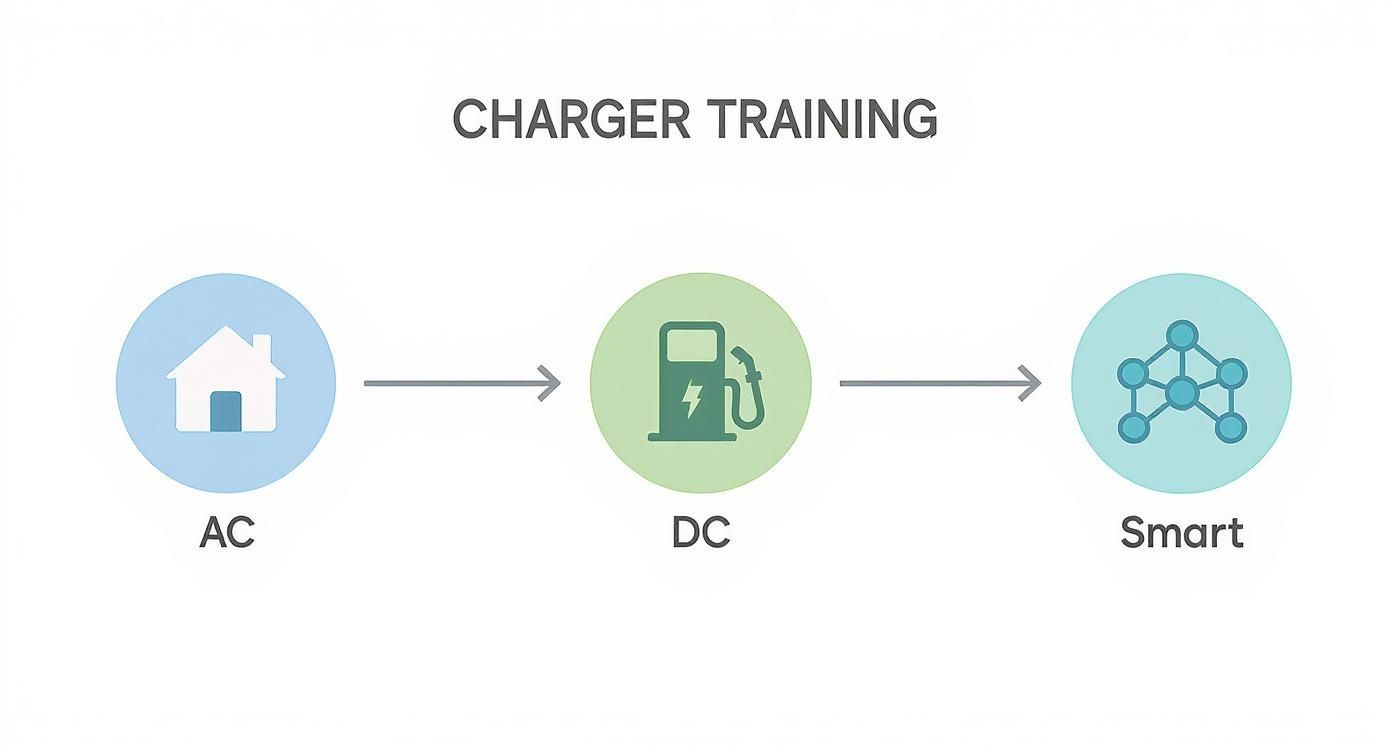
As you can see real expertise comes from mastering not just the hardware (the AC and DC chargers themselves) but also the intelligent software and energy management systems that make them all work together efficiently.
Creating Distributed Energy Resources
The final piece of the puzzle is learning how to weave combined on-site renewables like solar panels into the mix with EV charging and batteries . Do this and you create a powerful distributed energy resource (DER) turning a simple car park into a miniature, self-sufficient power station.
Picture a supermarket with solar panels covering its roof. During the day that solar energy gets stored in a BESS. This banked power can then be used to charge customer cars, sell back to the grid for a profit or even power the store itself when electricity is most expensive. This seamless integration of grid-scale batteries and local generation is the pinnacle of modern energy management.
An ev charger installation course that dives into these advanced topics gives you the tools to design and build these integrated systems from the ground up. You learn how all the pieces—chargers, batteries, solar, the grid—talk to each other and work in harmony to squeeze every last drop of value out of the energy used, creating brand new revenue streams for the site owner. It’s this holistic grasp of distributed energy that positions you to lead the market, delivering solutions that aren't just powerful but sustainable and economically sharp too.
How to Choose the Right Training Provider
With the market for qualified installers booming it feels like a new training provider pops up every week. Choosing the right ev charger installation course is a huge decision that will genuinely shape your career path. A great course does more than just get you through an exam; it gives you the real, practical skills and deeper knowledge to confidently take on the complex projects that pay well.
You have to look past the shiny brochures and really dig into what's being offered. Trust me not all courses are created equal and the provider you choose will make all the difference to your competence and confidence out in the field.
Evaluate Industry Credentials and Course Content
First things first check the provider's credentials. Are they actually recognised by industry heavyweights like City & Guilds? Do the instructors have proper, hands-on experience—not just as electricians but specifically with EV charging infrastructure? That kind of focused expertise is non-negotiable.
Next get forensic with the curriculum. Any basic course will cover the essentials but a top-tier one will set you up for the future of energy, not just the present.
Look for modules that go deeper, covering things like:
- Advanced Systems: Does the course tackle rapid EV charging , mobile EV charging and systems designed for tricky constrained grid connections ?
- Battery Integration: Is there a proper focus on EV charging and batteries ? Do they explain how to bring grid scale batteries (BESS) into a project?
- Renewable Energy: Does the course teach you how to combine on-site renewables with charging infrastructure creating sophisticated distributed energy resources?
Any training provider that only teaches the basics of fitting a simple AC wall box is preparing you for yesterday's market. The real career opportunities are in tomorrow's integrated energy projects so find a course that gives you those skills.
Prioritise Hands-On Practical Training
Theory is important but it's completely useless if you can't apply it on-site. The single most important thing to look for is the quality of the hands-on training facilities. A course that's all classroom learning or, worse, just computer simulations will leave you unprepared for the real world.
You need to get your hands on the actual equipment. You need to troubleshoot common faults and run test and inspection procedures on real hardware. As you're sizing up different providers think about their teaching methods and the pros and cons of instructor-led vs. self-paced learning. For a trade like this there's no substitute for in-person, instructor-led, hands-on experience.
Don't be afraid to ask direct questions. What’s the split between practical and theory? What specific types of chargers and battery systems will you get to work on? The chance to get familiar with the kind of advanced systems you'll see in the field is an absolutely priceless advantage.
Consider Bespoke and On-Site Training Options
If you're a business owner looking to get your whole team up to speed sending them off one-by-one to a public course might not be the smartest move. The best training providers will offer bespoke, on-site training packages built around what your company actually needs.
This approach pays dividends. The training can be matched to the exact systems your team will be installing day in, day out—like advanced battery-backed solutions. It means your engineers aren't just certified; they become genuine experts in the specific technology that gives your business its competitive edge. On-site training also cuts down on travel and downtime and the curriculum can be laser-focused on your commercial goals whether that’s fleet charging, public rapid charging hubs or BESS integration. Choosing a provider with this kind of flexibility can be a powerful strategic move.
Your Career Path After Certification
Earning your qualification from an EV charger installation course isn’t the finish line—it’s the starting pistol firing. With that certificate in hand a huge range of rewarding career paths and new business opportunities immediately opens up for skilled electrical professionals right across the UK.
This is your moment to step into a sector with sky-high demand. You can now put your skills to work on everything from straightforward domestic installs to complex, large-scale commercial projects. Think of the qualification as a key unlocking access to more advanced and profitable work.
Your Immediate Next Steps
Once you’re certified your first practical move should be to join a Competent Person Scheme (CPS) . This is a self-certification scheme that lets you sign off on your own electrical work confirming it meets Building Regulations without needing a separate, time-consuming inspection. It’s a vital step for both efficiency and professional credibility.
Next up get yourself on the list of OZEV-authorised installers . This is a critical business move. It allows your customers to access government grants for home and workplace charging making your services far more attractive. Being OZEV-authorised opens up a massive chunk of the market that would otherwise be completely closed off to you.
Think of these accreditations as professional multipliers. They don’t just validate your skills; they actively generate business by giving you access to grant-funded projects and boosting customer confidence in your expertise.
Diverse Sectors with Soaring Demand
Your new qualification makes you a valuable asset in countless industries that are rapidly going electric. The need for certified installers isn't confined to one small niche; it's a widespread demand fuelled by the UK's green energy transition.
You'll find massive opportunities in:
- Residential Developments: Working with property developers to get charge points into new builds and entire blocks of flats.
- Commercial and Fleet Hubs: Designing and installing the charging infrastructure for logistics firms, delivery services and corporate car parks. This often means getting stuck into rapid EV charging and complex load management systems.
- Public Charging Networks: Partnering with local authorities and private operators to expand the UK's public charging infrastructure from high streets to motorways.
The Future of Your Career
To really lead the pack your skills need to evolve just as fast as the technology. The most sought-after installers will be those who master the integration of EV charging and batteries . Your understanding of distributed energy will become your greatest asset.
Expertise in managing constrained grid connections and weaving on-site renewables together with grid-scale batteries will put you right at the cutting edge. You'll be able to offer clients complete, intelligent energy solutions, not just simple charger installations. This is how you transition from being an installer to an indispensable energy systems specialist—someone actively shaping the UK's green energy landscape. Keep learning, keep pushing and those incredible opportunities will be yours for the taking.
Got Questions? We've Got Answers
Thinking about getting qualified to install EV chargers? It's a smart move. Here are some straight answers to the questions we hear most often helping you decide on the right path.
Do I Need to Be a Qualified Electrician First?
Yes you absolutely do. Getting qualified in EV charger installation is a specialisation not a starting point. Think of it as adding a high-value skill to your existing toolkit.
Any reputable training provider worth their salt will require you to be a fully qualified electrician—holding something like a Level 3 Diploma—and be completely up-to-speed with the latest IET Wiring Regulations (BS 7671). This isn't just red tape; it ensures you have the fundamental electrical knowledge to safely handle the unique demands of Electric Vehicle Supply Equipment (EVSE).
How Long Does a Typical Course Take?
For an experienced electrician not long at all. Most dedicated EV charger installation courses in the UK are pretty intensive designed to be completed in just two to three days .
Because you've already got a solid foundation in electrical principles the course can focus squarely on what makes EV charging different—everything from the initial design and installation right through to inspection, testing and getting the system commissioned and online.
Will the Course Cover Battery Storage and Grid Issues?
A good course should and the best ones definitely will. Basic charger installation is one thing but the real future of this industry lies in integrated energy systems. A top-tier course will prepare you for the complex challenges you'll actually face in the field.
Look for training that covers these crucial areas:
- EV charging and batteries: How to properly integrate Battery Energy Storage Systems (BESS) to create resilient, powerful charging hubs that aren't entirely dependent on the grid.
- Constrained grid connections: This is a huge one in the UK. You'll learn the techniques for installing chargers where the local grid supply is weak or already at capacity.
- Combined on-site renewables: Understanding how to wire up EV charging with solar panels or other local energy sources to create truly efficient and sustainable distributed energy systems.
These aren't just 'nice-to-have' skills. They're essential if you want to work on the big, interesting projects like rapid EV charging hubs, commercial fleet depots or forecourt installations.
Choosing a course that dives into these advanced topics is more than just training—it's a career strategy. It equips you not just for the jobs of today but for the complex, integrated energy projects that are fast becoming the new standard. It's how you make sure your skills stay valuable for years to come.
Ready to power the future with resilient, intelligent charging solutions? ZPN Energy offers cutting-edge, battery-backed EV charging systems that overcome grid limitations and integrate seamlessly with renewables. Discover our bespoke solutions.