UK Commercial EV Charging Station Cost Guide
When you start looking into commercial EV charging, it's easy to focus on the price of the charger itself. But the reality is that's just the tip of the iceberg. The total project cost can swing wildly, from a few thousand pounds right up to over £100,000 .
This huge range isn't arbitrary. It's driven by the charger type you choose, how much groundwork is needed and crucially, what it costs to connect to the local electricity grid. Understanding how to integrate EV charging, rapid EV charging and even mobile EV charging solutions with on-site renewables and grid-scale batteries is key to managing these costs effectively.
Understanding the Full Investment Picture
Before you even think about getting quotes for chargers, you need to grasp the full financial scope. Just looking at the hardware price is like trying to price a car by only looking at the engine; you're missing the chassis, the electronics, the labour – everything that actually makes it work. A successful project starts with a budget that sees the whole picture from day one.
Thinking this way helps you sidestep the common traps where unexpected costs suddenly pop up and derail a perfectly good project. Many businesses get a nasty surprise when they see the bill for the grid connection, which can sometimes cost more than all the charging units combined.
To give you a clearer idea, here's a quick look at how the costs typically break down.
Estimated Cost Breakdown for Commercial EV Charging Installation
| Cost Component | Typical Price Range (£) | Key Factors Influencing Cost |
|---|---|---|
| Charger Hardware | £1,000 - £75,000+ per unit | Charger type (AC vs. DC), power output (kW), brand, smart features. |
| Grid Connection & Reinforcement | £5,000 - £100,000+ | Existing site capacity, distance to substation, DNO fees, need for new transformers. |
| Installation & Civil Works | £2,000 - £20,000+ | Trenching distance, ground surface (tarmac vs. soil), concrete bases, electrical work. |
| On-site Energy Systems | £10,000 - £250,000+ | Size of solar PV array, grid-scale batteries, or Battery Energy Storage System (BESS). |
| Software & Management | £15 - £40 per charger/month | Subscription fees for network management, payment processing, reporting. |
| Maintenance & Operations | £250 - £1,000 per charger/year | Annual service contracts, call-out fees, replacement parts. |
This table highlights that the charger is just one piece of a much larger financial puzzle.
Key Cost Components Beyond the Charger
To build a realistic financial plan, you have to factor in the entire ecosystem of expenses. These are the elements that truly define your final commercial EV charging station cost and the long-term health of your investment.
- Grid Connection and Reinforcement: This is the big one. Your site’s connection to the grid is everything. The local Distribution Network Operator (DNO) might need to upgrade the network to handle the extra electrical load, especially if you're installing rapid DC chargers. Those fees can be substantial.
- Installation and Civil Works: This covers all the physical work – digging trenches for cables, pouring concrete pads for the chargers to sit on, installing new switchgear and making sure every bit of it meets strict safety standards.
- On-site Energy Solutions: This is where things get interesting. Integrating distributed energy systems like solar panels or a Battery Energy Storage System (BESS) adds to the upfront cost but it can slash your long-term running costs and help you sidestep expensive grid limitations.
- Ongoing Operational Costs: Don't forget the recurring expenses. This includes software subscriptions to manage your chargers, fees for processing payments and routine maintenance contracts to keep everything running smoothly and reliably.
A common oversight is underestimating the DNO's role and potential costs. An early grid assessment is one of the most important first steps to understand your site's capacity and avoid six-figure surprises later in the project.
All these initial investments are reflected in what the public pays to charge their car. In the UK, you'll often see public rapid chargers priced between £0.55 and £0.79 per kWh , depending on the network and charging speed. You can explore more about the UK's charging cost landscape on Autohit.co.uk. By planning for all these moving parts from the start, you can build a solid business case and get a much clearer picture of your return on investment.
Choosing Your Hardware: From AC to Ultra-Rapid DC
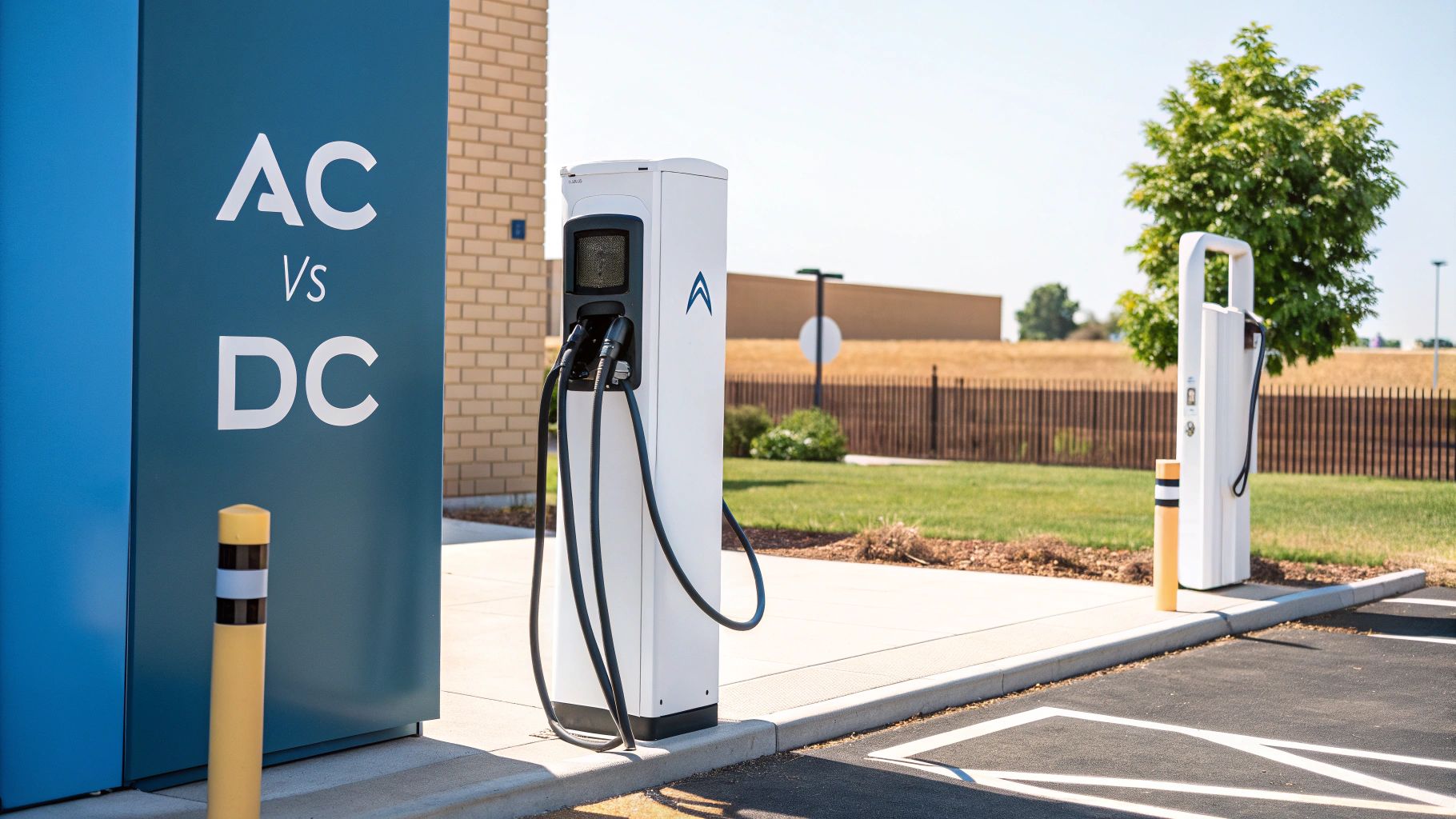
The charger hardware is usually the first big-ticket item you’ll see on a quote and it plays a huge role in the total commercial EV charging station cost. But this isn't about finding the cheapest unit off the shelf. It's about picking the right technology for your site, whether you're serving your fleet, your employees or the general public.
A great way to think about it is comparing a tap to a fire hose. Both deliver water but they’re built for completely different jobs and come with vastly different price tags and plumbing requirements.
AC chargers are your tap: slow, steady and perfect for places where cars will be parked for hours. DC chargers are the fire hose: incredibly fast and powerful, designed for a quick refill where every minute counts.
The Reliable Tap: AC Charging
AC (Alternating Current) chargers are the most common and cost-effective choice. They’re a natural fit for workplaces, retail parks and hotels – anywhere a vehicle is likely to sit for a few hours.
They usually deliver between 7kW and 22kW of power, which is enough to add roughly 30 to 80 miles of range per hour of charging.
The reason they’re cheaper to buy and install is simple: they let the vehicle's own onboard converter do the heavy lifting of changing AC power from the grid into DC power the battery can use. This simplicity keeps your upfront hardware costs down.
The Powerful Fire Hose: DC Rapid Charging
DC (Direct Current) chargers, also known as rapid or ultra-rapid chargers, are a different beast entirely. They bypass the car’s onboard converter and feed high-power DC electricity straight into the battery. This is what enables those seriously fast charging speeds, starting at 50kW and climbing all the way to 350kW and beyond.
This kind of power is non-negotiable for public charging hubs, motorway service stations and commercial fleets that need to get vehicles back on the road ASAP. A 150kW ultra-rapid charger can pump in over 100 miles of range in just 10-15 minutes .
Of course, that speed comes at a price. The hardware is far more complex and the installation requires a much beefier grid connection, which often brings its own set of significant costs. To get a better handle on the details, check out our comprehensive guide to UK DC fast charging.
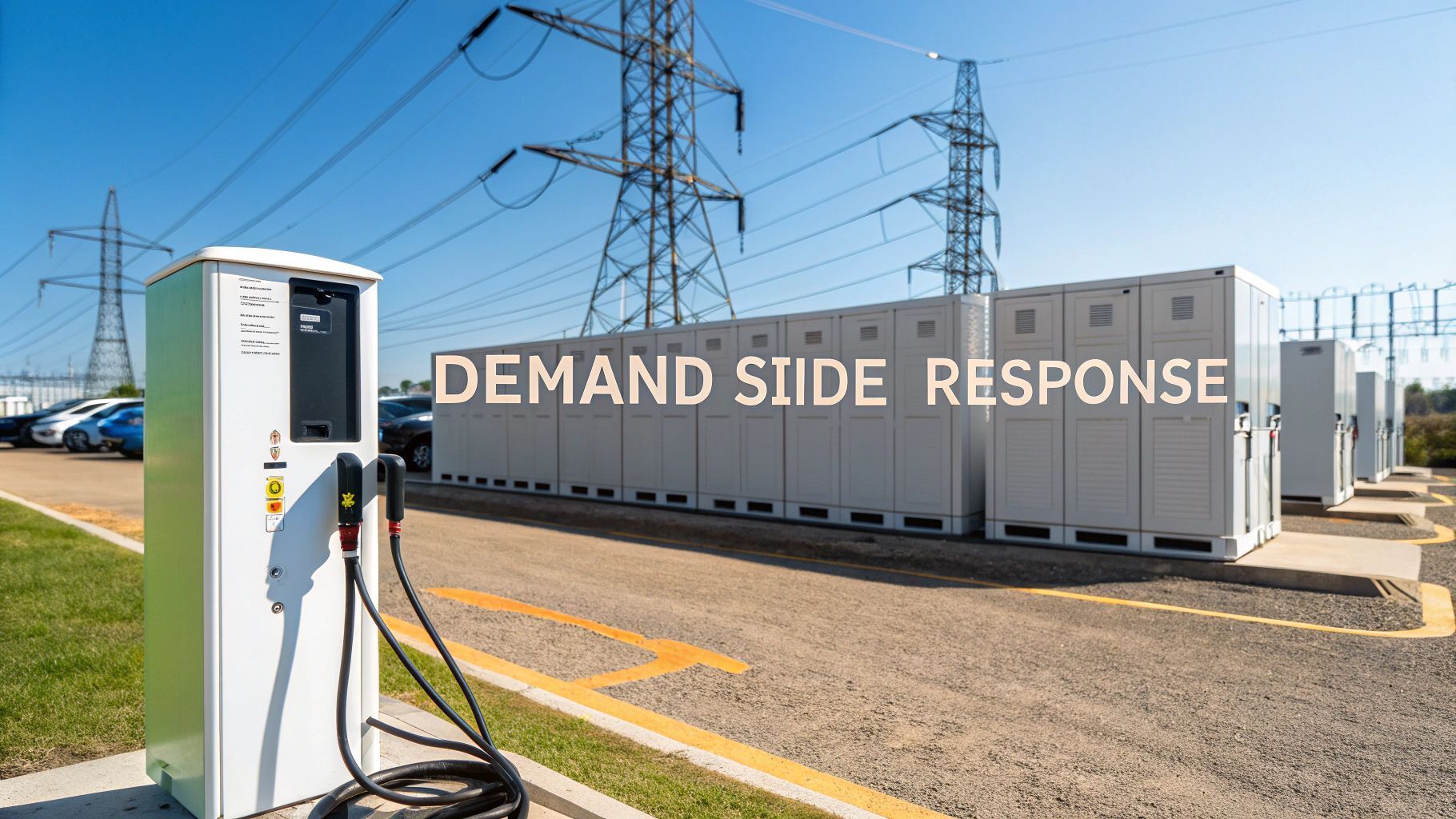
A key thing to remember is that rapid DC chargers put a massive strain on the local grid. This is where solutions like battery energy storage become so critical. They allow businesses to offer rapid EV charging even on sites with constrained grid connections by smartly storing and deploying energy when it’s needed most.
Commercial EV Charger Hardware Comparison
To make sense of the options, it helps to see them side-by-side. This table breaks down the key differences in power, cost and best-fit scenarios for your business.
| Charger Type | Power Output (kW) | Estimated Hardware Cost (£) | Best Use Case |
|---|---|---|---|
| AC (Slow/Fast) | 7kW - 22kW | £1,000 - £6,000 | Workplaces, retail parks, hotels, overnight fleet depots |
| DC (Rapid) | 50kW - 100kW | £20,000 - £40,000 | Public charging hubs, supermarkets, fleet depots with quick turnarounds |
| DC (Ultra-Rapid) | 150kW - 350kW+ | £40,000 - £100,000+ | Motorway service stations, dedicated charging forecourts, heavy-duty fleets |
Ultimately, the right choice depends entirely on how your customers or employees will use the chargers. A hotel guest staying overnight is perfectly happy with a 7kW AC unit whereas a delivery driver on a tight schedule needs the power of a 150kW DC charger.
What Else Affects Hardware Costs?
The sticker price isn't just about raw power. Several other features can influence the final cost and getting them right is crucial for a successful installation.
- Smart Features: Look for things like load balancing . This tech intelligently distributes the available power across multiple chargers, which is vital for preventing your site’s main fuse from tripping and helps you avoid expensive grid upgrades.
- Payment Systems: Are you offering charging for free or is this a new revenue stream? Chargers with built-in contactless payment terminals or RFID readers cost more upfront but are essential for any public-facing commercial operation.
- Brand and Build Quality: Commercial chargers have to endure constant use and whatever the British weather throws at them. Investing in robust, reliable hardware from a reputable brand with solid support will always pay off in the long run.
- Accessibility and Compliance: Making sure your chargers meet accessibility standards, like PAS 1899, isn't just a box-ticking exercise. It's about building an inclusive network that works for every EV driver.
Getting Real About Installation and Grid Connection Costs
While the price tag on the charger itself is a good starting point, it's often the installation and grid connection fees that truly shape your final investment. This is where budgets can spiral if you haven't planned for what's happening behind the scenes. The physical work of getting chargers in the ground and hooked up to the electrical network is a lot more involved than just plugging something in.
Think of it like putting in a new kitchen. The cost of the oven is just one line item. You also have to pay the builders, plumbers and electricians to fit the units, run new pipework and install the wiring. For EV chargers, this groundwork is just as crucial and frankly, can often cost more than the charging units themselves.
These "hidden" expenses are fundamental to understanding the total cost of a commercial EV charging station. Let's break them down.
The Nuts and Bolts of Physical Installation
The first stage of any installation involves serious civil and electrical works and the costs here can vary wildly depending on your site. One of the biggest factors? The distance from your electrical supply to the parking bays. The further you have to run cables, the more expensive the job gets.
Here’s a look at the typical groundworks and electrical tasks involved:
- Trenching and Cabling: This means digging trenches to lay heavy-duty armoured power cables from your main supply to each charging point. Costs climb with distance and the type of surface you’re digging up – tarmac is a lot tougher and therefore pricier, to get through than soft ground.
- Concrete Plinths: Floor-standing chargers need a solid foundation. Pouring concrete bases ensures they are secure, stable and protected from the occasional knock.
- Safety Measures: Installing protective bollards or wheel stops is a small price to pay to prevent a vehicle from damaging your expensive new hardware.
- Electrical Fit-Out: All the internal wiring, consumer units and safety switchgear must be fitted by a qualified electrician to meet strict UK regulations. This isn't a corner you can cut.
These elements are non-negotiable for a safe, professional installation and can easily add thousands of pounds per charging bay to your project total.
Navigating the Grid Connection Maze
This is, without a doubt, the most critical and potentially eye-watering part of the entire project. Your site's ability to draw enough power from the national grid is the ultimate deciding factor. Every commercial EV charger installation requires you to work with your local Distribution Network Operator (DNO) .
The DNO is the company that owns and operates the pylons, cables and substations delivering electricity to your property. Before you can even think about installing chargers, you have to apply to them for a connection agreement. They’ll then carry out an assessment to see if your existing supply—and the local grid itself—can handle the extra load.
The DNO assessment is a make-or-break moment for any EV charging project. Finding out your site needs a grid upgrade can add months of delays and costs that can easily stretch into six figures, completely changing the financial picture of the project.
If the DNO decides the local network needs beefing up to support your new chargers, you're the one who has to pay for it. This could mean anything from installing a brand-new substation on your property to upgrading transformers and cables down the road. Getting an early grid assessment isn't just a good idea; it's absolutely essential to avoid a catastrophic budget blowout.
For sites with a constrained grid connection —where an upgrade is just too expensive or would take too long—a Battery Energy Storage System (BESS) can be a game-changer. A BESS can slowly 'trickle charge' from a weak grid connection during off-peak hours, store that energy and then discharge it rapidly to power the EV chargers when needed. It effectively works around the grid's limitations, turning what might have been a non-starter into a prime location for rapid charging.
Using Renewables and Batteries to Cut Costs
High energy bills and grid connection headaches can feel like major roadblocks when you're planning a commercial EV charger installation. But they don’t have to stop your project in its tracks. With the right strategy, you can slash those running costs and even sidestep the need for an expensive grid upgrade altogether.
By bringing on-site renewables and energy storage into the mix, you create a powerful combination of distributed energy resources. It lets your business generate its own clean electricity, store it for later and use it smartly. Suddenly, you’re in the driver's seat, controlling your energy costs and your charging infrastructure.
The Power of On-Site Renewables
Generating your own power is the most direct route to cutting the day-to-day cost of running your EV chargers. Solar carports are a brilliant example of this in action. They transform simple parking areas into dual-purpose assets that give drivers shelter while generating clean, cheap power right where it's needed.
This self-generated energy can massively reduce how much you rely on the grid. Instead of buying electricity at peak prices to charge vehicles during the day, you’re using free energy produced just metres away. This has an immediate impact on your commercial ev charging station cost and brings your return on investment that much closer.
Taming the Grid with Battery Energy Storage
A Battery Energy Storage System (BESS) is the secret weapon for unlocking the full potential of your on-site generation and beating grid limitations. Think of it as an energy reservoir for your site. It can fill up on electricity when it’s cheap or plentiful and then release it when prices are high or demand spikes.
This ability is a game-changer for two big reasons:
- Peak Shaving: A BESS can charge up overnight using cheap, off-peak grid electricity or soak up excess energy from your solar panels during the day. It then discharges this stored power during peak hours when grid tariffs are at their highest. This practice, known as 'peak shaving,' protects your business from eye-watering bills and makes your charging costs predictable and low.
- Grid Constraint Mitigation: This is where a BESS really shines. Many sites just don't have a big enough grid connection to handle the massive power draw of rapid or ultra-rapid chargers. A BESS gets around this by 'trickle charging' from the weaker grid connection over several hours, slowly filling its reservoir. When a driver plugs in, the BESS unleashes its stored energy at a high rate, delivering a rapid charge without ever tripping the main breaker.
For a lot of businesses, a BESS isn't just a nice-to-have; it's the core technology that makes a rapid charging project possible. It lets you sidestep the six-figure costs and year-long delays that often come with a formal grid upgrade from the Distribution Network Operator (DNO).
The infographic below breaks down the main costs you'd typically face in an installation project.
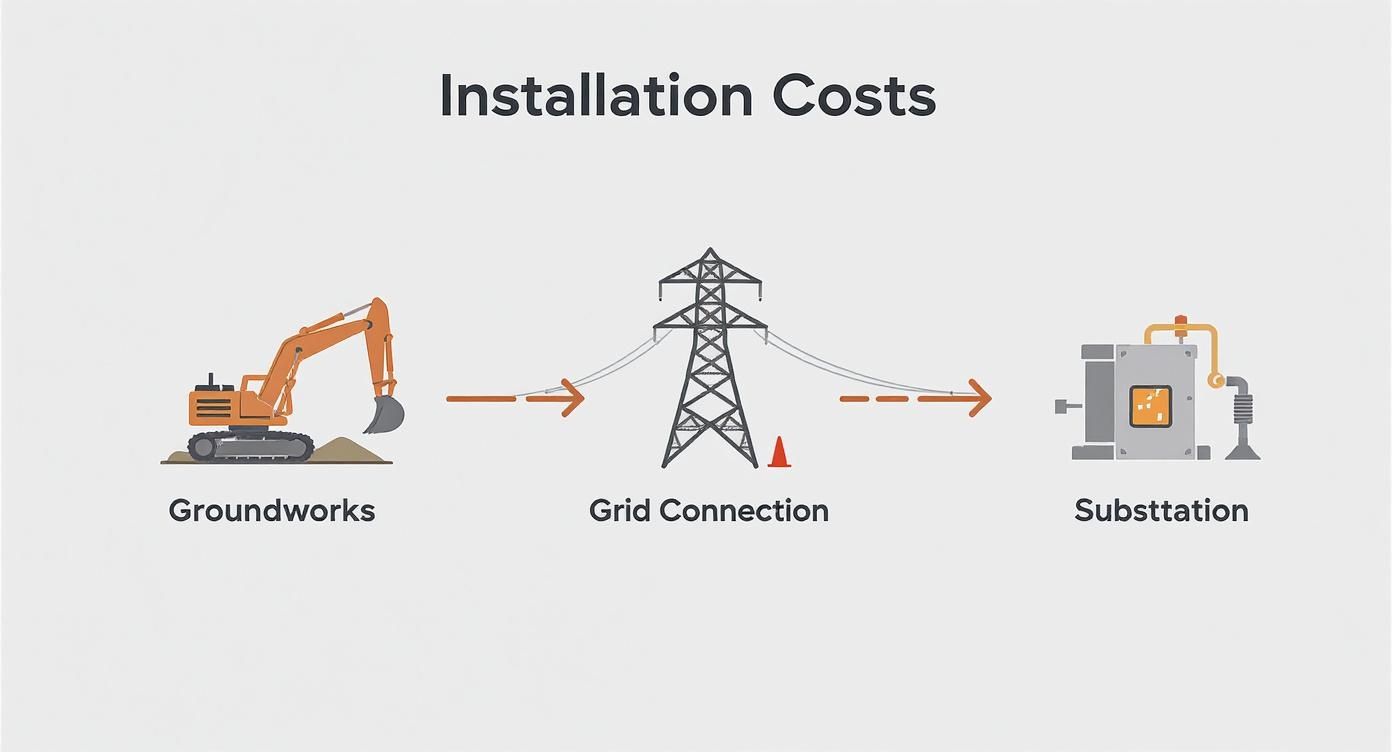
As you can see, the grid connection and any substation work are huge expenses—exactly the kind a BESS helps you avoid.
Creating an Independent Energy Ecosystem
When you combine on-site renewables like solar with a BESS, you build a self-sufficient energy ecosystem for your business. This integrated setup gives you some serious advantages over just plugging your chargers straight into the grid.
- Reduced Energy Costs: You make your own power, store it and use it to dodge the most expensive grid tariffs.
- Revenue Generation: You can potentially sell the stored energy in your BESS back to the grid when demand is high, opening up a new income stream.
- Enhanced Resilience: If there’s a power cut, a BESS can provide backup power to keep your chargers—and maybe other essential site operations—online.
- Future-Proofing: An integrated system gets your business ready for a future where energy management is smart and decentralised. You can learn more about how to power your business and EV fleet with commercial solar and battery storage in our detailed guide.
By taking this forward-thinking approach, you stop being just a passive consumer of electricity. You become an active manager of your own energy strategy, turning a potential cost centre into a valuable, resilient and profitable asset. This kind of strategic investment fundamentally changes the long-term economics of your commercial ev charging station cost .
Getting to Grips with Running Costs and ROI
Think of your EV charging station as a long-term asset, not just a one-off purchase. Once the physical installation is complete and the dust settles, your focus needs to shift to the ongoing operational expenditures (OPEX) and mapping out a clear path to profitability. Nailing these continuous costs is absolutely vital for figuring out a realistic return on your investment.
The financial success of your station hinges on much more than just the initial setup bill. Daily running expenses, how you price your service and how often the chargers are actually used all play a huge role in shaping your business case. This is where you graduate from project planning to active asset management.
Breaking Down the Day-to-Day Costs
Before you can even think about revenue, you need a firm grasp on what it will cost to keep your chargers running, secure and easy for drivers to use. These recurring costs are an essential piece of the total commercial EV charging station cost puzzle.
Common operational expenses you'll need to factor in include:
- Software and Network Fees: Most smart chargers need a subscription to a Charge Point Operator (CPO) network. This is the brain behind the operation, handling payments, user accounts, remote diagnostics and load balancing. Typically, this will set you back £15 to £40 per charger each month .
- Payment Processing: If you're taking credit card payments directly at the charger, you can expect to pay a small percentage of each transaction to the payment provider—just like any other retail business.
- Routine Maintenance and Servicing: To keep everything safe and reliable, annual servicing is a must. A solid maintenance contract can cost anywhere from £250 to £1,000 per charger per year , covering things like inspections, filter changes and critical software updates.
- Repairs and Call-Outs: Even with the best hardware, things can go wrong. It's just smart business to budget for potential repairs or emergency call-out fees to minimise any costly downtime.
Crafting Your Revenue Model
With your costs understood, it's time to build a pricing strategy. The model you choose will depend entirely on your main objective—are you aiming for direct profit, offering a perk for your employees or using the chargers as a magnet to attract more customers?
The most successful charging hubs don't just set a price and forget it. They use a flexible strategy, maybe changing the price per kWh based on the time of day to encourage off-peak charging. This helps manage the load on the grid and crucially, reduces your own electricity costs.
A key part of this is intelligently managing how your chargers draw power. You can learn more about how smart software balances these energy demands in our guide on dynamic power management for EV charging .
Popular revenue models to consider:
- Pay-As-You-Go (PAYG): The simplest approach. Users pay per kilowatt-hour (kWh) of energy they use. This is the standard for public charging.
- Subscription Plans: Offering a monthly fee for a set amount of charging can build real loyalty with regular users, like local residents or your own staff.
- Fleet Charging Contracts: Securing contracts with local businesses to charge their commercial fleet vehicles can provide a consistent, predictable and often premium revenue stream.
- Hybrid Models: Many sites mix and match. They might offer PAYG for the general public while providing discounted subscription rates for frequent users to get the best of both worlds.
Calculating Your Return on Investment
Your Return on Investment (ROI) is the ultimate measure of success. A basic calculation is pretty straightforward: project your annual revenue, subtract your annual operational and electricity costs and then divide that final number by your total initial investment.
Let's walk through a simplified example for a single rapid charger to see it in action:
- Total Initial Investment: £60,000 (for hardware, installation and grid connection)
- Daily Utilisation: 8 charges per day
- Average Energy per Charge: 40 kWh
- Price to Customer: £0.65 per kWh
- Your Electricity Cost: £0.30 per kWh
First, let's figure out the daily profit: ( £0.65 - £0.30 ) * 40 kWh * 8 charges = £112 profit per day .
Next, we can project the annual gross profit: £112 * 365 days = £40,880 per year .
Finally, subtract your annual running costs (let's say £2,000 for software and maintenance): £40,880 - £2,000 = £38,880 net annual profit .
In this scenario, the payback period would be just over 18 months (£60,000 / £38,880). This really shows how a well-used rapid charger can deliver a strong and surprisingly swift ROI, turning your initial cost into a profitable, long-term asset.
Let's face it, government support can be the secret sauce that turns a good investment into a truly great one. When it comes to the upfront cost of commercial EV charging stations, tapping into the right funding can make your entire project more financially viable from day one.
The UK government has rolled out several schemes specifically to give businesses a helping hand with charging infrastructure. While navigating grants can sometimes feel like a bit of a maze, understanding the main options available can unlock some serious savings. For most businesses, there are two key schemes you’ll want to get familiar with: the Workplace Charging Scheme (WCS) and the EV Infrastructure Grant.
The Workplace Charging Scheme (WCS)
Think of the WCS as a direct discount on your hardware and installation. It’s a straightforward, voucher-based scheme designed to give businesses, charities and public sector organisations a nudge to get their first charge points in the ground.
- What it offers: The WCS provides up to £350 per charging socket .
- How many you can claim: A single business can claim for up to a maximum of 40 sockets across all of its sites.
- Who is eligible: The main requirements are having dedicated off-street parking for your staff or fleet and you must use an OZEV-approved installer to carry out the work.
This scheme is absolutely perfect for businesses looking to install a handful of chargers for their employees or to power up their own company vehicles. It directly chips away at that initial bill, making it much easier to get the project signed off.
The EV Infrastructure Grant
If you're thinking on a larger scale, the EV Infrastructure Grant for staff and fleets is where you’ll find more substantial support. This grant is all about helping small and medium-sized businesses prepare for a future where EVs are the norm. It does this by funding the installation of the underlying infrastructure you'll need for large-scale charging.
The real beauty of this grant is that it future-proofs your site. It covers the costly groundwork—installing cabling and sorting grid connections for multiple charge points—even if you only install a few chargers to begin with. This smart approach means you won't have to deal with expensive and disruptive digging later on when you need to expand.
The grant provides up to £350 per charging bay that has the supporting infrastructure ready to go, plus an extra £500 per parking bay that has an active charger installed. All told, you can claim for up to £15,000 per grant .
These kinds of government incentives have been incredibly effective at speeding up charge point installation right across the country. On a wider scale, schemes like the Electric Vehicle Chargepoint Grant (EVCG), which kicked off in April 2022, had already funded over 28,000 sockets by October 2025. This injected £19.2 million into the system, mostly for residential settings like rental properties and car parks. If you're interested in the bigger picture, you can dig into more EV charging statistics on Uswitch.com.
Frequently Asked Questions
When you're digging into the costs of commercial EV charging, it's natural for questions to pop up. We've tackled some of the most common ones below to give you the clear, straightforward answers you need to move forward.
How Much Does a Single Commercial EV Charger Cost in the UK?
The final price tag for one commercial charger can vary wildly. A simple, wall-mounted 7kW AC unit with a straightforward installation might only set you back around £2,500 . On the other end of the scale, an ultra-rapid 150kW+ DC charger that needs serious groundwork and a new grid connection could easily top £80,000 .
It's crucial to remember that the charger itself is just one piece of the puzzle. A basic AC unit might be £1,000 and a high-power DC charger starts at £30,000 but it’s the installation, grid fees and software that often make up the bulk of the final investment.
Can I Install Rapid Chargers with a Weak Grid Connection?
Yes, you absolutely can and this is where a Battery Energy Storage System (BESS) becomes a game-changer. Think of a BESS as an energy reservoir. It can slowly 'trickle-charge' from a weak grid connection over many hours, filling itself up without causing any strain.
Then, when an EV driver plugs in and needs a fast charge, the BESS discharges all that stored energy at a very high rate, sending it straight to the charger. This clever workaround completely bypasses the grid's immediate limitations.
While adding a BESS does increase the initial capital outlay, it's often a far cheaper and quicker solution than paying your Distribution Network Operator (DNO) for a major grid upgrade. Those upgrades can be prohibitively expensive and drag on for months, if not years.
This approach is what makes rapid EV charging possible for countless sites that would otherwise be stuck.
What Is the Typical Payback Period for a Commercial Charger?
This really depends on how you use the charger, your electricity costs and the pricing you set for drivers. For a public rapid charger on a busy motorway service station with high usage, you could see a payback period as short as 3-5 years .
On the other hand, a workplace charger offered as a free perk for staff won't generate direct revenue. Instead, its return on investment is measured in things like better employee retention and a much stronger story on sustainability.
Bringing on-site renewables like solar panels into the mix can massively cut your energy costs and slash the payback period, no matter the scenario. This makes the overall commercial EV charging station cost far more attractive in the long run.
At ZPN Energy , we specialise in delivering advanced battery-backed EV charging solutions that overcome grid limitations and reduce operational costs. Our unique technology allows for rapid charging even on constrained sites, turning impossible projects into profitable realities. Discover our bespoke charging infrastructure at https://www.zpnenergy.com.