What Does a Kilowatt Hour Mean An EV Energy Guide
Ever found yourself staring at an energy bill, wondering what a kilowatt-hour (kWh) actually is? It’s a term we see all the time but its meaning can feel a bit fuzzy. Simply put, a kilowatt-hour is the standard unit of energy your supplier uses to measure how much electricity you’ve consumed over a period. It's the number that ultimately determines what you pay.
Understanding Kilowatts and Kilowatt-Hours
To really get to grips with kWh, it helps to first understand its relationship with kilowatts (kW) . The two are often confused but they measure very different things: power and energy.
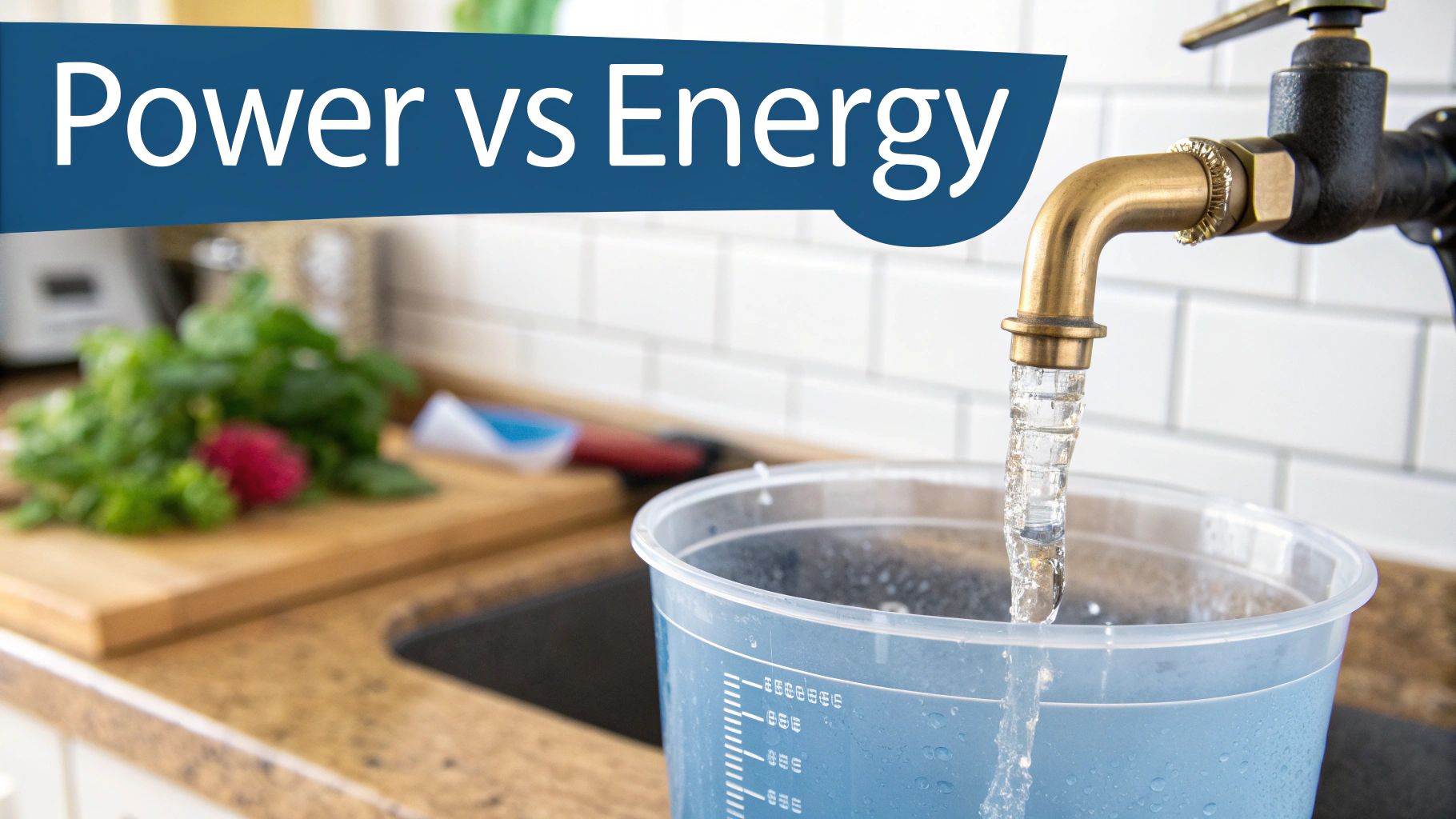
Imagine electricity is like water flowing from a tap. The rate at which the water gushes out—how fast it’s flowing at any given moment—is its power . In the world of electricity, we measure this power in kilowatts (kW) . A high-powered device like a rapid EV charger is like a fully open tap; it has a high kW rating because it demands a lot of electricity instantly.
Now, think about the total amount of water you've collected in a bucket over time. That’s the energy you’ve used, which we measure in kilowatt-hours (kWh) . If you leave that powerful tap running for a full hour, you’ll collect a large volume of water. In the same way, running a 1 kW appliance for one hour uses exactly 1 kWh of energy.
This distinction isn't just academic; it’s fundamental for managing everything from electric vehicle fleets and grid-scale batteries to your business's energy costs. Getting this right is the first step toward smarter energy management.
The image below breaks down this core difference, showing power (kW) as the rate of flow and energy (kWh) as the total volume consumed.
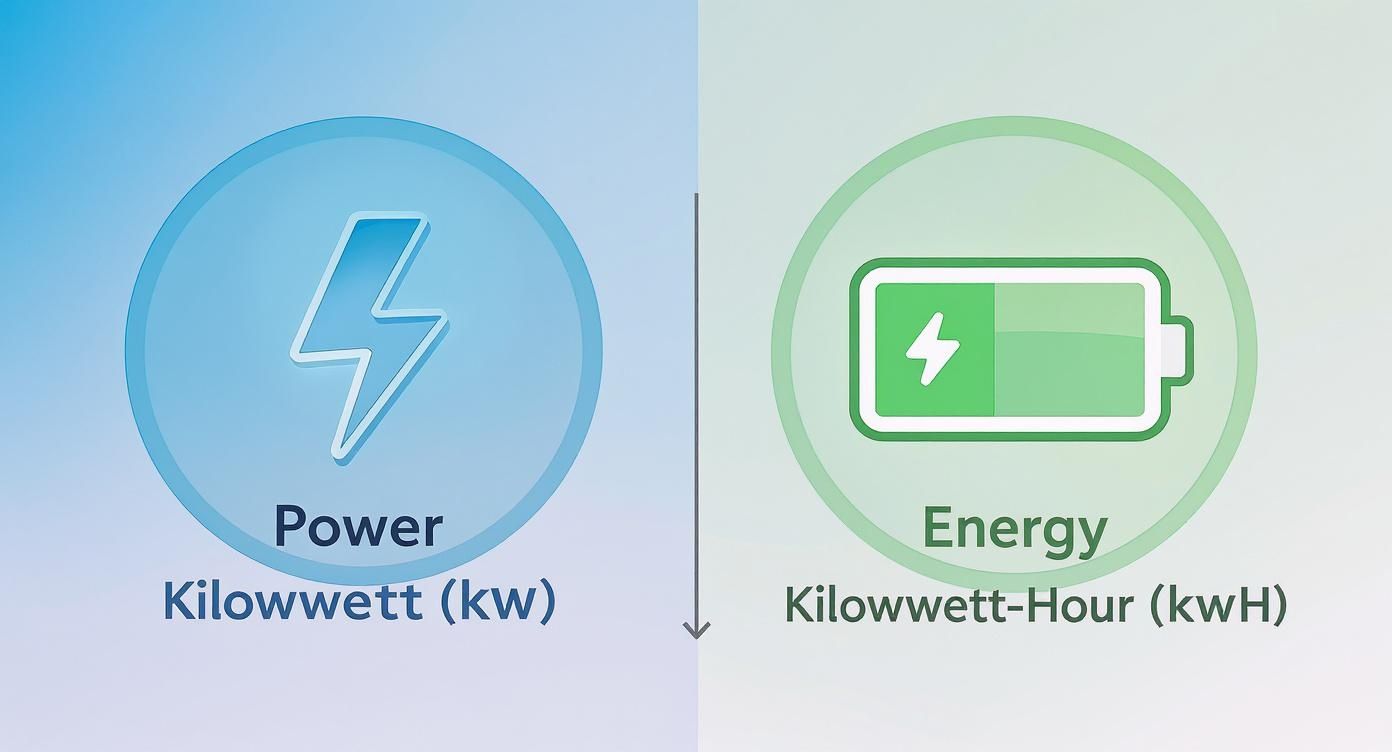
As you can see, the kW rating tells you the instantaneous power an appliance needs, while the kWh figure tells you how much energy it has actually used over time.
Kilowatt (kW) vs Kilowatt-Hour (kWh) at a Glance
Sometimes a direct comparison is the best way to make a concept stick. Here’s a simple table to clear up any lingering confusion between the two terms.
| Concept | Kilowatt (kW) | Kilowatt-Hour (kWh) |
|---|---|---|
| What it Measures | Power (the rate of energy use) | Energy (the total electricity consumed) |
| Analogy | The speed you're driving your car | The total distance you travelled on a journey |
| Real-World Use | The power rating of an EV charger or an appliance | The energy capacity of a battery or your monthly energy bill |
This table makes it clear that while related, kW and kWh serve very different purposes.
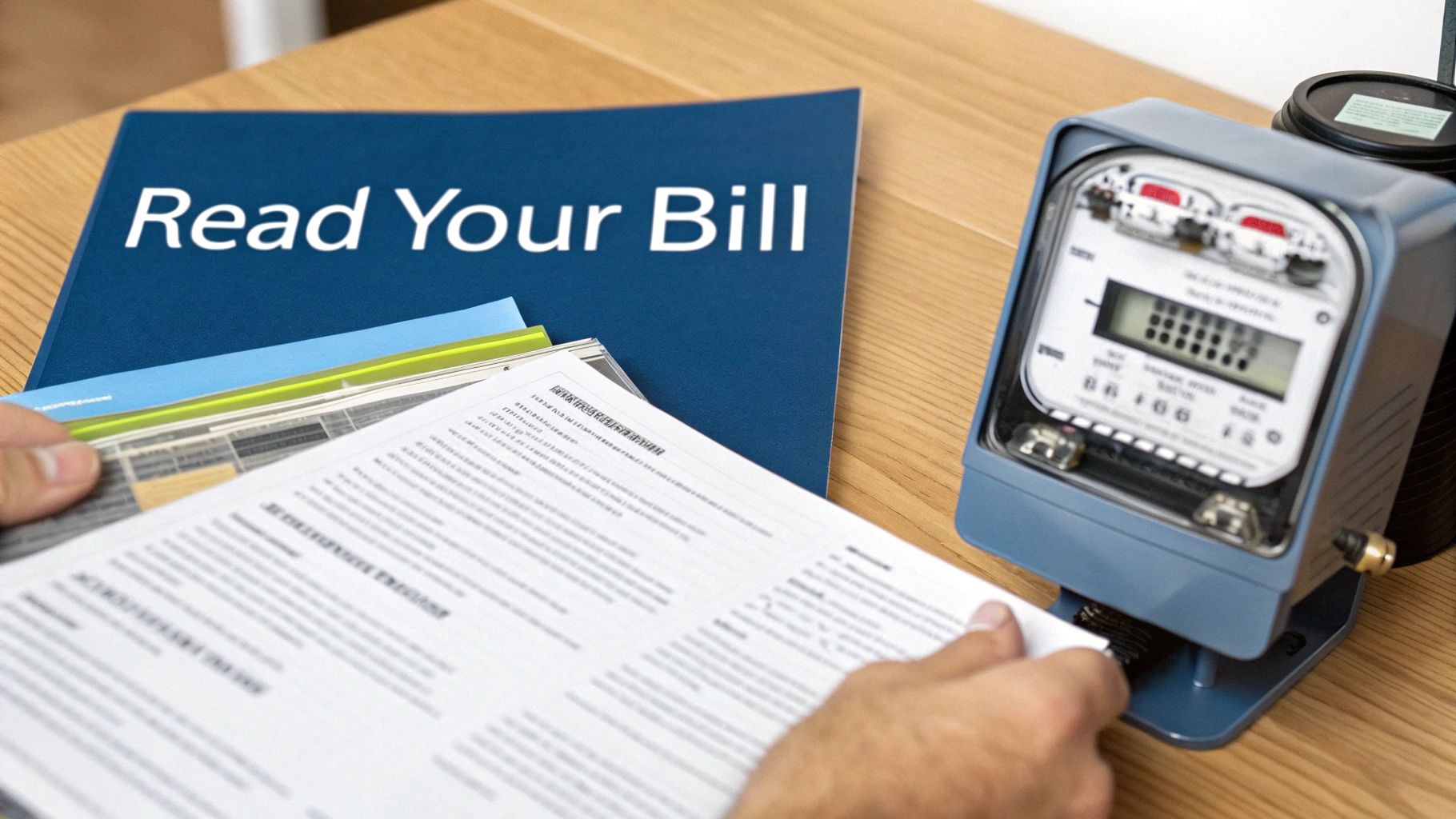
To see this in action, it helps to get familiar with your own energy data. You can learn how to read a smart meter to track your own kWh consumption firsthand. For businesses, especially those dealing with EV charging on sites with grid constraints, monitoring this precise data is absolutely crucial for managing costs and operations.
A great way to remember the difference is this: kW is how fast you use energy , and kWh is how much energy you've used . One measures the demand at a single moment, while the other measures the total consumption over time. This is the bedrock of everything from EV charging solutions to managing on-site renewable energy systems.
How Kilowatt-Hours Drive Your Energy Bill
It’s one thing to understand the concept of a kilowatt-hour but seeing how it directly hits your finances is where the lesson really sinks in. For any business—from a small workshop to a large depot with a fleet of electric vehicles—the kWh is the fundamental unit energy suppliers use to calculate your bill. It’s the metric that turns your operational energy use into pounds and pence.
At its core, your energy bill is a straightforward calculation. Your supplier multiplies the total number of kilowatt-hours your business consumed during a billing period by a set price, known as the unit rate . This rate, expressed in pence per kWh, is the heart of your energy cost.
But the unit rate isn’t the only piece of the puzzle. Commercial energy bills also include a standing charge , which is a fixed daily fee covering the cost of maintaining the energy network and delivering power to your premises. This charge applies every day, regardless of how much electricity you actually use.
Your Total Bill = (Total kWh Used × Price per kWh) + (Standing Charge × Number of Days)
This simple formula is the key to decoding your energy expenses. Once you get a handle on it, you can predict costs, spot potential savings and make smarter decisions about your entire energy strategy.
Breaking Down a Commercial Energy Bill
Let's put this into a real-world scenario. Imagine a small logistics company that runs an office and a charging point for a handful of electric vans. To figure out their monthly energy bill, they first need to know their total kWh consumption. It's as simple as subtracting the previous month's meter reading from the current one.
If last month's reading was 25,000 kWh and this month's is 28,500 kWh , their consumption for the period is 3,500 kWh .
Now, they just need to apply their commercial tariff to this number. The type of tariff they’re on is critical.
- Fixed-Rate Tariffs: These lock in a constant price per kWh for the entire contract. This is great for budget certainty, as the unit rate won't budge even if wholesale energy prices go on a rollercoaster.
- Variable-Rate Tariffs: On these tariffs, the price per kWh can change, often moving with wholesale market prices. While you can catch some serious savings when market prices are low, it also exposes a business to significant risk if prices spike.
Assuming our logistics company is on a fixed-rate tariff of 28p per kWh with a standing charge of £1 per day , their bill for a 30-day month would break down like this:
- Energy Cost: 3,500 kWh × £0.28/kWh = £980
- Standing Charge Cost: 30 days × £1/day = £30
- Total Cost (before VAT): £980 + £30 = £1,010
This calculation shows exactly how every single kilowatt-hour consumed adds directly to the bottom line. By understanding this relationship, businesses can start to see where savings can be made, whether through changing operations, installing on-site renewables or deploying battery storage to manage consumption more effectively.
Putting Consumption into Context
To give these numbers some perspective, it helps to compare them to what a typical home uses. In the UK, the average household consumes between 2,700 and 2,900 kWh of electricity per year.
With an average electricity cost of around 26.35 pence per kWh in late 2023, that works out to an annual bill of roughly £700 to £765. You can find out more about how suppliers calculate these domestic rates and what they mean for the average consumer.
The Role of kWh in Modern EV Charging
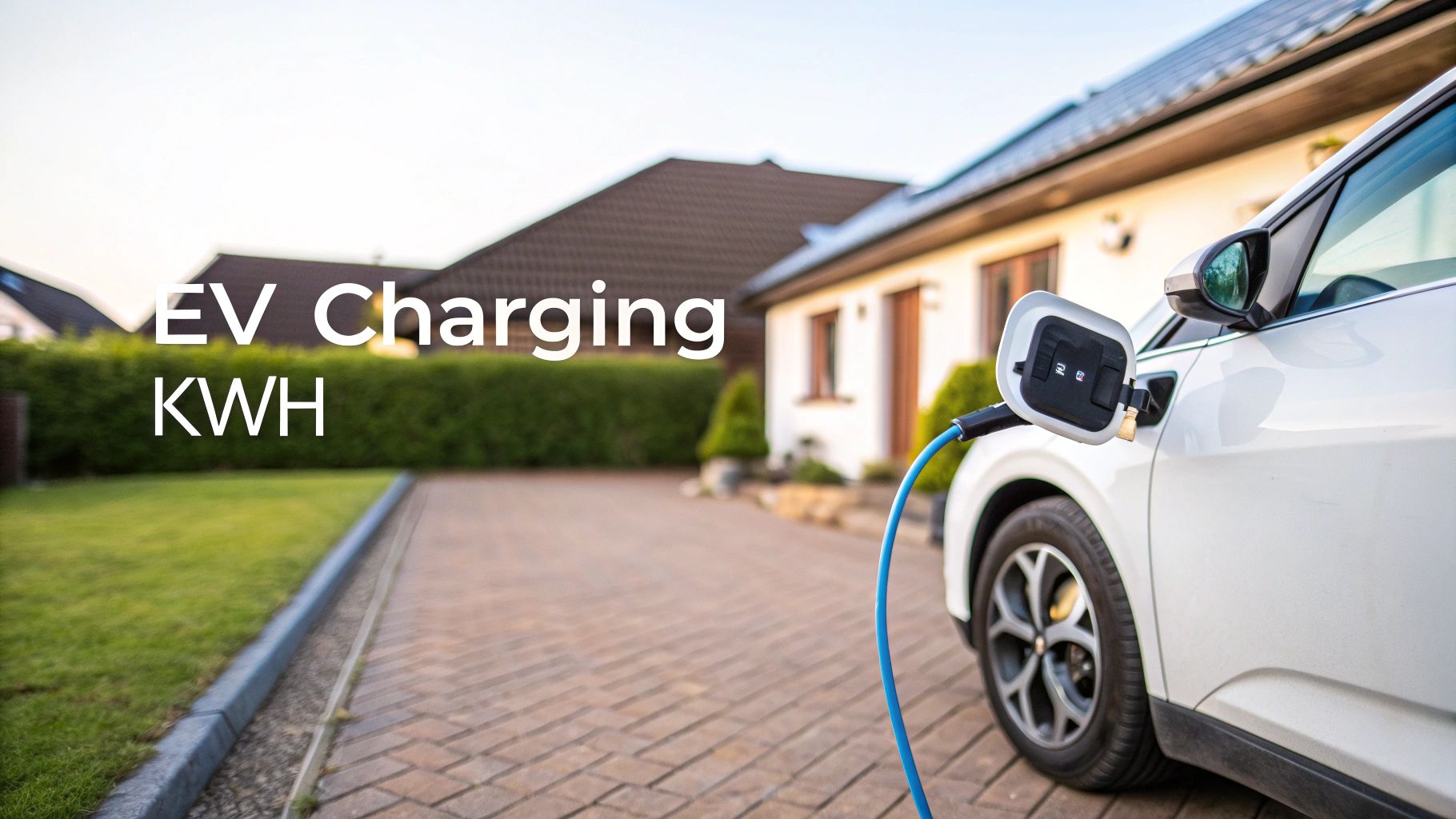
If you’re an electric vehicle driver or a fleet manager, the kilowatt-hour is your new litre of petrol. It’s that simple. Getting your head around what a kilowatt-hour actually means is fundamental because it touches every part of owning and running an EV—from battery capacity and driving range right down to the running costs.
Just as you’d measure fuel in a petrol tank in litres, the energy stored in an EV's battery is measured in kilowatt-hours (kWh) .
An EV’s battery size, stated in kWh, directly translates to its potential range. A car with a 75 kWh battery can hold more energy—and therefore drive further on a single charge—than one with a 50 kWh battery, assuming they're equally efficient. This single number is the most important metric for understanding what an EV can do.
While the concept of stored energy in kWh is your starting point, it works hand-in-hand with charging power, which is measured in kilowatts (kW). It’s easy to mix them up but confusing the two can lead to some big misunderstandings about charging times and capabilities.
Charging Speed vs Energy Delivered
The speed an EV charges at is all down to the charger's power output in kW. But the total amount of energy that actually ends up in the vehicle's battery is measured in kWh. A high-power charger gets the job done faster but the total kWh added still depends on how long the vehicle is plugged in.
Think of it like filling a bucket. A rapid charger is like a high-pressure fire hose, while a slow home charger is more like a garden tap. Both can fill the same bucket (the EV battery) but the fire hose does it in a fraction of the time.
- Slow AC Chargers: These are the units you typically find at homes or workplaces, often with a power output of around 7 kW . To fill a 60 kWh battery from empty would take over eight hours, trickling energy in at a steady pace.
- Rapid DC Chargers: Found at public charging hubs, these powerhouses can deliver 150 kW or more. They can add a serious number of kWh to a battery in just minutes, making them essential for long journeys. ZPN Energy's systems, for instance, are built for exactly this purpose—providing reliable, high-speed charging when you need it most.
The key takeaway is that kW determines the speed of charging, while kWh measures the amount of energy delivered . This distinction is critical for businesses planning their charging infrastructure, as the choice between slow and rapid chargers depends entirely on operational needs.
Real-World Scenarios for kWh in EV Charging
Understanding how kWh works becomes even more vital when you look at practical, real-world applications—especially in commercial settings where efficiency and vehicle uptime are everything.
A great example is mobile EV charging . When a recovery service provides an emergency charge, what they're really delivering is a specific number of kilowatt-hours to get a stranded vehicle to the next charge point. A quick 5 kWh boost might be enough to provide 15-20 miles of range, depending on the vehicle's efficiency.
Another critical scenario involves sites with constrained grid connections . Many commercial locations simply don't have the grid capacity to support multiple high-power rapid chargers at once. This is where combining EV charging with on-site batteries and renewables becomes a game-changer. A battery energy storage system can store kWh from the grid during cheap off-peak hours or from solar panels during the day. This stored energy can then be released at high power (kW) to charge vehicles, neatly bypassing grid limitations.
This approach is central to deploying effective rapid charging without waiting for expensive and time-consuming grid upgrades. If you're interested in the technical side, our guide on DC fast charge technology digs deeper into these advanced solutions.
For businesses running electric fleets, keeping charging costs under control requires smart tools. You can discover how some of the latest smarter fleet energy management solutions help track and optimise kWh consumption for every vehicle. Ultimately, a firm grasp of what a kilowatt-hour means is the foundation for making smart, cost-effective decisions in the world of electric mobility.
Connecting Battery Storage and Kilowatt-Hours
Battery energy storage systems (BESS) are completely changing how businesses manage power and the kilowatt-hour sits right at the heart of this shift. For any organisation exploring energy independence, getting to grips with how kWh relates to battery storage is essential. It's the key to unlocking serious cost savings and operational resilience.
Put simply, a battery’s capacity is measured in kilowatt-hours (kWh) . This number tells you the total amount of energy the battery can hold when it's full, just like the volume of a fuel tank. A 100 kWh battery can store twice the energy of a 50 kWh one. Easy enough.
But there's another crucial figure: a battery's power rating, measured in kilowatts (kW) . This tells you how quickly the battery can charge or discharge its stored energy. A high kW rating means the battery can deliver a huge amount of power instantly—vital for things like rapid EV charging or firing up heavy machinery.
Unlocking Savings with On-Site Renewables
The real magic happens when you pair battery storage with on-site renewables like solar panels. During the day, solar panels often generate more electricity than a business needs. Without a battery, that surplus energy is usually sold back to the grid for pennies.
A BESS changes the game. It allows you to capture and store every spare kilowatt-hour you generate. This stored energy becomes a powerful asset. Instead of paying a premium to draw from the grid during peak hours, you can simply discharge your battery and run your operations on the free, clean energy you generated earlier.
This strategy is known as peak shaving .
By storing low-cost or free energy (in kWh) and deploying it during high-cost periods, businesses can drastically reduce their reliance on the grid and slash their energy bills. A battery’s kWh capacity directly translates into financial resilience and greater energy independence.
The Vital Role of kWh in Distributed Energy
This idea extends far beyond a single business site. The future of energy is a network of distributed energy resources (DERs) , where countless local generation and storage systems work in harmony. In this model, every kWh of stored energy contributes to a more stable, flexible national grid.
Grid-scale batteries, with massive capacities measured in megawatt-hours (MWh), do the same thing but on a much larger scale. They soak up excess energy when supply is high and release it when demand peaks, helping to balance the entire system.
This decentralised approach brings some major advantages:
- Grid Stability: Localised battery storage reduces the strain on the national grid, preventing blackouts and ensuring a more reliable power supply for everyone.
- Enhanced EV Charging: Sites with weak grid connections can use batteries to offer rapid EV charging. They store energy slowly over time and then release it in a powerful burst, all without needing expensive grid upgrades. ZPN Energy specialises in this, providing battery-backed systems that make rapid charging possible anywhere.
- Increased Renewable Use: Batteries make intermittent sources like solar and wind far more practical by storing the energy they produce for when it's actually needed.
Understanding how a kilowatt-hour of stored energy can be strategically deployed is the foundation of modern energy management. For a closer look at how these systems are being rolled out, you can explore detailed information on how battery storage systems are powering the EV revolution. It shows the real-world impact that mastering kWh can have on infrastructure and business operations across the country.
How kWh Shapes the National Grid
While a kilowatt-hour is a neat way to measure energy for a single business or an EV, its real significance snaps into focus when you zoom out to the UK's entire energy system. At a national level, the kWh and its bigger cousins—the megawatt-hour (MWh) and gigawatt-hour (GWh) —are the language of grid balance. They're the fundamental units we use to keep the power stable and the lights on for everyone.
Think of the National Grid as a colossal, delicate balancing act. It has to constantly match the energy being generated with the energy being consumed, second by second. When millions of us switch on our kettles after a popular TV show, the grid feels that immense, sudden strain.
This is where massive grid-scale batteries come into their own. These are huge facilities, with capacities measured in MWh (one million watt-hours) or even GWh (one billion watt-hours), acting as enormous energy reservoirs. They soak up surplus kilowatt-hours when generation is high but demand is low—say, on a windy Sunday afternoon. Then, when demand peaks, they can discharge that stored energy back into the grid in a powerful, controlled burst to prevent blackouts and help stabilise prices.
The Rise of Distributed Energy
But this idea of storing and releasing energy isn’t just for giant, centralised batteries anymore. We're now building a more flexible and robust grid through distributed energy , which is basically a web of smaller, local energy assets. Instead of one single power hub, picture a network of interconnected sources.
This network is made up of:
- Local Renewables: Solar panels on factory roofs or local wind turbines, all generating their own kWh.
- Commercial Battery Storage: Systems installed at business parks or EV charging depots, storing and deploying energy right where it's needed.
- Mobile EV Charging Units: Even fleets of vehicles can act as mobile batteries, ready to inject kWh into the system wherever required.
Each of these elements, all measured in kilowatt-hours, contributes to a smarter, more resilient grid. This decentralised model is absolutely critical for supporting the mass adoption of EVs, especially in areas with older, constrained grid connections. By intelligently managing these scattered assets, we can build a far more efficient power network. For businesses looking to find their place in this evolving system, exploring modern grid energy management solutions is the essential first step.
Framing the UK’s Immense Energy Needs
To truly grasp why precise kWh measurement is so vital, you just have to look at the sheer scale of the UK's energy appetite. Historically, the kilowatt-hour became the standard for a reason: it allows for clear tracking, policy-making and planning.
To put it in perspective, the UK's total final energy consumption in 2023 was reported as 125 million tonnes of oil equivalent (mtoe) . This staggering figure is the same as roughly 1.45 trillion kWh —a number so vast it highlights the incredible complexity of managing our national energy security. You can dig into the full government data to understand more about the UK's energy consumption statistics.
This immense scale shows that a kilowatt-hour is far more than just a unit on your bill. It's the core metric for national energy accounting, infrastructure planning and securing a stable energy future for the whole country.
Here's the rewritten section, crafted to sound like it was written by an experienced human expert.
Putting It All into Practice: How to Manage Your kWh Consumption
Alright, understanding what a kilowatt-hour is represents the first major hurdle. But real, tangible results only come from taking action. For any business ready to get a grip on its energy consumption, the big question is often, "Where on earth do I start?"
This is your practical toolkit for turning that knowledge into savings. We're going to pinpoint exactly where your energy—and your money—is going.
The journey always begins with a solid energy audit . Don't let the name intimidate you. This is simply a systematic look at your entire operation to figure out which processes and bits of kit are the hungriest for kWh. You don’t need a team of experts for this first pass; just walking through your premises and taking notes on what's running and when can reveal some surprising inefficiencies.
Pinpoint Your Biggest Energy Spenders
The first job in any audit is to get the data. Guesswork won't cut it. Modern tools like smart meters and energy monitoring software are brilliant here, giving you a real-time feed of your kWh consumption. This is how you move from vague assumptions to informed decisions.
Once that data starts flowing in, you can look for patterns. Are your HVAC systems blasting away overnight in an empty building? Got machinery idling for hours between production runs? Answering these questions will shine a spotlight on your biggest opportunities for some quick wins.
The old saying holds true: you can't manage what you don't measure. By tracking your kWh consumption in detail, you empower your business to make targeted changes that have a real impact on your bottom line and your sustainability goals.
High-Impact, Low-Cost Strategies
Once you know where the energy is going, you can start making changes. The good news is that many of the most effective strategies require very little investment but deliver significant returns by slashing wasted kilowatt-hours.
Here are a few high-impact actions perfect for any commercial setting:
- Optimise Equipment Schedules: A simple but powerful change. Make sure high-draw machinery is only running when absolutely necessary. Use timers and automated controls to shut things down during evenings, weekends and other downtime.
- Get Your Staff on Board: Your team can be your greatest asset here. Launch a simple awareness campaign to encourage habits like switching off lights, shutting down computers properly and flagging any obvious energy waste.
- Check Your HVAC Settings: Heating, ventilation and air conditioning are often the biggest energy hogs in a business. Make sure your thermostats are programmed correctly for when people are actually in the building and think about zoning off areas so you're not heating or cooling empty space.
- Keep Your Equipment Maintained: A poorly maintained machine is an inefficient one, using far more energy to do the same job. Regular servicing—for everything from your fleet vehicles to your production line motors—ensures they operate at peak efficiency, cutting their kWh consumption.
These steps aren't just about trimming the fat from your energy bills; they represent a fundamental shift towards smarter, more deliberate energy management. Getting your head around the kilowatt-hour is the foundation but applying that knowledge through consistent, practical action is how you truly cut waste and build a more sustainable business.
Frequently Asked Questions About kWh
We’ve covered a lot of ground, from the basics of kilowatts to the real-world impact of kilowatt-hours. This final section pulls it all together with quick, clear answers to the most common questions we hear, helping you put this knowledge into practice with confidence.
Is a Kilowatt the Same as a Kilowatt-Hour?
No but they are closely related. Think of it this way: a kilowatt (kW) is a measure of power—the rate at which electricity is being used at any given moment. A kilowatt-hour (kWh) , on the other hand, measures energy, which is the total amount of electricity you’ve used over time.
It’s like driving a car. Your speed at this exact second is your power (kW), while the total distance you’ve travelled on your journey is your energy (kWh).
How Does kWh Affect EV Charging Time?
The size of an electric vehicle's battery, measured in kWh , dictates how far it can travel on a single charge. The charging speed, however, is all about power, measured in kW .
A high-power rapid charger (rated in kW) can pump a large number of kilowatt-hours into a battery far more quickly than a standard home charger. For instance, a 150 kW rapid charger can deliver roughly 75 kWh of energy—enough for a substantial range boost—in just 30 minutes.
What is the Most Important kWh-Related Metric on My Energy Bill?
Without a doubt, it’s the unit rate . This is the price you pay for every single kilowatt-hour you consume, usually shown as pence per kWh (p/kWh).
This figure, multiplied by your total kWh consumption, forms the lion’s share of your energy costs. Getting to grips with your unit rate is the first and most critical step toward managing your business's energy spend.
Grasping what a kilowatt-hour means is fundamental for any business involved with EV charging or on-site energy generation. It's the language of energy cost, battery capacity and grid management.
Can Battery Storage Help Manage kWh Consumption?
Absolutely. A battery energy storage system (BESS) is designed to store energy, measured in kWh. This capability unlocks two incredibly powerful strategies for businesses:
- Store Excess Renewable Energy: Instead of exporting surplus energy from your solar panels back to the grid for a low price, you can store those valuable kWhs in your battery to use later.
- Peak Shaving: You can charge the battery with low-cost, off-peak electricity and then discharge that stored energy during expensive peak demand periods. This directly slashes your average cost per kWh and protects you from high tariffs.
This is particularly vital for deploying rapid EV charging, especially when dealing with a constrained grid connection. The battery can release its stored kWh at a very high rate of power (kW), effectively bypassing the grid's limitations.
At ZPN Energy , we specialise in creating advanced battery-backed EV charging and energy storage solutions that give you complete control over your kWh consumption. Our unique technology works with constrained grid connections, enabling you to deploy more chargers and build resilient energy infrastructure. Discover how we can help your business at https://www.zpnenergy.com.