Mastering EV Charger Maintenance
Proper EV charger maintenance is not just a box-ticking exercise. It is the active practice of inspecting, servicing and repairing your charging points to make sure they run safely, reliably and just as efficiently as the day they were installed. It demands a proactive strategy, built around scheduled checks and swift repairs, to maximise uptime and protect your long-term infrastructure investment.
Why Proactive EV Charger Maintenance Is Non-Negotiable
Moving beyond a simple ‘fix it when it breaks’ mindset is absolutely critical for any serious charge point operator. A purely reactive approach, where you only address faults after they happen, is a recipe for disaster. It guarantees charger downtime, lost revenue and deeply frustrated drivers.
In today's competitive market, reliability is what sets you apart. It is what builds customer loyalty and protects your brand's reputation. A proactive maintenance strategy is all about getting ahead of the curve and spotting issues before they cause a complete failure. This is especially vital for complex charging hubs that integrate various distributed energy assets.
The Challenge of Modern Charging Infrastructure
Today's advanced charging sites are a world away from a simple socket on a wall. They are miniature power stations, often juggling multiple technologies that all need to work in perfect harmony:
- Rapid EV Charging: These high-power units put significant stress on electrical components, which means they require frequent and thorough monitoring.
- Grid Scale Batteries (BESS): A Battery Energy Storage System is often essential for supporting EV charging from constrained grid connections but it comes with its own specialised maintenance schedule for thermal management and cell health.
- Combined On-site Renewables: Solar panels or wind turbines need their own servicing routines to ensure they are delivering a consistent, clean energy supply to the entire distributed energy system.
- Mobile EV Charging Units: Deployed units face some of the harshest conditions imaginable and require robust checks on their internal batteries and power inverters to keep them running.
The true cost of poor charging infrastructure extends far beyond a single failed transaction. Each out-of-service charger damages public confidence and can deter potential EV adopters, impacting the entire network's growth and profitability.
The Reality of UK Charger Reliability
The UK’s public charging network is growing at an incredible pace but reliability remains a major stumbling block. Government statistics reveal a persistent issue, with various reports indicating that around 15-20% of public chargers are out of service at any given time due to faults.
That means nearly one in every six chargers could be unavailable when a driver needs it most, highlighting the urgent need for robust, professional servicing protocols.
For a wider view on the legal and safety imperatives, this practical guide to equipment maintenance offers some valuable insights. Ultimately, adopting a structured approach to EV charger maintenance is not just good business practice—it is essential for the long-term success of your operations.
Building Your Preventive Maintenance Framework
A generic, one-size-fits-all checklist just will not cut it for serious commercial EV charger maintenance. To be truly effective, your strategy needs a framework that adapts to the specific conditions of each site. This means building a maintenance schedule based on real-world factors, not just a template.
The whole point is to move away from expensive, disruptive reactive repairs and towards a predictable, proactive model. This does not just minimise charger downtime; it extends the life of your valuable assets. It all comes down to a plan that understands the unique demands on your hardware and its environment.
As you start shaping your strategy, it’s worth understanding the core differences between predictive and preventive maintenance. Knowing which approach—or blend of approaches—works best will help you build a far more effective and cost-efficient plan for your charging infrastructure.
This flowchart shows the simple but powerful transition from a reactive model to a proactive one, which is the secret to maximising uptime.
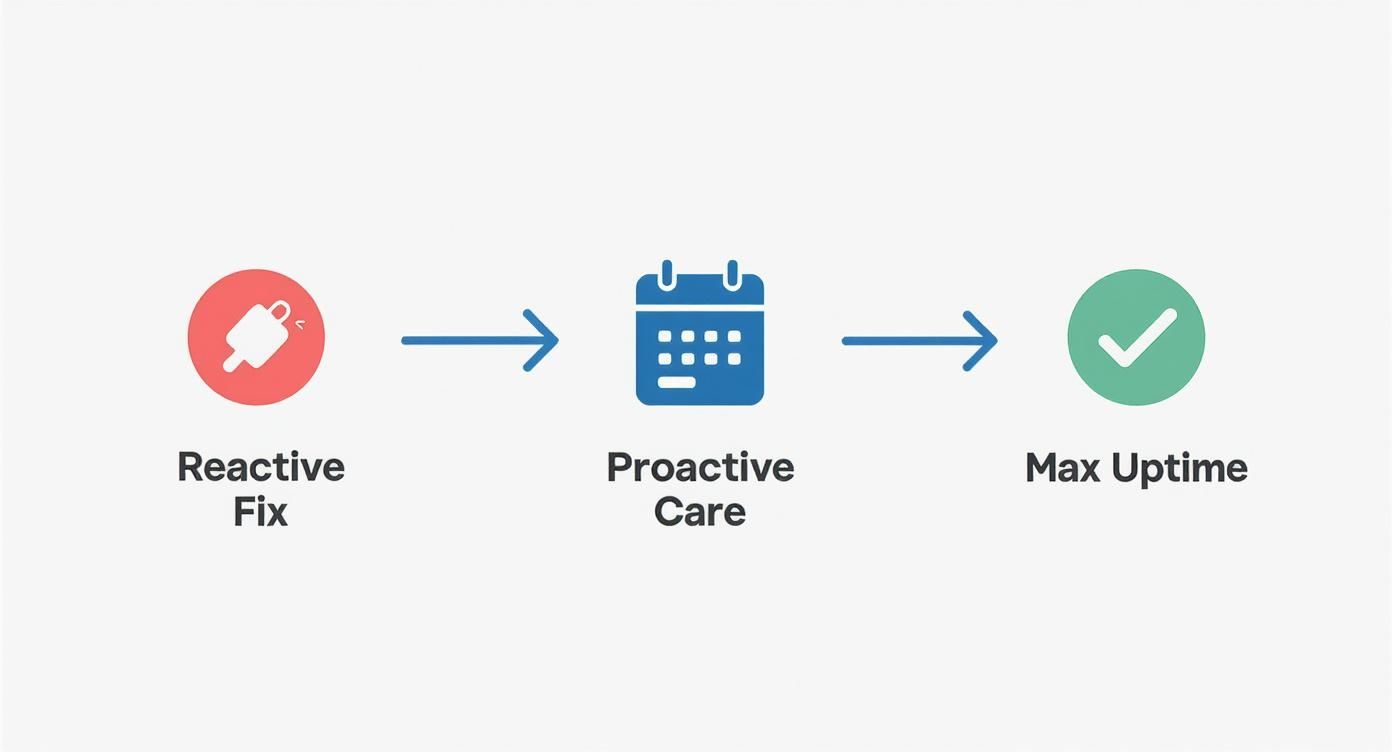
As the diagram illustrates, the journey from simply fixing what is broken to implementing scheduled, forward-thinking care is what delivers consistently high network reliability.
Tailoring Your Schedule to Real-World Conditions
The frequency and depth of your maintenance schedule have to reflect how and where your chargers actually operate. A quiet workplace car park simply does not face the same stresses as a bustling motorway service area and your plan should reflect that.
Several key factors will shape your schedule:
- Charger Type: AC chargers (up to 22kW ) are relatively simple compared to the complexity of DC rapid and ultra-rapid chargers. The high-power modules, sophisticated cooling systems and advanced control electronics in DC units demand more frequent and specialised attention.
- Usage Intensity: High-turnover sites see significantly more wear and tear on physical components like cables, connectors and payment terminals. A charger handling 50 sessions a day will degrade much faster than one used only five times.
- Environmental Factors: Chargers exposed to harsh weather, coastal salt spray or industrial pollutants need more regular cleaning and inspection for corrosion. Likewise, units in areas prone to vandalism require more frequent physical checks.
A tailored approach means you put your resources where they are needed most. It stops you from over-servicing low-use assets while ensuring your high-revenue rapid chargers get the attention they need to maintain peak performance.
To help structure this, here’s a sample schedule that breaks down typical tasks by charger type and frequency.
Sample Preventive Maintenance Schedule by Charger Type
This table provides a detailed checklist of recommended maintenance tasks, outlining their frequency for different classes of commercial EV charging hardware.
| Task | Frequency | AC Charger (e.g. 22kW) | DC Rapid Charger (50-150kW) | Ultra-Rapid Charger (150kW+) |
|---|---|---|---|---|
| Visual Inspection (damage, graffiti) | Weekly | ✓ | ✓ | ✓ |
| Check Cables & Connectors | Weekly | ✓ | ✓ | ✓ |
| Verify User Interface/Screen | Weekly | ✓ | ✓ | ✓ |
| Clean Charger Enclosure | Monthly | ✓ | ✓ | ✓ |
| Test Emergency Stop Button | Monthly | ✓ | ✓ | ✓ |
| Clean Air Filters & Vents | Monthly | N/A | ✓ | ✓ |
| Functionality Test (test charge) | Quarterly | ✓ | ✓ | ✓ |
| Internal Component Inspection | Annually | ✓ | ✓ | ✓ |
| Torque Electrical Connections | Annually | ✓ | ✓ | ✓ |
| Full Electrical Safety Test (PAT/EICR) | Annually | ✓ | ✓ | ✓ |
| Cooling System Fluid Check/Top-up | Annually | N/A | As needed | ✓ |
| Software/Firmware Update Check | Annually | ✓ | ✓ | ✓ |
This schedule serves as a strong starting point but always remember to adjust the cadence based on your site-specific conditions and the manufacturer's own recommendations.
Structuring Your Maintenance Cadence
A logical maintenance framework breaks tasks down into daily, monthly and annual schedules. This approach spreads the workload, blending simple on-site checks with more technical inspections by qualified engineers to create a multi-layered defence against failure.
Daily and Weekly Visual Checks
These are simple yet incredibly effective inspections that can be handled by trained on-site staff. They are your first line of defence, catching obvious physical issues before they escalate into serious faults that need an engineer.
Key tasks should include:
- Physical Inspection: Check the charger enclosure for any signs of damage, graffiti or tampering.
- Cable and Connector Check: Make sure charging cables are not frayed, cracked or damaged. Connectors should be clean and free of debris and any cable management systems should be working correctly.
- Screen and User Interface: Confirm the display is clear, readable and responding to touch. Check that payment terminals are operational.
- Area Cleanliness: Keep the charging bay clear of litter or obstructions that could create a hazard.
Monthly and Quarterly Inspections
These checks are more hands-on and might require a technician with basic electrical knowledge. The focus here is on the operational integrity of the charger and its immediate systems.
- Functionality Tests: Run a test charging session to confirm the charger communicates correctly with a vehicle, ramps up to the expected power level and terminates the session properly.
- Safety Feature Verification: Physically test the emergency stop button to ensure it immediately cuts power and halts the charging session.
- Filter and Vent Cleaning: Inspect and clean all air intake filters and ventilation grilles. This is crucial for preventing overheating, one of the most common causes of failure in high-power DC chargers.
Annual Comprehensive Servicing
This deep-dive inspection must be carried out by a qualified electrical engineer. It involves intrusive testing to verify the electrical safety and performance of the unit, ensuring it remains compliant with standards like BS 7671 .
The average public EV charger in the UK gets a scheduled maintenance visit every 3 to 6 months , depending on its location and usage. High-traffic sites like motorway services often see checks every quarter, which are supplemented by an average of 1.5 emergency visits per charger per year for everything from software glitches to hardware failures.
Alright, let's move from the high-level planning to the hands-on work. This is where the theory of good EV charger maintenance meets the reality of keeping your hardware running safely and efficiently day in, day out. These practical, on-the-ground tasks are absolutely fundamental. Get them right and you’ll prevent most common failures and stay compliant with UK safety standards.
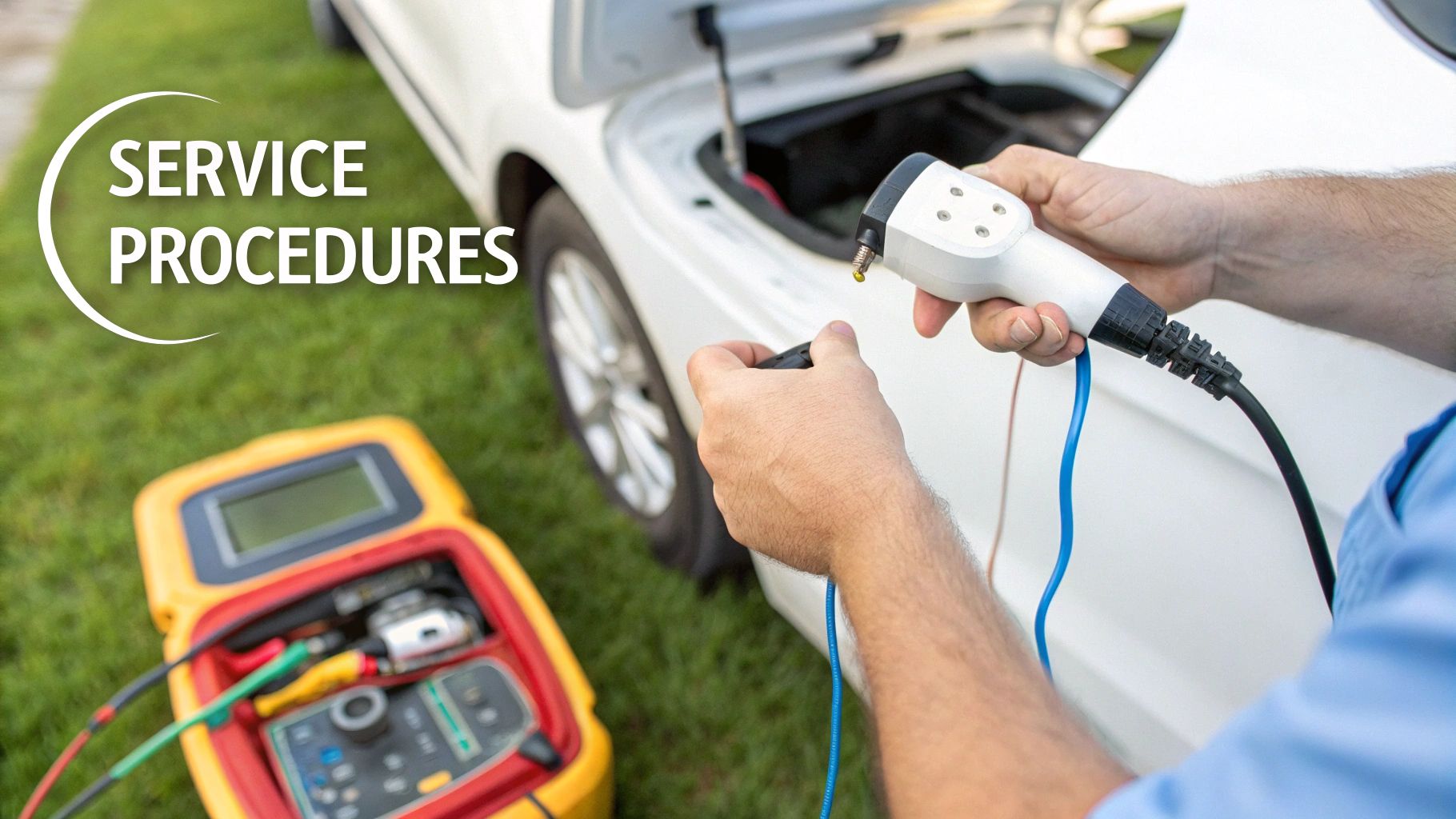
It’s important to understand that these procedures are not all the same. Some are simple visual checks your on-site staff can—and should—be doing regularly. Others involve complex diagnostics that demand a certified engineer. Drawing that line clearly is key to building an effective maintenance programme that keeps everyone safe.
Essential Physical Inspections and Cleaning
Your first line of defence is always the charger's physical condition. Dust, moisture and general grime are the sworn enemies of high-power electronics. For rapid and ultra-rapid chargers with complex cooling systems, regular cleaning is not just a nice-to-have; it is non-negotiable.
Overheating is one of the biggest culprits behind component failure and throttled charging speeds. If air vents are blocked or filters are clogged, the whole system has to work harder. This puts premature wear on fans and power modules, leading to expensive, avoidable repairs.
Key cleaning and inspection tasks include:
- Enclosure and Seal Integrity: Give the charger's exterior a thorough wipe-down to get rid of dirt. But more importantly, take a close look at all the seals and gaskets. Any signs of perishing or damage are a red flag for potential water ingress.
- Cooling System Vents and Filters: Clear out any leaves, litter or other debris blocking the air intake and exhaust vents. Pop out the air filters and either clean or replace them based on the manufacturer’s schedule. This is vital for maintaining proper airflow.
- Cable and Connector Health: Inspect the entire length of the charging cable for any cracks, abrasions or exposed wiring. The connector itself needs special attention—check for debris, signs of arcing (look for black scorch marks) or any physical damage. A damaged connector is not just an inconvenience; it is a major safety hazard.
A clean charger is a reliable charger. Simple housekeeping prevents the most common environmental failures and sends a clear message to drivers that your equipment is well-maintained and trustworthy.
Verifying Critical Safety and Electrical Systems
While your on-site team can handle the visual checks, the moment a tool is needed to open the charger's enclosure, the work must be done by a certified electrical engineer. This is not just a recommendation; it is a legal requirement to ensure you are compliant with standards like BS 7671 (the IET Wiring Regulations).
These technical procedures are what guarantee a charger is not just working but is fundamentally safe for the public. They’re designed to test the protective systems that prevent electric shock and protect the equipment from catastrophic failure.
The Role of the Qualified Engineer
A qualified engineer brings a level of scrutiny that goes far beyond a simple visual check. Their job is to provide concrete assurance that all the high-voltage systems are operating exactly as they should be.
- RCD Testing: They will properly test the function of the Residual Current Device (RCD) or RCBO. This critical safety component is designed to cut the power instantly if it detects an earth fault, which is what protects users from a potentially lethal electric shock.
- Emergency Stop Verification: The big red button is not just for show. The engineer will physically test the emergency stop to confirm it immediately and reliably cuts all power to the charger—a crucial function in any crisis.
- Torque Settings on Connections: Over time, the cycle of heating and cooling, along with vibrations, can cause electrical connections inside the unit to work themselves loose. An engineer will check and re-tighten all internal connections to the manufacturer’s specified torque settings. This prevents poor connections that can lead to overheating and create a serious fire risk.
- Thermal Imaging: Using a thermal camera, an engineer can spot 'hot spots' on components like contactors, busbars and circuit breakers long before they fail. It’s a brilliant diagnostic tool that allows for proactive repairs, swapping out a component before it has a chance to bring the whole station down.
Firmware Updates and Software Health
The physical hardware is only half the story. The software running your charger is just as critical. Firmware updates are not just for adding flashy new features; they are an essential part of EV charger maintenance . Manufacturers constantly push out updates to:
- Fix known bugs that cause charging sessions to fail.
- Improve compatibility with the latest EV models hitting the road.
- Patch security vulnerabilities and protect your network from cyber threats.
- Fine-tune charging algorithms for better efficiency and performance.
Ignoring firmware updates is like never servicing your car's engine management system. You’re leaving your asset vulnerable to performance issues and security risks, which ultimately erodes the reliability of your entire network. Any professional service contract should always include checking for and applying the latest stable firmware.
Maintaining Complex Integrated Energy Systems
Today’s charging hubs are a world away from a simple plug on a wall; they are sophisticated, distributed energy assets. When your site starts to integrate grid-scale batteries, on-site solar panels or even mobile EV charging units, the maintenance challenge gets a lot bigger. These are not just separate systems working side-by-side. They’re deeply interconnected and a failure in one component can easily cascade and disrupt your entire operation.
That’s why a synchronised maintenance approach is non-negotiable. Think about it: the performance of your Battery Energy Storage System (BESS) directly impacts the reliability of your rapid chargers, especially if your grid connection is a bit constrained. If that BESS is not properly looked after, it cannot provide the power buffer needed for ultra-rapid charging, which means throttled speeds and unhappy drivers.
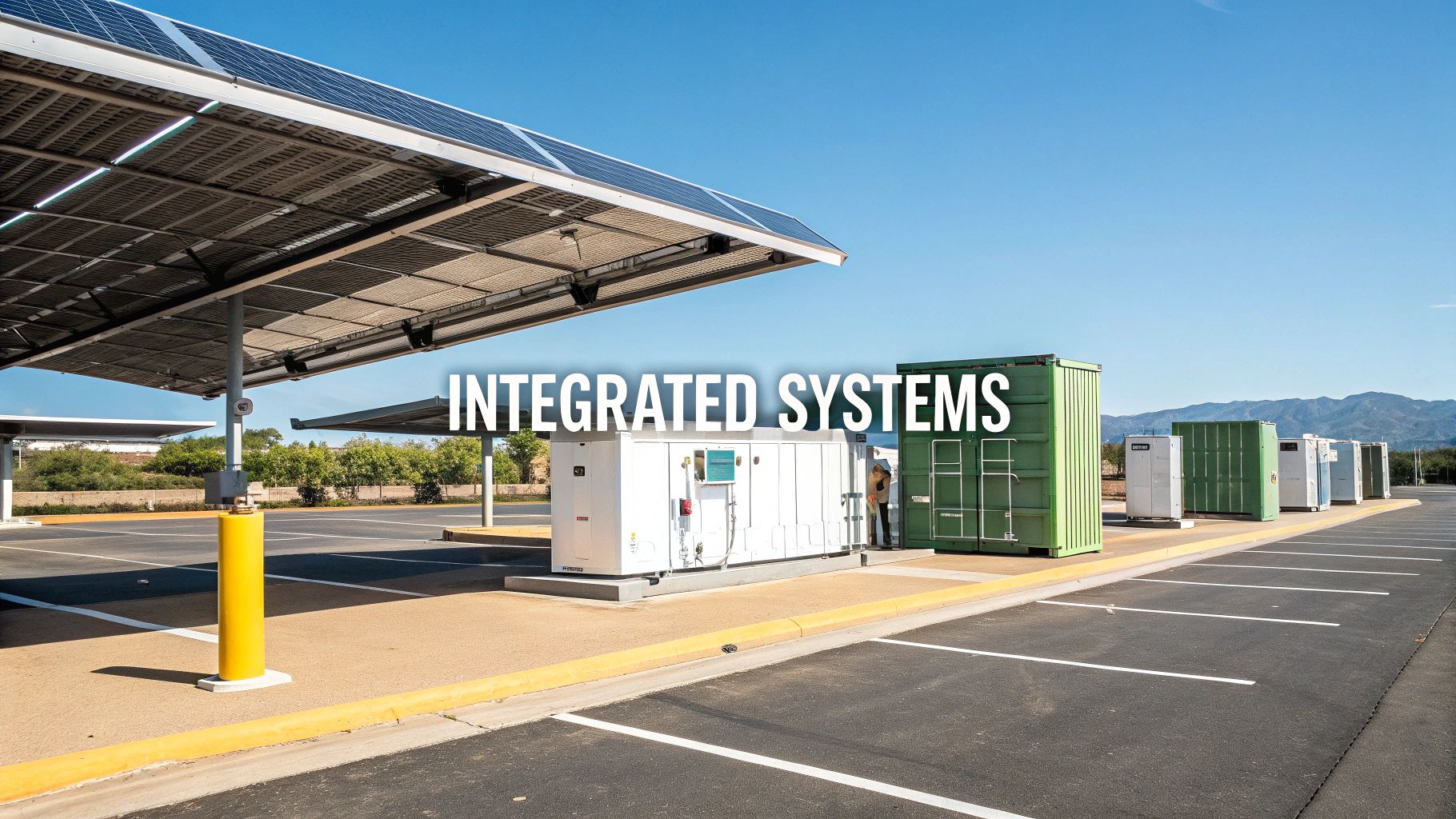
This interconnectedness demands a holistic view of EV charger maintenance . You can no longer service a charger in isolation when its power source is a complex dance between the grid, solar and battery storage. The service schedules for all assets have to be aligned.
Servicing Grid-Scale Batteries (BESS)
A BESS is the engine room of a modern charging hub, particularly where the grid connection is limited. Its maintenance needs are quite different from the chargers themselves but are absolutely vital for delivering consistent, high-power charging. Neglecting the BESS can quickly sink your entire operation.
Key maintenance protocols for a BESS typically involve:
- Thermal Management: Batteries are fussy about temperature. Servicing means inspecting and cleaning HVAC systems, checking coolant levels and making sure all fans and thermal sensors are working as they should. Overheating does not just reduce battery lifespan; it is a serious safety risk.
- Battery Health Monitoring: Technicians need to dig into the data from the Battery Management System (BMS). This is not a quick glance; it is about checking for cell imbalances, degradation rates and the overall state of health (SoH). Spotting a degrading battery module early means you can replace it proactively, before it takes the whole site's performance down with it.
- Inverter and Converter Servicing: The power conversion system (PCS) is the crucial link between the DC battery and the AC grid. Maintenance here involves the practical stuff—cleaning filters and checking electrical connections—as well as updating firmware to keep it operating at peak efficiency.
If you’re keen to get deeper into how these systems juggle power sources, our guide to dynamic power management for EV charging is a great place to start. It explains how intelligent software balances energy from the grid, BESS and renewables.
Combined On-Site Renewables Maintenance
When your hub includes solar carports or other renewable sources, their upkeep has to be woven into your overall plan. A drop in solar generation—whether from dirty panels or a dodgy inverter—puts more strain on your BESS and the grid. That translates directly to higher operational costs.
Servicing for on-site renewables should always focus on:
- Panel Cleaning and Inspection: It might sound basic but regular cleaning to shift dirt and debris is critical for maximising energy production. At the same time, technicians should be looking for any physical damage, like cracks or delamination.
- Inverter Checks: Just like with a BESS, solar inverters need regular inspection and cleaning. This prevents overheating and ensures they are converting that DC solar power to AC as efficiently as possible.
- Structural Integrity: The mounting systems for solar carports or ground arrays need an annual check-up to ensure they’re still secure and free from corrosion. You cannot afford for them to fail.
Maintaining each part of a distributed energy system—from the solar panel to the battery and finally to the EV charger—is not a series of separate tasks. It is one unified process aimed at ensuring the entire ecosystem delivers reliable, high-speed charging.
Protocols for Mobile EV Charging Units
Mobile EV charging units bring their own unique set of maintenance headaches. Unlike fixed infrastructure, these units are constantly on the move, deployed in all sorts of varied and often harsh environments. Their maintenance has to be all about durability and the health of their on-board power systems.
Key things to watch for with mobile units include:
- Battery Cycle Management: The internal batteries are the heart of the unit. Good maintenance means closely monitoring their state of charge, depth of discharge and overall cycle life to squeeze every last bit of longevity out of them.
- Inverter Servicing: The on-board inverter, which turns the battery’s DC power into AC for the vehicle, is a critical component. It needs regular inspections and software checks to stay reliable.
- Physical Durability: Because they get transported so frequently, mobile units need thorough inspections of their chassis, wheels, towing hitches and enclosures. You need to be sure they’re still roadworthy and can handle the rigours of field deployment.
Diagnosing and Resolving Common Charger Faults
When a charger goes offline, every minute it is not working represents lost revenue and a knock to driver confidence. Knowing how to troubleshoot effectively is the key to minimising that costly downtime. A structured approach to fault diagnosis helps you quickly separate minor glitches from serious hardware failures, making sure you deploy your resources where they’re needed most.
The first step is always to check your back-office management system. Modern platforms give you a wealth of real-time data, allowing you to run remote diagnostics before even thinking about a site visit. This remote-first approach can resolve a surprisingly high number of issues, especially those related to software or communication.
The Power of Remote Diagnostics
Before you dispatch an engineer, your first port of call should always be the charger’s management portal. Think of it as a digital window into your hardware's health—one that can often pinpoint the root cause of a problem within minutes and save you the significant cost of an unnecessary call-out.
There is a lot you can usually do from your desk:
- Perform a soft or hard reset: It is the classic "turn it off and on again" for a reason. A remote reboot can clear temporary software glitches, sort out communication errors with the back-office system or fix a frozen user interface.
- Check the error logs: These logs provide a detailed history of the charger's operations and any faults it has registered. An error code pointing to a "payment gateway timeout" is a very different—and much simpler—problem than one indicating a "power module failure".
- Review session data: Dig into recent charging sessions. Did they terminate unexpectedly? Was the power output lower than expected? This data can reveal intermittent faults that might not be immediately obvious.
The ability to diagnose and often resolve issues remotely is one of the most significant advances in modern EV charger maintenance . It transforms your O&M from a purely reactive, field-based model to a proactive, data-driven strategy.
Common Faults and Troubleshooting Workflows
When remote diagnostics don’t solve the problem, a logical on-site troubleshooting workflow is essential. This means mapping common symptoms to their likely causes to guide an engineer’s investigation. Understanding these patterns helps you distinguish between simple fixes and complex hardware problems.
Take a rapid charger that’s delivering power far below its advertised rate. This could be down to a variety of issues. It might be an internal fault with a power module or it could be a problem with the site's distributed energy system, like a depleted BESS unable to supply the required peak power from a constrained grid connection. An engineer would need to investigate both paths.
A common issue with UK DC fast charging is thermal throttling. If the charger's cooling system gets clogged or malfunctions, it will deliberately reduce its power output to prevent overheating. It’s a perfect example of why combining diagnostic data with physical, on-site inspection is so important.
Here’s a practical guide that maps common symptoms to potential causes and actions, helping your team get to the root of the problem faster.
Common EV Charger Fault Diagnosis Flow
This table maps common charger error symptoms to likely causes and actionable troubleshooting steps for operators.
| Symptom/Error Code | Potential Cause | Remote Action | On-Site Action |
|---|---|---|---|
| Charger Unresponsive/Offline | Loss of network connectivity (4G/Ethernet) | Attempt remote reboot. Check network status with provider. | Verify physical network connections. Check power supply to comms module. |
| Payment Terminal Failure | Failed payment gateway communication or hardware fault | Remotely reboot the payment terminal. Check for gateway outages. | Inspect terminal for physical damage. Test with a different payment card. |
| Session Fails to Start | Vehicle-charger communication handshake error (ISO 15118) | Remotely reset the charger. Check for firmware updates. | Test with a different EV model. Inspect charging cable and connector for damage. |
| Low Charging Speed (Throttling) | Overheating, power module fault or BESS/Grid issue | Review charger temperature logs. Check BESS state of charge. | Clean all air filters and vents. Inspect cooling system. Test individual power modules. |
| Emergency Stop Fault | The emergency stop button has been physically activated or is faulty | Review logs to see when the fault was triggered. | Check if the button is pressed; reset if necessary. Test the button's electrical circuit. |
This kind of structured approach ensures that when an engineer does arrive on-site, they are already armed with valuable diagnostic information. That means a faster, more effective and less costly repair.
Building the Business Case for Professional Maintenance
Thinking of professional EV charger maintenance as just another cost is a common mistake and frankly, a costly one. In reality, it’s a strategic investment that directly protects your revenue and your reputation. The real expense is not the scheduled service visit; it’s the cascading impact of downtime, which goes far beyond a single lost charging session.
Every time a charger goes offline, the financial hit multiplies. You’re not just losing the immediate income from that charge. You’re also chipping away at your brand. An unreliable network quickly gets a bad name, pushing drivers to your competitors and damaging the trust you’ve worked to build. This is especially true for sites with high-value assets like rapid chargers and integrated systems like BESS, where underperformance throws your entire energy strategy off kilter.
Understanding Operations and Maintenance Contracts
When you bring on a maintenance partner, you’re not just hiring a contractor; you’re entering into a critical business relationship formalised by an Operations & Maintenance (O&M) contract. This document is the playbook for your partnership, so getting to grips with its key terms is vital. A solid O&M agreement is what moves you from reacting to expensive, unpredictable emergency call-outs to managing a predictable, budgeted operational expenditure.
There are a few key elements you absolutely must scrutinise in any O&M agreement:
- Service Level Agreements (SLAs): These are the promises that matter. They need to be specific and measurable, like a guaranteed four-hour response time for a critical fault on a rapid charger. No vague language allowed.
- Guaranteed Uptime: Look for a hard number, typically 97% or higher . This is the ultimate performance metric and holds your partner directly accountable for keeping your network online and earning.
- Reporting Capabilities: A true partner provides transparent, detailed reports. You need data on asset performance, fault history and maintenance activities to see what you are paying for and make smarter business decisions down the line.
Choosing the Right Maintenance Partner
The right partner brings deep technical expertise that goes beyond the chargers themselves. They need to understand the entire energy ecosystem you operate in. That means grasping the unique demands of rapid EV charging, the specific servicing needs of grid-scale batteries and the complexities of integrating on-site renewables. Their engineers must be certified to work on high-voltage equipment—it is a non-negotiable for safety and compliance.
Investing in a professional O&M contract is not an expense; it is an insurance policy for your revenue stream and your brand. It ensures your complex energy assets are managed by genuine experts, maximising your ROI and keeping drivers happy.
Just look at the UK’s expanding network to see the scale of the challenge. The annual maintenance bill for public chargers is already estimated to be between £120 million and £150 million , a figure largely driven by the specialist skills needed for rapid chargers. As you can learn more about the UK's EV charging expansion , it is clear that professional oversight is the only way to prevent a massive maintenance backlog and protect public confidence in the EV transition.
Here are some of the questions we get asked most often by charge point operators and asset managers. We’ve pulled together some clear, direct answers based on our experience in the field.
How Often Should Commercial Rapid EV Chargers Be Serviced?
For your high-traffic rapid and ultra-rapid chargers, you really want a professional service every 3 to 6 months . Think of these as the workhorses of your network; they need more attention.
This is not just a quick look-over. A proper service involves full electrical safety tests, thermal imaging of key components to spot heat-related stress and a deep clean of the cooling systems. For these high-power units, keeping them cool is absolutely vital for performance and longevity.
On the other hand, your less-used AC chargers, maybe in a private staff car park, could probably get by with a professional check just once a year. But this has to be backed up by regular visual inspections from your own on-site staff.
What’s the Biggest Cause of EV Charger Downtime?
It is easy to assume that when a charger goes down, a physical part has failed. And while hardware failures definitely happen, a huge slice of downtime comes from software and communication glitches.
We see it all the time – failed payment authorisations, a lost connection to the central management system or a firmware bug that just will not let a session start. This is exactly why a modern EV charger maintenance plan has to include robust remote diagnostic capabilities and a solid process for regular software updates.
A maintenance strategy that only focuses on hardware is fighting with one hand tied behind its back. The health of your software, firmware and network connectivity is just as crucial for maximising uptime and keeping drivers happy.
Can Our On-Site Staff Perform EV Charger Maintenance?
Absolutely and they should! Your on-site team is your first line of defence. Basic, non-intrusive tasks are perfect for them. This includes cleaning the unit's exterior, checking for any obvious physical damage and making sure cables are coiled and stored correctly. These simple habits can prevent a surprising number of faults.
However, the moment the job involves opening the charger's enclosure, testing electrical components or pushing firmware updates, that is a hard stop. This work must be carried out by a qualified and certified technician .
There is no room for compromise here. It’s essential for safety, for keeping the manufacturer's warranty valid and for staying compliant with UK regulations.
At ZPN Energy , we design and build integrated, battery-backed charging solutions that are engineered for maximum reliability, especially on constrained grid connections. Our comprehensive maintenance and support ensure your assets deliver peak performance and ROI. Explore our advanced charging and energy storage systems at https://www.zpnenergy.com.