Global Substation Solutions for a Modern UK Grid
Global substation solutions are the critical hubs that manage and transform electrical power, ensuring it gets from where it is generated to where it is needed. They are absolutely fundamental for integrating renewables, supporting the boom in EV charging and keeping the grid stable. But these are not just boxes of transformers and switchgear anymore; modern solutions combine battery storage, smart software and advanced communications to build an energy network fit for the future.
The Evolving Role of Substations in the UK’s Energy Grid
Think of the UK's national grid like a massive motorway network. For decades, substations were the simple roundabouts, directing a predictable, one-way flow of traffic from huge power stations out to our towns and cities. That landscape is changing fast and those old roundabouts are being rebuilt into smart, multi-level interchanges.
This whole evolution is being pushed by new demands on the grid and new sources of power coming online. The explosion of electric vehicles, especially rapid EV charging hubs, puts sudden, massive pressure on local grid connections. At the same time, a surge in distributed energy from wind farms and solar panels creates a two-way flow of electricity—something the old infrastructure was never built to handle.
Modern substations are the unsung heroes making this transition possible. They have become intelligent hubs that actively manage these complex energy flows, keeping the lights on and the grid stable. To do this, they have to integrate new technologies directly into their footprint.
Integrating Advanced Energy Technologies
To meet these new challenges, today’s global substation solutions bring together several key components that work in harmony:
- Grid-Scale Batteries (BESS) : These large battery systems are like energy reservoirs. They store excess power from renewables when it is sunny or windy and release it during peak demand, helping to balance the grid and power EV chargers even on constrained connections.
- Combined On-Site Renewables : Substations are increasingly being built alongside their own solar or wind generation. This creates self-sufficient energy hubs that can operate with more independence from the main grid.
- Advanced Control Systems : Smart software and communication tech allow for real-time monitoring and management of power, redirecting it precisely where it is needed most. You can dive deeper into how these elements create a smarter network in our guide to UK smart grid solutions for future energy.
This integration is fuelling major investment in the United Kingdom's energy infrastructure. The UK substation market is on track to grow at a compound annual growth rate of around 3.0% from 2025, a trend driven largely by the need to bring more renewables online and modernise ageing networks. You can find more detail on this growth over at futuremarketinsights.com.
By combining EV charging, battery storage and distributed energy, substations are no longer passive components. They are active, dynamic assets essential for unlocking a reliable, net-zero future for the UK.
Powering the EV Revolution from Constrained Grid Connections
The rapid switch to electric vehicles is creating a monumental challenge for the UK's local grids. A single rapid EV charger can pull as much power as a small block of flats. When you deploy a whole hub of them, the strain on existing infrastructure can be immense, often completely overwhelming the local grid connection. This is a major roadblock to expanding the UK’s charging network, especially in rural areas or older city centres.
But waiting around for slow and expensive grid upgrades is not the only way forward. Modern global substation solutions offer a direct and powerful answer by creating a brilliant synergy between the substation, on-site battery storage and renewables. This approach turns a simple grid connection point into an intelligent, largely self-sufficient energy hub.
Think of a substation with an integrated battery as a local energy reservoir. It cleverly draws power from the grid during off-peak hours—when demand is low and electricity is cheaper—and stores it. When EV charging demand surges during the day, this stored energy is released to top up the grid supply, ensuring drivers get the power they need without frying the local network.
Combining Batteries and Renewables for Maximum Impact
This model gets even more potent when you add on-site renewable generation, like solar carports. During sunny spells, the energy generated can either charge vehicles directly or be tucked away in the battery for later. This creates a virtuous cycle of clean, locally generated power that cuts down reliance on the grid and slashes running costs.
This visual shows the seamless flow of energy from on-site renewables through a smart substation hub to end-users like EV chargers.
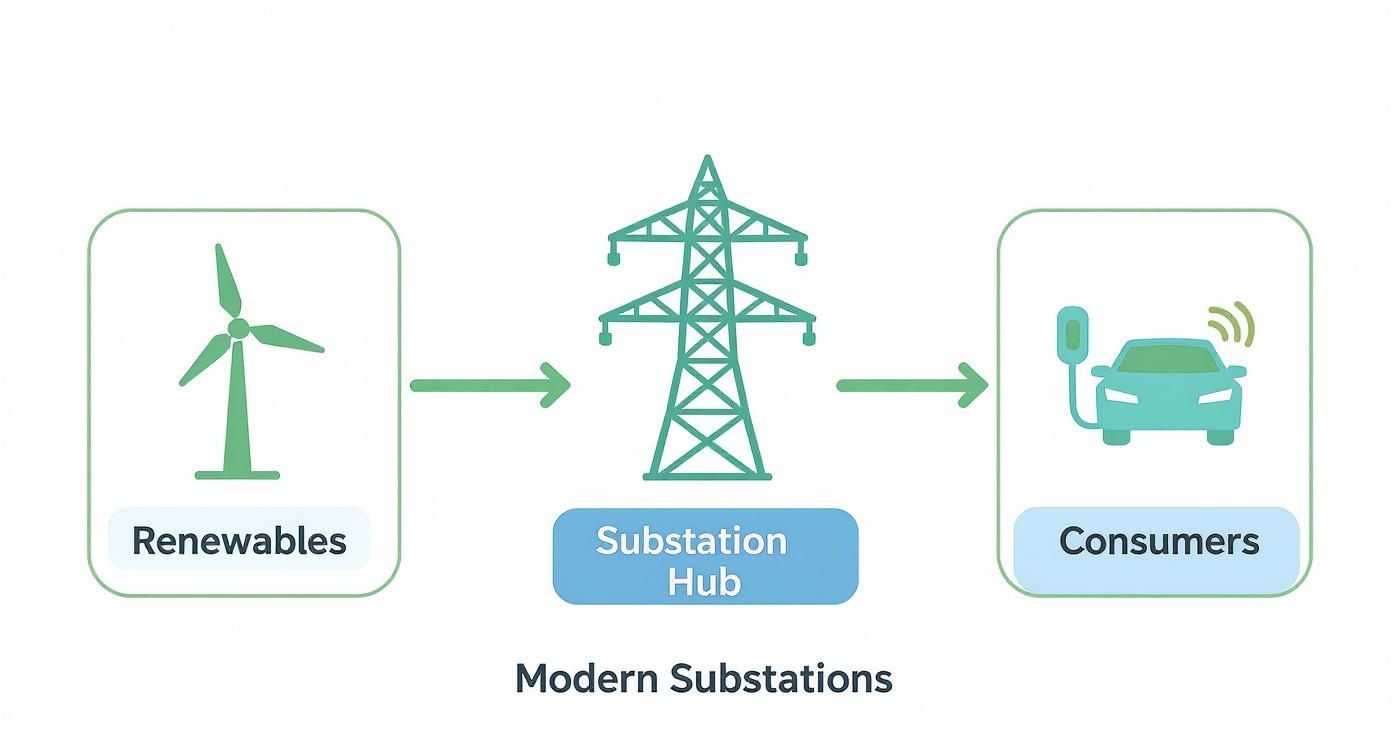
By integrating these technologies, developers can roll out extensive rapid and ultra-rapid EV charging facilities in places that were previously written off due to a weak grid connection. This is absolutely critical if we are going to achieve widespread EV adoption.
The symbiotic relationship between advanced substations, batteries and renewables allows for a faster, more flexible and cost-effective rollout of the UK's essential EV charging infrastructure. It is the key to unlocking charging capacity exactly where it is needed most.
The Rise of Mobile EV Charging Solutions
Beyond fixed installations, the problem of grid constraints has also sparked the development of mobile EV charging units. These systems are, in essence, a battery and charger combo on wheels, providing an incredibly flexible solution for all sorts of scenarios. They are perfect for events, fleet depots with temporary charging needs or even providing emergency power to stranded EVs.
Mobile units work on the same principle as their bigger, fixed cousins. They can be charged from a standard grid connection overnight and then sent out to deliver rapid charging during the day, completely independent of any high-power grid infrastructure on-site. This flexibility means you can avoid the need for permanent, costly civil works for temporary requirements.
Key applications for mobile and battery-backed charging include:
- Fleet Depots: Allowing large fleets of electric vans or lorries to be charged without needing a multi-megawatt grid upgrade.
- Public Charging Hubs: Enabling the installation of rapid chargers at service stations or retail parks with limited grid capacity.
- Workplace Charging: Providing charging facilities for employees without disrupting the building's existing electrical system.
- Distributed Energy Projects: Integrating EV charging into larger microgrids that also support local buildings or industrial processes.
Ultimately, these integrated substation and battery systems provide a practical toolkit for clearing one of the biggest hurdles to electrification. They decouple the charger's power output from the grid's immediate capacity, creating a buffer that ensures reliability and supports the transition to electric mobility across the country. It is a forward-thinking approach and it is fundamental to building a resilient and responsive energy network for the future.
Harnessing Grid Scale Batteries for a Stable UK Grid
The modern substation has a tough job. It is no longer just a simple node in the network; it is the nerve centre for a complex, often unpredictable energy landscape. To manage this, we need new tools and one of the most powerful is the Battery Energy Storage System (BESS) . Think of it as the ultimate shock absorber for the national grid.
These huge batteries are absolutely essential for creating the stability we need to bring more and more intermittent renewables, like wind and solar, online.
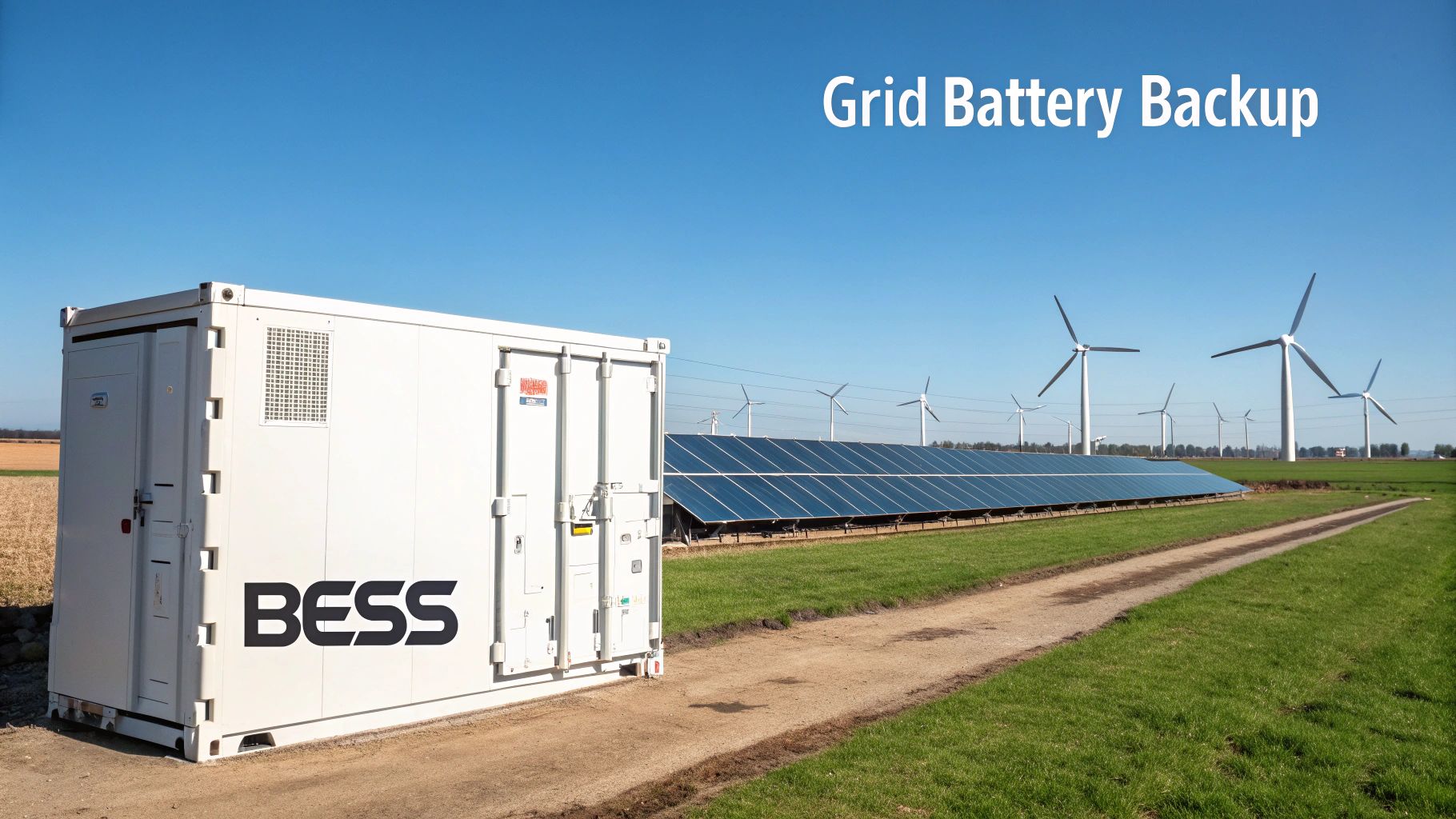
The simplest way to picture a BESS is as a giant ‘grid piggy bank’. When the wind is howling across the North Sea or the sun is blazing down, the UK often generates far more electricity than it needs. Instead of letting all that clean energy go to waste, a BESS soaks it up and stores it, preventing the grid from becoming unstable.
Then, when everyone gets home and puts the kettle on and renewable generation naturally drops off, the BESS can instantly inject that stored energy back into the grid. This simple act of charging and discharging is the key to balancing supply and demand—a task that gets trickier with every new solar panel or wind turbine we connect.
Key Roles of BESS in Substation Operations
But these grid-scale batteries do much more than just hold onto energy. They perform a whole range of sophisticated services that are critical for keeping our lights on. Because they can react in milliseconds, they are perfectly suited for jobs that traditional, lumbering power plants just cannot do efficiently. This capability is at the heart of the global substation solutions needed for a modern, decentralised grid.
Battery storage has several key applications that make it indispensable at the substation level:
- Frequency Response: The grid has to operate at an incredibly precise frequency— 50 Hz here in the UK. A BESS can inject or absorb power almost instantly to correct tiny deviations, preventing cascading failures and blackouts.
- Peak Shaving: By discharging during peak demand, a BESS takes the strain off the wider grid. This means we can put off spending millions on costly upgrades to transmission lines and transformers.
- Renewable Integration: They act as a buffer, smoothing out the spiky, unpredictable output from wind and solar farms. This turns a fluctuating source of power into a reliable, steady flow of clean energy.
These abilities turn a substation from a passive piece of kit into an active, intelligent energy hub. You can learn more about how these systems are powering the UK's energy future with grid-scale battery storage in our deep-dive guide.
A grid-scale battery does more than just store power; it provides a suite of essential balancing services that are the bedrock of a stable and modern energy network. It is the key to unlocking the full potential of the UK’s renewable resources.
Below is a quick overview of how these systems are becoming the backbone of a smarter, more resilient grid.
BESS Applications within Modern Substations
| BESS Application | Primary Function | Key Benefit to the UK Grid |
|---|---|---|
| Frequency Response | Rapidly injects or absorbs power | Maintains the crucial 50 Hz grid frequency, preventing blackouts. |
| Peak Shaving | Discharges during high demand | Reduces strain on grid infrastructure, deferring costly upgrades. |
| Renewable Integration | Smooths volatile energy output | Enables more wind and solar power without destabilising the grid. |
| Black Start | Provides initial power after an outage | Speeds up grid recovery and enhances overall system resilience. |
| Voltage Support | Manages local voltage levels | Improves power quality and efficiency for end-users. |
As the table shows, BESS is not a one-trick pony. It offers a portfolio of services that collectively make our entire energy system more robust and efficient.
Enabling Black Start Capabilities and Grid Resilience
One of the most impressive functions of a substation-integrated BESS is its ability to provide ‘black start’ capability . If a major outage knocks out a large section of the grid, a BESS can deliver that initial spark of electricity needed to restart the big power plants and bring the network back online, piece by piece. This capability can slash recovery times and makes the whole system much more resilient.
This is especially vital as we phase out the large coal and gas power stations that traditionally handled this job. By placing grid-scale batteries at strategic substation sites, we can ensure power is restored quickly and safely, without relying on those old fossil-fuel generators.
Ultimately, building BESS into substation design is no longer a "nice-to-have". It is a fundamental requirement for any serious grid strategy. These systems deliver the flexibility, stability and resilience the UK needs to navigate the energy transition, keeping the lights on as we welcome millions of EVs and a growing fleet of renewable generators.
Deploying Mobile and Modular Substations for Grid Agility
In an energy world that demands speed and adaptability, the old way of building a substation from the ground up can feel like a major bottleneck. This is where mobile and modular substations really come into their own, offering a flexible, fast-track alternative. Think of them as ‘plug-and-play’ power systems, a powerful tool for overcoming grid constraints and supporting rapid infrastructure growth right across the UK.
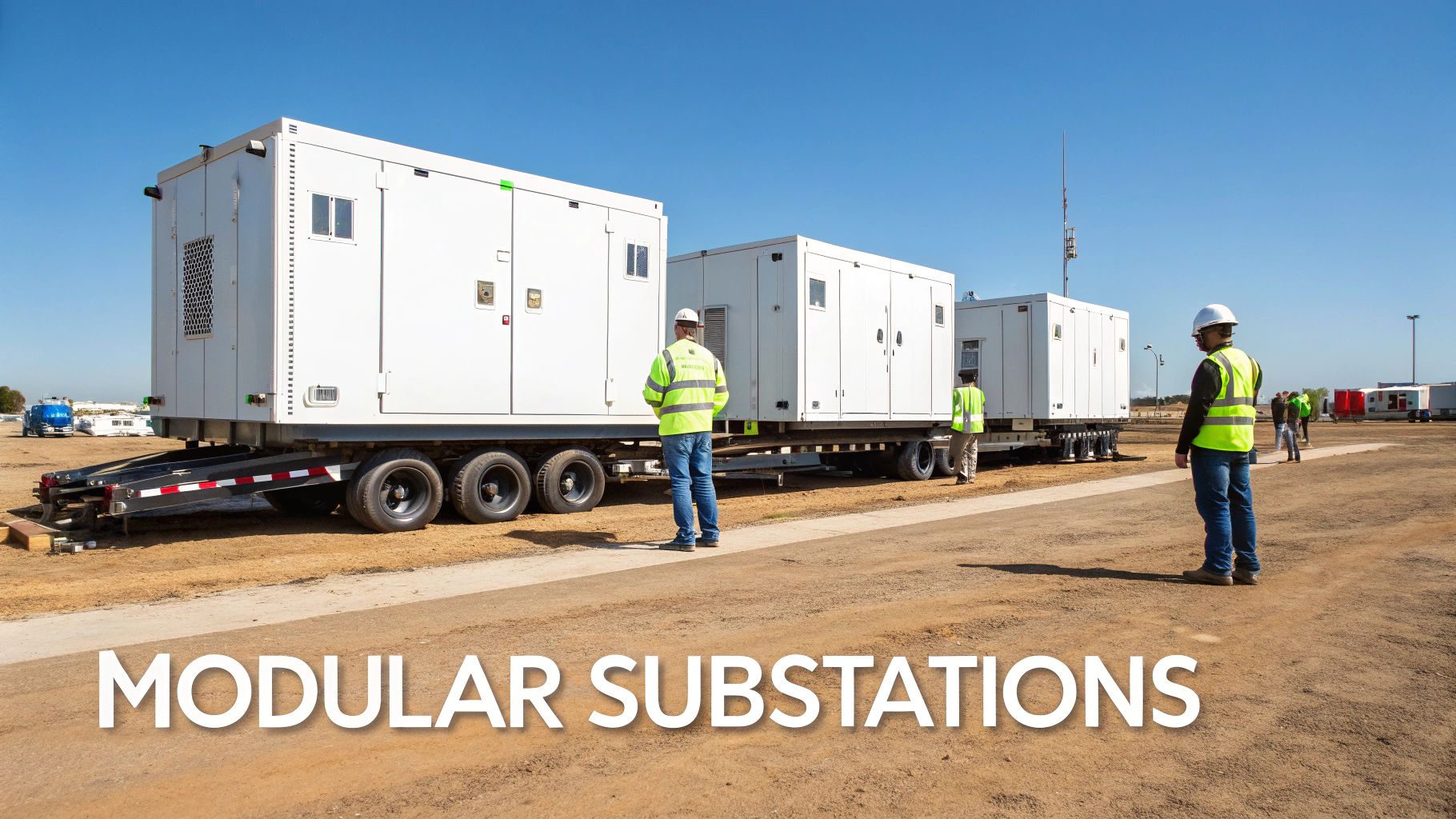
Unlike a conventional substation build, which involves months of heavy-duty on-site civil engineering, modular units are built and pre-tested in a controlled factory environment. These containerised or skid-mounted blocks are then simply transported to their final location and assembled.
This approach dramatically cuts down construction time and local disruption. It is perfect for getting new EV charging depots or renewable projects connected to the grid months, or even years, ahead of schedule.
Accelerating Connections and Enhancing Resilience
The ability to deploy power infrastructure quickly is a complete game-changer. For a business trying to roll out a rapid EV charging hub or connect a new solar farm, waiting years for a permanent grid connection can kill a project before it even starts. A modular substation bridges that gap, delivering the necessary power in a fraction of the time.
Mobile substations—quite literally, substations on wheels—offer another layer of critical flexibility. They are indispensable for a few key scenarios:
- Emergency Power Restoration: After a storm, flood or major equipment failure, a mobile unit can be driven to a site to get the lights back on for a community while permanent repairs are underway.
- Planned Maintenance: They can temporarily take over from a fixed substation during upgrades or maintenance, ensuring customers never experience a service interruption.
- Temporary Demand: They are ideal for supporting large-scale construction projects or major events that have a significant but short-term power requirement.
Mobile and modular substations are not just temporary fixes; they are strategic assets that give the grid much-needed agility. They prevent long waits for permanent connections and seriously bolster the UK’s overall energy resilience.
A Growing Market for Flexible Power
This need for adaptable power solutions is fuelling serious growth in the sector. In the UK, the mobile substation market is set to expand significantly, driven by increasing urbanisation and the sheer complexity of modern power grid requirements.
By 2035 , the market is expected to reach USD 71.23 million , a figure that reflects its vital role in network expansions and meeting the immediate power demands of new infrastructure. You can explore the full forecast and understand more about the market drivers from Spherical Insights.
This growth also highlights the importance of combining these agile substation solutions with other technologies. Integrating battery storage is particularly powerful, allowing for the creation of completely self-contained power systems. These units can be charged from a low-power grid connection and then deliver high-power output for rapid EV charging or industrial use—a concept at the very heart of advanced global substation solutions .
You can find out more about this technology in this deep dive on mobile energy storage systems and their applications. This combination of mobility, modularity and energy storage is a key enabler for a more responsive and robust national grid.
Getting Your Substation Project Off the Ground in the UK
For any business, developer or local authority, putting money into a substation is a massive strategic call. This is not just about buying a piece of kit; it is about building energy infrastructure that can handle the future demands of EV charging, battery storage and local renewable energy projects. To get it right, you need a solid grip on the UK's investment climate and a clear roadmap for getting a project from paper to power-on.
Bringing a modern substation to life takes more than just technical drawings. You have got to understand the funding options, navigate the maze of regulations and get to grips with what the big network operators are focused on. From scouting the perfect patch of land to the final flick of the switch, a step-by-step approach is the only way to keep costs and timelines from spiralling out of control.
The UK is currently ploughing serious money into its grid and substations are a huge part of that. National Grid, for example, is planning to invest around £23 billion in electricity transmission for the 2025 financial year alone, focusing on keeping the system healthy and reinforcing weak spots. This is just one slice of a wider five-year, £60 billion investment plan, which shows you the sheer scale of the grid upgrade underway. You can get more detail by reading about National Grid's substantial investment plans.
Finding the Right Site and Getting a Grid Connection
First things first: you need a location. The perfect spot has to be physically accessible for construction while also being close enough to a viable point on the grid to plug into. Talking to your local Distribution Network Operator (DNO) right at the start is absolutely essential. They hold the keys to the kingdom, providing the critical data on grid capacity and what it is likely to cost to connect.
Getting that grid connection agreement is often the longest, most complicated part of the whole journey. It kicks off with a detailed application to the DNO, who will then run studies to figure out what impact your project will have on their local network. If they give you the green light, you will get a formal connection offer which lays out all the technical requirements and the price for your link to the grid.
When you are adding EV charging and battery storage into the mix, your grid connection application has to be rock-solid. You need to show how your on-site assets will help smooth out demand peaks. This can actually reduce the need for the DNO to carry out expensive network upgrades, which makes your business case a whole lot stronger.
The Financials: Looking Beyond the Upfront Cost
The sticker price is just the beginning. A proper financial model has to consider the Total Cost of Ownership (TCO) , which is about a lot more than the initial capital spend. It includes:
- Installation and Commissioning: This covers everything from the groundwork and civil engineering to installing the equipment, running tests and synchronising with the grid.
- Operational Costs: Think of the day-to-day running costs, like maintenance, monitoring software and any fees for using the grid.
- Decommissioning Costs: You also have to factor in the cost of safely taking everything apart and disposing of it at the end of its life.
On the other side of the coin, you have your Return on Investment (ROI) . For something like a commercial EV charging hub, this means forecasting how much money you will make from charging fees. If you have got a system with battery storage, you might also earn revenue by selling services back to the grid or save cash by dodging peak electricity prices.
Key Things to Think About When Buying a Substation
When you are ready to procure a substation solution, especially one with complex tech integrated, there are a few things to look for. You need to look past the price and assess the long-term value and reliability of any potential partner and their equipment.
- Technical Specs and Standards: Make sure the proposed solution ticks all the boxes for UK standards and meets the specific technical demands laid out by the DNO in your connection offer.
- Scalability for the Future: Your design needs room to grow. How easily can you add more EV chargers or beef up the battery capacity when demand inevitably increases?
- Supplier Experience: Go with a company that has a proven track record of delivering similar projects. Do not be shy about asking for case studies and references.
- Support and Maintenance: A solid service level agreement is non-negotiable. It is your guarantee of long-term reliability and your best defence against costly downtime.
By carefully working through these investment and procurement stages, you can confidently deliver a sophisticated substation project that is not only financially sound but also perfectly in step with where the UK’s energy system is heading.
The Future of Substations and Distributed Energy
The next big leap for global substation solutions is their deep integration with distributed energy and the move towards a fully digitalised grid. We are leaving behind the era of substations as simple, passive connection points. Instead, they are becoming intelligent, proactive hubs that orchestrate entire local energy ecosystems.
This evolution is absolutely critical for managing the complex, decentralised grid that is rapidly becoming our reality.
The Rise of the 'Digital Substation'
At the core of this shift is the 'digital substation' . Think of it as replacing bundles of old copper cables with high-speed fibre optic ethernet. This one change dramatically simplifies everything from installation to maintenance. By digitising all the communication, a substation can suddenly process a huge amount of data from smart sensors and devices, which makes the whole operation safer and more reliable.
This digital foundation is what makes advanced analytics and predictive maintenance possible. With IoT sensors and AI-driven software, a digital substation can monitor the health of its equipment in real-time. It can spot potential faults and flag them for attention long before they cause a blackout. It is a fundamental shift from reacting to problems to proactively managing the grid.
Substations as Local Energy Markets
Looking ahead, the substation's role is set to expand even further, becoming something like a local energy market manager. Its job will be to orchestrate the complex, two-way flow of power coming from a massive variety of distributed energy resources.
Imagine a single substation balancing the energy from:
- Rooftop Solar Panels: Juggling the surplus energy pouring in from homes and businesses during a sunny afternoon.
- Vehicle-to-Grid (V2G) Charging: Using thousands of parked electric vehicles as a massive, distributed battery to support the grid during peak demand.
- Community Batteries: Storing energy locally to boost resilience and even sell services back to the main network.
In this future, the substation's control system is constantly making decisions, sending energy where it is most needed or most valuable at any given moment. This creates a stable, localised grid that is far less dependent on distant, centralised power stations. For components that are integral to these distributed energy strategies, like backup generators, you can explore related power generator products to see how they fit into the bigger picture.
Automation and Digital Twins
The sheer complexity of this future grid demands powerful new tools. This is where digitalisation truly shines, making it possible to create a 'digital twin' —a complete, virtual model of the substation. This allows engineers to simulate changes, test new control strategies and even train staff, all in a completely risk-free environment.
A digital twin is not just a static model; it is a live, data-rich replica that unlocks a new level of operational intelligence. Projects using this approach have seen design times cut by as much as 15% and material waste reduced by up to 2% .
This vision is not science fiction; it is the clear path toward a smarter, more resilient and decentralised energy system. Advanced substation solutions are not just supporting this transition—they are the engines driving it. The intelligent heart of tomorrow's grid is being built today.
Common Questions About Modern Substations
Getting to grips with modern grid infrastructure can throw up a lot of questions, especially when you start weaving in technologies like EV charging and battery storage. Here are some straightforward answers to the questions we hear most often about bringing global substation solutions to life in the UK.
Powering EV Charging from a Weak Grid
How can a substation possibly support a big EV charging hub if the grid connection is weak?
It is a common problem, but one that a modern substation solves by bringing a Battery Energy Storage System (BESS) and on-site renewables like solar into the mix. The BESS quietly charges up during off-peak hours when grid demand is low and electricity is at its cheapest.
Then, when a rush of EVs all need a rapid charge at once, the BESS steps in and discharges its stored energy to back up the grid. This clever trick, known as ‘peak shaving’, stops the local connection from being overloaded. It means you can build powerful charging hubs in places that would otherwise need a slow and eye-wateringly expensive grid upgrade.
The Advantage of Modular Designs
What is the real benefit of a modular substation compared to a traditional one?
Speed. It is all about getting the project finished and operational in a fraction of the time.
Traditional substations are built entirely on-site, a process that can drag on for months, involving major civil engineering and countless delays. Modular substations, on the other hand, are built and fully tested in a controlled factory environment. These finished modules are then simply delivered and assembled on-site, slashing construction time, weather delays and disruption to the local community.
This accelerated timeline is a game-changer. It means new renewable projects or industrial sites can get connected to the grid far faster than with old-school methods, keeping crucial projects on time and on budget.
The True Role of Grid-Scale Batteries
Are not grid-scale batteries just for storing solar and wind power?
That is a big part of their job, but it is really just the beginning. When integrated into a substation, grid-scale batteries become the swiss army knife of the energy world. They provide critical grid-balancing services like frequency response, helping to keep the entire national network stable, second by second.
They can also provide ‘black start’ capability, which is a fancy way of saying they can help restart a whole section of the grid after a blackout. For businesses, they are a powerful tool for cutting electricity bills by storing energy when it is cheap and using it during those expensive peak periods.
This incredible versatility makes BESS a multi-purpose asset that strengthens grid resilience, improves power quality and delivers economic wins that go way beyond just storing renewable energy. They are a cornerstone of the flexible, reliable energy system we need for the future.
At ZPN Energy , we deliver bespoke, battery-backed substation and EV charging solutions that work even with the most constrained grid connections. Our patented technology and UK-based manufacturing ensure you receive a robust and efficient system tailored to your exact needs. Discover how we can power your project at https://www.zpnenergy.com.