How Does EV Charging Work? A UK Driver's Guide
At its core, an electric vehicle charger does one simple thing: it pulls electrical current from a power source like the National Grid and sends it to your car. Think of it as a specialised hose filling your vehicle's battery 'bucket' with electricity.
The real magic though is in converting the grid's Alternating Current (AC) into the Direct Current (DC) that all batteries need to store energy.
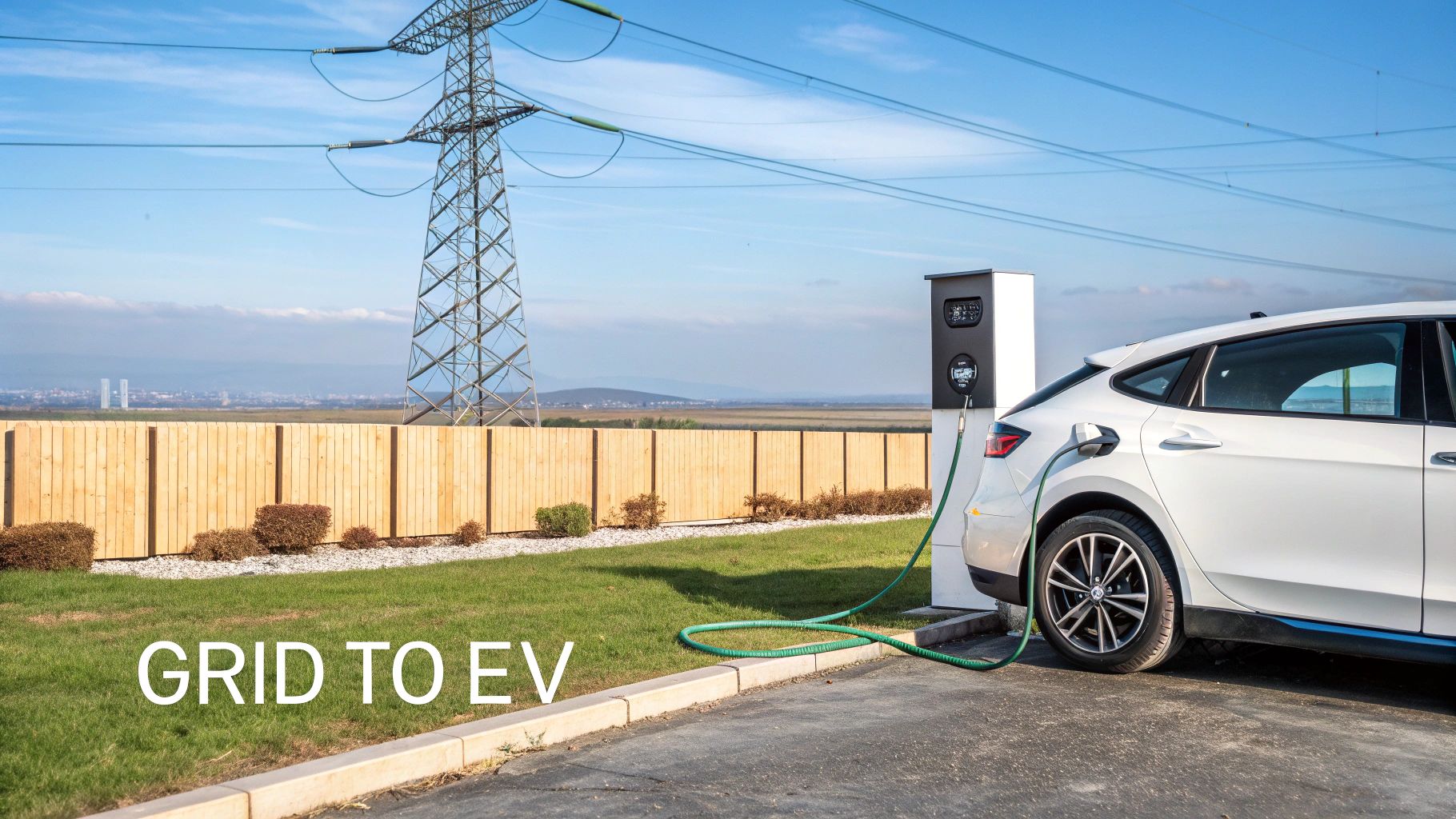
The Journey of Power From Grid to EV
Powering your EV is a fascinating journey that begins long before electricity reaches your charging point. It starts at a power station, travels across the country through the high-voltage transmission lines of the National Grid and eventually arrives at your home or a public charger, ready to use.
This process involves several key steps to get the power into the right format for your vehicle's battery. To really get a grip on how EV charging works, you first need to understand the two fundamental types of electricity involved.
This infographic shows the simple flow of power from the grid to the charger and finally into your electric vehicle.
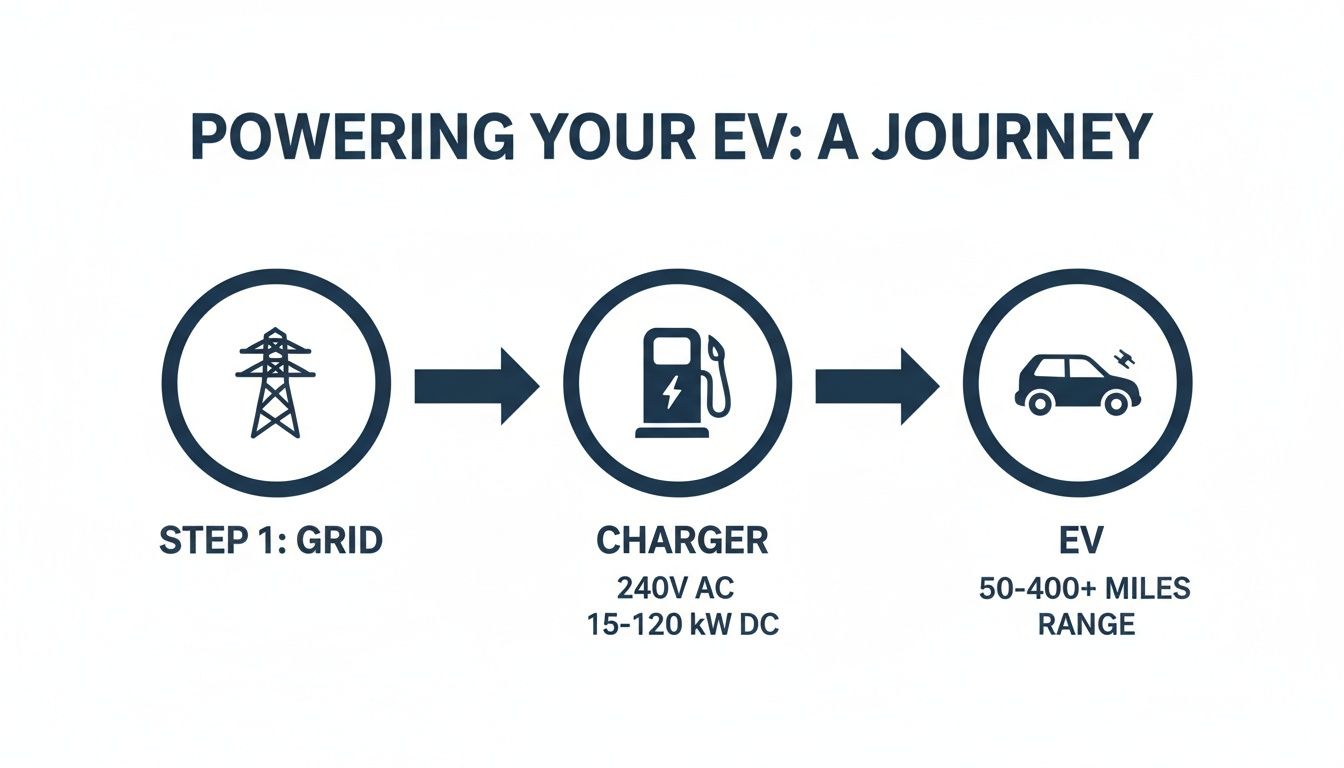
This visual breaks down the entire process into three core stages, showing how the charger acts as the critical go-between, connecting the vast power grid to your car's battery system.
Understanding AC and DC Power
The electricity that powers our homes, offices and most of the national infrastructure is Alternating Current or AC . It’s brilliant for travelling long distances across power lines but it can’t be stored in a battery.
Vehicle batteries, just like the one in your phone, can only store Direct Current or DC . This means that for an EV to be charged, the AC power from the grid must be converted into DC power before it can top up the battery.
This conversion from AC to DC is the single most important concept in understanding EV charging. Where and how this conversion happens is what separates a slow home charger from an ultra-rapid motorway hub.
This distinction sets the stage for everything else. The speed, location and technology of a charger are all determined by how it handles this crucial energy conversion.
-
Alternating Current (AC) is the standard electricity supplied by the grid. Its direction changes, or 'alternates', which is why it's no good for storage.
-
Direct Current (DC) flows in a single, constant direction. This is the only type of power that batteries can use to store and release energy effectively.
Knowing this difference is the first step in decoding the world of EV charging. It explains why some chargers take hours while others take just minutes and it opens the door to the core technologies that make rapid and even mobile EV charging possible—especially in places where the grid connection isn't very strong.
Decoding Charger Speeds: AC vs DC Power
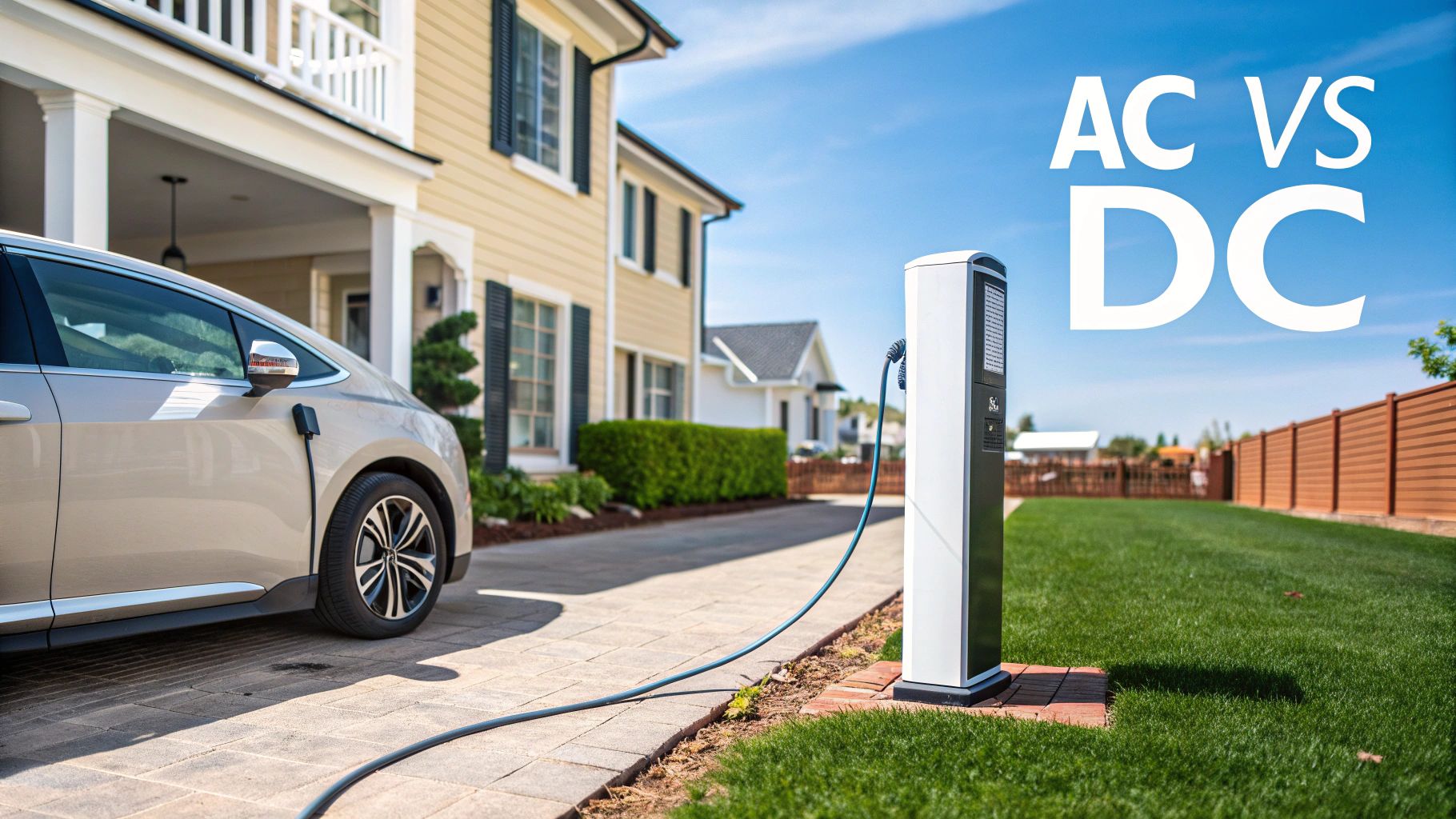
Now that we know the two types of electricity, we can get into why charger speeds vary so wildly. The difference between charging your car overnight and doing it in the time it takes to grab a coffee comes down to one crucial detail: where the AC to DC power conversion happens.
When you plug in at home, your AC charger feeds Alternating Current straight from your wall socket into the car. The vehicle's own onboard converter then gets to work, changing that AC power into the DC power its battery needs. This built-in unit is kept small and light to save space which is exactly why AC charging is the slower of the two.
In contrast, a public rapid charger is a completely different beast. These units contain a huge, powerful converter inside the charger itself. This means they convert the grid’s AC power to DC before it even gets to your vehicle, completely bypassing the car's smaller onboard unit and pumping high-power DC electricity directly into the battery. This is the secret to their incredible speed.
Key Charging Terms Explained
When you start talking about charging speeds and how long an EV can travel, two terms pop up constantly: kilowatts (kW) and kilowatt-hours (kWh). The easiest way to get your head around them is with a simple analogy.
Imagine your EV battery is a water tank.
- Kilowatt-hours (kWh) tell you the size of the tank. A bigger number, like a 75kWh battery, means your car has a larger tank and can hold more energy, giving you a longer range.
- Kilowatts (kW) measure the flow rate of the hose you're using to fill that tank. A higher kW number, like a 150kW rapid charger, means a much faster flow, filling your battery far quicker than a 7kW home charger.
The core idea is this: the charger's speed (kW) dictates how quickly you can fill your battery's capacity (kWh). It’s the difference between using a garden hose and a fire hose.
This simple relationship explains why a powerful 350kW charger can add hundreds of miles of range in minutes, while a standard 7kW home unit is perfect for a slow and steady overnight top-up.
Comparing UK Charger Types
The UK’s charging network is a mix of different speeds, each designed for a specific job. For instance, by late 2023, there were over 17,000 rapid and ultra-rapid chargers strategically placed along motorways and major routes to tackle range anxiety, capable of delivering an 80% charge in as little as 20–40 minutes. Slower AC units however still make up the backbone of the network for destination charging where you'll be parked for hours.
Understanding these different tiers helps you plan where and when to plug in. For a much deeper look into the technology that makes the faster speeds possible, you might find our ultimate guide to DC rapid EV charging useful.
The table below breaks down the common charger types you'll come across in the UK.
UK EV Charger Types Compared
| Charger Type | Power Output (kW) | Typical Time to 80% Charge | Common Locations | Primary Connector (UK) |
|---|---|---|---|---|
| Slow | 3kW - 6kW | 8 - 12 hours | Home (overnight), Workplace | Type 2 |
| Fast | 7kW - 22kW | 4 - 8 hours | Supermarkets, Car Parks, Workplace | Type 2 |
| Rapid | 50kW - 149kW | 20 - 40 minutes | Motorway Services, Public Hubs | CCS & CHAdeMO |
| Ultra-Rapid | 150kW+ | 10 - 20 minutes | Dedicated Charging Hubs, Major Routes | CCS |
As you can see, each charger type has a clear role. Slow and fast AC chargers are ideal for situations where your car is parked for several hours anyway, like at home overnight or during a full day at the office. Rapid and ultra-rapid DC chargers on the other hand are the pit stops of the EV world—essential for long journeys where a quick top-up gets you back on the road with minimal fuss. This blend of infrastructure is what makes the UK's growing EV fleet viable.
We’ve traced the journey of electricity from the grid to the charger. Now let’s pop the bonnet and look at how the car itself handles that power. The real heart of any electric vehicle is its battery and getting to grips with how it works is fundamental to understanding the whole charging process.
At the core of almost every modern EV is the lithium-ion battery . This technology has become the industry standard for a very good reason: it offers the best blend of energy density (how much juice it can pack into a given space) and longevity, meaning it’s built to withstand thousands of charging cycles.
But a powerful battery is useless without a clever 'brain' to look after it. This is where the Battery Management System (BMS) steps in. The BMS is the unsung hero of your EV, a sophisticated bit of electronics that acts as a guardian for the entire battery pack.
The Role of the Battery Management System
Think of the BMS as an air traffic controller for energy. Its job is to constantly monitor and manage every aspect of the battery’s performance to keep it safe, healthy and working as efficiently as possible.
The BMS has a few critical jobs on its plate:
- Monitoring Health: It keeps a close eye on the temperature, voltage and current of individual battery cells to prevent overheating or damage.
- Balancing Charge: It makes sure all cells are charged and discharged evenly, a simple but vital process that massively extends the battery's lifespan.
- Calculating State of Charge (SOC): The BMS is what gives you that accurate "fuel gauge" on your dashboard, letting you know exactly how much range you have left.
- Protecting the Battery: If it spots any trouble, it will immediately shut down charging to protect your investment from potential harm.
This constant oversight is what makes EV charging safe and effective. The BMS is always in communication with the charger, telling it exactly how much power the battery can safely handle at any given moment.
Connecting to the Grid with Smart Charging
The intelligence of the BMS inside the car is now being matched by a growing intelligence outside it: smart charging . This technology creates a two-way conversation between your car, your charger and the wider energy grid, turning charging from a simple one-way power dump into a dynamic, responsive process.
Smart charging allows a vehicle to automatically tweak its charging speed and schedule based on signals from the grid. This is a game-changer for managing energy demand and just as importantly, costs.
Smart charging is the key to integrating millions of EVs onto the grid without causing instability. It allows vehicles to charge when electricity is cheapest and greenest, turning them into assets that support the grid rather than just straining it.
For instance, your smart charger can be set to only kick in late at night, when overall electricity demand plummets and prices on time-of-use tariffs are at their lowest. This simple change saves you money and helps balance the load on the National Grid. The benefits are so obvious that the UK has made this approach a regulatory standard. To learn more about managing these power demands, check out our guide to dynamic power management for EV charging.
The UK government’s Electric Vehicles (Smart Charge Points) Regulations now require new private chargers to default to smart charging. This policy gently pushes charging to off-peak hours when low-carbon energy is more abundant. An evaluation even found this approach helped lower the average cost of home chargers by over 30% between 2020 and 2023. You can discover more insights about smart charging policies on theicct.org.
This seamless integration between battery technology and grid intelligence is not just a nice-to-have; it's fundamental to building a sustainable transport future.
The Impact of EVs on the National Grid
With millions of electric vehicles now on UK roads, a common question keeps cropping up: can the National Grid actually cope with the extra demand? It’s a valid concern but the challenge isn’t about the total amount of energy EVs will use. Instead, it’s all about managing peak demand .
Peak demand happens when electricity usage spikes, typically between 5 pm and 7 pm. This is when people get home from work and switch on ovens, televisions and kettles all at once. If millions of EV drivers plugged in their cars at this exact same time, it would place a huge strain on local substations and the wider grid network.
Luckily this worst-case scenario is highly unlikely, thanks to the smart technologies we’ve already discussed. The solution isn’t to build more power stations; it’s to charge more intelligently.
Turning a Problem into an Asset
The real story here isn’t one of strain but of opportunity. Smart charging, encouraged by time-of-use tariffs that offer cheaper electricity overnight, is already shifting the bulk of EV charging away from peak hours. This simple change smooths out demand and makes use of the grid's spare capacity during quiet periods.
But the most powerful solution lies in seeing EVs not as simple consumers of energy but as a vast, connected network of batteries on wheels. This is the whole idea behind distributed energy resources .
Instead of just taking power from the grid, a future network of EVs could act as a massive, decentralised battery. This network could store surplus renewable energy and release it back to stabilise the grid when demand is high, turning a potential liability into a powerful asset.
This approach completely flips the dynamic. When the wind is blowing and the sun is shining but demand is low, millions of parked EVs could soak up that excess green energy. Later, during the evening peak, they could feed a small amount back to support the grid.
The Future is Vehicle-to-Grid Technology
This two-way flow of energy is known as Vehicle-to-Grid (V2G) technology. While still an emerging field, V2G represents the ultimate form of smart grid management. It allows EV owners to actively participate in balancing the national energy supply, potentially even earning money for the energy they contribute back.
When you combine this with other technologies, the impact becomes even greater:
- Mobile EV Charging: For immediate, localised support, mobile units can deliver power exactly where it’s needed, acting as temporary support for the grid during unexpected outages or events.
- Grid-Scale Batteries: Large Battery Energy Storage Systems (BESS) installed at charging hubs can absorb cheap off-peak power and then discharge it to support rapid EV charging during peak times. This completely shields the local grid from sudden spikes. To find out more, explore how our battery storage systems are powering the UK's EV revolution.
- Combined On-Site Renewables: When charging hubs combine grid-scale batteries with their own solar panels, they can become almost entirely self-sufficient. This creates microgrids that reduce reliance on the national network.
Ultimately the mass adoption of EVs isn't a threat to the National Grid. It's a catalyst for making it smarter, more flexible and better equipped to handle the fluctuations of renewable energy. By using distributed energy resources like EVs and batteries, we aren’t just powering cars; we’re building a more resilient and sustainable energy future for everyone.
Solving Charging Challenges for Fleets and Businesses
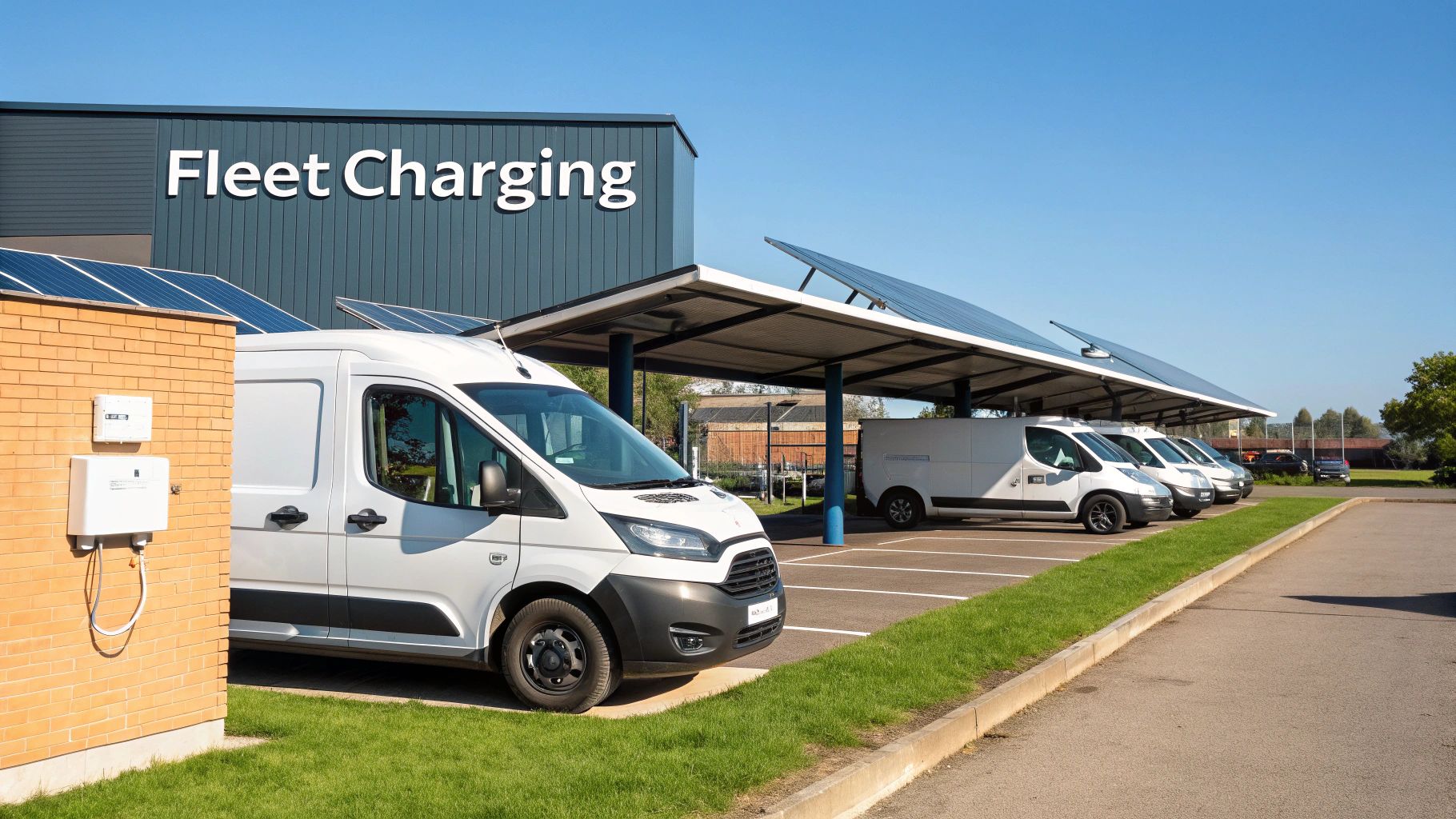
For any business managing a large fleet or running a commercial site like a service station, the move to electric power throws up some serious challenges. Installing a single rapid charger can put a real strain on the local grid connection. So how do you install dozens for an entire fleet? It can feel impossible without spending a fortune on grid upgrades that take an age to complete.
The heart of the problem is the sheer amount of power needed all at once. Picture a logistics depot where 50 vans finish their shifts and plug in simultaneously. That could demand megawatts of power, far more than most commercial sites were ever designed to handle. This issue of charging from a constrained grid connection has been a major roadblock for businesses looking to go electric.
Luckily this is a problem that modern energy technology solves brilliantly, allowing businesses to sidestep those grid limitations. This is where integrated energy systems come in, combining smart storage and on-site generation to create powerful, independent charging hubs.
Overcoming Grid Constraints with Battery Storage
The real game-changer for mass rapid charging on a tight grid connection is the Battery Energy Storage System (BESS) . Think of a BESS as a huge, grid-scale battery that sits between the grid and your EV chargers. It completely rewrites the rules of energy flow.
Instead of your chargers causing massive power spikes by pulling directly from the grid, the BESS can slowly and steadily ‘trickle-charge’ itself during off-peak hours when grid demand is low and electricity is cheap. It quietly gathers energy over many hours, saving it up for when you need it most.
A Battery Energy Storage System allows a site to draw, for example, a steady 100kW from the grid over 24 hours but then discharge that stored energy at 2 megawatts to power a bank of ultra-rapid chargers for a short, intense period. It effectively decouples charging speed from the grid's capacity.
This approach brings some immediate, tangible benefits for businesses:
- Avoids Costly Upgrades: It removes the need for expensive and slow substation upgrades from the local Distribution Network Operator (DNO).
- Reduces Energy Costs: By charging up when electricity is cheapest, it drastically cuts the overall cost per kilowatt-hour.
- Unlocks New Revenue: Site owners can sell charging services at a premium without being held hostage by peak electricity prices.
This technology is the key to making EV charging work at a commercial scale. It turns what was an insurmountable grid problem into a much more manageable energy management task.
Creating Self-Sufficient Hubs with Renewables
You can take the power of a BESS even further by pairing it with on-site renewables like solar panels on warehouse roofs or carports. This combination creates a virtuous cycle of clean, low-cost energy that can make a charging depot almost entirely self-sufficient.
During the day, the solar panels generate electricity. Instead of exporting this valuable power back to the grid for pennies, you can use it to charge the BESS directly. This stored solar energy can then be used to charge your fleet overnight. You’re effectively running your vehicles on sunshine you captured hours earlier.
This integrated system turns a simple charging depot into a sophisticated microgrid. The site can generate, store and manage its own power, only falling back on the main grid as a backup. This is the model that will power the logistics hubs, bus depots and motorway service areas of the future.
The Rise of Distributed Energy and Mobile Charging
This shift toward localised energy systems is all part of a bigger trend: distributed energy . Instead of relying on a few massive, distant power stations, the grid of the future will be supported by thousands of smaller, interconnected energy assets—including charging hubs with their own batteries and generation capabilities.
This model also opens the door to flexible solutions like mobile EV charging . A mobile unit is essentially a BESS on wheels. It can be deployed to provide temporary rapid charging at events or to support a fleet depot while permanent infrastructure is being installed. It’s a versatile tool that adds another layer of resilience to the whole charging ecosystem.
By combining rapid EV charging, grid-scale batteries and on-site renewables, businesses are no longer just passive consumers of electricity. They become active players in the energy market, controlling their costs, securing their operations and building the infrastructure for a fully electric future. This is how EV charging works—efficiently and profitably—at scale.
Navigating the UK Public Charging Network
Knowing the theory behind EV charging is one thing but getting out there and actually using the public network is a whole different ball game. It's where the real-world learning curve begins.
The good news is that the UK’s infrastructure is growing at an incredible pace. New rapid hubs are popping up on motorways and on-street chargers are becoming a common sight in towns and cities, making EV ownership a practical choice for more people than ever before.
This expansion is being fired up by a mix of private investment and government support. By mid-2025, the UK's network had swelled to roughly 82,369 public charging devices spread across over 40,479 locations. Schemes like the Government’s LEVI (Local Electric Vehicle Infrastructure) fund have been absolutely vital, helping councils install on-street chargers for the estimated 40% of drivers who don't have a private driveway.
Payment Methods and Charging Etiquette
When you pull up to a public charger, you’ll find a few different ways to get the power flowing. Many of the newer rapid chargers now have simple contactless payment which is a massive relief for drivers who just want to tap their bank card and go. That said, it’s still common to find chargers that need a specific network’s mobile app or an RFID card to start a session.
A good tip is to have a few of the major network apps downloaded on your phone before you set off. It means you’re always prepared and you can also check real-time charger availability and pricing before you even leave.
Using shared charging bays also comes with a few unwritten rules. A bit of good etiquette makes the experience better for everyone.
- Don't hog the charger: Once your car has enough charge to get you where you’re going (usually around 80% on a rapid charger is plenty), it’s good form to move it and let someone else have a turn.
- Keep things tidy: Always coil the charging cable neatly and pop the connector back in its holster. It prevents damage and keeps the bay safe for the next person.
- Be patient and communicate: If all the chargers are busy, it’s fine to wait nearby but try not to block other vehicles or cause a jam.
For drivers navigating busy public sites, exploring different strategies for public charging queue management can make all the difference. Ultimately, being prepared and considerate helps the entire public network run more smoothly for every EV driver on the road.
Common EV Charging Questions Answered
To round things off, let's tackle some of the most common questions that pop up when people really start digging into how EV charging works. These are the practical queries that bridge the gap between understanding the tech and feeling confident enough to use it every day.
How Long Does It Really Take to Charge an Electric Car?
This is the classic "how long is a piece of string" question. It all comes down to two key factors: your car’s battery size (measured in kWh ) and the charger’s power output (measured in kW ).
For most people, a typical 7kW home charger is the bread and butter. It will take around 8-10 hours for a full charge which is perfect for an overnight top-up while you sleep.
Out on the road, a 50kW public rapid charger can add about 100 miles of range in just 35 minutes . If you find one of the newer 150kW+ ultra-rapid chargers, you can get that same 100 miles in as little as 10-15 minutes , making long journeys a breeze.
Can I Use Any Public Charger for My Electric Car?
For the most part, yes. The UK and Europe have thankfully standardised connectors to make life much simpler.
The 'Type 2' connector is the universal standard for AC charging, which covers all the slow and fast chargers you'll find at homes, workplaces and supermarkets. For DC rapid charging, the 'CCS' (Combined Charging System) connector is the dominant standard.
Nearly every new EV sold in the UK uses these two. You might still see a 'CHAdeMO' plug on some older Japanese models but the good news is most rapid charging stations provide both CCS and CHAdeMO cables to cover all bases.
Is It Cheaper to Charge at Home or in Public?
Charging at home is always significantly cheaper. It’s not even close.
If you switch to a special off-peak electricity tariff designed for EV owners, you could be paying as little as 7-10p per kilowatt-hour . Compare that to a public rapid charger, where prices can range anywhere from 45p to over 85p per kWh .
To put that into perspective, a full charge at home might cost you between £5 and £8 . That very same charge on a public rapid network could easily set you back £30-£45 . The premium you pay in public is purely for speed and convenience.
What Is Mobile EV Charging and When Is It Used?
Think of mobile EV charging as a power bank on wheels. It’s a big, portable, high-powered battery unit that can be brought directly to a vehicle to provide an emergency charge—much like getting a jerry can of petrol if you run out.
Its main use is for roadside assistance services to rescue stranded EV drivers with flat batteries. However it's also proving to be a fantastic problem-solver for businesses that need temporary charging for events or for fleets operating in depots where permanent infrastructure isn't yet installed. It’s a flexible solution for very specific scenarios.
At ZPN Energy , we specialise in overcoming the toughest charging challenges with advanced battery-backed systems. Whether you have a constrained grid connection or need a fully integrated energy solution, our UK-built technology delivers reliable, rapid power where others can't. Explore our solutions at https://www.zpnenergy.com.