How to charge a battery fast in the UK: EV guide
Tired of spending hours tethered to a slow charger? You're not the only one. The reality is, if you want to charge a battery fast —especially when dealing with commercial and fleet EVs at scale—you need serious rapid EV charging technology that can handle high power levels safely and effectively.
This guide is your roadmap to getting it right.
The Growing Need for Faster EV Charging
Right across the UK, the demand for truly rapid EV charging is exploding. This isn't just about a bit of extra convenience for private car owners; it is now an absolute necessity for businesses, fleet operators and public services making the switch to electric. The old model of just plugging in overnight at home does not work for everyone.
Think about it. Millions of drivers do not have access to off-street parking, making public charging their only lifeline. At the same time, commercial fleets—from delivery vans to private hire vehicles—cannot afford to have their assets sitting idle for hours. For them, charging speed isn't a luxury; it is fundamental to operational efficiency and staying profitable.
Responding to Market Demands
The UK's charging network is racing to keep up. In just one year, over 15,000 new chargers were installed, pushing the national total past 86,000 . More importantly, over 17,356 of these are rapid or ultra-rapid units capable of adding significant range in well under 30 minutes . You can dive deeper into the UK's network expansion over at FutureTransport-News.com.
But while the numbers are heading in the right direction, simply installing more rapid chargers isn't always a straightforward fix. Many of the best spots for charging hubs, like retail parks or motorway services, are hampered by weak grid connections. Trying to power a bank of high-speed chargers from a constrained grid connection can trigger eye-watering upgrade costs and months, if not years, of delays.
The challenge has moved beyond just building more chargers. It is now about building smarter charging infrastructure that can deliver high-speed power exactly where it's needed, even when the local grid cannot handle the load.
This is precisely where integrated energy solutions change the game. Instead of relying solely on a direct grid connection, modern strategies blend several key technologies to sidestep these limitations and deliver a seamless, high-power charging experience.
These solutions typically involve:
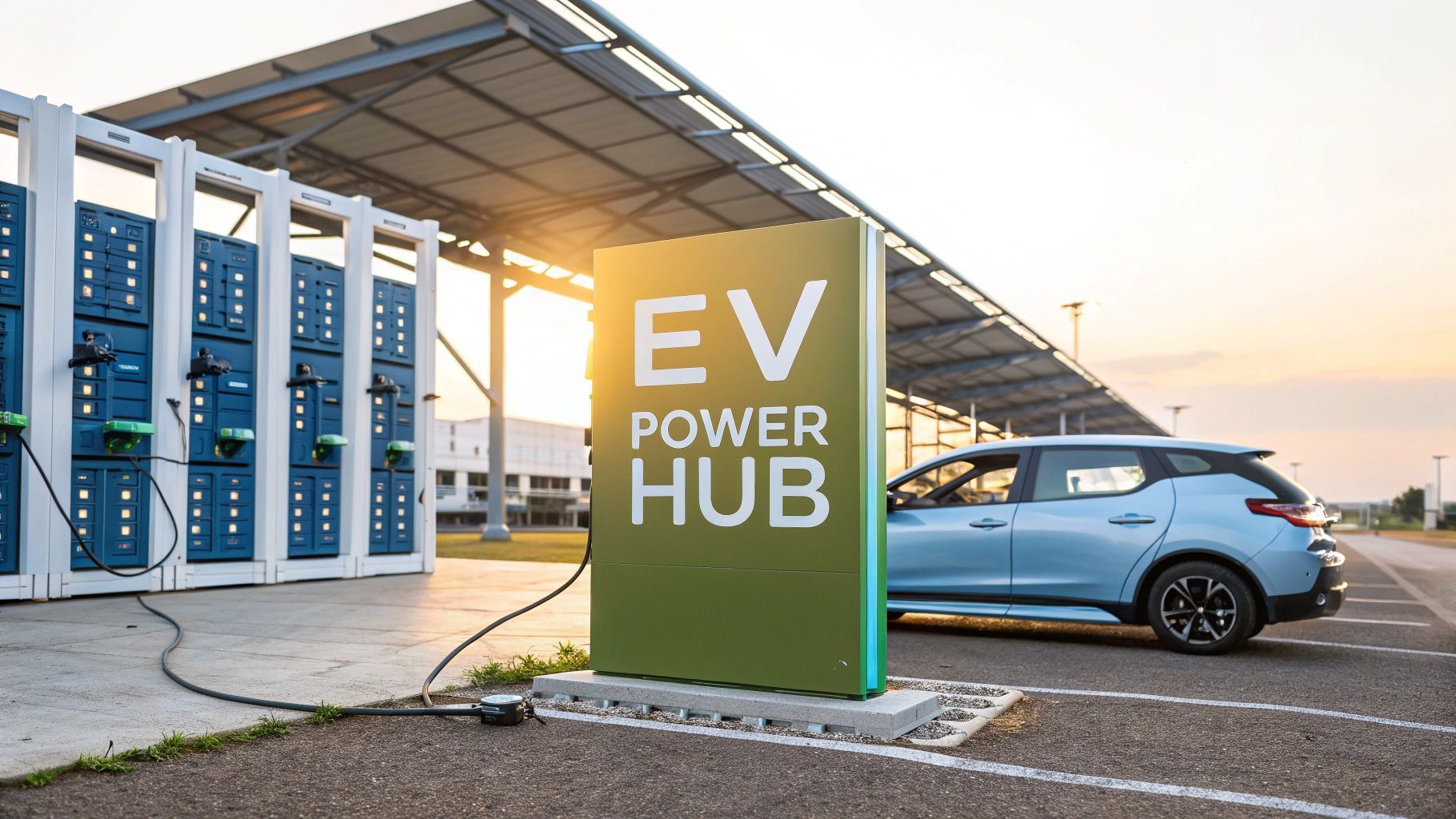
- Grid-scale batteries: On-site Battery Energy Storage Systems (BESS) can slowly draw power from the grid during cheap, off-peak hours. They then discharge that stored energy at high speed to multiple vehicles at once during peak demand. This is a core feature of distributed energy.
- On-site renewables: Pairing battery storage with on-site renewables like solar generation creates a far more resilient and sustainable charging ecosystem, cutting down reliance on the grid and reducing energy costs.
- Mobile EV charging: Deploying mobile EV charging units can provide a flexible way to support fixed hubs during busy periods or offer emergency charging in more remote locations.
By thinking beyond the plug, businesses can develop powerful and profitable charging hubs that genuinely meet the market's demand to charge a battery fast .
Understanding the Tech Behind Rapid Speeds
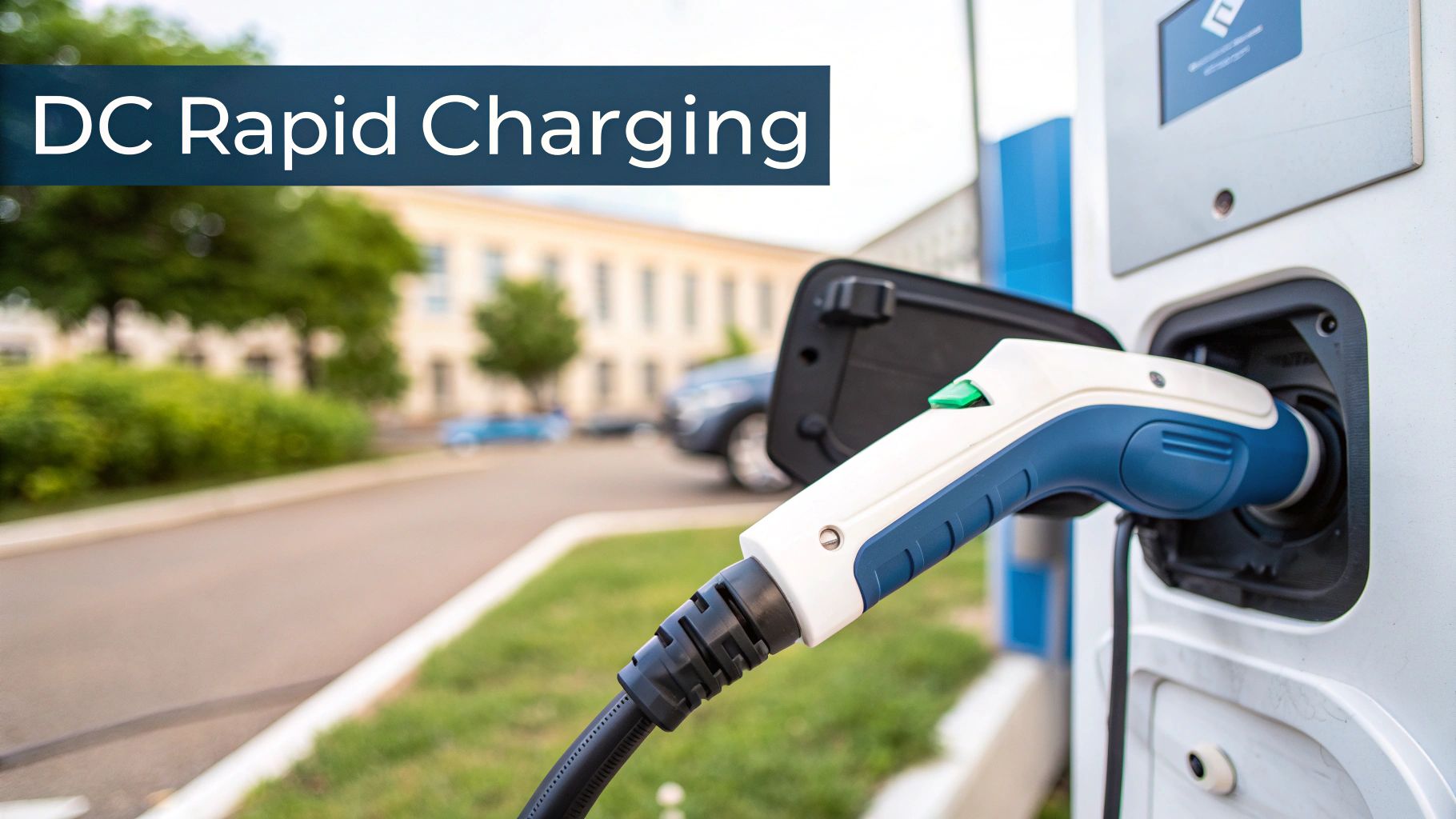
To really get to grips with how to charge a battery fast , it pays to look under the bonnet at the technology making it all possible. The key difference boils down to the two types of electricity: Alternating Current (AC) and Direct Current (DC).
The electricity in your home is AC, which is perfectly fine for a slow, overnight top-up. The catch is that an EV battery can only store DC power. When you use a standard AC charger, the car’s small onboard converter has the job of changing AC to DC and that is a relatively slow process.
Rapid EV charging completely changes the game. It takes the grid's AC power and converts it to high-voltage DC inside the charging unit itself. This smart approach lets it bypass the car’s slower onboard converter entirely, feeding DC power straight into the battery. It is this direct connection that unlocks those dramatic rapid and ultra-rapid charging speeds.
AC vs DC Charging: A Practical Comparison
For businesses planning their EV infrastructure, understanding the fundamental differences between AC and DC charging is crucial. It is not just about speed; it is about cost, application and site requirements. This table breaks down the key distinctions to help you make an informed decision.
| Feature | AC Charging | DC Fast Charging |
|---|---|---|
| Location of Conversion | Inside the EV (using the onboard converter) | Inside the charging station itself |
| Charging Speed | Slower (typically 3kW to 22kW) | Much faster (50kW to 350kW+) |
| Ideal Use Case | Overnight fleet charging, workplace top-ups, long-stay destinations. | Public charging hubs, motorway services, high-throughput commercial depots. |
| Hardware Cost | Lower initial investment. | Significantly higher due to complex power electronics. |
| Grid Connection | Can often use existing single-phase or three-phase connections. | Requires a substantial, high-capacity grid connection. |
| Vehicle Impact | Speed is limited by the car's onboard converter capacity. | Speed is dictated by the charger's output and the car's battery architecture. |
Ultimately, the choice isn't about one being "better" than the other. AC charging is a cost-effective solution for dwell-time charging, while DC is the undisputed king for rapid turnarounds and minimising vehicle downtime. Many successful fleet strategies actually use a mix of both.
Decoding the Charging Curve
You will quickly notice that even with a powerful DC charger, the speed isn't constant throughout the session. This is because of the charging curve , a safety protocol managed by the vehicle’s Battery Management System (BMS) to protect the battery’s health.
When the battery is low, it can accept power at its maximum rate. But as it fills up—usually around the 80% mark—the BMS deliberately slows the charging speed down. This prevents overheating and protects the battery cells from damage. A good analogy is filling a glass of water: you can pour quickly at the start but you have to slow down as you get to the top to avoid spilling over.
The Unseen Heroes: Thermal Management and Preconditioning
To hit and maintain those impressive charging speeds safely, two other elements are working hard behind the scenes: thermal management and battery preconditioning. Pushing huge amounts of power into a battery generates a lot of heat, which can degrade the battery cells if it is not managed properly.
- Thermal Management: Sophisticated liquid-cooling systems are the norm in modern EVs. They circulate fluid around the battery pack to carry heat away, keeping the cells in their ideal temperature range. This is why EVs with better thermal management can sustain higher charging speeds for longer.
- Battery Preconditioning: When you use the car's navigation to head to a known rapid charger, many EVs will start to precondition the battery. The system will gently warm or cool the battery pack to the perfect temperature for receiving a fast charge, making sure you get the best possible speed the moment you plug in.
Effective rapid charging is a finely tuned conversation between the charger and the vehicle. The charger provides the power but the car’s internal systems dictate how much power can be safely accepted at any given moment to protect the battery.
The UK government's own data shows a clear shift towards this advanced infrastructure. With around 86,000 public charging points now available, the growth of the rapid charger network to over 17,000 units signals a national strategy to cut charging times. These are the units that make an 80% charge possible in as little as 20 to 40 minutes for compatible vehicles.
You can explore the latest government statistics on EV infrastructure to see the full picture. For a more technical breakdown, take a look at our guide to fast charger electric vehicle technology.
Using Grid-Scale Batteries to Beat Grid Constraints
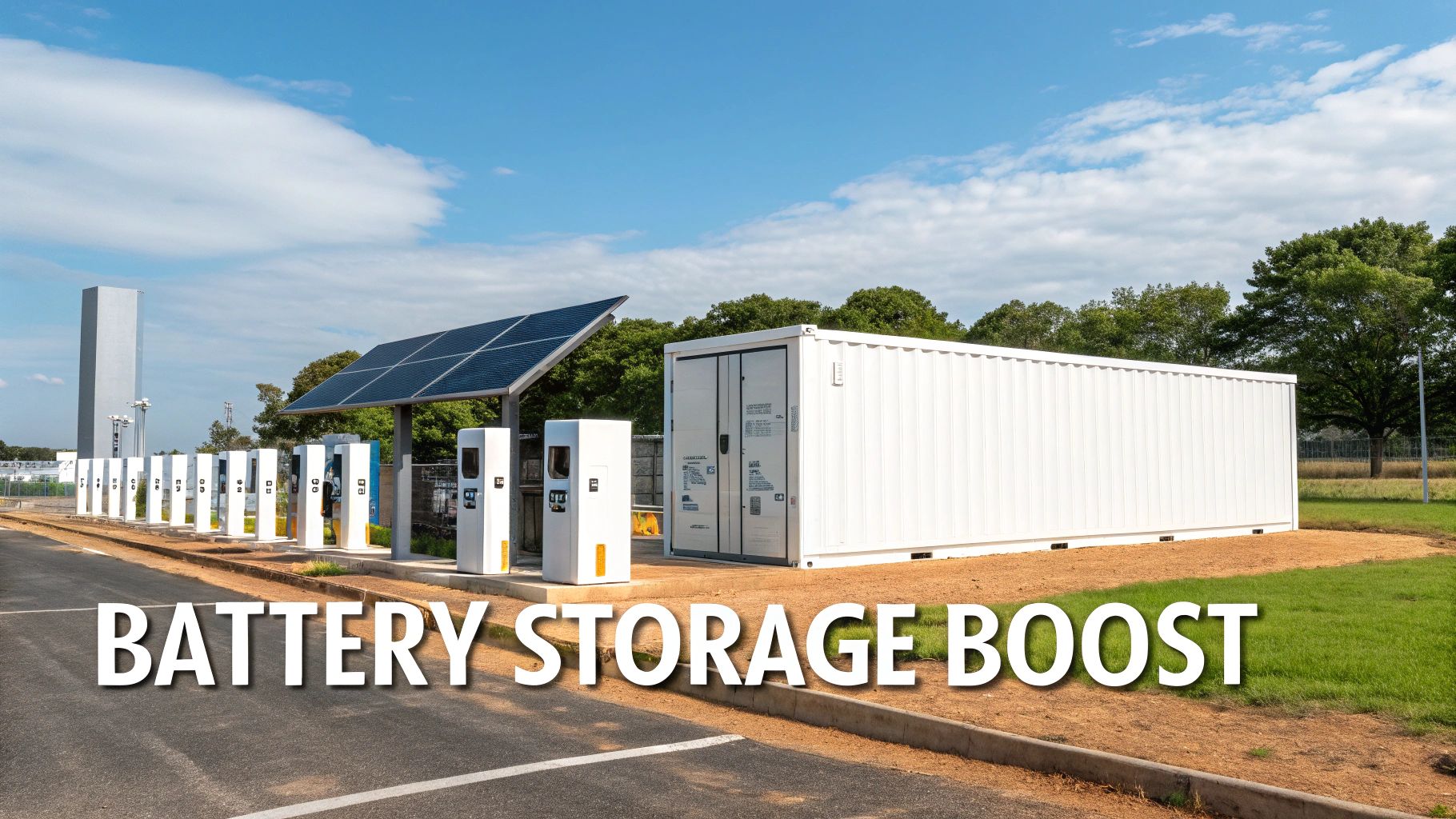
So, you've found the perfect spot for a new rapid EV charging hub. The only problem? The local grid connection is too weak to handle the power you need. It is a frustratingly common roadblock for many businesses, often leading to eye-watering grid upgrade costs and major project delays.
But a constrained grid connection does not have to be a dealbreaker. Not anymore.
This is exactly where on-site Battery Energy Storage Systems (BESS) or grid-scale batteries become a game-changer. Think of a BESS as a local energy reservoir, letting you sidestep the limitations of the existing grid infrastructure. Instead of trying to pull a massive amount of power from the grid all at once, you can install a system that works much, much smarter.
How On-Site Batteries Unlock Rapid EV Charging
The idea behind a BESS is beautifully simple but incredibly effective. The battery system slowly sips power from the grid during off-peak hours—overnight, for instance—when electricity is cheaper and demand is low. This gentle, consistent draw does not strain the local network at all.
That stored energy is then ready to be unleashed at a moment's notice. When vehicles arrive and plug in during peak times, the BESS can discharge its stored power at an extremely high rate. This means you can supply multiple ultra-rapid chargers simultaneously without ever overloading your grid connection.
This strategy, known as peak shaving , is the key to deploying high-power charging infrastructure on sites that would otherwise be completely unsuitable. It effectively decouples your charging speed from the grid's immediate capacity.
This approach delivers two huge financial wins. First, you avoid the punishing demand charges that energy suppliers levy for sudden, high spikes in electricity use. Second, it can completely eliminate the need for costly and time-consuming grid reinforcement work, which can easily run into hundreds of thousands of pounds and take months, if not years, to complete.
To get a real sense of how this technology is reshaping possibilities, it is worth exploring how battery energy storage systems can overcome UK grid limitations for EV charging .
Creating a Self-Sufficient Charging Ecosystem with On-Site Renewables
The benefits of on-site battery storage get even better when you combine them with on-site renewables, like solar panels. By pairing a BESS with a solar array, you create a powerful, self-sufficient charging ecosystem that drastically reduces your reliance on grid electricity.
This integrated system works seamlessly:
- During sunny periods: Solar panels can directly power the EV chargers while funnelling any surplus energy into the BESS for later.
- During cloudy periods or at night: The BESS kicks in, discharging its stored solar energy to power the chargers and maintain a consistent supply.
- Grid as a backup: The grid connection is only used to top up the battery when solar generation is low for a prolonged period.
This combination of distributed energy resources does not just provide a reliable way to charge a battery fast ; it also seriously boosts your business's green credentials. It shows a genuine commitment to sustainability while delivering significant long-term operational savings by slashing your energy costs. Better yet, mobile EV charging units, often backed by their own batteries, can be deployed to supplement fixed installations during peak times, adding another layer of operational flexibility.
Adopting Smart Charging for Better Throughput
Having the most powerful hardware is only one part of the puzzle. To truly charge a battery fast and efficiently at a busy site, you need intelligent operational strategies. The key is to move beyond simply offering power and towards actively managing its distribution for maximum vehicle throughput.
This is where smart charging technologies make a profound difference. They ensure that every kilowatt of available power is used to its full potential, serving more drivers in less time and improving customer satisfaction.
Embracing Dynamic Load Balancing
One of the most effective smart strategies is dynamic load balancing . Imagine a charging hub with several vehicles plugged in, each with a different battery size, state of charge and maximum charging capability. Instead of giving each charger a fixed, static power output, a dynamic system intelligently distributes the total available site power across all connected vehicles.
It constantly monitors each vehicle's needs and adjusts the power flow in real time. For example, as one car's battery fills up and its charging rate naturally slows, the system automatically diverts the surplus power to other vehicles that can accept it. This ensures no energy is wasted and every vehicle charges as quickly as its battery allows. Our detailed guide on dynamic power management for EV charging explores this topic further.
Dynamic load balancing transforms a charging site from a collection of individual posts into a coordinated, highly efficient ecosystem. It maximises throughput without needing to upgrade your grid connection, directly boosting your site's revenue potential.
The Rise of Mobile EV Charging
Flexibility is another cornerstone of smart charging operations. While fixed charging hubs are essential, mobile EV charging units offer a versatile way to manage fluctuating demand. These battery-backed units can be deployed to support busy sites during peak periods, such as bank holidays or local events, effectively adding temporary capacity exactly when it's needed.
Furthermore, mobile chargers provide a vital service for roadside assistance, offering a quick boost to stranded drivers. This creates an additional revenue stream and builds a reputation for reliability, encouraging drivers to seek out your network.
Learning from European Leaders
Looking across the continent provides valuable context for the UK's strategy. A comparative overview of Europe's EV infrastructure shows a clear focus within the UK on expanding its rapid and ultra-rapid charging network to accelerate EV adoption.
While nations like the Netherlands may lead in the sheer number of charge points per capita, the UK's strategic emphasis is on enabling quick battery replenishment to reduce journey times and overcome range anxiety. You can find more details in this European EV charging report .
This focus highlights the importance of not just installing fast hardware but operating it smartly. By combining powerful distributed energy assets like grid-scale batteries with intelligent management systems, UK site operators can deliver the high-speed, reliable service that the modern EV driver expects.
Operating a Profitable Fast Charging Hub
Building a rapid charging hub that turns a profit is about much more than just putting chargers in the ground. You have to move beyond the installation phase and focus on operational excellence. It is a blend of smart site layout, the right pricing strategy and creating an experience that keeps drivers coming back.
Some of the most critical decisions you will make happen long before a single shovel breaks ground. Getting the location right is obviously paramount. High-traffic spots like retail parks, key arterial routes and commercial depots give you a ready-made customer base. But the physical layout of the site itself is just as vital.
Designing for Efficiency and Accessibility
An effective hub is all about maximising vehicle throughput. That means giving drivers plenty of room to manoeuvre, using clear signage to guide them and making sure every bay is easy to get in and out of. Think about the needs of all potential users. For example, chargers that meet the PAS 1899 disability access standards open up your service to the entire community, which is not only the right thing to do but also enhances your site's reputation.
Your choice of hardware has a direct impact on reliability and customer satisfaction, too. I've seen sites where small details make a huge difference. Chargers equipped with theft-resistant, self-recoiling cables, for instance, are a game-changer. They drastically cut down on maintenance headaches and keep the site looking tidy and safe. It is these thoughtful touches that create a premium feel and encourage repeat business.
A profitable charging hub isn't just a power source; it's a service. Reliability, ease of use and accessibility are the cornerstones of building a loyal customer base and ensuring a strong return on investment.
This process flow shows how smart energy management is the backbone of an efficient hub, funnelling power from the grid, balancing it with on-site resources and delivering it smoothly to vehicles.
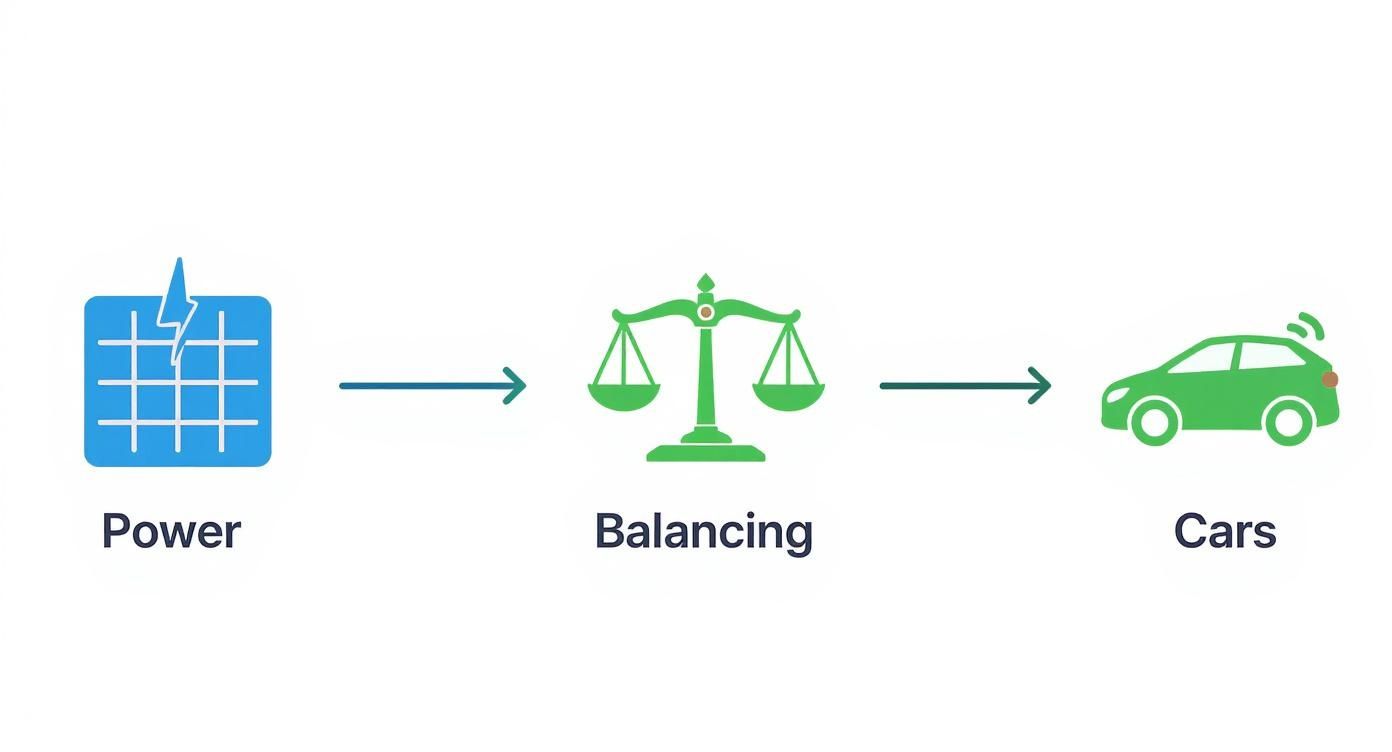
This visual really drives home the importance of balancing the grid supply with your own assets like a BESS. It is the key to being able to charge a battery fast without putting too much strain on your connection.
Setting Competitive and Smart Pricing
Your pricing model is another make-or-break factor. It needs to be sharp enough to attract drivers but robust enough to cover all your operational costs, navigate volatile energy tariffs and ultimately, deliver a profit. Many of the most successful operators are now using dynamic pricing, which allows them to adjust rates based on the time of day or the real-time cost of grid energy.
There are a few common structures to consider:
- Per-kWh: This is the most transparent approach. Drivers pay for exactly what they use, which they appreciate.
- Session Fee: A simple flat fee for plugging in, which is often combined with a per-kWh rate to cover fixed costs.
- Time-Based: Charging by the minute can be a good way to discourage drivers from hogging a bay long after their car is fully charged.
In my experience, the best strategy is often a hybrid of these models, all managed through a reliable and user-friendly payment system. The less friction, the better. Offering multiple payment options—from contactless card readers to slick app-based solutions—makes the whole process effortless for the customer.
Your Top Questions on Fast EV Charging Answered
Stepping into the world of rapid EV charging can throw up a lot of questions, especially for fleet managers and businesses weighing up a serious investment. Here are some straightforward answers to the queries we hear most often, designed to help you make the right call on how to charge a battery fast and do it right.
Can I Install Rapid EV Charging with a Constrained Grid Connection?
Yes, you absolutely can. This is a hurdle many sites face but it is entirely solvable with the right tech.
For any location with a constrained grid connection, a Battery Energy Storage System (BESS) is the go-to solution. It is a smart way to sidestep the costly and often painfully slow process of getting grid upgrades approved and built.
A BESS works by trickle-charging from the grid during off-peak hours when electricity demand and tariffs are at their lowest. It then unleashes that stored power at a high rate to supply your rapid chargers during the busiest times of the day. This simple but powerful strategy effectively shields your operation from the grid's limitations, making high-power charging possible where it once seemed out of reach.
How Much Does Battery Preconditioning Affect Charging Speed?
The impact is huge. Preconditioning is just the vehicle’s battery management system warming (or cooling) the battery to its sweet spot before you even start a rapid charge.
A battery that is too cold or too hot will intentionally slow down the charging process to protect its own long-term health and avoid damaging the cells. It is a built-in safety feature.
Many modern EVs handle this automatically when you use the car's sat-nav to route to a known fast charger. Taking this one simple step means you get the fastest possible charging speed the moment you plug in, slashing your time at the charger.
The real-world difference is night and day. On a cold winter morning, a vehicle might only pull 40kW . That same car, with a preconditioned battery, could easily hit its peak of 150kW or more on the very same charger.
What Is the Real Difference Between Rapid and Ultra-Rapid?
The main distinction comes down to the maximum power output, which we measure in kilowatts (kW). While you might see the terms used differently, here is a reliable guide for the UK:
- Rapid Chargers: These typically offer a power output of around 50kW .
- Ultra-Rapid Chargers: These deliver 150kW or more. Some of the newest units on the market can now push out an incredible 350kW .
But remember, the actual speed you get is always dictated by what the vehicle itself can handle. Plugging a car with a 100kW maximum charge rate into a 350kW charger will not make it charge any faster than 100kW . The car's own Battery Management System (BMS) is always the one in control, calling for only as much power as it can safely accept.
At ZPN Energy , we specialise in knocking down these barriers with advanced, battery-backed charging solutions. Our unique systems are built to run from constrained grid connections and are designed for maximum reliability and user accessibility. Find out how our technology can power your move to electric by visiting us at https://www.zpnenergy.com.