How to Charge EVs with Limited Grid Connections: A Practical UK Guide
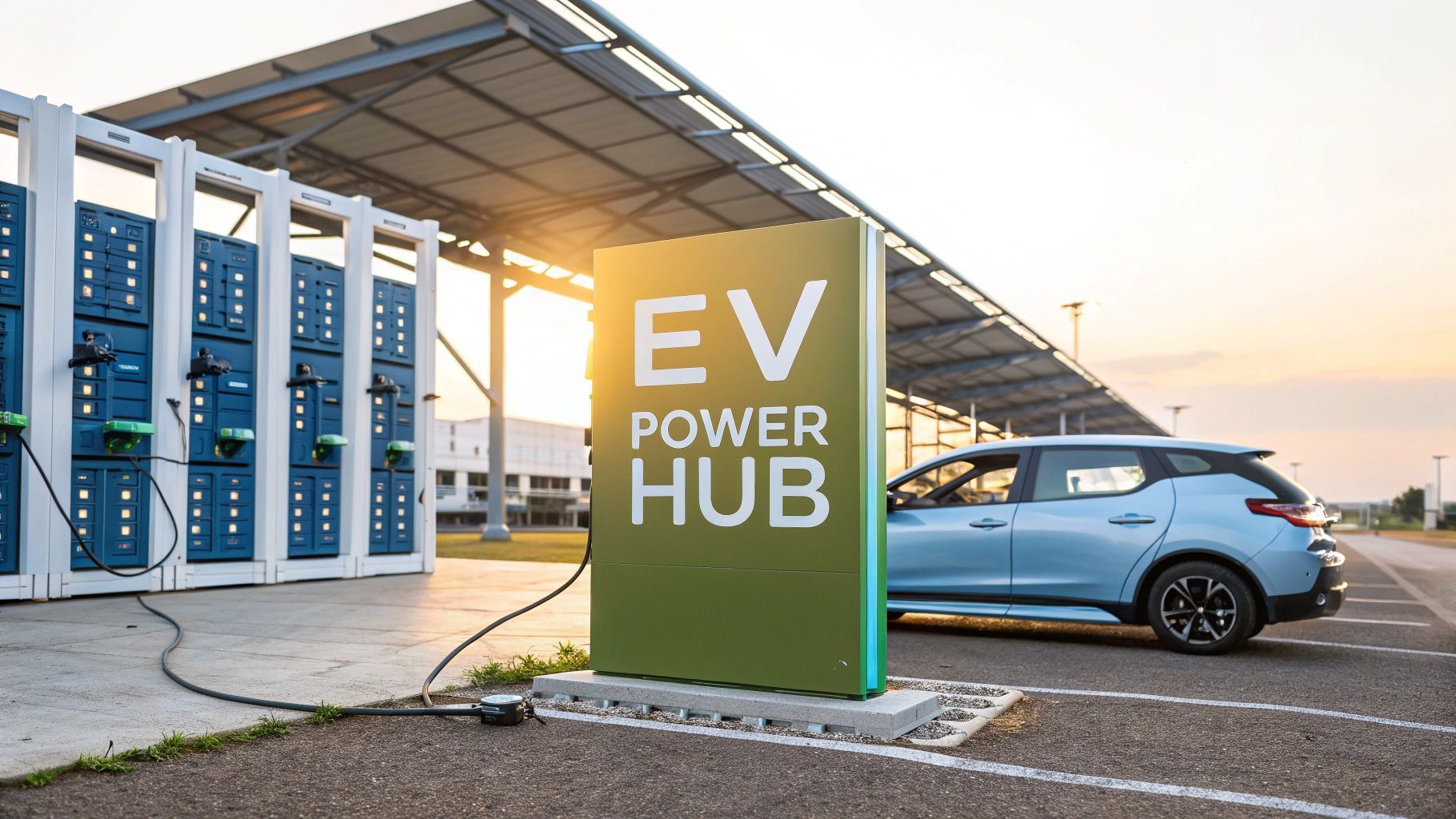
It is absolutely possible to install rapid EV chargers with a limited grid connection. The key is using battery energy storage systems (BESS) to gather power during off-peak times and then release it for rapid EV charging whenever you need it.
Often combined with on-site renewables like solar panels this approach completely sidesteps the need for slow and expensive grid upgrades. It turns a frustrating grid limitation into a powerful, self-sufficient energy hub, allowing you to meet high charging demand without ever overloading your existing electrical infrastructure.
The Grid Bottleneck Facing UK Businesses
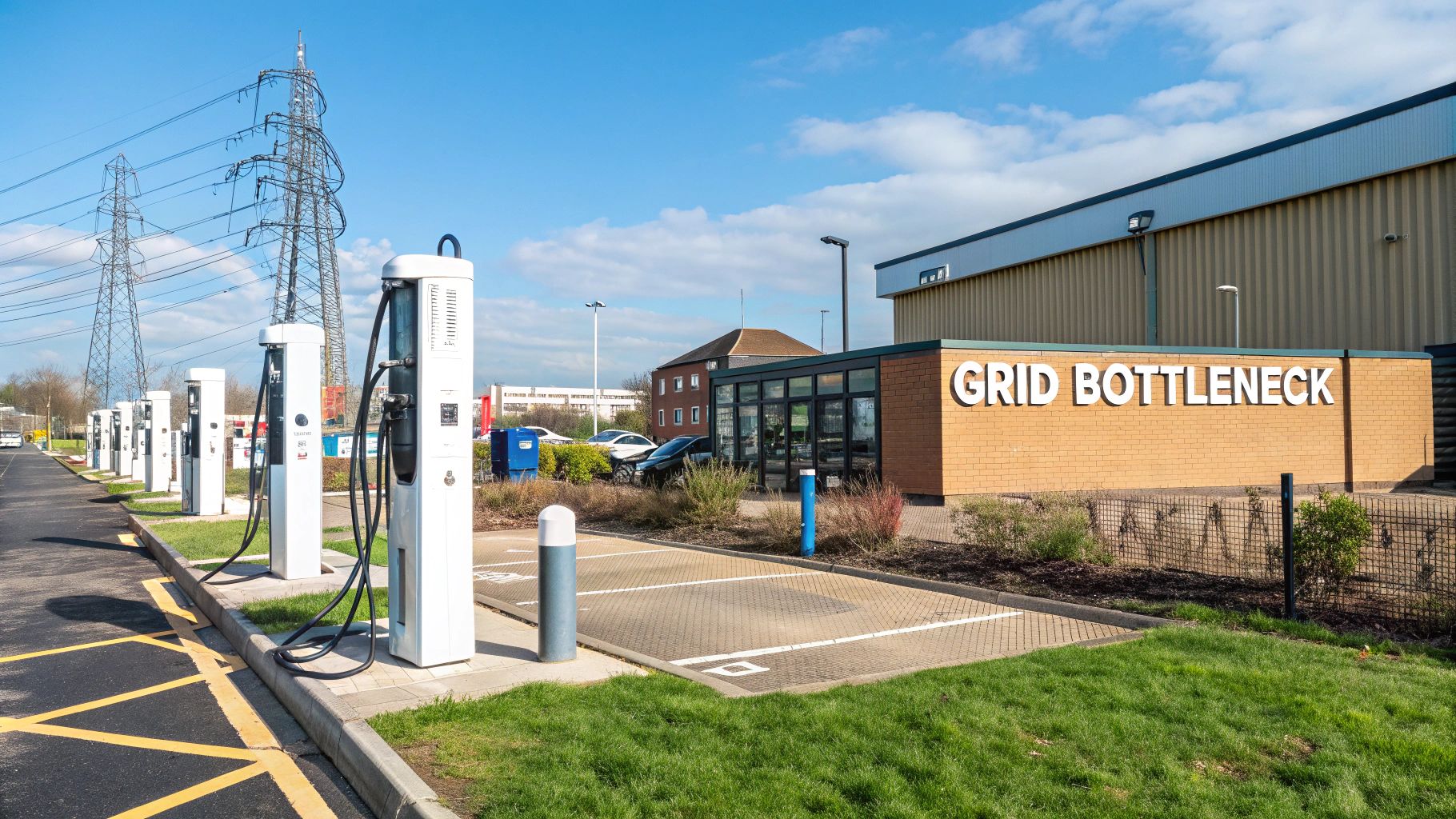
For many UK businesses and fleet operators the dream of electrification comes to a grinding halt after a single phone call to their Distribution Network Operator (DNO). Sound familiar? You might have been quoted an astronomical price for a grid upgrade or perhaps you were simply told your local connection can't handle the power needed for rapid EV charging. You are not alone.
This problem is rooted in the UK's legacy electrical infrastructure which was never built to support the intense, concentrated power demands of modern transport. Installing a bank of rapid EV chargers can pull as much power as a small industrial estate, putting an impossible strain on local substations that are often already running close to full capacity.
Common Roadblocks to Electrification
The challenges businesses run into are often frustratingly complex. The most common hurdles we see are:
- Prohibitive Upgrade Costs: Grid reinforcement can easily run into the hundreds of thousands or even millions of pounds. For most this makes the business case for EV charging completely unworkable.
- Extended Timelines: Even if the budget is there the wait can be staggering. We've seen grid connection delays stretch on for years, stalling electrification plans indefinitely.
- Capacity Constraints: In many places—especially rural spots or dense urban centres—the local grid simply has no spare capacity left to give. This leaves businesses with no obvious path forward.
These roadblocks are a huge barrier to the UK's net-zero goals, leaving fleet operators stuck and unable to move away from fossil fuels.
Bypassing the Grid with Smart Technology
The solution isn't about waiting for the grid; it's about building your own distributed energy ecosystem. This is how you charge EVs from constrained grid connections. By integrating technologies like grid-scale batteries and combined on-site renewables you can create a resilient charging hub that operates independently of grid constraints.
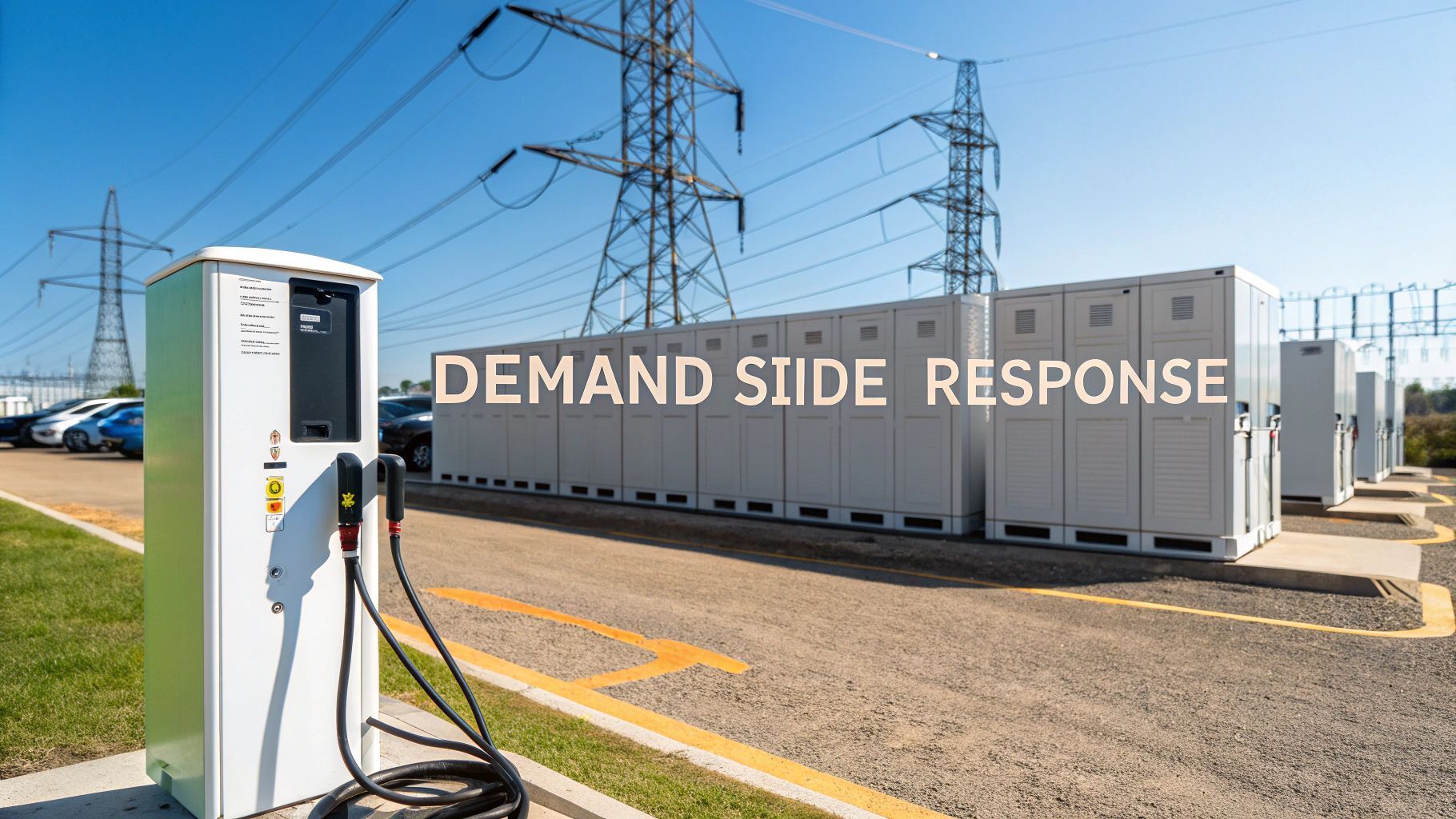
A Battery Energy Storage System (BESS) works like an energy reservoir. You can trickle-charge it slowly from a very small grid connection overnight or charge it for free using solar panels during the day. This stored energy is then unleashed to power multiple rapid EV chargers at once, meeting peak demand without ever troubling the local grid.
This strategy does more than just solve your immediate charging problem—it turns your site into a valuable energy asset. It creates opportunities to generate new revenue, improves your energy security and sends a powerful message about your commitment to sustainability.
These systems are absolutely key to unlocking the full potential of EV adoption and as we explore in how our energy solutions support grid stability and resilience they also help the wider network. By embracing battery-backed systems you can build your EV-ready future today, without waiting for the grid to catch up.
Getting the Lay of the Land: Auditing Your Site for EV Charging
Before a single piece of hardware is ordered the first crucial step is a thorough site audit. This isn't just about picking a spot for a charger; it's a deep dive into your property's entire energy landscape. Getting this right ensures any charging solution you deploy is technically viable, commercially sound and ready for the future.
Think of it like this: skipping the audit is like building a house without checking the foundations. It’s a shortcut that almost always leads to costly mistakes and headaches down the road.
The process kicks off with a simple physical walk-through of your premises. You're looking for more than just empty tarmac; you need to pinpoint practical, optimal locations for every part of a modern charging system. Where will vehicles flow? How easy is access? And critically, how far is it from your existing electrical intake? Answering these questions early on guarantees a smoother installation and avoids operational nightmares later.
Uncovering Your Energy Profile
Your site's historical energy usage is a goldmine of data. By getting your hands on your half-hourly energy data (your electricity supplier can provide this) you can build a detailed consumption profile. This profile is a map of your energy demand, showing all the peaks and troughs throughout the day, week and year.
Understanding these patterns is absolutely vital for two key reasons:
- It tells you exactly when you have spare electrical capacity . This is the 'dead time' that can be used to slowly trickle-charge a Battery Energy Storage System (BESS) without disrupting your day-to-day operations.
- It gives you a solid baseline to accurately forecast the extra demand from EV charging , based on your fleet size, vehicle types and charging schedules.
Take a logistics depot, for example. It might see a massive energy spike during the morning rush as sorting machinery fires up but demand will likely plummet overnight. That overnight trough is the perfect window to charge a BESS, getting it ready to deliver rapid EV charging the next day without ever needing a grid upgrade.
Decoding Your Grid Connection Agreement
Your connection agreement with the local Distribution Network Operator (DNO) is one of the most important documents you'll read. It specifies your Maximum Import Capacity (MIC) – the absolute upper limit of power you can legally draw from the grid at any given moment. Breaching this limit can trigger some eye-watering financial penalties.
This document dictates the hard power limit for your entire site. Understanding your MIC is non-negotiable. It defines the boundary you have to work within and powerfully illustrates why battery-backed solutions are so effective for sites with constrained grid connections.
Your DNO agreement, combined with the physical realities of your site, will ultimately shape the scale and nature of your project. You need to look closely at:
- Agreed Supply Capacity: The specific kilowatt (kW) or kilovolt-ampere (kVA) figure you cannot go over.
- Physical Infrastructure: The location of your main incoming supply, any substations and your switchgear. These will directly impact cabling routes and installation costs.
- Access and Space: Practical hurdles like narrow access roads or a lack of suitable space for a containerised BESS or solar canopy can be deal-breakers. As you audit your site it’s worth thinking about broader innovations in Commercial Real Estate Technology that could influence future infrastructure choices.
EV Charging Solution Comparison for Constrained Grids
When your site audit reveals a grid connection that's less than ideal you're not out of options. In fact this is where innovative technology really comes into its own. Understanding the different approaches is key to making the right long-term investment.
Here’s a quick comparison of the most common solutions for deploying EV charging on sites with limited grid capacity.
| Solution Type | Key Benefit | Ideal Scenario | Primary Limitation |
|---|---|---|---|
| Direct Grid Connection (Slow Chargers) | Low initial cost | Sites with very few EVs and long dwell times (e.g. overnight staff parking). | Extremely slow charging speeds; not suitable for commercial fleets or rapid top-ups. |
| Grid Upgrade | High power availability | Sites where a DNO upgrade is quick, affordable and feasible. | Very expensive, long lead times (often 12-24+ months ) and disruptive civil works. |
| Load Management Software | Optimises existing capacity | Sites with multiple chargers that can share a limited connection dynamically. | Doesn't add new capacity; charging speeds are still limited by the MIC. |
| Battery-Backed Charging (BESS) | Adds significant charging capacity without a grid upgrade | Grid-constrained depots, fleet operators and public charging hubs needing rapid speeds. | Higher initial capital investment compared to software-only solutions. |
| Hybrid (BESS + Solar) | Creates on-site energy, further reducing grid reliance and costs | Sites with available roof or ground space for solar panels, seeking maximum energy independence. | Most complex solution to design and integrate; dependent on solar generation. |
As the table shows, while simpler solutions have their place, battery-backed charging is often the most practical and powerful way to bypass grid limitations entirely.
A proper site audit brings these three elements together: the physical survey, the energy data and the grid agreement. This complete picture gives you the clarity to design an EV charging system that works with your limitations, turning a potential grid bottleneck into a strategic advantage. It's the groundwork that ensures your project is built to succeed from day one.
Designing Your Hybrid EV Charging Ecosystem
Once you’ve got a clear picture of your site's potential it's time to engineer an EV charging system that works around your specific grid constraints. This isn’t about just plonking a few chargers on the ground. It's about creating a cohesive, intelligent ecosystem where every component works in harmony to build a charging hub that's far more powerful than the sum of its parts.
At the heart of this approach is a blend of three key technologies: a Battery Energy Storage System (BESS) , on-site renewables like solar PV and intelligent rapid EV charging hardware. Get the integration right and these elements create a synergy that lets you sidestep the need for slow, costly grid upgrades.
The first step is always a thorough on-site audit, covering everything from the physical survey and energy data analysis to a proper grid capacity assessment.
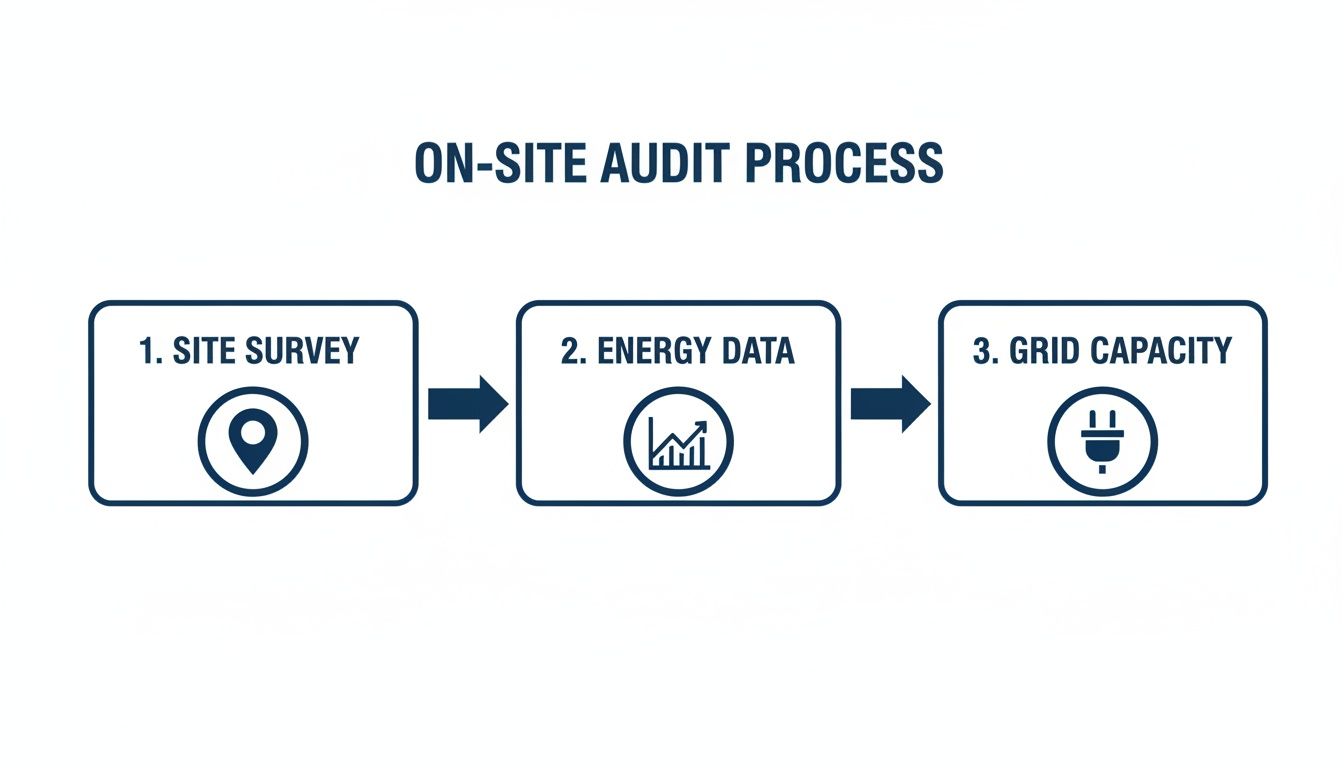
This structured audit ensures your design is built on solid data. It prevents expensive miscalculations down the line and makes sure the final system is perfectly sized for your actual needs.
How The Components Work Together
The real magic of a hybrid system is its ability to manage energy flow intelligently. A BESS acts as an energy reservoir, decoupling your charging operation from the grid’s limitations. It can be slowly trickle-charged from even a small grid connection during off-peak hours when electricity is cheapest.
Better still, it can be charged for free from an on-site solar PV array during the day. This stored energy is then ready to be discharged at high power, enabling multiple rapid EV chargers to operate at once during peak demand without putting any strain on the grid. It’s a dynamic that makes charging EVs with a weak grid connection not just possible but highly effective.
Imagine a logistics depot that needs to get 20 electric vans back on the road every afternoon. A traditional setup would demand a massive, multi-megawatt grid connection. With a hybrid system a relatively small 30kW grid connection can charge a 500kWh BESS overnight, which then delivers all the high-power charging the fleet needs the next day.
This approach doesn't just solve the grid capacity headache; it also slashes your operational costs by shifting energy use to low-cost periods or tapping into your own self-generated renewable power.
Sizing Your BESS and Solar Array
Getting the sizing of the BESS and any accompanying solar array right is absolutely critical. This is where the data from your site audit really proves its worth. It’s a careful calculation based on your specific operational needs.
Key Sizing Considerations:
- Fleet Charging Demand: How many vehicles need charging daily? What are their battery sizes (in kWh) and what state of charge do they need to reach? This gives you the total energy (kWh) required each day.
- Charging Window: How quickly do the vehicles need to be turned around? A shorter window demands higher power output (kW) from the BESS.
- Grid Connection Capacity: The size of your available grid connection determines how quickly the BESS can be refilled from the grid, especially when solar generation is low.
- Solar Generation Potential: A proper site survey will tell you the viable size of a solar array which in turn shows how much free energy you can feed into the BESS to cut your reliance on the grid.
Let’s say a depot needs to charge 10 vans, each requiring 40kWh of energy within a 4-hour window. That means you need 400kWh of deliverable energy. The BESS must also be able to supply power at a rate of at least 100kW ( 400kWh / 4 hours) to hit that target. Your solar array and grid connection then need to be sufficient to replenish that 400kWh in the remaining 20 hours of the day.
You can see how ZPN Energy's specific approach makes battery-backed EV charging a seamless, practical solution.
Enhancing Resilience with Advanced Topologies
Beyond the core components the system's architecture plays a huge role in its efficiency and reliability. Many traditional setups use a simple radial design where each charger is a separate endpoint. A far more advanced approach is the ring topology – a patented ZPN Energy innovation.
In a ring topology chargers and battery units are connected in a continuous loop. This design offers vastly superior power distribution and resilience. If one part of the system has a fault, power is simply rerouted around the ring, keeping the other chargers fully operational. This distributed energy model is inherently more robust and is a game-changer for large-scale deployments where any downtime is simply not an option.
Applying Smart Energy Management Strategies
Having the right hardware like battery storage and solar panels is a great start but it's only half the story. The real intelligence in a modern EV charging ecosystem comes from its software. Think of it as the brain that directs the flow of power, making sure your system runs at peak efficiency and saves you the most money. This is especially crucial when you're trying to charge EVs from a constrained grid connection.
This software layer is what turns a collection of individual components into a single, responsive system. It makes real-time decisions to balance charging demand, grid availability and your on-site generation. The end goal? To protect your connection from overload while actively driving down your operational costs.
Without this smart control you're just reacting to whatever demand comes your way. With it you're proactively managing your site's energy to hit specific commercial targets.
Mastering Power with Dynamic Load Balancing
One of the most essential software features for any site with more than one charger is dynamic load balancing . Picture this: several vehicles plug in at once. A basic system might try to give them all full power which would almost certainly trip your site's main breaker. Dynamic load balancing stops that from ever happening.
It works by constantly monitoring the total power being drawn by all the chargers and comparing it to your site's pre-set limit—what's known as your Maximum Import Capacity (MIC) . If the demand threatens to go over this limit, the software automatically and intelligently reduces the power sent to each vehicle.
This doesn't mean charging grinds to a halt. Instead the available power is shared out proportionally across all the cars that are plugged in. Then, as one vehicle finishes charging and unplugs, the system instantly reallocates that freed-up capacity to the remaining vehicles, speeding up their sessions. It's a completely seamless process that ensures you get the absolute maximum value from your grid connection without ever risking a costly penalty for going over your limit.
For a deeper look at this technology, you can explore our comprehensive guide to dynamic power management for EV charging.
Aligning Charging with Costs Using Smart Scheduling
Beyond just managing the load a truly smart system helps you get a firm grip on your costs. This is where smart scheduling comes in, a powerful tool that aligns your charging activity with times when electricity is cheapest or when your own renewable generation is at its peak.
Many commercial energy tariffs, often called Time-of-Use tariffs, have prices that fluctuate throughout the day. Electricity is often significantly cheaper overnight than during the peak afternoon hours. Smart scheduling lets you take full advantage of this.
By programming your BESS to recharge from the grid only during these cheap, off-peak windows you can dramatically lower your energy procurement costs. Similarly you can instruct the system to prioritise charging from your solar array during sunny periods, using free, self-generated energy before drawing from the grid or the battery.
This strategy effectively turns your charging operation into an active player in the energy market, buying low and using stored energy to avoid buying high.
The Importance of Open Communication Protocols
For any of these advanced strategies to work all the different parts of your system—the chargers, the BESS, the solar inverter and the management software—need to speak the same language. This is where communication protocols are critical.
The Open Charge Point Protocol (OCPP) is the global standard for communication between charging stations and their central management systems. ZPN Energy was the first in the UK to achieve compliance with the latest and most advanced standard, OCPP 2.0.1 , which is a vital differentiator.
This protocol enables the kind of sophisticated, two-way communication that is essential for:
- Real-time data exchange on charging status, energy use and system health.
- Remote management and troubleshooting of every charger on your network.
- Implementing complex smart charging commands , like dynamic load balancing and scheduled charging.
- Unlocking future grid services , such as Vehicle-to-Grid (V2G), where EVs can export power back to the grid to earn you revenue.
Choosing a system built on OCPP 2.0.1 ensures your investment is future-proof. It means you're ready to integrate with wider energy networks and tap into new revenue streams as the market evolves. It is the digital backbone that makes intelligent, grid-conscious EV charging a reality.
Getting It Built: Procurement, Installation, and Compliance
With a solid design in hand it's time to bring your charging hub to life. This is where the project moves from paper to reality but it's also where you'll face the practical hurdles of procurement, installation and the ever-present web of regulations. Getting this stage right is all about choosing the right partners and understanding your legal responsibilities.
The company you work with needs to be more than just a hardware supplier. You're looking for a genuine expert in delivering EV charging from constrained grid connections , someone with a proven track record of making these complex projects happen smoothly. Ideally you want a partner who can handle everything—from the initial design and planning applications right through to commissioning and long-term maintenance.
Selecting Your Technology Partner
Choosing your partner is probably the most critical decision you'll make in this entire process. You need to look beyond the basic specs and focus on suppliers who offer real-world advantages that simplify deployment and lower your total cost of ownership over the long haul.
A huge differentiator to look for is the option of no-groundworks installations . These systems, often built on surface-mounted bases, completely sidestep the cost, disruption and planning headaches that come with digging up your site. For any location where excavation is a non-starter this is an absolute game-changer.
The physical design of the hardware matters immensely too. Key features to ask about include:
- PAS 1899 Accessibility: Is the charger designed to be easily used by everyone, including disabled drivers? This is fast becoming a non-negotiable for public and commercial installations.
- Theft-Resistant Cabling: With cable theft and vandalism on the rise patented, recoiling cable systems are a smart investment. They don't just protect your assets; they keep your site safer and tidier.
- Integrated Solutions: Can one provider supply the whole package? Having your EV charging and batteries and any solar integration come from a single source makes project management infinitely simpler.
Navigating the Regulatory Landscape
You can't just plug in grid scale batteries and high-powered chargers and hope for the best. There’s a maze of regulations to get through and a misstep here can cause serious delays and fines.
Your first stop will almost always be your local planning authority. Most charging projects, especially those involving a BESS, will need formal planning consent. The key is to start these conversations early to understand what the local requirements are and build a robust application.
Beyond that you are legally required to notify your Distribution Network Operator (DNO) of what you're planning. The DNO has to assess the potential impact of your new system on their network, even if you’ve designed it to stay within your current connection limits. They will then issue a connection agreement outlining the technical and legal rules for your installation.
Navigating the complex world of regulations is a specialist task. A competent technology partner will handle the entire process on your behalf, from submitting planning applications to managing all DNO communications, ensuring a compliant and hassle-free deployment.
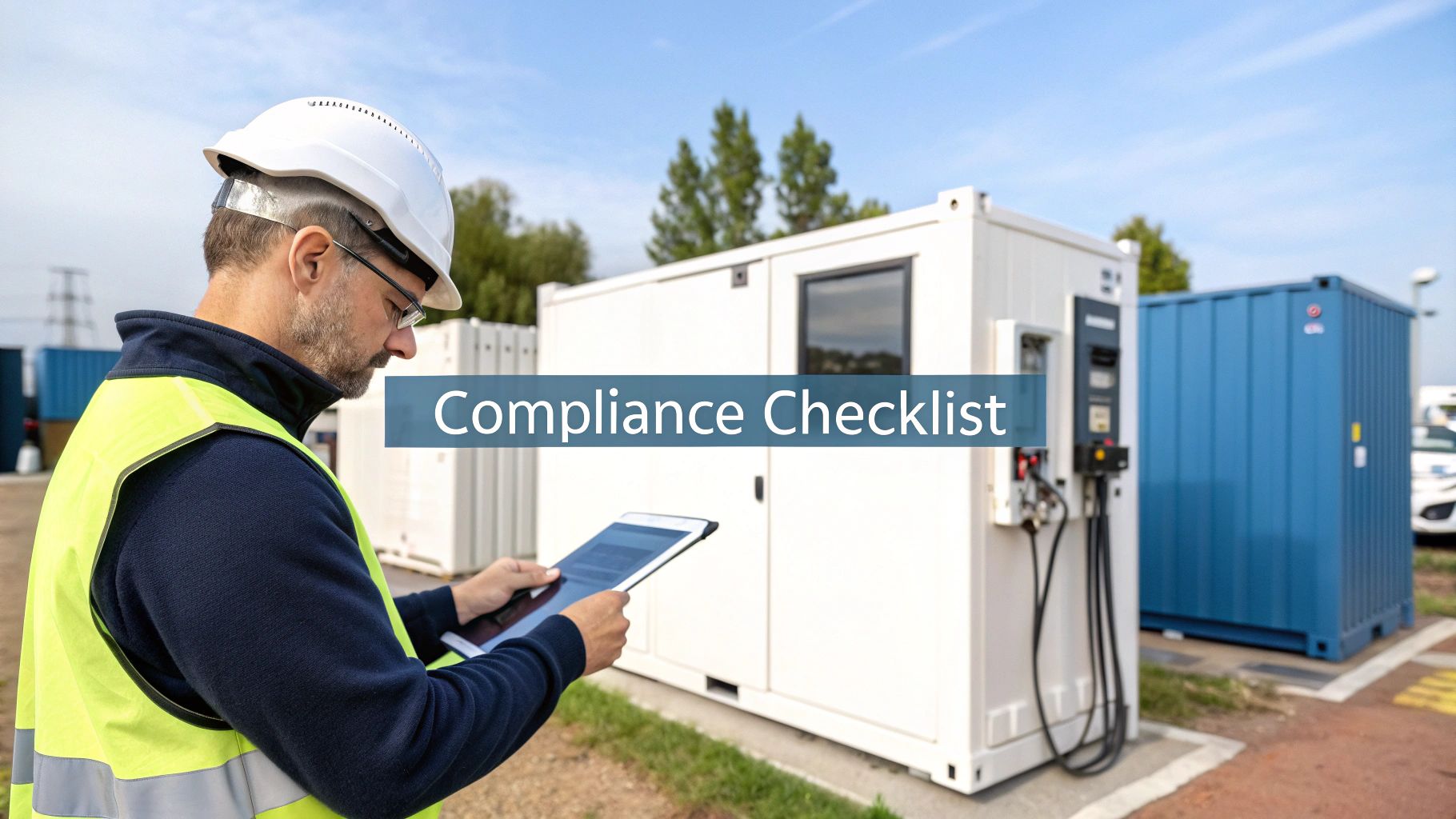
It's vital to ensure every part of your installation meets all relevant standards. You can get a better sense of effective compliance management strategies to see how this fits into a resilient business framework.
A Practical Deployment Checklist
To keep things on track, use this checklist as a guide when you're talking to potential suppliers. It'll help make sure nothing gets missed.
- Technical Specification: Double-check that the proposed BESS capacity and charger power match the needs you identified in your site audit.
- Compliance and Certification: Ask for proof of compliance with UK safety standards, PAS 1899 and OCPP 2.0.1 . Don't just take their word for it.
- Installation Plan: Get a clear, proposed timeline. How long will it take? Will there be any site downtime? What's the plan for civil works, if any are needed?
- DNO and Planning: Be crystal clear about who is taking responsibility for managing and submitting all the necessary DNO and planning applications.
- Warranty and Support: Make sure you fully understand the warranty terms for all hardware and the specifics of any ongoing maintenance and support contracts.
With this knowledge you're in a much stronger position to pick the right partner and manage a successful deployment, turning your charging vision into a functioning, valuable asset.
Your Questions Answered
When businesses start exploring EV charging for sites with a weak grid connection a lot of the same practical questions come up. It's one thing to talk about the technology but quite another to understand the real-world implications for your site.
We get it. These questions quickly move beyond technical specs and into the nitty-gritty of space, cost and day-to-day flexibility. Getting straight answers is the only way to build a solid business case before you commit to this kind of game-changing infrastructure project.
How Much Space Does a Battery Energy Storage System Need?
One of the first things people ask is about the physical footprint of the hardware. There's a common misconception that grid-scale batteries need a huge amount of space but modern systems are surprisingly compact.
Typically a Battery Energy Storage System (BESS) is housed in a self-contained unit, often similar in size to a standard shipping container. The exact footprint scales with the system's capacity, which we measure in megawatt-hours (MWh).
- For a commercial depot, a smaller system might fit neatly into the space of a single car parking bay .
- Larger, multi-MWh systems designed for public rapid charging hubs may need the equivalent of a few parking spaces.
The key takeaway here is that the space requirement is almost always manageable. These systems can usually be integrated into the existing layout of most commercial sites without causing significant disruption.
What Is the Typical Return on Investment?
Working out the return on investment (ROI) for a battery-backed charging system goes way beyond just the revenue from selling electricity. The real business case is a powerful mix of direct income and just as importantly, significant cost avoidance.
The ROI isn't just about selling power to drivers. It's a blend of operational savings, new revenue streams and future-proofing your business against volatile energy markets and eye-watering grid connection costs.
Here are the key factors that really drive the ROI:
- Grid Upgrade Avoidance: This is often the biggest win. You can sidestep a DNO grid reinforcement project that could easily run into hundreds of thousands of pounds.
- Energy Cost Reduction: By charging the BESS with cheap off-peak electricity or free solar energy and dispatching it during expensive peak times you can make a serious dent in your site's overall energy bills.
- Public Charging Revenue: If you decide to open your chargers to the public you create a direct and growing income stream from EV drivers.
- Grid Service Payments: Looking ahead, BESS operators will be able to earn money by helping to balance the national grid. This creates a powerful, additional revenue stream that boosts the long-term value of the asset.
Can This Technology Create a Mobile Charging Solution?
Absolutely. The containerised, all-in-one design of these systems makes them inherently transportable. This opens up a whole world of possibilities for mobile EV charging —an essential service for places where permanent infrastructure just isn’t feasible or necessary.
A BESS and charger unit can be mounted on a truck or trailer and deployed in no time to provide temporary rapid EV charging. It's a perfect fit for:
- Events and festivals
- Remote construction sites
- Emergency support for your fleet
- Testing demand at potential new charging locations before committing to a permanent install
This flexibility means you can deliver high-power charging exactly where it's needed, completely untethered from any local grid limitations.
Ready to bypass grid limitations and build your own powerful EV charging hub? ZPN Energy delivers market-leading battery-backed charging solutions, from fixed infrastructure to mobile units, all designed to work with constrained grid connections. Discover our unique no-groundworks installations and patented technology today at https://www.zpnenergy.com.