The UK Guide to Plug and Charge EV Charging
Ever paid for petrol without pulling out a wallet, card or phone? Probably not. But that’s the brilliantly simple experience Plug and Charge technology is bringing to electric vehicles. It automates the entire authentication and payment process, meaning you just plug your car into a compatible rapid charger and walk away.
What Is Plug and Charge and How Does It Work?
For too many UK drivers, public EV charging is a bit of a lottery. You're often left juggling multiple smartphone apps, fumbling for the right RFID card or tapping away at a clunky payment terminal. It’s a fragmented system that creates needless friction, turning a simple task into a potential headache.
Plug and Charge is designed to wipe all that away.
Think of it like the leap from chip-and-PIN to contactless payments. Where you once had to physically insert a card and type in a PIN for every single purchase, now you just tap. Plug and Charge goes one better: the simple act of plugging in the charging cable is the tap. No extra steps needed.
This magic happens thanks to a secure communication standard called ISO 15118 . This protocol acts as a universal language, allowing your EV and the charging point to talk to each other directly and securely, without any intermediaries.
The Automated Handshake
The moment you connect your EV to a compatible charger, a secure digital 'handshake' happens in the background. Your vehicle presents a unique, encrypted digital certificate—think of it as a digital passport—to the charging station. The station then checks this certificate with your energy provider to confirm your identity and billing details.
Once that check is complete, the charging session starts immediately.
The whole process is a massive improvement on the old way of doing things. It's a single, fluid action that transforms the public charging experience from a chore into a seamless interaction. This simplicity is a true game-changer, making EV ownership far more practical and appealing for everyone.
To see just how much simpler it is, let's compare the old and new methods side-by-side.
Traditional EV Charging vs Plug and Charge
| Step | Traditional Charging (App/RFID) | Plug and Charge (ISO 15118) |
|---|---|---|
| 1. Arrival | Park at the charger. | Park at the charger. |
| 2. Authentication | Open an app, find the right RFID card or use the payment terminal. | Plug the charging cable into the vehicle. The car and charger communicate automatically. |
| 3. Authorisation | Wait for the network to approve the payment method. | The vehicle's digital certificate is verified in seconds. |
| 4. Start Charging | Manually start the session via the app or on the charger screen. | Charging starts automatically once authentication is complete. |
| 5. End Charging | Unplug the vehicle. May need to end the session via the app. | Unplug the vehicle. |
| 6. Payment | A receipt is sent to your app or email. | Billing is handled automatically through your pre-registered account. |
The table makes it clear: Plug and Charge cuts out the unnecessary steps that cause delays and frustration, creating a far more efficient and user-friendly system.
A Standard for the Future
This isn't just about convenience though. The technology represents a fundamental step towards a much more intelligent and integrated energy ecosystem where vehicles can communicate seamlessly with the grid.
By standardising this communication, ISO 15118 paves the way for a more unified charging network. It removes the 'walled gardens' created by different operators, ensuring your car works with any compatible charger.
This interoperability is vital. It tackles that widespread frustration of arriving at a public charger only to find you do not have the right app or membership. Better yet, it lays the groundwork for more advanced applications, like smart charging that can manage demand from constrained grid connections and integrate with on-site renewables or large-scale battery storage.
The Technology Behind Seamless EV Charging
The convenience of Plug and Charge can feel like a bit of magic but it’s all built on a seriously robust and secure technological foundation. The secret sauce is an international standard called ISO 15118 , which lays down the rules for a two-way conversation between an electric vehicle and the charging station. This standard is what unlocks the whole automated experience.
Think of ISO 15118 as the common language that lets your car and the charger have a private, secure chat. Without it, they could not exchange the complex details needed for automatic identification and billing. This communication protocol is what elevates the process from a simple power transfer to an intelligent, secure data exchange.
This conversation kicks off the very instant you connect the charging cable.
The Digital Handshake Explained
When you plug your EV in, a process known as a digital ‘handshake’ begins. Your vehicle presents a unique digital certificate to the charging station, which works a lot like a digital passport. This certificate is stored securely within your vehicle’s hardware and contains encrypted information that uniquely identifies it.
The charging point, a key piece of electric vehicle supply equipment , receives this certificate and checks in with the charging network's backend system to verify it. This whole exchange is locked down by a sophisticated security framework, confirming not just the vehicle's identity but also the active charging contract tied to it. Once validated, the charger is authorised to start the flow of power.
From the driver's point of view, it’s as simple as these three steps.
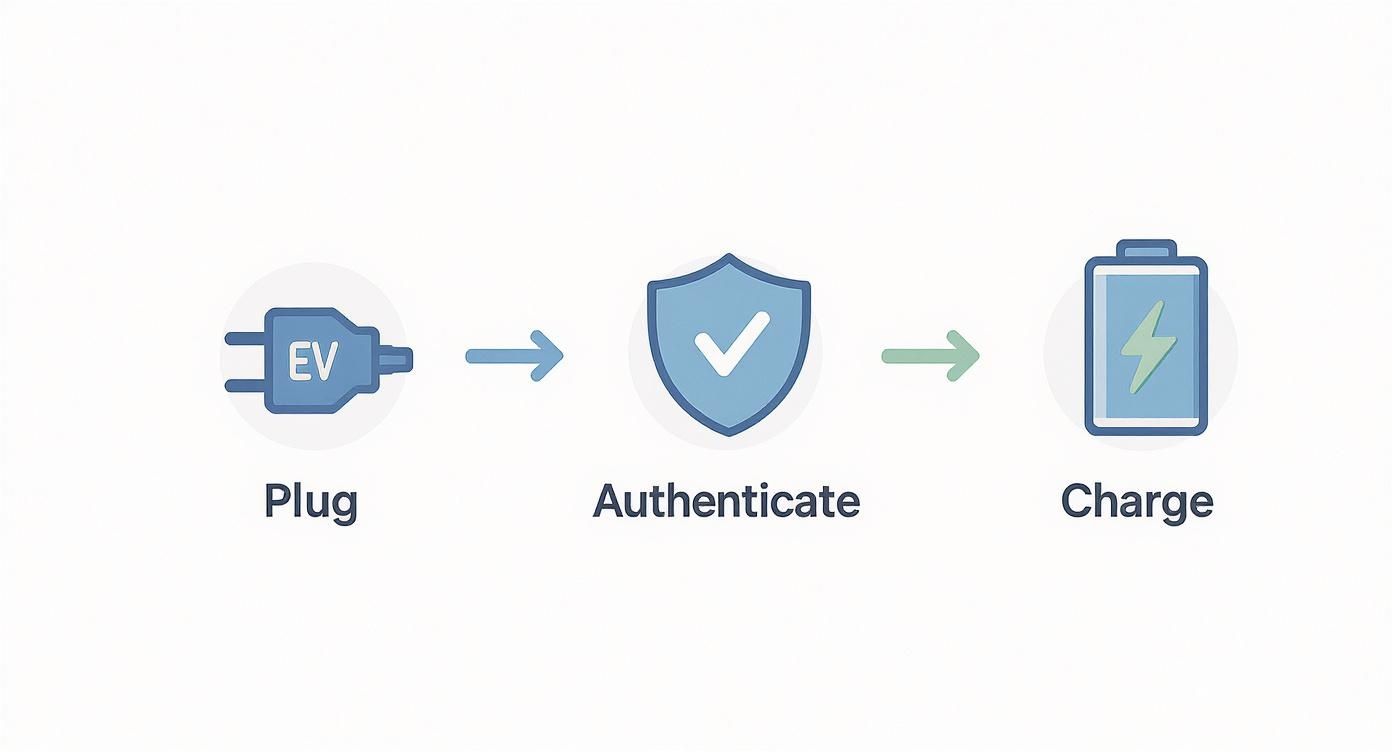
This process neatly shrinks what used to be a clunky, multi-step chore into one fluid action, showing just how efficient the technology is.
The Role of Public Key Infrastructure
The security holding this entire system together relies on a well-established cryptographic method known as Public Key Infrastructure (PKI) . If that sounds familiar, it should. PKI is the same technology that secures online banking and e-commerce, making it a proven and highly trusted system for protecting sensitive data.
PKI works by using a matched pair of cryptographic keys—a public key and a private key—to encrypt and decrypt information.
- The Vehicle’s Role: The EV holds its private key and the digital certificate securely on board. It uses this private key to digitally 'sign' any communications, proving it is what it says it is.
- The Charger’s Role: The charging station uses the vehicle’s public key to verify that signature, confirming the certificate is genuine and has not been messed with.
This ensures the conversation between the car and the charger is completely private. It effectively blocks common cyber threats like 'man-in-the-middle' attacks, where a third party might try to eavesdrop on the data exchange.
By using PKI, the Plug & Charge standard fundamentally hardwires security into the charging process. It’s not an add-on but a core component, making it vastly more secure than methods that rely on RFID cards—which can be lost, cloned or stolen.
This built-in security is a game-changer for commercial operators and fleets. It provides total certainty that only authorised vehicles are using the infrastructure and that all billing is accurate and tamper-proof. The technology does not just simplify the user experience; it delivers the kind of peace of mind that comes with enterprise-grade security.
The Future of Smart Energy and EV Charging
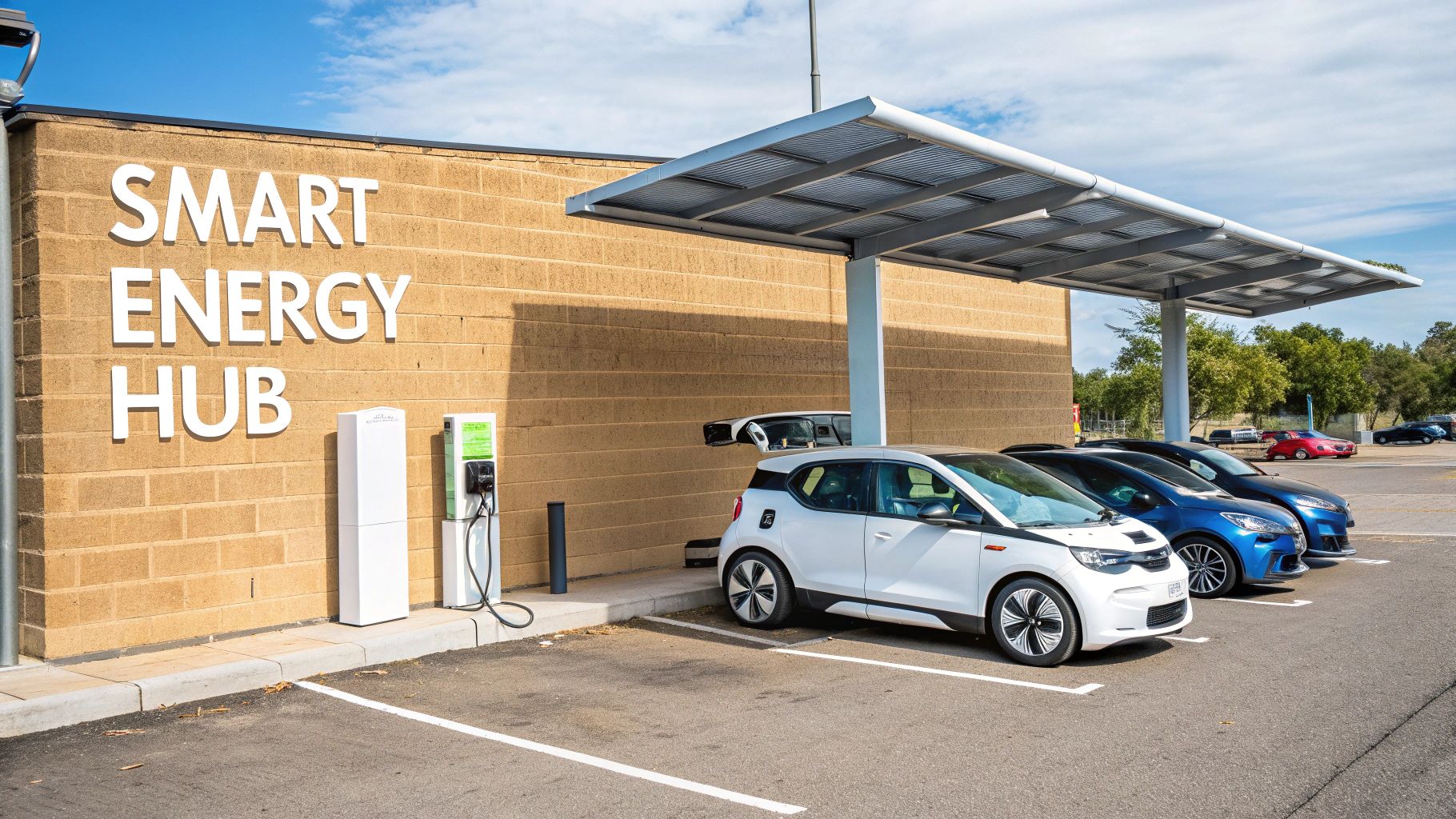
The sheer convenience of Plug and Charge is really just the warm-up act. Its true power is in creating an intelligent, two-way conversation between the vehicle and the charger, making it a foundational piece of the UK’s future smart energy grid.
This constant dialogue unlocks advanced energy management features that turn a simple charging point into a dynamic, grid-aware asset.
This is a game-changer for rapid charging hubs. These sites draw enormous amounts of power, which can put a massive strain on local infrastructure, especially where there are already constrained grid connections . Without smart management, the only fix is often a hugely expensive and slow grid upgrade.
Plug and Charge, built on the ISO 15118 standard, offers a much smarter way forward. It’s the key that unlocks smart charging , where the flow of electricity can be managed with pinpoint precision in real time.
Adapting to a Dynamic Energy Landscape
With this technology in place, a charging site stops being a passive drain on electricity. It becomes an active player in the wider energy ecosystem, able to adjust its demand based on all kinds of signals.
For instance, charging speeds can be automatically dialled back during peak grid demand and then ramped up again when demand eases. This helps to balance the local network and prevent overloaded circuits, all without the driver or the site operator having to lift a finger.
This dynamic control is also crucial for integrating on-site renewables like solar canopies.
When the sun is shining, the system can prioritise using that free, green electricity to charge connected vehicles. When clouds roll in and solar output drops, it can intelligently blend grid power or energy from on-site batteries to keep the charging experience seamless.
This automated decision-making gets the most out of every available resource, driving down operational costs and squeezing every last drop of value from renewable generation.
Integrating Grid-Scale Batteries for Ultimate Flexibility
But the real magic happens when you pair this smart ecosystem with grid-scale batteries , or what's known as a Battery Energy Storage System (BESS). This combination transforms a charging hub into a potent distributed energy resource, creating whole new levels of resilience and commercial opportunity.
This powerful duo allows a site to:
- Store low-cost energy: The batteries can be charged up overnight using cheap, off-peak electricity from the grid.
- Discharge during peak times: That stored energy can then power rapid EV charging during the day, completely sidestepping expensive peak-rate tariffs.
- Provide grid services: The site can even sell stored energy back to the grid when it's under stress, opening up a brand-new revenue stream.
This approach effectively decouples the charging operation from the immediate state of the grid. It means a site with a weak grid connection can still deliver reliable, high-speed charging to a large number of vehicles by drawing on its own energy reserves. It also acts as a buffer against power cuts, ensuring critical fleet vehicles stay on the road no matter what.
While programmes in other regions, like the one detailed in Mastering Xcel EV Credit: Essential Insights for Colorado Residents , show how incentives can shape energy behaviour, the business case for combining EV charging and batteries here in the UK is becoming just as compelling on its own merits.
From Charging Point to Energy Hub
By weaving all these elements together, Plug and Charge acts as the central nervous system for a sophisticated local energy microgrid. The ISO 15118 standard enables the flow of data needed not just for billing but for intelligent load balancing, energy arbitrage and seamless integration with renewables.
It transforms a collection of chargers from a simple utility into a strategic asset that bolsters grid stability, slashes energy costs and unlocks new financial models. This is the future of smart energy: a decentralised, responsive and highly efficient network where vehicles aren't just transport but active participants in the system.
For UK businesses and fleet operators, this shift represents a fundamental change in how they will manage both energy and mobility for years to come.
Why UK Fleets and Businesses Are Adopting Plug and Charge
Beyond the perks for individual drivers, Plug and Charge presents a powerful business case for UK commercial fleets and charge point operators. In a world where operational efficiency is everything, the technology delivers tangible returns by removing the friction points that cost time and money.
For a busy commercial driver, every minute saved fiddling with a charger is a minute gained on the road.
This is where the technology's real value comes to light. By getting rid of the need to juggle payment cards, mess about with apps or file complex expense claims, you directly boost driver productivity and job satisfaction. A smooth, dependable charging experience means vehicle turnaround times at depots get faster, keeping your valuable assets on the move rather than sitting idle.
Slashing Administrative Overheads
For fleet managers, the admin that comes with managing EV charging can be a real headache. Reimbursing drivers, tracking energy use across dozens of vehicles and reconciling payments from different charging networks is a time-consuming job that’s often riddled with errors.
Automated authentication and centralised billing change all of that.
With Plug and Charge , every charging session is automatically logged and billed to one central account. This gives managers a clear, consolidated view of energy consumption and costs, slashing the time spent on paperwork and financial admin. You can learn more about optimising your depot in our guide to EV charging for fleets.
The system also virtually eliminates the risk of energy theft or unauthorised use. Because authentication is tied directly to the vehicle's unique digital certificate, only approved fleet vehicles can draw power, giving you complete control over your energy spend.
This level of security and automation is a huge leap forward from traditional methods, giving businesses the confidence to scale their electric fleets without drowning in complexity.
Enhancing Brand and Customer Experience
For businesses that offer EV charging to customers or staff—like retail parks, workplaces or hotels—the user experience is paramount. A clunky, unreliable charging system reflects poorly on the brand. A frictionless one creates a lasting positive impression.
Offering a premium Plug and Charge experience shows a commitment to quality and forward-thinking technology. It becomes a key differentiator, helping to attract and keep high-value EV-driving customers who appreciate the simplicity. This is not just a hunch; surveys show that 68% of EV drivers who have used Plug and Charge found it faster and more user-friendly than older methods.
Calculating the Return on Investment
The return on investment from this technology is not just about convenience; it creates a compelling financial argument for its adoption. The benefits translate directly into a stronger bottom line through both cost savings and, in some cases, new revenue.
Here’s how the operational advantages stack up:
- Increased Driver Productivity: Faster charging sessions mean drivers spend less time stationary and more time on the job, directly improving how well your assets are used.
- Reduced Administrative Costs: Automated billing and reporting significantly cut down on the hours needed to manage expenses and track energy usage.
- Elimination of Energy Theft: Secure, vehicle-specific authentication stops unauthorised charging, plugging a common source of financial leakage.
- Improved Brand Reputation: For customer-facing businesses, offering a seamless charging service can attract new visitors and build loyalty.
Ultimately, by automating the entire charging process, Plug and Charge streamlines operations from top to bottom. It transforms EV charging from a logistical challenge into a smooth, integrated part of the daily workflow, delivering clear operational savings and making the whole business more efficient.
A Practical Checklist for UK Implementation
For UK businesses, fleet managers and developers looking to adopt Plug and Charge, the jump from theory to practice can feel like a big one. The technology promises a frictionless future but making it a reality takes careful planning and a solid grasp of all the moving parts. This practical checklist is designed to cut through the complexity and walk you through the essential stages.
Following a clear, structured approach is the best way to make informed decisions, sidestep common pitfalls and roll out a truly seamless, secure charging solution.
1. Confirm Hardware and Software Compatibility
First things first: a simple but critical audit of your existing or planned assets. Not all electric vehicles and chargers are created equal and ISO 15118 compatibility is the absolute, non-negotiable foundation for Plug and Charge.
-
Vehicle Verification: Check the manufacturer's specs for your fleet vehicles. Many newer models support ISO 15118 straight from the factory but you must confirm this. It’s generally not something you can add to older vehicles, as it needs specific hardware for secure certificate storage.
-
Charger Compliance: Your charging hardware also needs to be fully compliant with the ISO 15118 standard. When buying new units for rapid EV charging , make this a specific requirement in your tender. If you have existing infrastructure, talk to the hardware provider to see if a firmware update can enable the functionality.
2. Select the Right Network Partners
With compatible hardware in place, the next job is to choose the software and network providers who manage the ecosystem behind the scenes. This means selecting a Charge Point Operator (CPO) and an e-Mobility Service Provider (eMSP) that both fully support the Plug and Charge protocol.
The CPO is the one managing the physical charging infrastructure, while the eMSP handles driver accounts and billing. For the experience to be seamless, these two partners must be able to communicate flawlessly using the ISO 15118 standard.
When you're assessing potential partners, ask them directly about their support for the protocol and their experience with live deployments. A provider with a proven track record will be far better equipped to handle the technical details of implementation.
3. Understand the Security Framework
Security is not an optional extra; it’s the very core of the Plug and Charge system. This is all managed through a Public Key Infrastructure (PKI) , which handles the creation, management and validation of the digital certificates that make secure authentication possible.
You'll need to work with your CPO and eMSP to ensure a robust PKI is in place. This complex system is the backbone of trust, verifying that every transaction is secure and that only authorised vehicles can access your network. It’s what prevents fraud and guarantees the integrity of your entire charging operation.
4. Plan for Roaming and Interoperability
Your drivers will not always be charging at your home depot. To make sure they get the same seamless experience out on the road, it's vital to think about roaming. This allows your vehicles to use other public charging networks just as if they were your own.
This is made possible by roaming hubs, which act as a central clearing house connecting different CPOs and eMSPs. When choosing your network partners, dig into their roaming agreements to understand the extent of their UK network coverage. A broad roaming network means your drivers can travel with confidence, knowing a compatible charger is always within reach.
5. Integrate with Energy Management Systems
Finally, to truly unlock the full potential of your investment, you need to integrate your Plug and Charge system with wider energy management platforms. This is especially important for sites with constrained grid connections or those using on-site renewables and grid-scale batteries .
The data provided by ISO 15118 is the key to unlocking smart charging. It allows for intelligent load balancing, helping you avoid expensive grid upgrades and make the most of the power you have available. You can learn more in our detailed guide to dynamic power management for EV charging.
By connecting your chargers to a central energy system, you transform them from simple power dispensers into active assets that can optimise energy use, slash costs and even generate new revenue.
Got a few lingering questions? You're not alone. New tech always brings up the details and that’s a good thing. Let's run through the most common queries about Plug and Charge to clear up the final pieces of the puzzle.
Think of this as the quick-start guide to the finer points, from what works with what to how your data stays safe.
Is My Electric Vehicle Compatible with Plug and Charge?
This all comes down to the manufacturer. Compatibility with the ISO 15118 standard has to be built in at the factory, so you'll typically find it on newer EV models. It's not quite universal yet but it's getting there fast.
The surest way to know is to check your vehicle's handbook or the official technical specs. It's worth remembering this is not something you can add later with a simple software update; it needs specific hardware on board to handle the digital certificates securely. Do not forget, both your car and the charging network need to support it.
How Secure Is the Plug and Charge System?
Exceptionally secure. The whole system is built on the ISO 15118 standard, which insists on using a Public Key Infrastructure (PKI) . This encrypts every bit of communication between your car and the charger.
Your vehicle gets a unique digital certificate—think of it as a tamper-proof digital passport. This design makes it incredibly resilient to the kind of cloning or fraud that can sometimes plague RFID cards or basic mobile apps. That secure, encrypted 'handshake' keeps your identity and payment details locked down, making it one of the safest rapid EV charging methods out there.
This level of security is fundamental. By using cryptographic verification, Plug and Charge ensures that only the authorised vehicle can initiate a charging session, providing peace of mind for both individual drivers and commercial fleet operators.
What Is the Difference Between Plug and Charge and AutoCharge?
Both get you charging without pulling out a card or app but under the bonnet, they're worlds apart—especially when it comes to security.
- Plug and Charge: This is the industry standard, built on the secure, international ISO 15118 protocol. It uses those encrypted digital certificates we mentioned for a rock-solid, interoperable authentication process.
- AutoCharge: This is a more basic, proprietary system. It identifies your vehicle by its unique network identifier, known as a MAC address.
The general consensus is that AutoCharge is less secure. Why? Because MAC addresses can, with the right know-how, be copied or 'spoofed'. The cryptographic security of Plug and Charge is what makes it the industry's choice for a truly secure and future-proof charging ecosystem, particularly as we see deeper integration with things like grid-scale batteries .
Can I Use Plug and Charge Across Different UK Networks?
Yes, and that's one of its biggest selling points. The catch is that it depends on roaming agreements between the different network providers. Your e-Mobility Service Provider (the company you have your charging contract with) needs to have a deal in place with the Charge Point Operator whose station you want to use.
This all happens behind the scenes, usually via roaming hubs that connect everyone together. As more networks across the UK adopt Plug and Charge , this kind of seamless, cross-network experience is becoming the norm. Still, it's always smart to check your provider’s network map before a long trip to see exactly where you can plug in and go.
At ZPN Energy , we design and build advanced battery-backed rapid charging solutions that work seamlessly with constrained grid connections. Our fully integrated systems, including the UK's only EV chargers meeting PAS 1899 disability access standards, are engineered for the future of smart energy. Discover our bespoke charging and energy storage solutions at https://www.zpnenergy.com.