The Ultimate Intelligent Charging System Guide
Think of an intelligent charging system as an air traffic controller for electricity. Its job is to direct energy to electric vehicles in the most efficient, cost-effective and grid-friendly way possible. It’s a huge leap beyond the simple ‘plug in and power up’ model, creating a dynamic, two-way conversation between the vehicle, the charger and the wider energy network. This smart approach is absolutely vital for managing the UK's booming EV fleet without putting the national grid under impossible strain.
What Is An Intelligent Charging System?
As electric vehicle ownership explodes across the UK, the pressure on our national grid is fast becoming a major headache. An intelligent charging system is the answer. It acts as a smart, coordinated network that orchestrates exactly how and when vehicles get their power. Instead of every EV simply demanding maximum power the second it's plugged in, this technology constantly balances energy supply with real-time demand.
This kind of sophisticated management is no longer a 'nice-to-have'—it's a necessity. Just look at the numbers. In the single month leading up to November 2025, a net 777 new public EV charging devices were installed. In that same period, nearly 350,000 more EVs hit UK roads compared to the start of the year. This breakneck growth absolutely underscores the need for a much smarter way to distribute energy.
To get a better sense of how an intelligent system improves upon the basics, let's compare it directly to a standard, or 'dumb', charger. The difference is night and day.
Key Differences Between Standard and Intelligent EV Charging
| Feature | Standard EV Charger | Intelligent Charging System |
|---|---|---|
| Control | Uncontrolled charging; starts immediately at max power. | Actively manages charging speed and timing. |
| Grid Interaction | Acts as a passive load, only drawing power. | Communicates with the grid to balance supply and demand. |
| Cost Management | Charges at any time, regardless of electricity price. | Shifts charging to off-peak hours to reduce costs. |
| Energy Source | Pulls power from the grid indiscriminately. | Can prioritise power from combined on-site renewables. |
| Scalability | Can easily overload local circuits if many are used at once. | Uses load balancing to share power safely across multiple units. |
| Future-Proofing | Limited functionality; cannot adapt to future needs. | Capable of grid services, V2G, and software updates. |
As you can see, the 'intelligence' isn't just about convenience. It transforms a simple power outlet into an active, responsive part of our energy infrastructure.
Core Functions of Intelligent Charging
An intelligent system goes far beyond the basic job of what we call electric vehicle supply equipment. It’s designed to think, react and adapt, weaving together several key functions to create a more resilient and efficient charging ecosystem.
Here’s what it can do:
- Load Balancing: This is crucial. It prevents local grid overloads by intelligently distributing available power across multiple chargers, ensuring no single connection point draws too much energy and trips the circuit.
- Demand Response: The system can automatically shift charging sessions to off-peak hours when electricity is cheaper and grid demand is lower. This is a win-win: it reduces costs for the EV owner and eases congestion on the grid.
- Renewable Energy Integration: The system can prioritise charging when your combined on-site renewables are generating power, maximising the use of clean energy and cutting your reliance on the grid.
- Grid Services: The most advanced systems can even turn a fleet of EVs into a virtual power plant. They can participate in grid balancing services, feeding power from vehicle or on-site batteries back to the grid during peak demand, often generating revenue in the process.
By blending these functions, an intelligent charging system turns a charging station from a passive energy drain into an active, incredibly valuable asset for the entire electricity network. It’s the key to everything from enabling rapid EV charging from constrained grid connections to building large-scale distributed energy projects.
How Intelligent Charging Systems Are Built
To really get what makes an intelligent charging system tick, we need to lift the bonnet and have a proper look. These systems aren't just one piece of kit; they're more like a carefully conducted orchestra of hardware, software and communication technologies all working together in perfect harmony. Every part has a job, from the hardware on the ground collecting data to the smart decisions being made up in the cloud.
At its heart, an intelligent charging system is a pretty sophisticated Internet of Things application. If you dig into the fundamentals of IoT application development , you’ll see how the core principles—connecting devices, gathering data and enabling remote control—are exactly what makes EV charging ‘intelligent’.
It’s this complex web of hardware and software that delivers the real-world benefits: a more stable grid, big cost savings for operators and a much greater use of green energy.
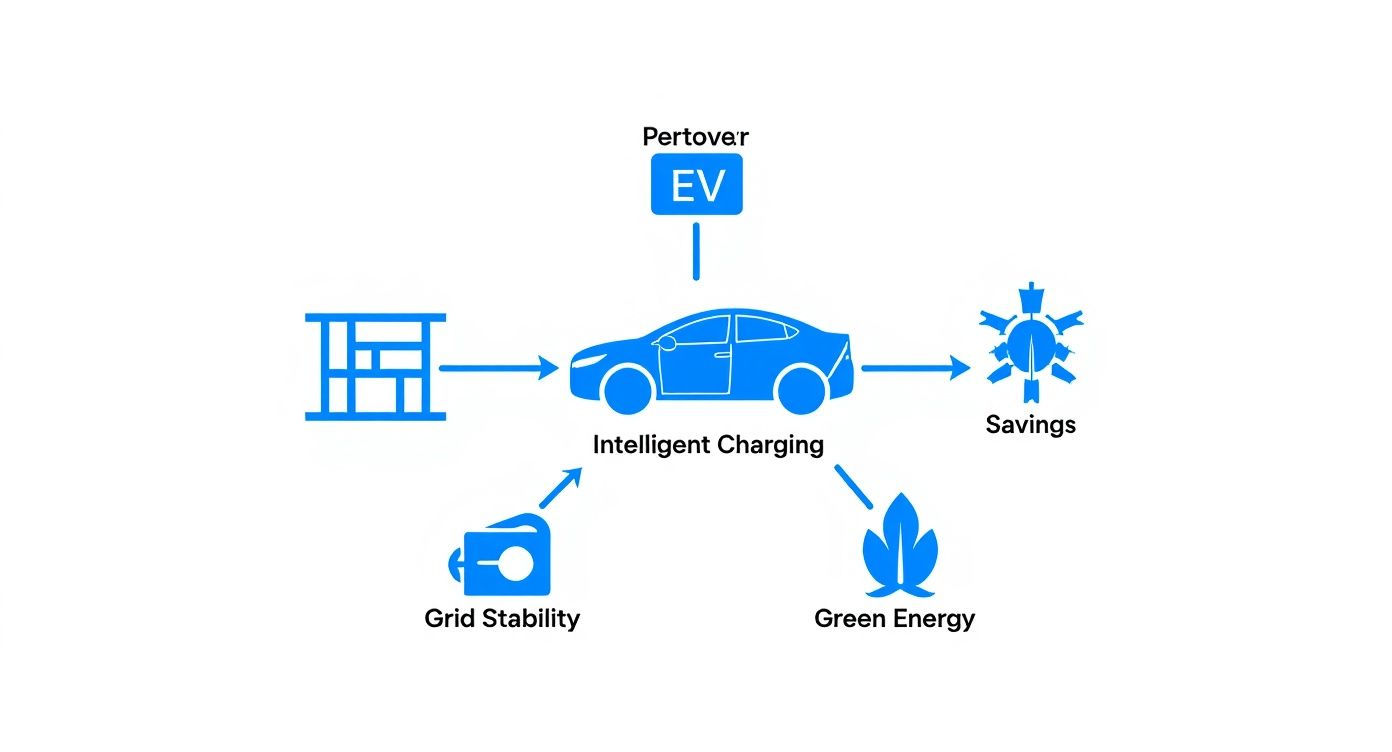
As you can see, the electric vehicle is just one piece of a much bigger puzzle. It's connected to the wider goals of stabilising the grid, slashing costs and bringing more renewables online. The value goes far beyond just charging a car; it impacts the whole energy ecosystem.
The Foundational Hardware Components
The physical hardware is the backbone of the entire system. It’s what directly interacts with both the vehicle and the grid. Without these solid, reliable components, all the ‘intelligence’ would be stuck in the cloud with no way to act.
Here are the key bits of hardware you’ll find:
- Smart Chargers: This is your main point of contact with the EV. Unlike your basic home charger, these units have their own processing power and communication modules. They can take instructions, check the charging status and send data back to a central system.
- Sensors and Meters: Think of these as the system's eyes and ears. They gather real-time data on everything from grid electricity prices and local power demand to how much energy is being generated by combined on-site renewables .
- Grid-scale Batteries: For sites with a weak grid connection or those wanting to be more self-sufficient, large on-site batteries—often called Battery Energy Storage Systems (BESS)—are essential. They can store up cheap, off-peak or renewable energy, ready to deliver rapid EV charging when the grid is under strain.
- Communication Gateways: These devices are the translators. They make sure all the different hardware components can talk to each other and connect securely to the software platform.
When you bring all this hardware together, an intelligent charging system can effectively create its own microgrid. This opens the door to powerful solutions, like mobile EV charging units that can be deployed pretty much anywhere.
Software and Communication Protocols
If the hardware is the body, the software is the brain. A powerful software platform is where the magic really happens. It takes all the data from the hardware, analyses it and then decides how to best manage energy flow across the entire network. This is where the real optimisation comes in.
To make sure everything works together, regardless of who made the parts, the system uses specific communication standards. The big one here is the Open Charge Point Protocol (OCPP) . You can think of OCPP as a universal language for EV chargers. It allows a central management system to monitor, control and update any charger that speaks this language, preventing you from getting locked into one supplier and ensuring things work together in the future.
An intelligent charging system architecture combines physical hardware with a decision-making software brain, all linked by standardised communication protocols like OCPP to create a responsive and efficient energy network.
This setup is what makes advanced strategies like Vehicle-to-Grid (V2G) possible. With V2G, EVs don't just take power; they can also act as distributed energy resources. The software can tell a connected EV to send a small amount of its battery power back to the grid when demand is high. This helps stabilise the network and can even earn the vehicle owner some money. It turns a parked car into a valuable asset for the grid.
Managing The Grid With Intelligent Charging
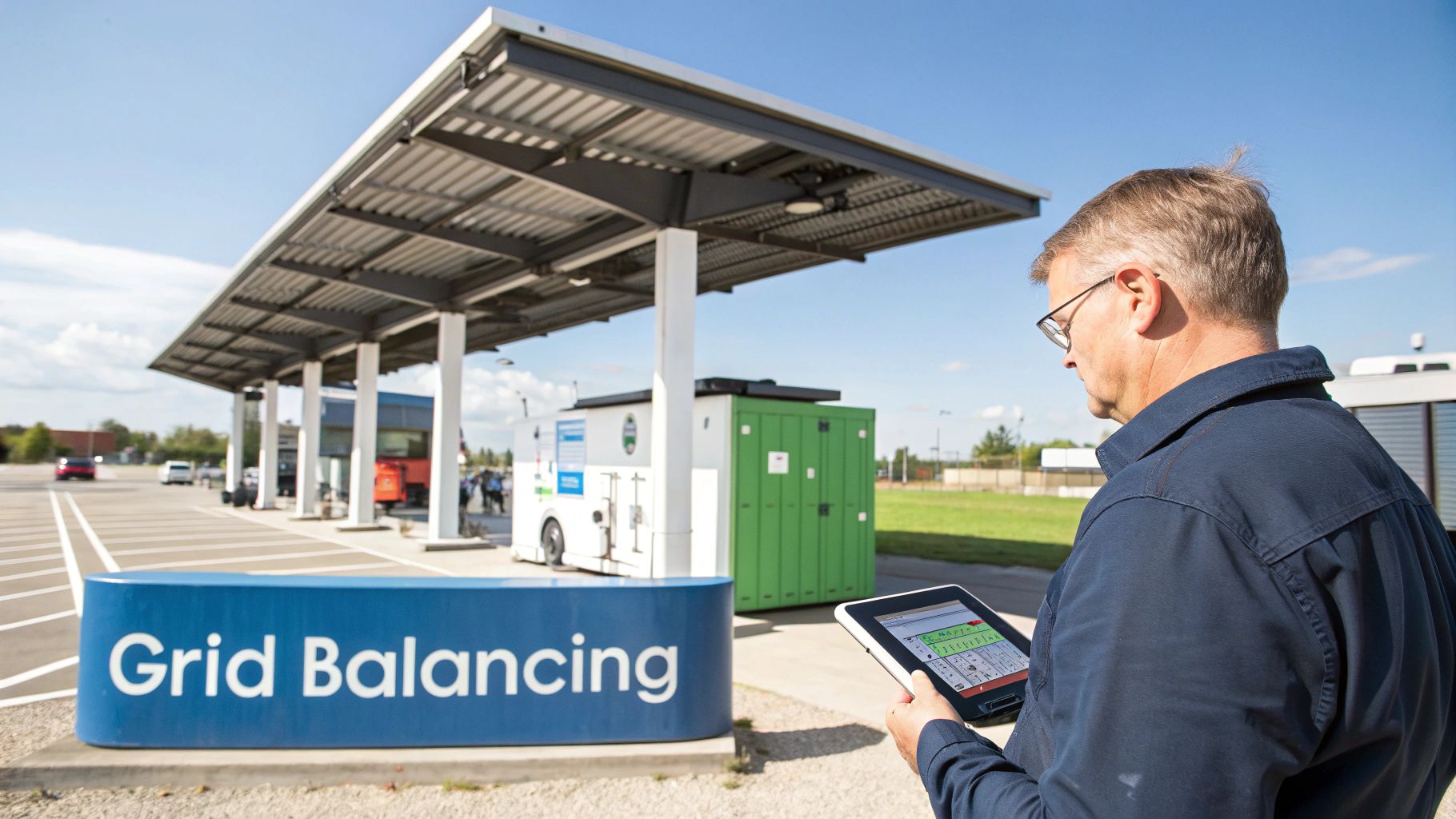
An intelligent charging system does far more than just top up a car's battery; it's an active participant in stabilising the UK's national grid. Think of it as a smart traffic controller for electricity. It prevents gridlock and keeps energy flowing smoothly, which is especially vital in areas with older, weaker grid connections.
Without this kind of smart management, the familiar post-work rush of EVs plugging in could easily overwhelm local infrastructure. The result? Blackouts, or the need for eye-wateringly expensive grid upgrades.
This is a serious consideration as the UK's EV fleet continues its rapid expansion. We saw over 75,000 public EV charging stations installed by September 2023, a 28% jump in just one year. That growth is absolutely essential to support the 14 million EVs projected to be on UK roads by 2030. Intelligent systems are the key to making this work, balancing the load and scheduling charging to avoid crippling the existing electrical grid. You can discover more insights about these EV charging statistics on meteorelectrical.com.
Demand Response and Load Balancing in Action
At the heart of grid management are two fundamental ideas: demand-side response and load balancing .
Demand-side response is all about the system automatically adjusting energy use to help out the grid. For instance, instead of letting an EV charge at 5 p.m. when everyone is getting home and putting the kettle on, the system might cleverly delay the session until 2 a.m. when demand is rock bottom and electricity is much cheaper.
Load balancing, on the other hand, works at a more local level. Picture a charging hub with ten chargers but only enough grid capacity to power five at full tilt. An intelligent system juggles the available power across all ten vehicles, perhaps by slightly reducing the charging speed for each one or by creating a smart queue.
This simple act of management prevents the local circuit from tripping and crucially, allows more chargers to be installed than the grid connection would normally handle. To really get under the bonnet of how this works, check out our guide to dynamic power management for EV charging. It’s this capability that makes rapid EV charging a reality, even with constrained grid connections .
Integrating Batteries and Renewables
The true game-changer, though, is when an intelligent charging system starts to blend EV charging with combined on-site renewables and grid-scale batteries . This is where a charging forecourt transforms from being a simple drain on the grid into a valuable grid asset.
Imagine a service station with solar panels on its roof and a large on-site battery storage unit.
- During the day: The solar panels are busy generating clean energy. Instead of selling any excess power back to the grid for pennies, it's stored in the battery.
- During peak hours: When grid electricity is expensive, the system can draw power from its own battery to charge vehicles, insulating the site from peak prices and easing strain on the grid.
- Grid Support: When the national grid is under extreme stress, the system can even become a power provider, exporting stored energy from its batteries back to the grid. This provides a vital stability service and opens up a whole new revenue stream.
By weaving together EV charging and batteries , these sites become what are known as Distributed Energy Resources (DERs). A network of these smart, self-sufficient charging locations can effectively act as a virtual power plant, supporting the grid, championing renewable energy and ensuring the transition to electric mobility is both sustainable and robust.
Right, so we've established that an intelligent charging system is the brains behind the operation, managing the flow of power but its real value goes far beyond just preventing a blackout. It's a powerful commercial tool, capable of opening up completely new ways to make money.
Instead of seeing charging infrastructure as a simple pay-per-charge setup, we can start treating it as a strategic investment. The intelligence isn't just for managing energy; it’s for monetising that energy in much smarter, more profitable ways. This is how you turn a charging station from a necessary cost into a thriving profit centre.
From Static Pricing to Dynamic Revenue
The most obvious win with an intelligent system is dynamic pricing . Forget flat rates. Now you can adjust the cost to charge in real-time based on what’s actually happening on the ground.
Think lower prices during quiet, off-peak hours to pull in more drivers, or premium rates for that ultra-rapid service when demand is sky-high. This flexibility lets you maximise revenue based on real-world conditions, paving the way for more sophisticated commercial models that solve specific problems for specific customers.
A few real-world examples spring to mind:
- Mobile EV Charging: For a logistics firm, every minute a vehicle is off the road is money down the drain. Mobile EV charging units, packed with their own battery power, can be sent straight to a depot or even a stranded vehicle. It's a premium, on-demand service that customers will happily pay more for.
- Self-Sufficient Forecourts: Imagine a forecourt with its own solar panels and grid-scale batteries . It can soak up cheap energy from the grid overnight or from the sun during the day, then sell it at a premium during peak times. You're not just selling power; you're playing the market while guaranteeing availability.
- Cost-Saving Workplace Schemes: Offering EV charging is a great employee perk but it can be expensive. An intelligent system can manage the charging schedule to sidestep costly peak-time energy tariffs, making the whole scheme affordable for the business while giving staff a valuable benefit.
Tapping into Grid Services Markets
Here’s where it gets really interesting. One of the most profitable opportunities is using your charging infrastructure to support the national grid. By combining EV charging with on-site batteries, a site can get involved in grid services markets .
This basically means you sell stored energy back to the grid when it's under strain or help keep its frequency stable.
These services are absolutely vital for the grid operator and they pay a premium for them. An intelligent charging system automates the whole process, effectively turning your network of chargers and batteries into a virtual power plant that generates a steady, reliable income.
This completely flips the economic model on its head. You're no longer just selling energy to drivers. You're selling stability and capacity back to the entire energy network, creating a much stronger and more diversified business case.
A Breakdown of Potential Revenue Models
An intelligent charging system opens up a whole portfolio of income streams that go way beyond simple charging fees. Each model targets a different slice of the market and uses the system’s smarts in a unique way. Here’s a look at how that breaks down.
Revenue Streams From Intelligent Charging Infrastructure
| Revenue Stream | Description | Target Market |
|---|---|---|
| Premium Rapid Charging | Offering guaranteed high-speed charging, often powered by on-site batteries to overcome grid constraints. | High-mileage drivers, taxi fleets, delivery services. |
| Grid Balancing Services | Selling stored energy back to the grid to help manage supply and demand, earning payments from the grid operator. | Commercial site owners, forecourts, large businesses. |
| Dynamic Energy Tariffs | Adjusting charging prices based on the time of day, grid load, or availability of on-site renewable energy. | Public charging networks, retail parks, workplaces. |
| Mobile Charging Services | Providing on-demand charging for fleets or at events, priced as a premium convenience service. | Fleet operators, event organisers, roadside assistance. |
As you can see, the opportunities are varied. By layering these models, operators can build a resilient and highly profitable business that not only serves EV drivers but also plays a crucial role in the wider energy ecosystem.
Getting Your Intelligent Charging System Up and Running
So, you understand the theory. Now it’s time to get your hands dirty. Moving from a plan on paper to a fully functioning intelligent charging system in the real world is where the real work begins and it requires careful planning with a solid grasp of the challenges you'll face on the ground.
This isn’t just about bolting some hardware to a wall. It’s a detailed process of assessing your site, understanding your grid connection and knowing exactly what your users need. Nailing these fundamentals right from the start is the difference between a successful rollout and a project plagued with problems.

The first steps are absolutely crucial. It goes beyond simply picking a good spot. You need a thorough assessment of your existing grid capacity. For many locations across the UK, especially those in older buildings or more remote areas, the grid connection itself will be your biggest hurdle. Understanding this limitation upfront is the key to designing a system that can deliver reliable rapid EV charging from constrained grid connections .
Navigating the Key Hurdles of Implementation
Once you’ve got a clear picture of what your site can handle, the next phase is to navigate the maze of technical and regulatory requirements. This is where meticulous planning saves you from massive headaches down the line, ensuring your system is both compliant today and ready for whatever comes next.
A few common challenges tend to pop up at this stage:
- Regulatory Compliance: The UK has a specific and evolving set of regulations for EV charging infrastructure. Making sure your deployment ticks every box for safety, accessibility and operational standards isn't optional—it's essential.
- Infrastructure Integration: Your shiny new system needs to play nicely with what’s already there. That means everything from physical space and cabling routes to integrating with building management systems or existing payment platforms.
- Cybersecurity: Let's be clear: an intelligent charging system is a connected network and that makes it a target. Building in robust security measures from day one is non-negotiable to protect your system, your revenue and your users' data.
Tackling these points proactively makes for a much smoother deployment and lays the foundation for a secure, efficient and profitable operation.
Why Open Standards and Interoperability Matter So Much
One of the most critical decisions you'll make is choosing a system built on open standards. Getting locked into a single manufacturer's proprietary hardware and software can become incredibly restrictive and expensive as your network grows.
Adopting the Open Charge Point Protocol (OCPP) is vital for future-proofing your investment. It ensures chargers from different manufacturers can all talk to a central management system, giving you the freedom to mix and match the best hardware as technology improves.
This idea of interoperability isn't just a technical footnote; it's a massive strategic advantage. It encourages healthy competition among manufacturers, drives innovation and guarantees you can always choose the best and most cost-effective solution for your needs. For a deeper dive into selecting the right kit, take a look at our guide on finding your ideal EV charger solution.
Ultimately, the goal is to build a network that people can rely on. The industry's focus on this is clear, with the UK mandating a tough 99% uptime requirement for rapid charging networks. User satisfaction is everything and the data shows we're making real progress. A 2025 survey found that 84% of UK BEV users said public charging was more convenient than it was just six months before, proving the huge impact of well-deployed, dependable infrastructure. You can read the full research about these UK charging insights from Roland Berger.
The Future of Smart Energy and Electric Mobility
So, where is all this heading? The path for intelligent charging is set to merge completely with the broader energy transition. We're moving well beyond simply managing the grid; we are stepping into an era of predictive, automated energy orchestration that will fundamentally change the game for electric mobility.
The next great leap forward is being driven by artificial intelligence and machine learning. These aren't just buzzwords. We're seeing these technologies integrated into charging platforms to get frighteningly accurate at predicting energy demand. By chewing through historical data, weather forecasts and even real-time traffic flows, these systems can anticipate exactly when and where charging will be needed—optimising energy distribution before a single car even pulls up.
This predictive power is everything. It allows us to proactively store renewable energy in grid-scale batteries and primes the network for spikes in demand, making sure the service is always smooth and reliable. Technologies like the Internet of Things (IoT) and its impact on business are the foundations upon which this smarter energy future is being built.
A Decentralised and Resilient Energy Ecosystem
What we're witnessing is the creation of a far more resilient and decentralised energy model, born from the convergence of EVs, on-site renewables and smart grid tech. Instead of being tethered to a handful of massive, distant power stations, we are building a web of smaller, interconnected energy hubs.
Suddenly, every location with EV charging and batteries becomes an active player in the energy market. This network of distributed energy resources can directly support the national grid, slash our reliance on fossil fuels and deliver genuine power security right at the local level.
The core message is clear: intelligent charging is not just about powering cars. It is a fundamental pillar of the UK's net-zero ambitions, turning every EV into a potential asset for a cleaner, more stable grid.
A Call to Action for a Smarter Future
This isn't some far-off concept anymore. The technology is here and it’s delivering real, tangible benefits today. For businesses, it's a key to unlocking new revenue streams and achieving energy independence. For policymakers, it’s a practical tool to put the transition to a low-carbon economy into overdrive.
To secure a cleaner, more prosperous future, we have to embrace the full potential of intelligent charging systems. By investing in this infrastructure now, businesses and public bodies can accelerate the shift towards smarter transport and energy, building a sustainable foundation for generations to come.
Frequently Asked Questions
When you start digging into intelligent charging, a few practical questions always pop up. Here are some straightforward answers to the most common queries we hear, covering everything from the financial upside to the technical nuts and bolts.
How Does An Intelligent Charging System Save Money?
This is where things get interesting. An intelligent system saves you money in two major ways. First, the easy win: it automatically shifts charging to off-peak hours when grid electricity is cheapest. This simple act directly chips away at your energy bills.
But there's a more advanced play. With Vehicle-to-Grid (V2G) technology, your system can actually start earning you money. It does this by selling stored energy from your EV or on-site batteries back to the grid when demand (and prices) are high. Your charging setup stops being just a cost and becomes a small but consistent revenue generator.
What Is The Difference Between Smart Charging and V2G?
It's a great question, as the terms are often used interchangeably. The easiest way to think about it is a one-way street versus a two-way street.
Smart charging is the one-way street. It’s all about optimising when your vehicle pulls power from the grid. The goal is simple: charge at the cheapest, most efficient time possible.
V2G , on the other hand, is the two-way street. It's a more sophisticated technology that lets your vehicle not only draw power but also push it back to support the grid.
So, while smart charging is about managing your own costs, V2G transforms your vehicle into an active part of the energy network—a piece of distributed energy infrastructure.
Can Intelligent Charging Work With A Weak Grid Connection?
Absolutely. In fact, this is one of its biggest strengths. An intelligent charging system is purpose-built to solve the headache of EV charging from constrained grid connections .
Instead of relying solely on a fragile grid connection, the system creates its own local power reservoir by integrating on-site resources. Here’s a look under the bonnet:
- Grid-scale batteries are used to bank cheap, off-peak energy.
- Combined on-site renewables , like solar panels, top up these reserves with free, clean electricity throughout the day.
When a driver pulls up needing a fast top-up, the system delivers a powerful charge from its stored energy, not by placing a sudden, massive demand on the weak grid. This is how you can offer true, rapid EV charging even in locations where the grid infrastructure would normally make it impossible.
ZPN Energy delivers market-leading intelligent charging systems that integrate seamlessly with on-site batteries and renewables to provide unparalleled performance, even on the most constrained grid connections. Explore our innovative solutions at https://www.zpnenergy.com.