UK Guide to Portable Charging Stations for Business
Portable charging stations give you a flexible, on-demand way to charge electric vehicles exactly where you need them, especially in places where permanent infrastructure is impractical or impossible. These units, packed with large batteries, deliver rapid EV charging without needing a high-power grid connection on the spot. For businesses and fleet operators, they’re a vital stopgap.
The Rise of Flexible EV Charging on a Constrained Grid
The UK's ambition for an all-electric future is picking up speed but it’s running into a major roadblock: the national grid. Fleet managers, businesses and local authorities are all asking the same question. How do you roll out essential EV charging when grid connection delays stretch into months or a permanent installation just doesn’t make sense for a location or a one-off event?
This is precisely where portable charging stations come in. Think of them less as simple chargers and more as mobile energy hubs—a 'power bank for the national grid', if you will. They neatly bridge the gap between the rapid pace of EV adoption and the much slower, often expensive, process of upgrading fixed infrastructure. They are a powerful answer to the headaches of EV charging from constrained grid connections.
Meeting Demand Where It Is Needed Most
Many commercial sites and public venues just don't have the electrical muscle to support rows of permanent rapid chargers without incredibly expensive and disruptive upgrades. Portable charging stations sidestep this problem entirely. Because they have their own grid-scale batteries, they can trickle-charge from a standard low-power source and then unleash that stored energy at high speed when an EV plugs in. This capability can be enhanced by combining on-site renewables.
This capability is a game-changer for situations where charging demand is temporary but intense:
- Large Public Events: Keep attendees powered up at festivals, concerts or sporting events without digging up the car park.
- Construction Sites: Power electric machinery and site vehicles where grid access is limited or non-existent.
- Pilot Fleet Electrification: Let businesses trial EV fleets without the massive upfront cost of upgrading their depots.
- Emergency Deployments: Offer a lifeline for roadside assistance or provide power during grid outages.
A Market Driven by Necessity and Growth
This isn't just a theoretical need; it's a booming market. In the UK, the portable electric vehicle charger market was valued at USD 58.22 million in 2024 and is expected to rocket forward with a compound annual growth rate of 21.8% through 2033. This growth is directly tied to the nation's push towards its net-zero emissions target by 2050.
While the public charging network is growing—hitting 76,507 devices by April 2025—a massive 56% of these are slow chargers. This highlights the urgent need for rapid charging alternatives that can be deployed wherever they’re needed. Recent industry reports on the European portable EV chargers market paint a clear picture of this accelerating demand.
This shift towards distributed energy assets highlights a fundamental change in how we manage power. Instead of relying solely on a centralised grid, businesses can now deploy energy exactly where it's needed, turning a logistical challenge into a strategic advantage.
As flexible EV charging becomes more common, it puts less strain on the electrical grid. To manage this new, dynamic landscape, understanding innovative networking models like What is Network as a Service (NaaS) is becoming crucial. These models provide the sophisticated communication and control needed for fleets of distributed energy resources, ensuring they all work together efficiently and reliably.
How Portable Chargers and Battery Storage Work Together
Today’s portable charging stations are much more than just plugs on wheels; they're sophisticated, distributed energy resources. Their real power lies in the seamless synergy between the charger itself and a large, integrated battery. This combination of EV charging and batteries is what elevates them from simple power outlets into strategic assets for managing energy wherever it's needed.
At its heart, the concept is beautifully simple. Think of a portable charging station like a smart water butt. You can fill it up (charge the battery) slowly over time when water (energy) is abundant and cheap—like during off-peak hours overnight or from on-site solar panels. Then, when you need it most, you can open the tap and release a powerful, high-pressure flow for rapid EV charging, without needing a huge mains supply at that exact moment.
This ability to store and then deploy energy is what allows these units to deliver rapid EV charging even from the most grid-constrained locations. A unit might only draw a steady 22kW from the mains to fill its internal battery but it can then discharge at 75kW, 150kW or even higher when a vehicle plugs in. This completely decouples the charging speed from the grid's immediate capacity on-site.
This is how portable chargers are bridging the critical gap between soaring EV adoption and the lag in fixed grid infrastructure.
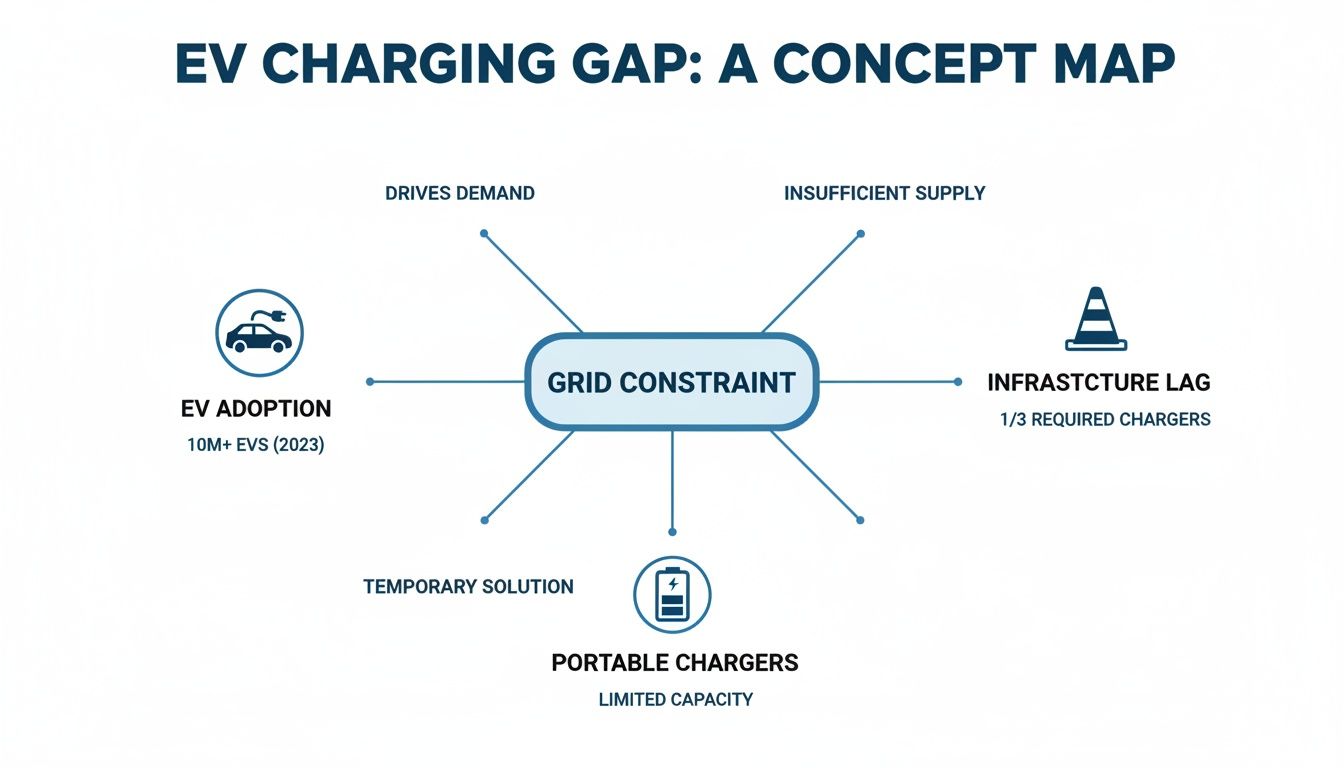
As you can see, these units act as a crucial buffer, taking the strain off the grid that’s being caused by slow infrastructure roll-outs and the fast-growing number of EVs on our roads.
The Key Components Inside
To pull this off, several key components work in harmony inside the unit, all managed by an intelligent control system. This is where the real brains of the operation come into play.
Three main elements make it all possible:
- The Battery Pack: This is the heart of the system. It’s a large-capacity lithium-ion battery, similar to those used in grid-scale batteries, acting as the energy reservoir for charging vehicles.
- The Battery Management System (BMS): The BMS is the brain. It constantly monitors the health of the battery cells, managing the flow of energy in and out to guarantee safety, efficiency and a long operational life.
- The Inverter: This critical piece of kit converts the direct current (DC) power stored in the battery into the alternating current (AC) drawn from the grid and it manages the high-power DC output needed for rapid charging.
Together, these components create a self-contained, stable and powerful energy source that can be deployed anywhere. They effectively turn any standard power socket into a potential rapid charging hub.
A Distributed Energy Solution
This technology positions portable charging stations as a vital part of the UK's move towards a distributed energy future. Instead of relying on a centralised model where all power has to come directly from the grid at the moment of use, these units create a network of mobile energy storage.
By storing off-peak or renewable energy, portable chargers don't just provide convenient EV charging; they actively contribute to grid stability. They can reduce peak demand, soak up excess renewable generation and offer a resilient power source during outages.
This capability makes them an invaluable tool for fleet operators, event organisers and any business looking to offer EV charging without kicking off costly and lengthy grid upgrades. The pairing of EV charging and batteries isn't just a temporary fix; it’s a fundamental building block for a smarter, more flexible energy system.
Key Business Use Cases for Mobile EV Charging
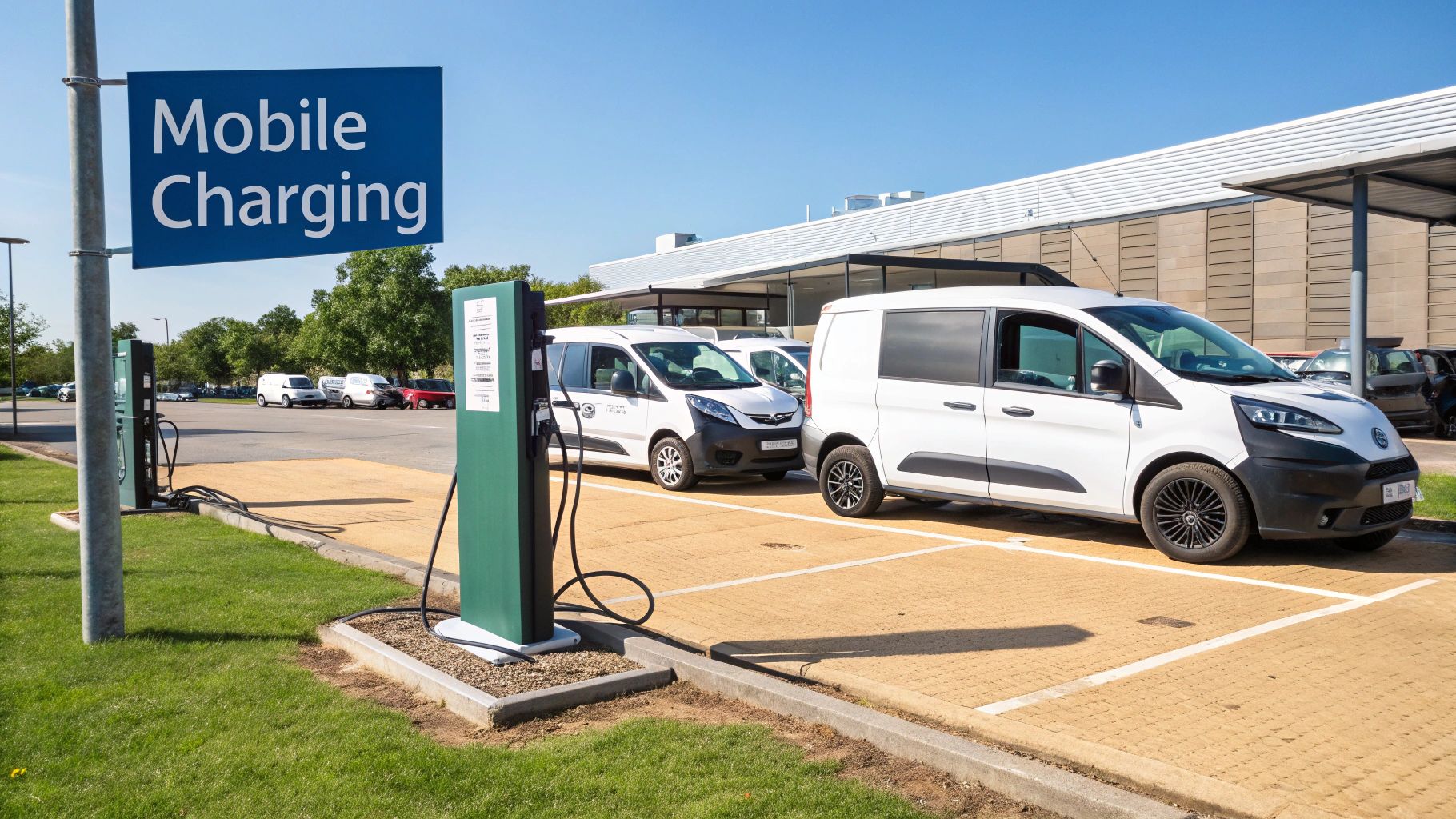
This is where the theory hits the road. The real value of portable charging stations shines brightest when you see them solving genuine business headaches. Across the UK, these mobile units are stepping in to provide practical, powerful solutions where fixed infrastructure simply can't keep up.
For any operations or procurement manager, getting to grips with these applications is the first step towards unlocking some serious operational efficiencies. The common thread you'll see is the need for fast, reliable EV charging in places where the grid is either too weak, temporarily needed or completely absent.
Temporary Power for Events and Festivals
Think about a big music festival or a sprawling agricultural show. They create a sudden, massive demand for EV charging that vanishes as quickly as it appears. It makes absolutely no financial or logistical sense to install permanent rapid chargers for a three-day event. This is the perfect job for portable charging stations.
We're talking about units that can be delivered to a site, strategically placed in car parks and provide rapid charging for hundreds of attendees, staff and vendors. When the last tent is packed away, the chargers are simply removed, leaving zero permanent footprint. It turns a potential logistical nightmare into a brilliant visitor amenity.
Emergency Roadside Assistance for Stranded EVs
"Range anxiety"—the fear of running out of juice—is still a major hurdle for many drivers thinking of switching to an EV. For breakdown services, a flat electric vehicle battery is a unique problem. You can't just show up with a jerry can.
Mobile EV charging units are completely changing the game for roadside assistance. A compact, powerful unit can be dispatched to a stranded motorist, giving them enough charge in a few minutes to comfortably reach the next fixed charging point. This doesn't just rescue drivers; it builds crucial confidence in the whole EV ecosystem.
By providing on-the-spot power, mobile charging turns a vehicle recovery mission into a simple refuelling stop. This dramatically reduces vehicle downtime and improves customer satisfaction for both private motorists and commercial fleet drivers.
The 'Depot-in-a-Box' for Fleet Electrification Trials
Countless UK fleet operators are eager to go electric but they're understandably wary of the massive upfront cost of depot-wide grid upgrades and permanent chargers. A portable charging station offers a fantastic, low-risk way to test the waters.
This "depot-in-a-box" concept allows a business to run a trial with a handful of electric vans or lorries without making any permanent changes to their site. The portable unit provides all the rapid charging needed to keep the trial vehicles on the road, allowing managers to gather real-world data on performance, running costs and driver feedback. It makes the final business case for full electrification far more robust. You can explore exactly how mobile EV chargers are powering UK fleets to get a clearer picture.
Flexible Workplace Charging Solutions
Businesses face growing pressure to provide workplace charging but it's not always straightforward. Leased buildings, limited parking or maxed-out grid connections can make installing permanent charge points a non-starter.
A portable charging station provides a clever workaround. It can be moved between parking bays to serve multiple employees' vehicles during the day or placed in a temporary spot without digging up the tarmac. This gives businesses a way to hit their sustainability targets and support their staff, even when their site has other plans.
To help you visualise where these units fit best, here’s a quick breakdown of their prime applications.
Portable Charging Station Application Matrix
| Use Case | Primary Challenge Addressed | Key Benefit | Ideal Power Level |
|---|---|---|---|
| Events & Festivals | Temporary, high-volume demand in locations with no permanent infrastructure. | Scalable, non-permanent solution that enhances visitor experience. | 50kW - 150kW+ |
| Fleet Trials | High capital cost and commitment of installing permanent depot chargers. | Low-risk, data-driven "try before you buy" approach to electrification. | 50kW - 100kW |
| Roadside Assistance | Inability to "refuel" a stranded EV with traditional recovery methods. | Rapid on-the-spot charging to get vehicles moving quickly. | 25kW - 50kW |
| Workplace Charging | Site limitations (leased property, grid constraints) preventing permanent installs. | Flexible, movable charging that adapts to site and employee needs. | 25kW - 75kW |
| Construction Sites | Lack of grid connection or temporary power needs during development phases. | Off-grid power for electric machinery and site vehicles without generators. | 50kW - 150kW |
This matrix shows just how adaptable these mobile powerhouses are, tackling distinct operational challenges with tailored power solutions. Their flexibility is what makes them such an indispensable tool for modern businesses.
Navigating Procurement and Deployment in the UK
Bringing portable charging stations into your operation isn't just a simple purchase. For any business or public sector body in the UK, a successful rollout depends on a strategic approach that balances technology, operational realities and the letter of the law.
Going for the cheapest unit on the market is almost always a false economy. Instead, a smarter approach is to focus on the Total Cost of Ownership (TCO) . This looks beyond the initial price tag to include everything from ongoing maintenance and software fees to day-to-day running costs. A well-built, reliable unit with solid support might cost more upfront but it will deliver far more value over its working life.
The right choice comes from asking the right questions. How will you move and position the unit? What does the maintenance schedule look like? Can the supplier offer remote diagnostics? These practical details are every bit as important as the charger's headline power rating.
Key Procurement Considerations
When you're comparing suppliers and models, you need a solid checklist. This is the only way to compare options on a true like-for-like basis and end up with a solution that makes sense for your specific needs—technologically, operationally and financially.
Your checklist should zero in on these key areas:
- Charging Speed and Battery Capacity: Make sure the unit can deliver the rapid EV charging speeds you need (say, 50kW or higher) and has a big enough battery to handle the expected number of vehicles before it needs its own recharge.
- Physical Footprint and Portability: Think about the unit's size, weight and how easy it is to move. If you're dealing with tight access or deploying to various locations, a compact and nimble design is essential.
- Supplier Support and Maintenance: Look for suppliers who offer comprehensive service level agreements (SLAs). This should cover scheduled maintenance, emergency call-outs and remote software updates to keep your charger online as much as possible.
- Software and Connectivity: A simple interface is crucial for both your team and the EV drivers using it. The system also needs reliable connectivity for payment processing, analysing usage data and remote management.
The procurement process should be viewed as a partnership. A good supplier won't just sell you a box; they will work with you to understand your operational challenges and configure a mobile EV charging solution that directly addresses them.
It also helps to understand how these units fit into the wider world of fixed infrastructure. For a deeper dive into the requirements, our commercial guide to EV charging infrastructure in the UK offers detailed insights that are just as relevant when procuring mobile solutions.
Site Planning for Temporary Deployments
Even for a temporary setup, proper site planning is non-negotiable. You can't just drop a unit anywhere. Getting the logistics and safety protocols right is critical to protect your staff, the public and the equipment itself.
Start with a thorough site assessment. You need to find a level, stable surface that can handle the unit's weight. You also need to ensure there's clear, safe access for both the delivery vehicle and the EVs that will be charging. Cable management is another big one—trailing cables are a serious trip hazard and must be safely covered or routed well clear of footpaths and traffic.
Ensuring UK Regulatory Compliance
In the UK, compliance isn't optional; it has to be a core part of your procurement process. Any portable charging station you deploy must meet strict safety and operational standards to protect users and the national grid.
The big one to watch is the Electric Vehicles (Smart Charge Points) Regulations . These rules require charge points to have 'smart' functionality, meaning they can manage charging times to help balance the grid. While these were written with fixed chargers in mind, the principles of safety, connectivity and data security apply directly to commercial-grade mobile units.
On top of that, all equipment must be CE/UKCA marked . This mark confirms that it meets UK standards for health, safety and environmental protection. Verifying these credentials with any potential supplier is a fundamental first step to making sure you invest in a safe, legal and effective solution.
Getting to Grips with Cost and ROI
For any finance director or procurement manager, the conversation always comes back to one question: what’s the return? The operational perks of portable charging stations might seem obvious but it’s the financial model that really needs to stack up to build a solid business case. This isn't just about the initial price tag; it's about understanding the full value these mobile units can bring to the table.
The return on investment (ROI) for portable EV charging isn't a simple, one-line calculation. Think of it as a blend of direct cashflow and, just as importantly, some major—and often missed—cost savings. It’s this dual-sided value that makes them such a sharp financial move, especially for sites wrestling with a weak grid connection.
Unlike fixed infrastructure, which can tie up capital for years before a single car gets plugged in, a portable unit can start earning its keep from day one.
Direct Revenue and Clever Cost-Cutting
The most straightforward route to ROI is through direct revenue. Setting up a simple pay-per-use model allows you to sell electricity at a healthy margin. This works brilliantly in high-demand, temporary spots like festivals, trade shows or even busy retail parks during peak seasons where drivers are happy to pay for quick, convenient charging.
But the financial upside goes well beyond charging fees. In fact, the indirect benefits are often where the real value lies:
- Attracting the Right Customers: EV drivers are a valuable demographic. Offering charging, even on a temporary basis, can seriously boost footfall and how long people stick around in retail, leisure and hospitality spots.
- Dodging Huge Grid Upgrade Costs: The bill for upgrading a local grid connection to handle permanent rapid chargers can easily run into tens, or even hundreds, of thousands of pounds. A portable charger completely sidesteps this, representing a massive saving on capital expenditure.
- Boosting Your Brand: Showing you’re committed to sustainability and supporting the EV transition can do wonders for your public image and corporate social responsibility credentials.
By mixing direct income with some very real cost avoidance, portable charging stations deliver a multifaceted ROI. They fix an immediate operational headache while opening up new revenue streams and protecting the balance sheet from eye-watering infrastructure costs.
This financial model is catching on fast in a market that's absolutely booming. The UK's EV charging industry, which includes portable charging stations , was valued at over £620 million in 2024 . That figure is expected to rocket to an incredible £9.7 billion by 2033 —a growth of over 1,400% . This explosion is being driven by EV sales hitting 21.6% of new cars in the first half of 2025 and is backed by huge industry investment. You can explore the full research on the UK's EV charging station market to see the sheer scale of this opportunity.
Building Your Business Case
To map out an accurate ROI, you need to model a few key factors. The initial cost of the unit is your starting point but you also need to factor in how much it’ll be used, what it costs to run (like recharging the unit and any software fees) and a smart pricing strategy.
A critical piece of the puzzle is a head-to-head comparison with the alternative: digging up the ground to install permanent charge points.
Financial Model Comparison
| Factor | Portable Charging Station | Permanent Rapid Charger Installation |
|---|---|---|
| Upfront Cost | A manageable capital outlay for the unit itself. | High cost for hardware, plus potentially enormous grid upgrade fees. |
| Installation Time | Next to none. It can be up and running in hours. | A long slog. Often involves months of planning, groundwork and DNO approvals. |
| Flexibility | Total. Move it where you need it, or sell it on if your needs change. | None. It's a sunk cost, physically tied to one spot. |
| Revenue Generation | Right away. You can start earning from the day it arrives. | Delayed. No money comes in during the long, drawn-out installation process. |
This comparison makes it clear that the financial argument for mobile EV charging isn’t just about lower initial costs. It’s about being agile, getting to market quickly and sidestepping the immense financial risk that comes with fixed infrastructure projects on sites with limited grid capacity. This is the kind of hard data you need to make an investment decision with confidence.
The Future of Mobile Charging and Distributed Energy
Portable charging stations are quickly moving beyond their role as a simple stopgap for grid constraints. They are becoming foundational pieces in the UK’s shift towards a smarter, more flexible and distributed energy system. The technology is evolving to not just consume power but to actively support and interact with the national grid.
This evolution is unlocking some serious capabilities and helping create a more resilient energy network for everyone. The future isn't just about mobile charging; it's about mobile energy management.
The Rise of Bi-Directional Charging and V2G
A huge leap forward is the integration of bi-directional charging , often called Vehicle-to-Grid (V2G). Soon, portable units won’t just charge EVs—they'll also be able to draw power back from a connected vehicle’s battery to support the grid when demand is high.
Imagine a fleet of these units at a major event. During the day, they're providing rapid charging for attendees. But in the evening peak, when grid demand soars, they could draw a small, managed amount of energy back from the connected cars to help stabilise the local network. This turns a car park full of EVs into a temporary power reserve.
Portable Chargers as Virtual Power Plants
When you connect multiple portable charging stations and manage them with smart software, they can act as one cohesive unit. This network is what’s known as a Virtual Power Plant (VPP) . It essentially aggregates the storage capacity of many individual units, allowing them to be controlled like a single, large-scale battery.
This approach brings some major benefits:
- Grid Balancing: The VPP can soak up excess renewable energy when it’s sunny or windy and then discharge it later when demand picks up.
- Peak Shaving: Businesses can use their fleet of portable chargers to cut down their reliance on expensive peak-time electricity from the grid.
- New Revenue Streams: VPP operators can actually sell energy back to the grid, participating in energy markets and creating a new income stream.
The concept of a Virtual Power Plant transforms portable chargers from isolated assets into active participants in the national energy market. They become a dynamic resource for maintaining grid stability and integrating renewables more effectively.
Advancements in Battery and Management Tech
The technology inside these units is also moving at a blistering pace. New battery chemistries are promising far greater energy density, which means future portable charging stations will be more compact, lighter and even more powerful than they are today. This will make them much easier to deploy in tight urban spaces or for rapid response scenarios.
Combine that with smarter energy management software—the kind that uses predictive analytics to optimise charging and discharging cycles—and the efficiency and ROI of these mobile assets will only continue to climb. All of this positions mobile EV charging as a vital part of a decentralised, intelligent energy future.
Frequently Asked Questions
Getting into the nuts and bolts of how these portable chargers work is a smart move before you invest. Here are some of the most common questions we get from businesses weighing up their options for mobile EV charging.
How Fast Can a Portable Charging Station Charge an EV?
The speed really depends on the model. While some smaller units offer a slower Level 2 charge (around 7-22kW ), the commercial-grade portable stations we're talking about are built for speed, typically delivering rapid EV charging at 50kW or more.
To put that in perspective, a 50kW unit can add about 100 miles of range in roughly 30 minutes . That kind of turnaround is essential for fleet operations, busy public events or roadside assistance, where every minute a vehicle is off the road costs money. The right power level always comes down to what you need it for.
Do We Need Planning Permission to Deploy a Portable Unit?
Usually, no. Because these units aren't permanent fixtures, you generally won't need to go through the formal planning permission process for temporary deployments.
However, it's always wise to check with the local council if you're placing a unit on public land or keeping it in one spot for a long time. They'll advise on placement, safety and any local rules. On your own private land, like a company car park, you've got much more freedom but you still need to follow health and safety regulations—think safe cable management to avoid trip hazards and clear signage for drivers.
How Are the Portable Charging Stations Recharged?
Most portable charging stations with their own large-scale batteries are recharged by plugging them into a mains electricity supply, typically an industrial three-phase socket. This is best done overnight or during off-peak hours when electricity is cheaper and there's less demand on the grid.
But here’s where they get really clever: they can be recharged using on-site renewables. Hook one up to a solar array, and you can capture and store clean energy, creating a completely self-sufficient mobile charging hub.
This turns them into a key part of a modern distributed energy strategy. It allows you to offer rapid EV charging and use the stored energy to completely bypass the need for an expensive, high-power grid connection right where you need to charge. A grid limitation suddenly becomes a real operational advantage.
Can These Units Work with a Weak Grid Connection?
Absolutely—that’s one of the main reasons they were designed. With their large internal batteries, these units can slowly trickle-charge from a low-power or constrained grid connection over many hours.
They bank all that energy and are ready to release it at high speed for rapid EV charging the moment a vehicle plugs in. This acts as a buffer, shielding the grid from the massive power spikes of rapid charging. It makes them the perfect solution for sites where permanent rapid chargers would require hugely expensive and disruptive grid upgrades.
Ready to overcome your grid limitations and deploy flexible, rapid EV charging? ZPN Energy offers the UK's only battery-backed portable charging stations with patented technology to deliver reliable power where you need it most. Explore our innovative solutions at https://www.zpnenergy.com.