UK Manufacturers of Electric Car Charging Stations: A Complete Guide
Choosing the right manufacturer for your electric car charging stations is one of the most important decisions you will make when investing in EV infrastructure. This is not just about the hardware; it is about finding a partner who genuinely understands power management, grid integration, and what is coming next in technology. This guide will help you cut through the noise in the UK market and make a choice that is right for your organisation.
Decoding the UK’s EV Charging Manufacturer Landscape
The UK's shift to electric vehicles is opening up massive opportunities for businesses, fleet managers and public sector organisations alike. Installing EV charging points has quickly moved from a "nice-to-have" perk to a fundamental part of any modern infrastructure strategy. But the success of your project really hangs on picking the right manufacturing partner from an increasingly crowded field.
This choice goes way beyond the physical charging unit you see on the wall or in the car park. You are investing in a long-term energy solution. The best partners do not just sell you a box; they provide the intelligence to manage power smartly, especially given the realities of the UK's electrical grid.
The Challenge of Constrained Grid Connections
Many of the best potential charging sites—from commercial depots to public car parks—run into a common problem: a constrained grid connection. Think of it like trying to fill several swimming pools at once using a single garden hose; the demand for power simply overwhelms the available supply. A manufacturer’s ability to solve this problem is what truly sets them apart. The smart solutions include:
- Grid Scale Batteries: These systems are a game-changer. They store up energy during off-peak times or from on-site renewables like solar, then deploy it for rapid EV charging without putting the local grid under stress.
- Intelligent Load Management: This is all about the software. It cleverly balances how power is distributed across multiple chargers, making sure every vehicle gets the charge it needs without tripping the site's main breaker.
- Combined On-Site Renewables: The ultimate solution is to combine EV charging with solar panels and battery storage. This creates a self-sufficient microgrid which not only slashes your reliance on the grid but also brings down your running costs.
The UK's EV charging sector is expanding at a phenomenal rate. The market has already blown past £620 million , with over 84,000 public chargers now installed. Forecasts suggest it could skyrocket to nearly £9.7 billion by 2033—an incredible growth of over 1,400% . You can read more about the UK's EV charging growth on Uswitch.com. This explosive growth just highlights how crucial it is to choose a future-proof solution from leading manufacturers of electric car charging stations.
Understanding Core EV Charging Technologies
Before you start talking to manufacturers of electric car charging stations , it helps to get your head around the foundational technologies that drive their products. The EV charging world is surprisingly diverse and picking the right type of charger is the first real step towards a successful roll-out for your business or fleet.
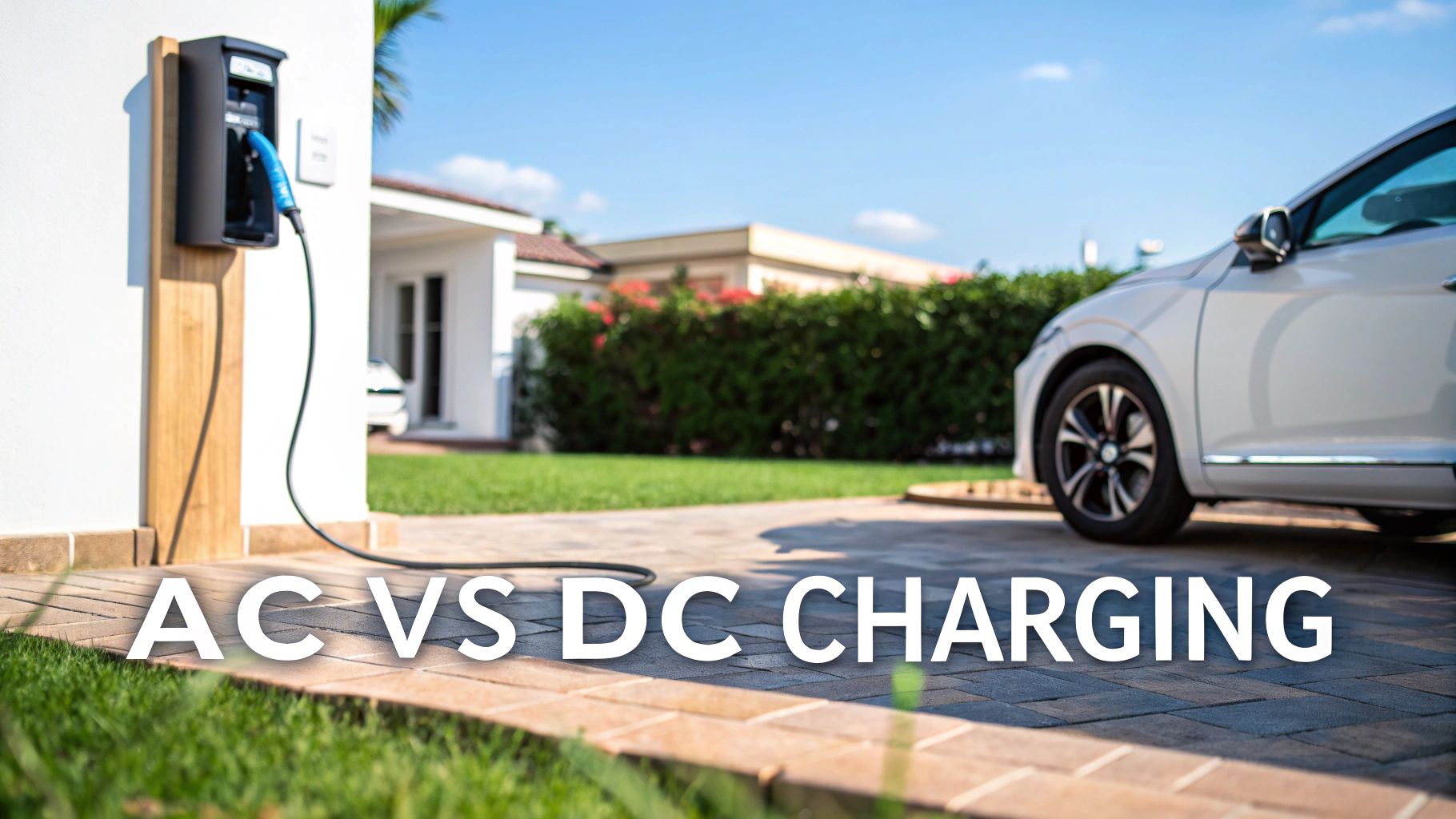
The main difference comes down to how power actually gets into the vehicle's battery. At its heart, the national grid supplies Alternating Current (AC), but every single EV battery stores its energy as Direct Current (DC). This simple fact is why we have two distinct types of charging infrastructure and knowing the difference is vital for matching the right hardware to your operational needs.
AC Charging: The Steady Approach
AC charging is the most common and familiar form of EV charging out there. Think of it like filling a swimming pool with a standard garden hose. It is a slow, steady process that works perfectly for situations where vehicles are parked for several hours at a time.
With an AC charger, the unit supplies AC power to the car and it is the vehicle's own on-board converter that does the job of changing it to DC to top up the battery. This naturally limits the charging speed to whatever the on-board converter can handle, which is typically between 7kW and 22kW .
- Best Use Cases: It is the ideal setup for workplace charging, where employees park all day, or for overnight charging at a fleet depot.
- Infrastructure: AC chargers are simpler and less expensive to install than their DC cousins, needing less complex hardware and lower-power grid connections.
This method is a fantastic baseline solution but it just cannot keep up with the demand for quick turnarounds needed by high-use commercial vehicles or drivers needing a quick top-up on the road.
DC Charging: The Rapid Solution
DC charging, often called rapid or ultra-rapid charging, flips the script entirely. To go back to our pool analogy, this is like calling in the fire brigade and using a high-pressure fire hose. It delivers a huge amount of power quickly and efficiently, making it absolutely essential for public charging networks and fast-turnaround commercial fleets.
With DC charging, the big, powerful AC-to-DC converter is not in the car; it is built right into the charging station itself. This allows it to completely bypass the car's smaller on-board unit and pump high-power DC electricity directly into the battery. This direct connection unlocks charging speeds from 50kW all the way up to 350kW and beyond, slashing charging times from hours to minutes.
DC fast chargers are the cornerstone of public charging networks and high-throughput fleet operations. They can add hundreds of miles of range in under an hour, making long-distance EV travel and intensive commercial use feasible.
If you’re keen to get into the nuts and bolts, our ultimate guide to rapid EV charging gives a full breakdown of this technology.
Of course, all that speed comes with greater complexity and cost. The hardware is more substantial and the installation often requires a hefty grid connection, which can be a major stumbling block for many sites. This is where innovative manufacturers come in, offering solutions like integrated battery storage to deliver rapid EV charging from constrained grid connections .
Mobile EV Charging: Flexible Power on Demand
Looking beyond fixed installations, mobile EV charging offers a brilliantly versatile alternative. These are self-contained chargers, often mounted on a vehicle or a trolley, that can be brought directly to an EV wherever it is. They are perfect for situations where digging up the ground for permanent infrastructure just is not practical or possible.
This flexibility makes them invaluable for a few key scenarios:
- Emergency roadside assistance for EVs that have run flat.
- Providing temporary charging at events, festivals, or conferences.
- "Charging as a Service" models for fleets in depots without fixed charge points.
Mobile units neatly bridge the gap between fixed infrastructure and immediate, on-the-spot demand. They are a great example of how advanced energy solutions can overcome logistical headaches and as the EV market continues to expand, being able to deliver power precisely where it is needed will become a game-changer for fleet managers and service providers alike.
Meeting the Key UK Electric Car Charging Station Manufacturers
Now that we have a solid grasp of the different charging technologies, it is time to look at the companies actually building these systems. The UK market is a fascinating mix of global industrial powerhouses going head-to-head with nimble, focused specialists and each brings something different to the table. For any business or public body, getting to know this landscape is the first step in finding the right partner.
This is not just about producing a box that delivers a charge; it is about providing a complete energy solution. That means robust hardware, intelligent software and reliable long-term support. The market is packed with major multinationals and dedicated UK firms all competing for your business. Big names like ABB Ltd , Siemens AG and ChargePoint Inc. are key players supplying the hardware and this healthy competition is pushing innovation forward, especially in the rapid charger space where everyone wants shorter charging times. You can explore more on the UK vehicle charging equipment market for a more detailed analysis.
This diversity is great for choice but it can also make the selection process feel a bit overwhelming. Let's break down the main players to bring some clarity.
Overview of Key EV Charging Manufacturers in the UK Market
To help you navigate the options, this table provides a snapshot of some prominent manufacturers, what they focus on and who they typically serve. It's a useful starting point for identifying potential partners that align with your project's goals.
| Manufacturer | Primary Focus | Key Product Categories | Target Market |
|---|---|---|---|
| ABB | High-power DC charging and industrial-grade solutions. | Rapid & ultra-rapid DC chargers, AC wallboxes, fleet charging systems. | Public charging networks, fleet operators, heavy industry. |
| Siemens | Integrated energy and eMobility infrastructure. | AC chargers, high-power DC chargers, depot charging solutions. | Commercial real estate, large-scale fleets, public sector. |
| ChargePoint | Networked charging solutions with a strong software focus. | AC and DC chargers, fleet management software, roaming services. | Workplaces, retail, multi-family housing, fleets. |
| Alfen | Smart charging systems and energy storage integration. | Smart AC chargers, transformer substations, battery storage systems. | Businesses, public spaces, grid operators. |
| ZPN Energy | Grid-independent rapid charging using integrated battery storage. | Ultra-rapid chargers with BESS, mobile charging units, microgrids. | Grid-constrained sites, fleets, forecourts, local authorities. |
This overview shows the variety in the market, from hardware-focused giants to specialists in software or integrated energy. Your specific needs—be it raw power, smart networking, or grid independence—will guide you toward the right type of manufacturer.
Global Engineering Giants
Some of the most established names in electrical engineering are, unsurprisingly, major forces in EV charging. Companies like ABB and Siemens apply their deep experience in energy infrastructure, automation and power electronics to produce incredibly reliable and scalable charging solutions.
Their main strengths often lie in:
- Comprehensive Portfolios: They offer everything from simple AC wall boxes for the office car park to massive high-power DC systems for public hubs and fleet depots.
- Proven Reliability: With decades of experience in tough industrial settings, their hardware is typically built like a tank, ready for heavy use and harsh weather.
- Global Support Networks: Their sheer size means they can offer service and maintenance support almost anywhere.
These giants are often the go-to choice for large-scale, critical projects where proven technology and bankability are the top priorities. They really shine in complex installations that require deep integration with existing power grids.
Dedicated EV Charging Specialists
Alongside the industrial titans, you will find a vibrant group of companies that live and breathe EV charging. Firms such as ChargePoint and Alfen have built their entire businesses around creating connected, user-friendly charging experiences. This single-minded focus allows them to be incredibly agile and often leads them to pioneer new software and network management features.
These specialist firms often lead the way in user experience and network integration. Their platforms are designed from the ground up for managing large, distributed networks of chargers, offering sophisticated tools for pricing, access control and analytics.
What really sets these companies apart is their holistic view of the charging ecosystem. They know the charger is just one piece of the puzzle; the software that controls it is just as, if not more, important. They provide solutions that are not just about delivering power but about managing it intelligently.
Innovators in Integrated Energy Solutions
A third, exciting category is now emerging: manufacturers who see EV charging not as a standalone product but as a key piece of a much bigger energy system. These forward-thinking companies are experts at combining EV charging with batteries and distributed energy resources like solar panels.
They tackle the critical challenge of grid constraints head-on. Instead of just plugging a high-power charger into the mains and hoping for the best, they design systems that use on-site battery storage to buffer the connection. This clever approach makes it possible to deploy rapid EV charging even in locations with very limited grid capacity.
By integrating grid scale batteries , these manufacturers transform a simple charging point into a smart energy asset. This is absolutely essential for future-proofing any charging investment, allowing sites to become more energy-independent, resilient and ultimately, more cost-effective.
Solving Power Challenges with Grid Scale Batteries
Let's be honest, one of the biggest roadblocks to rolling out rapid EV charging is not the charger itself—it is the local electricity grid. Many of the most logical spots for charging hubs, like petrol station forecourts or business parks, are stuck with surprisingly weak grid connections. It is like trying to power a massive industrial kitchen from a single household plug socket; the demand just completely swamps the supply.
This is where the truly forward-thinking manufacturers of electric car charging stations show their mettle. Instead of seeing a weak grid as a deal-breaker, they design clever systems that simply work around it. The secret ingredient? Integrating EV chargers with Battery Energy Storage Systems (BESS), what many call 'grid scale batteries'.
Bypassing Grid Limitations with Stored Energy
Think of a Battery Energy Storage System as a local power reservoir. It allows a site to slowly sip power from a weak grid connection during off-peak hours when electricity is cheaper and no one else wants it. Imagine filling up a huge water tank overnight using a tiny, slow-running tap.
That energy is then stored on-site, ready for when it is needed most. When an EV pulls up desperate for a rapid charge, the system does not try to pull a massive, grid-breaking surge of power from the mains. Instead, it unleashes the high power needed directly from its own battery, leaving the fragile local grid completely out of the picture.
This simple but powerful concept decouples charging speed from grid capacity. It means you can install multiple 150kW or even 300kW ultra-rapid chargers on sites that, on paper, could barely support a couple of slow 7kW units.
Suddenly, a massive liability becomes a major asset. A location that was once a complete non-starter for rapid charging is transformed into a high-power, revenue-generating hub. All without the eye-watering costs and endless delays of begging the local Distribution Network Operator (DNO) for a grid upgrade.
Creating a Smart and Resilient Energy Asset
But integrating batteries with EV charging does far more than just solve a power problem—it creates a smart, flexible energy ecosystem. The best manufacturers do not just build chargers; they deliver complete distributed energy management solutions.
This opens the door to a whole new world of capabilities:
- Combined On-Site Renewables: Got solar panels on the roof? The battery can soak up all that free, clean energy during the day and store it. Later, you can use that sunshine to charge cars, slashing your running costs and carbon footprint.
- Peak Shaving: The system is smart enough to know when electricity tariffs are at their highest. It can automatically use stored battery power to run the site's other loads during these peak times, dodging expensive rates and cutting your overall energy bills.
- Grid Services: These battery systems can even be configured to sell services back to the grid. By helping to stabilise the local network, they can open up entirely new revenue streams for the site owner.
By bringing these elements together, a simple charge point is transformed into an intelligent, resilient and profitable asset that actively manages its own power. It stops being a drain on your resources and becomes a cornerstone of your site's entire energy strategy. To see just how this works in practice, you can explore our deep dive into grid scale battery storage powering the UK .
The Future of EV Charging Infrastructure
As more and more of the UK’s vehicles go electric, the strain on the national grid is only going to get worse. Just plugging more and more high-power chargers directly into the mains is not a viable long-term plan. The cost and logistical nightmares of upgrading substations and laying new cables are huge barriers to the speed of expansion we need.
This is why manufacturers who specialise in battery-integrated charging are so critical. They are not just selling a product; they are delivering a fundamental piece of the UK’s future energy infrastructure. Their ability to provide rapid EV charging from constrained grid connections is absolutely essential if we are going to hit our net-zero targets and make sure drivers can charge quickly and easily, no matter where they are. This approach is not just a clever workaround; it is how we build a charging network that is robust, financially sound and ready for whatever tomorrow throws at it.
How to Choose the Right EV Charging Manufacturer
Picking the right partner from the crowded field of electric car charging station manufacturers is a decision that goes well beyond the initial price tag. For businesses, local authorities and fleet operators, this is a long-term investment in your energy infrastructure. A successful project means looking past the hardware's sticker price to truly understand its reliability, the intelligence of its software and the quality of support you will get down the line.
This guide gives you a practical framework to cut through the noise. It is designed to help you evaluate the essentials, ensuring you secure a solution that is both effective and economical over its entire lifecycle. The goal is simple: find a manufacturer whose technology not only meets today’s charging needs but also fits into your energy strategy for tomorrow.
This diagram shows how modern charging systems integrate batteries to deliver rapid charging, even when the grid connection is weak.
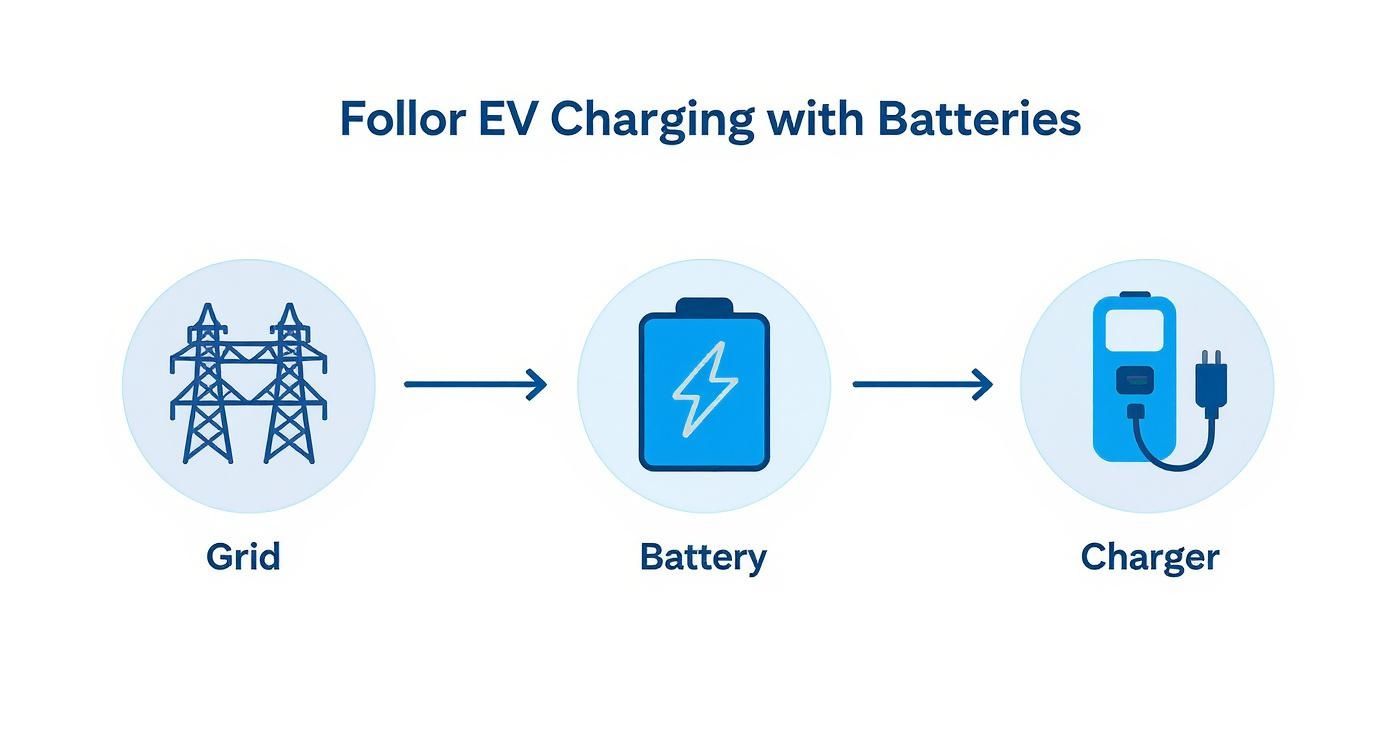
The flow from the grid to an on-site battery, and then to the charger, shows how stored energy can completely bypass grid limitations. This integration is the key to deploying high-power charging solutions without the costly and time-consuming process of grid upgrades.
Assessing Hardware Reliability and Compliance
The physical charger is the foundation of your whole system. It has to be built to last. Look for manufacturers who can prove their products can stand up to real-world conditions, especially in the demanding UK climate.
Your hardware evaluation should zero in on a few key areas:
- Certifications: Make sure every unit is CE marked and complies with all relevant UK safety standards. For accessibility, check for compliance with standards like PAS 1899 , which ensures they are easy to use for disabled drivers.
- Build Quality: Take a close look at the materials used for the casing and internal components. Are they tough enough to handle potential vandalism or accidental bumps in a busy car park?
- Cable Management: Messy, unmanaged cables are a frequent point of failure and a huge safety hazard. Smarter solutions, like theft-resistant recoiling cables, do not just improve safety—they can drastically cut your maintenance costs.
Evaluating the Software and Management Platform
The software, often called a Charge Point Management System (CPMS), is the brain of your entire operation. A powerful and intuitive platform is non-negotiable for handling remote management, user billing and energy optimisation.
A manufacturer with a robust, secure and user-friendly software platform provides significantly more long-term value than one that only supplies hardware. The software dictates your ability to generate revenue, manage loads and diagnose faults efficiently.
Key software features to scrutinise include:
- OCPP Compliance: Open Charge Point Protocol (OCPP) compliance is your ticket to freedom, ensuring you are never locked into a single vendor's network. Prioritise manufacturers who support the latest versions, like OCPP 2.0.1 , to get the most future-proof system.
- Load Balancing: The system must be able to intelligently share available power across multiple chargers. This is absolutely critical when you are working with a constrained grid connection.
- Remote Diagnostics: The ability to monitor units and troubleshoot problems from a distance will save you an enormous amount of time and money on engineer call-outs.
Scrutinising After-Sales Support and Total Cost of Ownership
Your relationship with a manufacturer does not end after the installation crew leaves. The quality of their after-sales support and the true total cost of ownership (TCO) are what determine your long-term success.
You have to dig deeper than the initial quote. Ask detailed questions about warranties, software update policies and the availability of technical support. The UK’s charging network is diverse; 20% of public chargers are high-power units of 50kW or more, while 56% are slower units between 3kW and 8kW . Make sure the manufacturer’s support team can handle the specific type of hardware you are deploying.
When sizing up potential partners, it is also useful to get a sense of their business model. For instance, some manufacturers work with independent sales representatives and it is worth understanding the role of manufacturers' representatives if that is the case. For a complete walkthrough of how to make your final decision, read our full breakdown on choosing EV charger manufacturers in the UK. It will help you weigh all the variables and select a partner that delivers genuine, long-term value.
The Future of EV Charging and Manufacturer Innovation
The world of EV charging is moving at a breakneck pace. The most forward-thinking manufacturers of electric car charging stations are not just keeping up; they are leading the charge. Today’s innovation is all about making charging faster, smarter and more deeply integrated into our national energy systems.
Take the push towards ultra-high-power charging. While rapid chargers are becoming more common, the new frontier is delivering power well over 350kW . This kind of performance aims to slash charging times down to little more than a conventional refuelling stop—a game-changer for high-mileage fleets and public confidence.
Of course, this relentless pursuit of speed has to be managed intelligently. That is why manufacturers are increasingly using AI to optimise energy use. This tech can predict charging demand and communicate with the grid, drawing power at the cheapest and greenest times.
Embracing Bi-Directional Charging and Open Standards
One of the most exciting developments on the horizon is bi-directional charging, often called Vehicle-to-Grid (V2G). This technology effectively turns every EV into a mobile battery.
Imagine your vehicle powering your home during a blackout or even selling energy back to the grid during peak demand. This creates a new revenue stream for vehicle owners and transforms cars from simple energy consumers into active participants in a distributed energy network.
To make sure all this clever technology works together seamlessly, manufacturers are getting behind open standards.
- Prevents Vendor Lock-in: The Open Charge Point Protocol (OCPP) is crucial here. It gives site owners the freedom to mix and match hardware and software from different suppliers, preventing them from being tied to a single ecosystem.
- Improves User Experience: Ultimately, it fosters a more competitive and user-friendly market where any driver can use any charger without hassle.
Choosing a forward-thinking manufacturer is not just about buying a piece of hardware. It is an investment in a long-term, profitable and sustainable energy strategy that will play a vital role in the UK's net-zero transition. It is about preparing for a future where EV charging and batteries are central to our energy independence.
Got Questions? Let's Get Them Answered
Dipping your toes into the world of EV charging naturally brings up a lot of practical questions, especially when you are looking to invest. As you start sizing up different manufacturers of electric car charging stations , it is completely normal to want straightforward answers on the big topics. This section tackles some of the most common queries we hear, designed to bring a bit of clarity to your procurement process.
Getting your head around these details is the first step to having a more productive chat with potential manufacturing partners. From the software that runs the show to the grid connection itself, knowing the right questions to ask is half the battle.
What’s the Difference Between an EV Charging Operator and a Manufacturer?
It is easy to mix these two up but they play very different roles. A manufacturer is the company that actually designs, engineers and builds the physical charging hardware. Think of them as the creators of the technology—from the complex power electronics tucked away inside to the user interface you see on the screen.
An EV charging network operator, on the other hand, owns and manages a public network of charging stations. They are the ones who buy hardware from various manufacturers and then offer a charging service to the public. The distinction is vital: you go to a manufacturer to buy the kit for your own site but you use an operator's network when you need to charge your car on the road.
How Important Is Software When Choosing a Charging Station Manufacturer?
In a word: critical. The software, or Charge Point Management System (CPMS), is the brain of the entire operation. It is not just a fancy dashboard; it controls everything from running remote diagnostics and handling payments to enabling smart charging and managing your overall energy use.
A manufacturer that provides a solid, secure and user-friendly software platform offers so much more long-term value than one just shifting hardware. The software is what determines your ability to generate revenue, efficiently manage your electricity load and fix faults without sending an engineer out every time. It is what turns a simple charger into a genuinely profitable asset.
Do I Need a Grid Upgrade to Install Rapid EV Chargers?
Not necessarily, and this is a huge misconception that puts a stop to far too many projects before they even start. The most forward-thinking manufacturers now specialise in creating solutions designed specifically for sites with constrained grid connections . This is where some of the most exciting innovation in the industry is happening.
The smartest solution involves pairing a Battery Energy Storage System (BESS) directly with the EV chargers. This setup lets you slowly top up an on-site battery from a weak grid connection during off-peak hours. Then, when a vehicle plugs in, the battery can discharge that stored energy at high power to deliver a rapid charge.
This approach neatly sidesteps the grid's limitations. It helps you completely avoid the eye-watering costs and frustratingly long delays that come with applying for grid reinforcement from the local Distribution Network Operator (DNO). For a huge number of locations, it is the only realistic way to offer proper rapid EV charging .
At ZPN Energy , we specialise in delivering rapid and ultra-rapid EV charging solutions that work, even on the most constrained grid connections. Our integrated battery storage technology and patented energy management systems provide unparalleled power and reliability. Explore our advanced charging solutions and see how we can power your project.