What Is a kWh Your Guide to UK Energy and EV Charging
A kilowatt-hour, or kWh , is the fundamental unit of measurement for the energy you use. It's not about speed or power; it’s about quantity.
Think of it like the litres of fuel you pump into a car. A litre is a specific amount and a kWh is a specific amount of electrical energy. This single unit is the cornerstone of your electricity bill and the key to understanding everything from charging an electric vehicle to sizing a grid-scale battery.
Demystifying The Kilowatt-Hour

To really get to grips with the kWh , we first have to draw a clear line between it and the kilowatt ( kW ). People often mix them up but they measure two completely different things.
-
Kilowatt (kW): This measures power. Think of it as the rate of energy flow at any single moment. A rapid EV charger might be rated at 150 kW while a kitchen kettle could be 3 kW . It's all about how much electricity an appliance needs right now.
-
Kilowatt-Hour (kWh): This measures energy. It’s the total volume of electricity consumed over a period. You get this figure by multiplying the power ( kW ) by the time (in hours) it's used for.
Here’s a simple analogy: imagine filling a bucket with a hose. The kilowatt (kW) is how fast the water is flowing out of the hosepipe. The kilowatt-hour (kWh) is the total amount of water you have in the bucket once you turn the tap off.
This distinction is crucial. A powerful 150 kW EV charger left running for one hour will consume 150 kWh of energy but a low-power device running for many hours could easily use the same amount.
Why The kWh Is Central To Energy Management
At its most basic, the kWh is what your energy supplier uses to bill you. It’s the universal language of energy consumption, making it vital for everything from calculating EV running costs to designing complex grid-scale battery systems.
The way we use energy has shifted dramatically over the years. For instance, typical electricity use per person in British households fell from around 720 kWh a year in 1997 to roughly 508 kWh by 2012, even as we all started using more gadgets. This drop highlights how efficient appliances and better insulation can seriously reduce our overall kWh consumption, making every unit of energy work harder. You can dive deeper into these consumption trends in Great Britain to see the bigger picture.
From EV Charging to Grid-Scale Batteries
Once you understand the kWh , you're empowered to make smarter decisions. If you know an EV has a 77 kWh battery, you can work out its charging cost. If a battery energy storage system (BESS) is rated at 200 kWh , you know exactly how much energy it can store to support a constrained grid connection.
Whether you're managing mobile EV charging for a commercial fleet or designing a system that combines on-site renewables with battery storage, the kWh is the metric that ties it all together. It’s the common denominator linking distributed energy generation, storage and consumption—making it the single most important unit in the modern energy landscape.
Seeing the kWh in Your Daily Life
To really get a feel for what a kWh is, let's step away from the theory and look at how it shows up in our everyday lives. A kilowatt-hour isn't just an abstract number on your bill; it's a tangible measure of the energy that powers everything, from charging an EV fleet to running a data centre.
Seeing the kWh in action helps put its value into perspective. Take your standard 3 kW kettle, for instance. It might take about three minutes to boil enough water for a few cups. That short, intense burst of power uses around 0.15 kWh . Do that a few times a day and you can see how quickly those small amounts add up.
Power vs. Time: The kWh Balancing Act
A common point of confusion is how very different appliances can end up using a similar amount of energy. The secret lies in the relationship between power (kW) and time (hours) . A high-power device used for just a few minutes can consume the same amount of energy as a low-power gadget left on for hours.
Let's compare two common items to see this play out:
- A Rapid EV Charger: A 150 kW rapid charger running for ten minutes delivers 25 kWh of energy. It’s powerful but you only use it for very short periods.
- A Low-Power Server: A small server might only draw about 250 watts (0.25 kW) but it’s likely running 24 hours a day . Over the course of one hundred hours, it also consumes 25 kWh .
This shows that getting a handle on your total kWh consumption isn’t just about the big, power-hungry equipment. It’s also about the small, always-on devices that are constantly sipping energy in the background, contributing to the baseload of your distributed energy system.
Understanding the kWh consumption of individual assets is the first step towards true energy awareness. It lets you see exactly where your energy is going and make smarter decisions to cut down on waste, which ultimately leads to lower electricity bills.
From Kettles to EV Fleets
Appliances and equipment all around your business offer perfect, real-world examples of kWh consumption. Each one has a power rating—usually in watts or kilowatts—which is the starting point for figuring out how much energy it uses.
Think about a rapid EV charger. A typical 30-minute charging session at 50 kW will deliver 25 kWh of energy to a vehicle's battery. An ultra-rapid charger operating at 150 kW for the same duration would deliver 75 kWh . This really highlights the impact that charging infrastructure choices can have on a fleet's operational efficiency and energy footprint.
Getting familiar with these figures helps you make smarter choices every day. You start to see the direct connection between your daily operations and your energy bill. For anyone serious about taking control, exploring ways of maximising home energy efficiency can uncover practical steps that lead to long-term savings. By looking at your business through the lens of the kWh, you gain the power to manage your energy much more effectively.
How kWh Drives Electric Vehicle Charging
When we make the switch from traditional petrol cars to electric vehicles, the way we think about "fuel" has to change too. In the world of EVs, the kilowatt-hour is everything. It becomes the new litre of petrol.
An EV’s battery capacity, which is basically the size of its fuel tank, is measured in kWh . A car with an 80 kWh battery can hold more energy and travel further on one charge than a vehicle with a smaller 50 kWh battery. It's the single most important number for figuring out an EV's potential range.
Your EV Battery as an Energy Tank
Just like you’d talk about a petrol car’s efficiency in miles per gallon, an EV's performance is measured in miles per kWh . This tells you exactly how far the car can go using one kilowatt-hour of energy. A really efficient EV might get 4 miles per kWh , meaning every unit of energy from its battery powers it for four miles.
Getting your head around this is the key to calculating real-world running costs. Once you know your electricity tariff and your car's efficiency, you can work out the precise cost of any journey. It puts you in control, letting you plan charging stops and manage your energy budget properly.
The infographic below helps put the energy of a single kWh into a more familiar, everyday context.
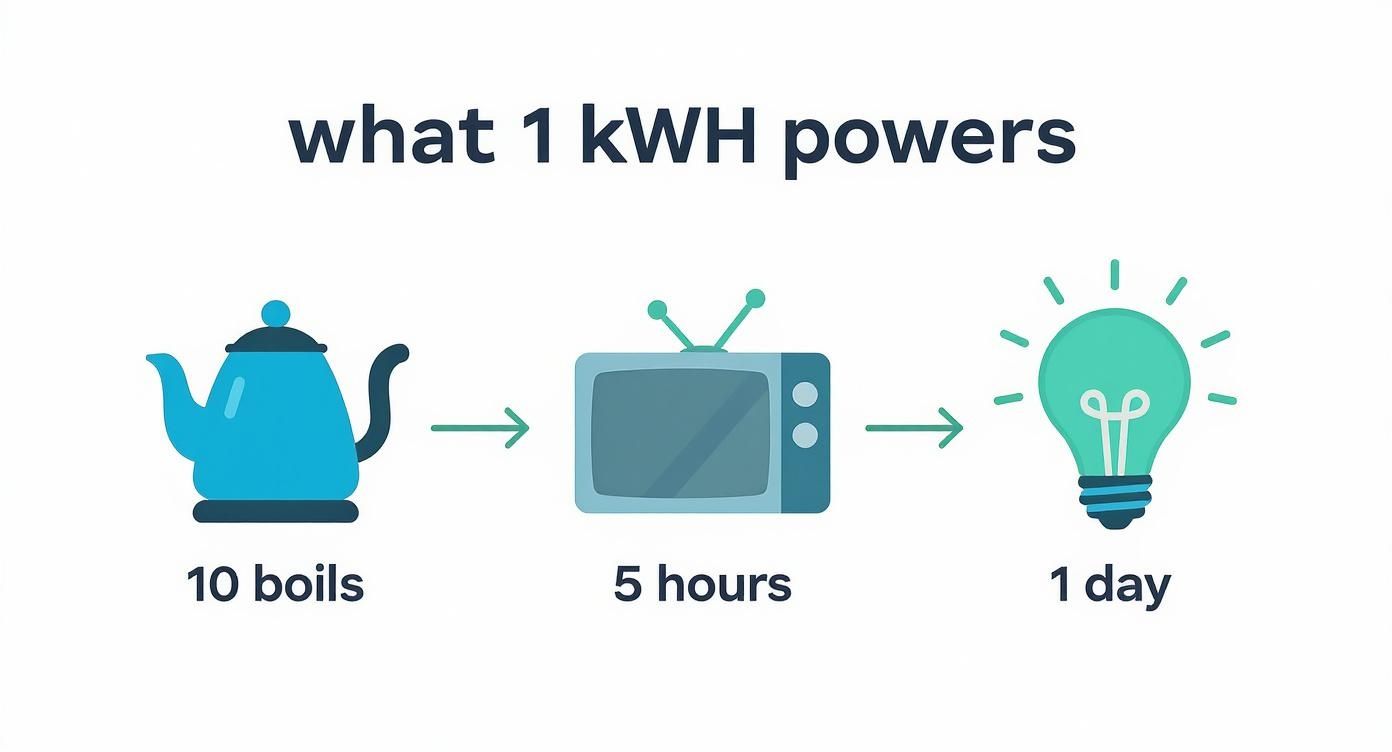
It shows that the same unit of energy that boils your kettle a few times can also propel an EV for several miles, neatly connecting the energy we use at home with the energy we use for transport.
Filling the Tank: The Role of Charging Speed
If kWh is the amount of energy in the tank, then charging speed—measured in kilowatts ( kW )—is how fast you can fill it up. The higher a charger's kW rating, the quicker it sends energy to your vehicle's battery. This is where the difference between charger types really matters for drivers and fleet managers.
Let’s quickly run through the common types of EV chargers in the UK:
- Workplace/Destination Chargers (e.g., 7 kW): These are perfect for all-day charging. A 7 kW unit adds about 7 kWh of energy to a battery every hour. For an EV getting 3.5 miles per kWh , that’s roughly 24.5 miles of range added each hour.
- Rapid Chargers (e.g., 50 kW): You’ll find these at service stations and public hubs, designed for quick top-ups on the go. A 50 kW charger can deliver 50 kWh in an hour, which is around 175 miles of range in that time—a huge help for drivers on longer journeys.
- Ultra-Rapid Chargers (150 kW+): These are the top tier of charging technology, essential for commercial fleets and high-throughput sites. A 150 kW charger can add a serious amount of range in just a few minutes, making long-distance EV travel and quick turnarounds more practical than ever.
The table below breaks this down, showing how long it takes to add 100 miles of range with different chargers, assuming an EV efficiency of 3.5 miles/kWh .
EV Charging Speeds and Times Explained
| Charger Type | Power Output (kW) | Energy Needed for 100 Miles (kWh) | Approximate Charging Time |
|---|---|---|---|
| Workplace Charger | 7 kW | 28.6 kWh | ~ 4 hours |
| Rapid Charger | 50 kW | 28.6 kWh | ~ 35 minutes |
| Ultra-Rapid Charger | 150 kW | 28.6 kWh | ~ 12 minutes |
It’s clear how much of a difference the charger's power makes. While a depot charger is great for overnight use, rapid and ultra-rapid options are essential for keeping vehicles moving efficiently during the day.
The relationship is simple: a vehicle's battery size (kWh) and the charger's power output (kW) directly dictate the charging time. A bigger battery will take longer to fill but a more powerful charger can slash that waiting period.
EV Charging with Constrained Grid Connections
One of the biggest hurdles for businesses wanting to install multiple rapid EV chargers is the limit of their grid connection. Drawing that much power (kW) all at once can easily overload the local infrastructure. This is where smart solutions like battery energy storage systems (BESS) and mobile EV charging are a game-changer.
A BESS can store up energy (kWh) during off-peak hours when electricity is cheaper and grid demand is low. It then uses that stored energy to power the rapid EV chargers during busy periods, all without putting extra strain on the grid. It's a clever way to install powerful charging hubs even where the grid connection is weak. Add on-site renewables like solar panels and you create a truly self-sufficient distributed energy system.
For businesses looking to solve these puzzles, balancing power demand is crucial. You can learn more by reading our guide to dynamic power management for EV charging. This technology intelligently shares out the available power, making sure all connected vehicles get charged efficiently without tripping the site's electrical capacity. It's the smart way to maximise your charging availability and protect your investment for the future.
Understanding Your UK Electricity Bill
For most businesses, an electricity bill is where the concept of a kilowatt-hour hits home, turning your energy usage into actual pounds and pence. At its core, your bill is a straightforward calculation: the number of kWh you’ve used in a billing period, multiplied by the price you pay for each one.
To really get to grips with your bill, you need to find two key numbers. The first is the unit rate – this is the price for every single kilowatt-hour ( kWh ) of electricity you use. It's usually listed in pence per kWh and is the part of your bill that goes up or down with your consumption.
The second is the daily standing charge . Think of this as a line rental for your electricity supply. It's a fixed daily fee that covers the cost of keeping you connected to the grid, maintaining meters and other network upkeep. You pay it every day, whether you use a lot of electricity or none at all.
How Tariffs Dictate Your kWh Cost
The price you actually pay per kWh isn't the same for everyone; it all comes down to your energy tariff. In the UK, there are several different tariff structures and picking the right one is absolutely crucial for keeping costs down, especially if you're running high-demand equipment like rapid EV chargers or grid-scale batteries.
- Standard Variable Tariffs (SVTs): On an SVT, the price you pay per kWh can change, often tracking the wholesale energy market. They offer flexibility but you’re exposed to price hikes, which can make budgeting tricky.
- Fixed-Rate Tariffs: With these, you lock in a specific price per kWh for a set term, usually 12 or 24 months . This gives you predictability and protects you from sudden price increases but you won't benefit if market prices happen to drop.
- Time-of-Use Tariffs: These are becoming a game-changer for businesses with EV fleets and battery storage. They offer much cheaper electricity during specific off-peak windows, typically overnight. Charging an EV or a BESS on an off-peak rate of 7.5p per kWh instead of a peak rate of 28p per kWh can slash your energy costs by over 70% .
Understanding your tariff is about more than just finding the lowest number. It’s about aligning your biggest energy demands with the times of day when each kWh costs you the least. For a commercial EV fleet or a business running rapid chargers from a constrained grid connection, this strategic thinking is fundamental to controlling operational expenses.
The Factors Influencing the Price of a kWh
That unit rate on your bill is shaped by a complex web of factors happening far beyond your meter. The single biggest driver is wholesale energy costs – what suppliers have to pay for electricity on the open market. When the price of gas or other fuels used for generation goes up, the cost per kWh for consumers almost always follows suit.
Network charges also play a big part. These are the fees for physically moving electricity from power stations to your premises through the national grid and local distribution networks.
Over the long term, electricity costs in the UK have seen major increases, reflecting everything from global fuel prices to investment in new infrastructure and shifts in government policy. To give you an idea, non-domestic electricity prices peaked at 28.39 pence per kWh in late 2023—more than double what they were in 2021—before easing slightly in early 2024. These swings show just how much complex market dynamics feed into the final price of every kWh you use.
You can learn more about the impact of energy costs on UK businesses from the Office for National Statistics. By grasping these elements, you get the full picture of what you’re paying for.
The kWh in Advanced Energy Systems
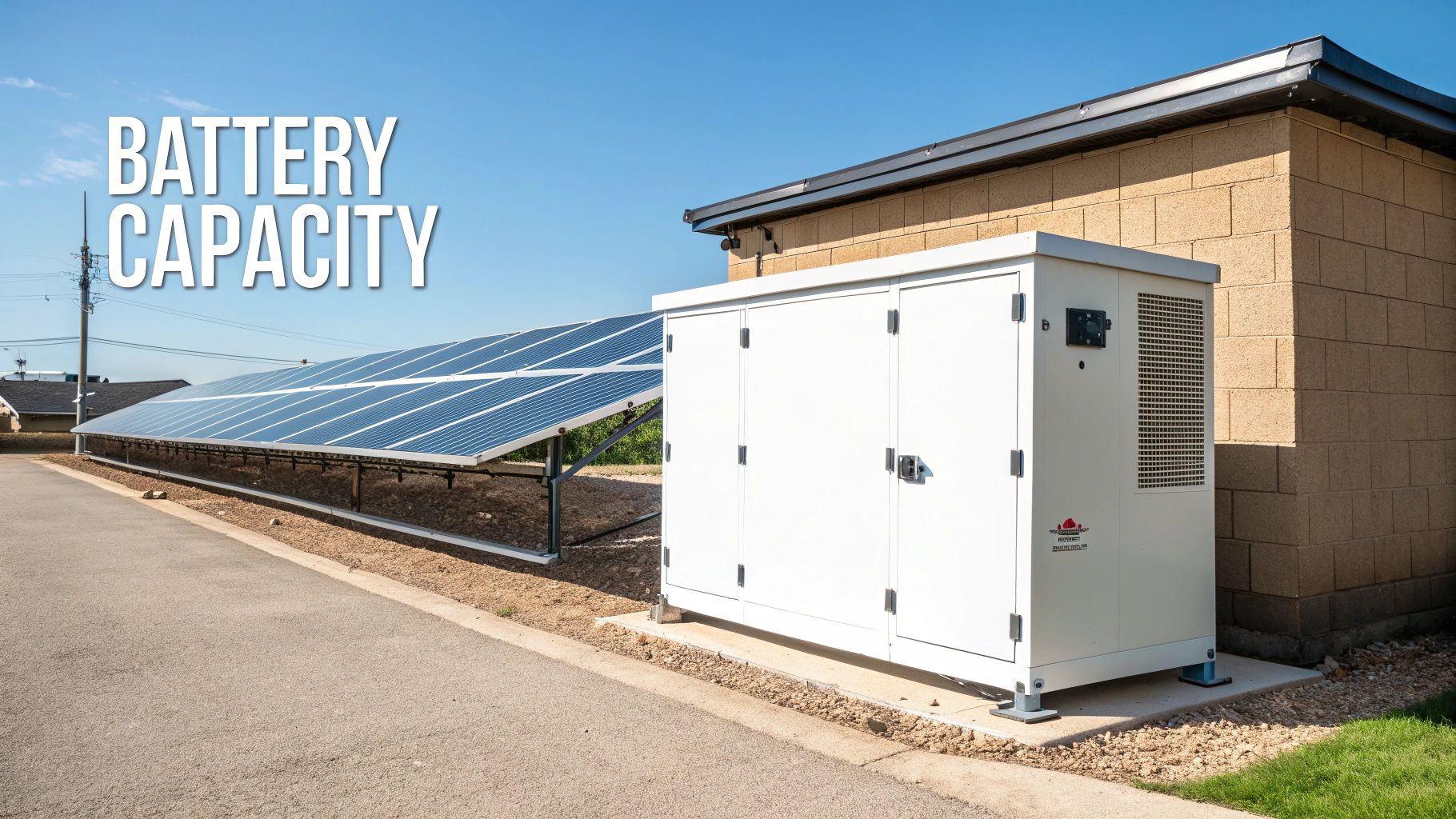
Most of us know the kilowatt-hour from our energy bills. But in the world of advanced energy solutions, its role gets a whole lot bigger. For systems like grid-scale batteries, combined on-site renewables and rapid EV charging hubs, the kWh becomes a fundamental building block for managing complex energy flows, keeping the grid stable and even opening up new ways to make money.
These sophisticated systems rely on a crystal-clear understanding of both power and energy. It’s why a Battery Energy Storage System (BESS) always comes with two distinct, vital ratings that work in tandem.
-
Power in Kilowatts (kW): Think of this as the system's speed. It tells you how quickly the battery can push out or pull in energy at any given moment. A high kW rating is what you need for demanding jobs, like firing up multiple rapid EV chargers all at once.
-
Energy Capacity in Kilowatt-Hours (kWh): This is the system's stamina—the total amount of energy the battery can actually hold. A large kWh capacity means the system can keep delivering power for much longer, essential for mobile EV charging solutions.
A great way to picture this is to think of the kW rating as the width of a water pipe and the kWh rating as the size of the water tank it's connected to. A wide pipe ( high kW ) can deliver a lot of water very quickly but the total amount it can supply depends entirely on the volume of the tank ( high kWh ).
Solving Grid Constraints with Stored kWh
One of the most powerful uses for a BESS is to get around grid limitations. Plenty of commercial sites, especially those in older or more rural areas, have constrained grid connections that just can't handle the huge power demands of a modern rapid EV charging hub. Trying to draw hundreds of kilowatts would simply overload the local infrastructure.
This is where stored kilowatt-hours come to the rescue. A BESS can be trickle-charged from the grid during off-peak hours when demand is low and electricity is cheap. It steadily gathers energy, perhaps storing 500 kWh or more overnight.
Then, during the day, this stored energy can be unleashed at a much higher power rate—say, 300 kW —to run several rapid chargers simultaneously. This lets a site offer top-tier charging services without the headache and expense of a major grid upgrade. It effectively disconnects the charging speed from the grid connection’s capacity. For anyone digging deeper into these solutions, our guide on how BESS can support the UK grid and EV charging offers more detail.
Creating Distributed Energy Hubs
The concept of the kWh is also at the heart of building resilient, local energy systems. By combining on-site renewables, like solar panels, with a BESS, a commercial site can transform itself into a distributed energy hub.
When the sun is shining, the solar panels generate electricity. This energy, measured in kWh, can power the building’s operations or charge EVs directly. Any extra kilowatt-hours that aren't needed right away are funnelled into the battery for later—perfect for overnight EV charging or keeping the lights on after sunset. When looking into components for these systems, a product like the Polycrystalline Renesola Virtus 260w solar panel is a relevant example.
This setup creates a powerful synergy:
- Reduced Grid Reliance: The site generates and stores its own clean energy, dramatically cutting the number of kWh it needs to pull from the grid.
- Lower Energy Costs: Using self-generated solar power is far cheaper than buying it from a supplier, especially during peak price times.
- Enhanced Resilience: If a grid outage hits, the stored kWh in the battery can provide backup power to keep critical operations online.
The Value of a Cleaner kWh
It’s not just about how many kWh you use but where they come from. The environmental impact of each kWh is changing for the better. The carbon intensity of UK electricity generation—which measures CO2 emissions per kWh—has plummeted.
Back in 2008, UK electricity generation produced around 495 grams of CO2 per kWh . By 2016, this figure had been slashed to 256 grams of CO2 per kWh , mostly thanks to a huge reduction in coal power and a surge in renewables.
This trend means the kWh stored in a BESS today, even when drawn from the grid, is significantly cleaner than it was a decade ago. And when you combine it with on-site solar, the carbon footprint of that stored energy drops even further, helping businesses hit their sustainability goals.
In advanced systems, a kWh is no longer just a unit of consumption. It’s a flexible, valuable asset that can be stored, deployed and even traded to build a more efficient, resilient and cleaner energy future.
Your kWh Questions Answered
As we get into more advanced energy solutions, knowing how the kilowatt-hour works in practice becomes crucial. This section tackles some of the most common questions we hear from fleet managers, business owners and energy professionals dealing with kWh in real-world scenarios like EV charging and battery storage.
Getting these concepts straight helps bridge the gap between theory and day-to-day operations, giving you the clarity needed to make confident, effective energy decisions.
What Is the Difference Between a kWh and a kVAh?
A kilowatt-hour ( kWh ) measures the actual, useful energy a system consumes to do its job. Think of it as the 'real power' that gets the work done. A kilovolt-ampere-hour ( kVAh ), however, measures 'apparent energy'.
Apparent energy is a mix of that useful energy and the 'reactive' energy that certain equipment—especially anything with motors or transformers—needs to function. For simple things like heaters, the kWh and kVAh readings are pretty much identical.
But in commercial settings full of motors and machinery, the kVAh figure will always be higher than the kWh. Many UK business energy suppliers now bill based on kVAh or penalise you for a poor 'power factor' (the ratio of kW to kVA) so understanding this difference is vital for keeping your energy costs in check.
How Do I Calculate the kWh Needed for a Commercial EV Charging Hub?
To get a solid forecast of the daily kWh your commercial EV charging hub will need, you have to look at three key factors. Getting this calculation right is essential for sizing your equipment correctly and keeping running costs under control.
- Number of Vehicles: Start by estimating the average number of EVs you expect to charge each day.
- Average Energy per Vehicle: Figure out the average amount of energy each vehicle will need. A typical top-up for a commercial vehicle might be around 40 kWh .
- Charger Efficiency: You need to account for energy losses. Most modern rapid chargers are about 90–95% efficient, so not all the energy you pull from the source makes it into the vehicle's battery.
Let’s run an example. Say you anticipate serving 20 vehicles a day, each needing a 40 kWh top-up. The total energy demand would be 20 vehicles × 40 kWh = 800 kWh . But when you factor in a 95% efficiency rate, you'll actually need to draw 800 kWh ÷ 0.95 = 842 kWh from your supply each day. This is the number you'll use to size a Battery Energy Storage System (BESS) or to discuss your constrained grid connection with the local Distribution Network Operator (DNO).
Why Is My BESS Rated in Both kW and kWh?
A Battery Energy Storage System (BESS) always has two ratings—kilowatts ( kW ) and kilowatt-hours ( kWh )—because they describe two separate but equally important functions: its power and its energy capacity.
The kW rating tells you the battery's power —how quickly it can push out or pull in energy. You need a high kW rating to run power-hungry equipment, like several rapid EV chargers at once. The kWh rating represents its capacity —the total amount of energy it can hold. A high kWh rating means it can supply power for a longer time or support mobile EV charging.
For instance, a BESS rated at 100 kW / 200 kWh can deliver a continuous power output of 100 kW for exactly two hours before it’s empty. Both ratings are critical for designing a system that can meet your site's peak power demands as well as its total daily energy needs.
How Does On-Site Solar Affect My Grid kWh Consumption?
Adding on-site solar generation directly cuts down the number of kilowatt-hours your business needs to buy from the grid. Simple as that. The kWh produced by your solar panels can be used instantly to power your site, charge up a BESS or refuel your electric vehicles.
If you generate any surplus kWh that you can't use or store right away, you can often export it back to the grid for a credit on your electricity bill. Your meter tracks both the kWh you import from the grid and what you export back to it.
This means your final bill is based on your 'net' consumption. For a business with high daytime energy use—like a depot with a fleet of EVs—combining on-site renewables with battery storage can slash the amount of kWh you import. It's a strategy that not only cuts your running costs but also makes a real dent in your organisation's carbon footprint by creating a distributed energy system.
At ZPN Energy , we specialise in creating bespoke energy solutions that overcome grid constraints. Our patented battery-backed EV charging and BESS technology enables businesses to deploy rapid charging infrastructure and achieve energy independence, even with limited grid connections. Discover how we can support your energy goals at https://www.zpnenergy.com.